
In this guide
In construction accounting, work in progress (WIP) is the running total of costs booked to a project that has not yet been sold, handed over or charged against revenue. For a real estate developer it behaves like inventory: land, approvals, materials, labour, subcontractor bills, allocated site overheads and capitalised borrowing cost accumulate against a project code and stay on the balance sheet until flats or contracts are completed and transferred out. Getting WIP accounting in construction right is what makes your cost-to-complete, your project margin and your audited stock figure defensible. This explainer walks through the definition, the formula, the journal entries and a worked project-wise example, and it stays informational: if you want this managed end to end, that is the job of Construction & Real Estate Accounting.
What is a WIP in construction accounting?
WIP is the value of construction work that is part-finished at the reporting date. Because a residential developer holds units for sale, that value is carried as inventory under the project, sometimes labelled construction work-in-progress or stock of unsold units under construction. It is not an expense yet, and it is not a customer liability. Each rupee sitting in WIP represents cost you have incurred and expect to recover when the unit sells.
The idea is the same one behind any manufacturer's part-finished stock, but the project horizon is longer and the cost heads are heavier. A single tower can carry WIP for three to five years before the first cost moves into the cost of sales. That long tail is why project-wise discipline, rather than a single company-level WIP balance, matters so much.
Is WIP an asset or a liability, and where does it sit on the balance sheet?
WIP is an asset, specifically a current asset shown under inventories. On a Schedule III balance sheet a developer usually presents it within Inventories as work-in-progress or as finished stock once the occupancy certificate is received. It does not appear as a liability at any point. What can look like a liability, advances collected from buyers, is recorded separately as customer advances or a contract liability, and it must never be netted against WIP.
So the two sides sit apart: your accumulated build cost is an asset in inventory, and the money buyers have paid ahead of possession is a liability. Confusing the two overstates neither and both, but it destroys the reader's ability to judge how much of the project is funded by cost you have sunk versus cash buyers have advanced.
What is the WIP formula and how do you calculate it?
The formula is straightforward:
Closing WIP = Opening WIP + Costs incurred during the period - Cost of units or contracts transferred out on completion.
To calculate it in practice, accumulate every cost booked to the project code for the period, then deduct the cost that has already moved into the cost of sales for flats or contracts handed over. Where you recognise revenue over time using the percentage of completion method, WIP is the cost incurred less the proportion of cost already charged against the revenue recognised so far. Whichever route applies, the closing balance should be compared to the physical stage of construction certified by the site engineer. A WIP figure that says 80 per cent of cost is incurred against a structure that is at plinth level is a red flag, not a rounding difference.
The sibling read on the over-time route is The Percentage Completion Method for Construction Contracts; this article stays on the inventory-WIP mechanics common to most developers.
Which project costs can be capitalised into WIP?
Only costs that bring the units towards a saleable state belong in WIP. Everything tied to selling the units, running the corporate office or financing a paused site is charged to profit and loss as incurred. The split below is the one that most often gets challenged in audit.
| Cost head | Into WIP (inventory) | Charged to P&L as incurred |
|---|---|---|
| Land and development rights | Yes, including premiums and transfer duties | - |
| Statutory approvals and premiums | Yes, project-specific approvals | - |
| Materials, labour, subcontractors | Yes, on the project code | - |
| Site supervision and site overheads | Yes, allocated to the project | - |
| Borrowing cost (Ind AS 23 / AS 16) | Yes, while construction is active | Interest during a suspension of development |
| Selling, marketing, brokerage | - | Yes, always expensed |
| Corporate and head-office overhead | - | Yes, always expensed |
| Expected loss on a project | - | Yes, provided immediately |
Borrowing cost is the pivot. Under Ind AS 23 and AS 16 you may capitalise interest on funds borrowed for the project only while active construction is under way. The moment development is suspended, capitalisation stops and interest goes to the P&L. The Institute of Chartered Accountants of India publishes the standards text if you need the exact wording, available at icai.org.
What is the journal entry for WIP (the double entry)?
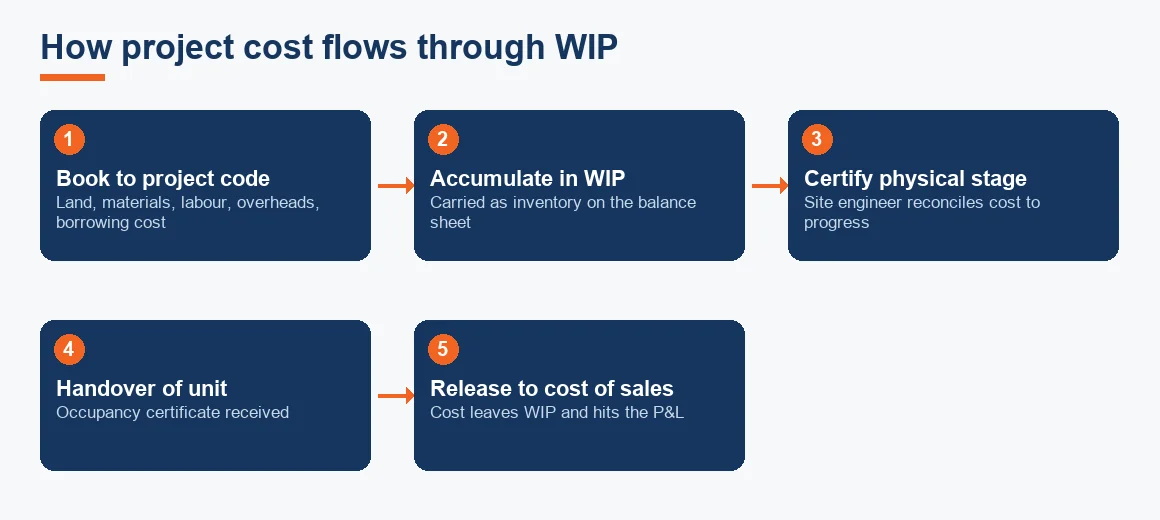
WIP is recorded through ordinary double-entry bookkeeping. As costs are incurred you build up the WIP asset; on handover you release that cost into the cost of sales. The two journal entries that carry most of the weight are:
1. As project costs are incurred (materials, labour, subcontractor bill, allocated overhead):
- Debit
- Work-in-Progress (Inventory, current asset)
- Credit
- Bank / Accounts Payable / relevant expense clearing
2. On completion and handover of a unit (moving the unit's cost out of WIP):
- Debit
- Cost of Sales (P&L)
- Credit
- Work-in-Progress (Inventory)
So WIP is debited to build the asset and credited to release it. Nothing touches the profit and loss account until entry two, which is why WIP itself never appears in the P&L, only its movement into the cost of sales does.
Does WIP appear in the profit and loss account?
No. The WIP balance is a balance sheet item. What flows through the P&L is the cost of sales recognised when units are handed over, and any provision for an expected loss. If a project is loss-making overall, that expected loss is charged to the P&L in full straight away and is not allowed to sit inside WIP, because inventory cannot be carried above its net realisable value. This is the one place where a future loss is recognised before the related revenue.
Worked example: project-wise WIP costing worksheet
Take a single tower for the year 2025-26. Opening WIP was carried forward, fresh costs were booked through the year, and one wing was handed over so part of the cost moved into the cost of sales. All figures are indicative and in INR lakh.
| Line | Amount (INR lakh) |
|---|---|
| Opening WIP (1 Apr 2025) | 1,200.00 |
| Add: Land premium balance capitalised | 150.00 |
| Add: Materials booked to project code | 640.00 |
| Add: Labour and subcontractor bills | 520.00 |
| Add: Allocated site overheads | 90.00 |
| Add: Borrowing cost capitalised (active period) | 110.00 |
| Total costs incurred in the period | 1,510.00 |
| Less: Cost of handed-over wing moved to cost of sales | (980.00) |
| Closing WIP (31 Mar 2026) | 1,730.00 |
The arithmetic follows the formula exactly: 1,200 opening + 1,510 incurred - 980 transferred out = 1,730 closing WIP. Note what is absent. Brokerage of, say, 60 lakh on the sold wing and 45 lakh of launch advertising are not in this worksheet at all; they were expensed to the P&L when incurred. The 980 lakh that left WIP is the only cost that hit the profit and loss account this year, matched against the revenue recognised on possession of that wing.
Key terms
- Work-in-Progress (WIP) Valuation: valuing part-finished project cost at the lower of cost and net realisable value.
- Percentage of Completion Method (POCM): recognising revenue and cost in proportion to work completed over time.
- Ind AS 115 Revenue Recognition: the standard that decides whether a developer recognises revenue at a point in time or over time.
- Cost of Goods Sold: the cost released from inventory when a unit is sold, the WIP figure's exit route.
- Current Assets: the balance sheet section under which construction WIP is presented as inventory.
Revenue at completion or over time: does WIP or a contract asset appear?
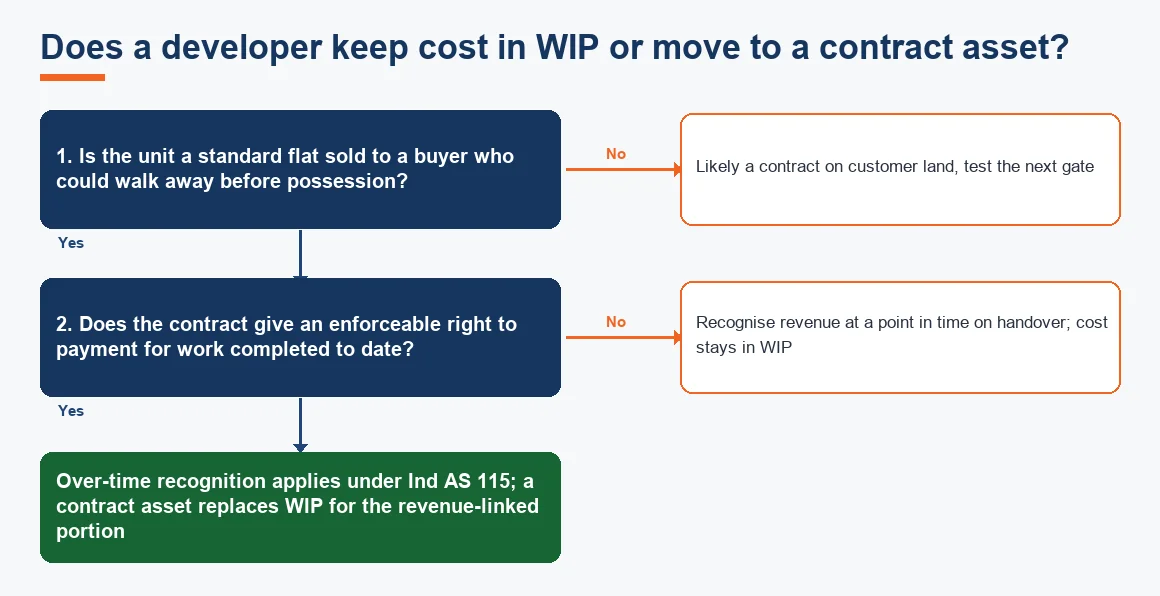
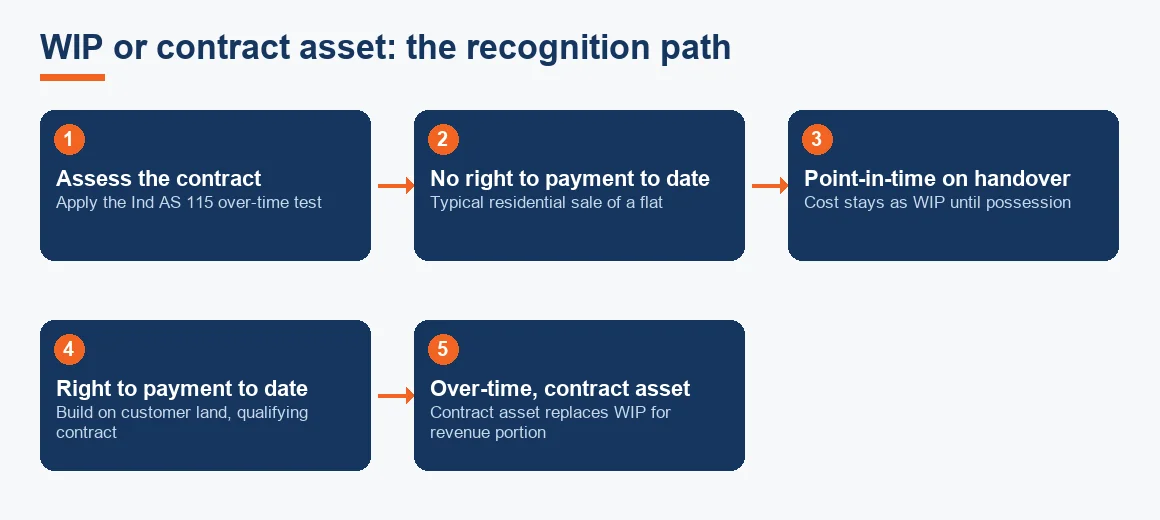
The reporting choice hangs on one test. Most Indian residential projects recognise revenue at a point in time, on handover of possession, because the developer usually has no enforceable right to payment for work completed to date if the buyer walks away. In that case the accumulated cost stays as WIP until possession. Over-time recognition under Ind AS 115 applies only where the contract meets the test, for example a construction contract built on the customer's own land, and then a contract asset replaces WIP for the revenue-linked portion. The Ministry of Corporate Affairs hosts the notified standards at mca.gov.in if you need to confirm applicability.
Two adjacent tax and compliance points sit alongside this and are covered by their own reads: the split of GST on under-construction versus completed property, and the treatment of land brought in under a Joint Development Agreement. If project cash is involved, the RERA 70% escrow rule governs how much of collections must stay ring-fenced for construction, which in turn affects how freely WIP-funding money can move.
How to keep project WIP audit-ready
Three habits keep the figure defensible. First, reconcile the WIP ledger to a physical stage certificate from the site engineer every quarter, so cost and construction progress tell the same story. Second, run a net realisable value check on every project at year-end and provide for any expected loss in the P&L rather than leaving it buried in inventory. Third, keep selling and head-office costs firmly out of WIP. Developers running several concurrent projects often benefit from the same project-margin discipline used in IT & Software Company Accounting Services and SaaS Accounting Services, and early-stage builders can lean on Startup Accounting Services India to get the project ledger structure right from day one. To sanity-check whether Ind AS even applies to your entity, the Ind AS Applicability Checker and the AS vs Ind AS Comparison Matrix are quick first steps.
Key takeaways
- WIP is a current asset in inventory, never a liability; buyer advances are a separate liability and must not be netted against it.
- Closing WIP = opening WIP + costs incurred - cost transferred to cost of sales; reconcile it to a certified physical stage.
- Land, approvals, build costs, site overheads and active-period borrowing cost capitalise; selling, head-office and suspension-period interest are expensed.
- WIP never hits the P&L; only its movement into the cost of sales and any expected-loss provision do.
- Point-in-time handover keeps cost in WIP; a qualifying over-time contract replaces WIP with a contract asset under Ind AS 115.
Decision guide