In this guide
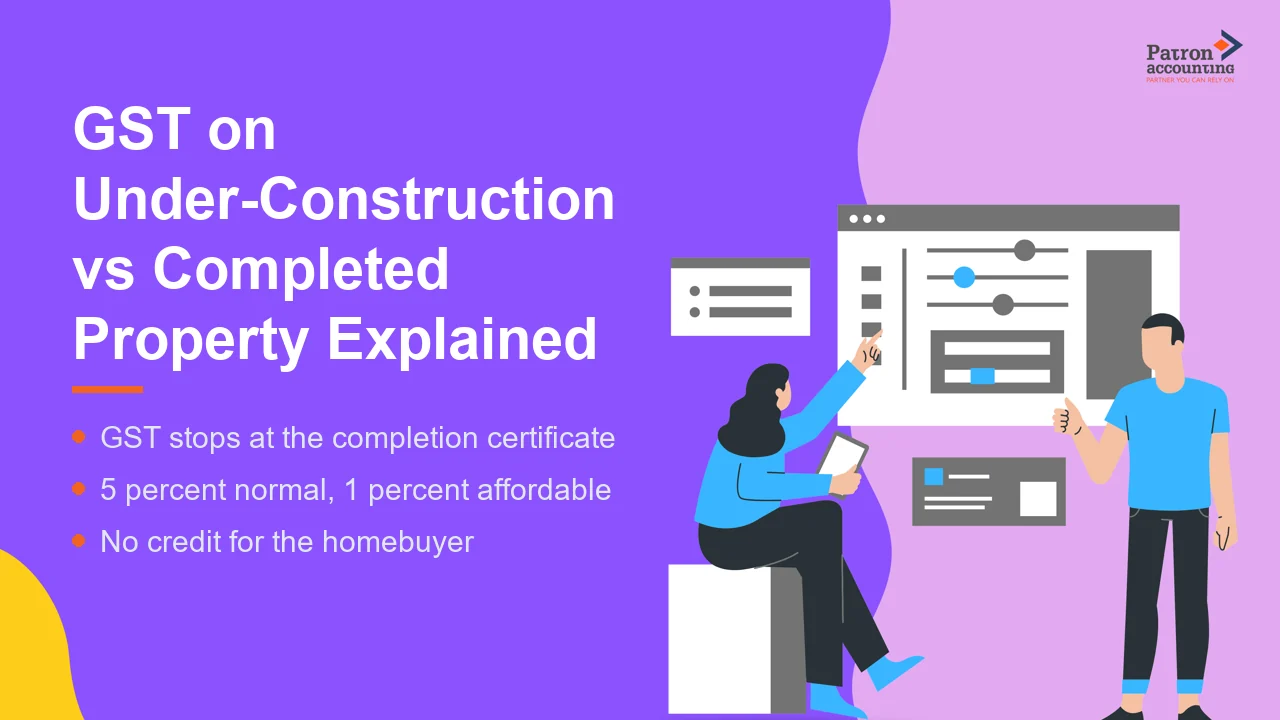
Yes, you pay GST on an under-construction property but not on a completed one. The dividing line is the completion certificate (or first occupation, whichever comes first). If any part of the price is paid before that certificate is issued, the sale is treated as a supply of construction service and GST applies. Once the certificate is in hand, the same flat becomes an immovable property sale that GST does not touch. This explainer sets out the rates, the thresholds and who actually bears the tax, so you can read a builder demand letter with confidence.
Do we need to pay GST for under-construction property?
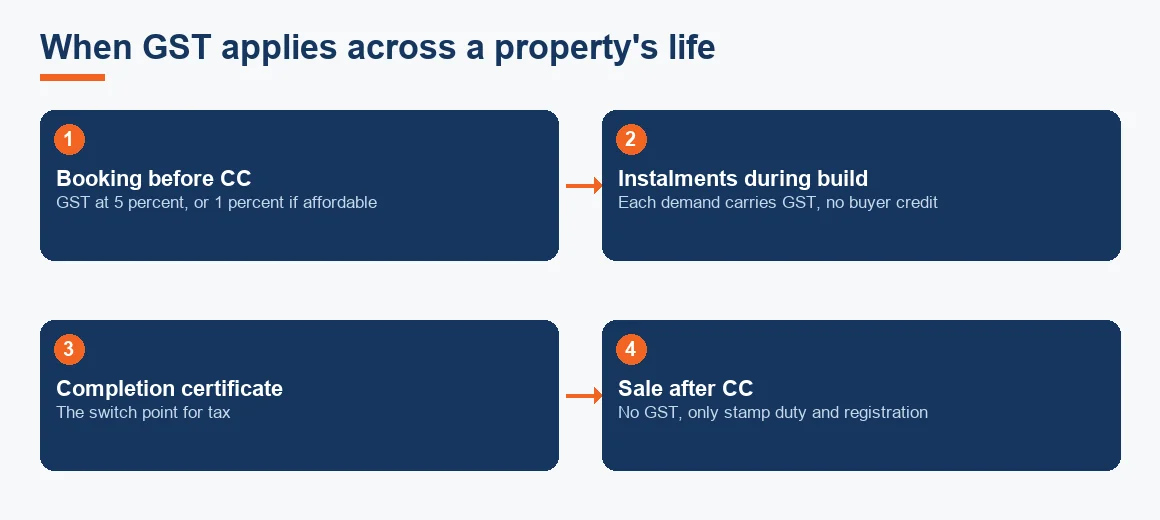
You do. Under Schedule II of the CGST Act, construction of a complex or building intended for sale to a buyer is a supply of service, and it stays taxable for as long as the consideration is received before the completion certificate. The tax attaches to the payment schedule, not to the date you take possession, so deferring an instalment does not remove the liability. The moment of relief is the completion certificate issued by the competent authority, or the first occupation of the building, after which Schedule III steps in and takes the transaction out of GST altogether.
This is why two identical flats in the same tower can have very different tax outcomes. A flat booked while the crane is still on site is a service supply that carries GST on every instalment. The flat next door, bought from the builder after the completion certificate, is simply a sale of built property, and the buyer pays only stamp duty and registration charges. If you would like the developer-side treatment of these receipts, our note on the percentage completion method for construction contracts covers how revenue is recognised as the project progresses.
What is the GST rate on an under-construction flat?
Since 1 April 2019 residential projects run on a fixed-rate scheme without input tax credit. There are two rates and they turn on whether the unit is affordable.
- Affordable residential apartment: 1 percent, without input tax credit.
- Any other residential apartment: 5 percent, without input tax credit.
- Commercial units in a residential project (RREP): 5 percent, without input tax credit.
- Purely commercial projects: 12 percent, with input tax credit available to the developer.
These effective rates already build in the notional one-third deduction for the value of land, so in practice you apply the headline percentage to the full agreement value. Because input tax credit is switched off in the residential scheme, the tax the builder pays on cement, steel and contractor bills becomes a cost that is priced into the flat rather than a credit you can see.
The rates and conditions sit in the rate notifications on the CBIC GST portal, which is the authority to check if a builder quotes something different.
GST on completed versus under-construction property
The single most valuable thing to understand is the switch that happens at the completion certificate. Before it, you are buying a service. After it, you are buying property. The table below sets the two side by side.
| Point of comparison | Under-construction (booked before CC) | Completed (bought after CC) |
|---|---|---|
| Nature of supply | Supply of construction service | Sale of immovable property (Schedule III) |
| GST on the flat | 5 percent, or 1 percent if affordable | Nil |
| Input tax credit to buyer | Not available | Not applicable, no GST charged |
| Stamp duty and registration | Payable | Payable |
| Who charges the tax | Builder, on each instalment | No one, for GST purposes |
Who pays GST, the builder or the buyer?
The legal person liable to deposit GST with the government is the builder, who is the supplier of the construction service. In economic terms, though, the buyer bears it. The builder adds GST to each demand note, collects it along with the instalment, and pays it to the exchequer. So the honest answer is that the builder is the taxpayer of record while the homebuyer is the person whose pocket the money comes from.
A homebuyer cannot recover any of it. A flat bought for personal use involves no onward taxable supply and no GSTIN, so there is nothing to set the credit against. Even a registered company buying an office on its own account is blocked by Section 17(5)(d), which denies credit on construction of immovable property for own use. For businesses in the sector, structuring these receipts correctly is exactly the kind of work our Construction and Real Estate Accounting team handles, and the project and phase-wise WIP costing note shows how the underlying costs are tracked.
Is there GST on flats above 45 lakh?
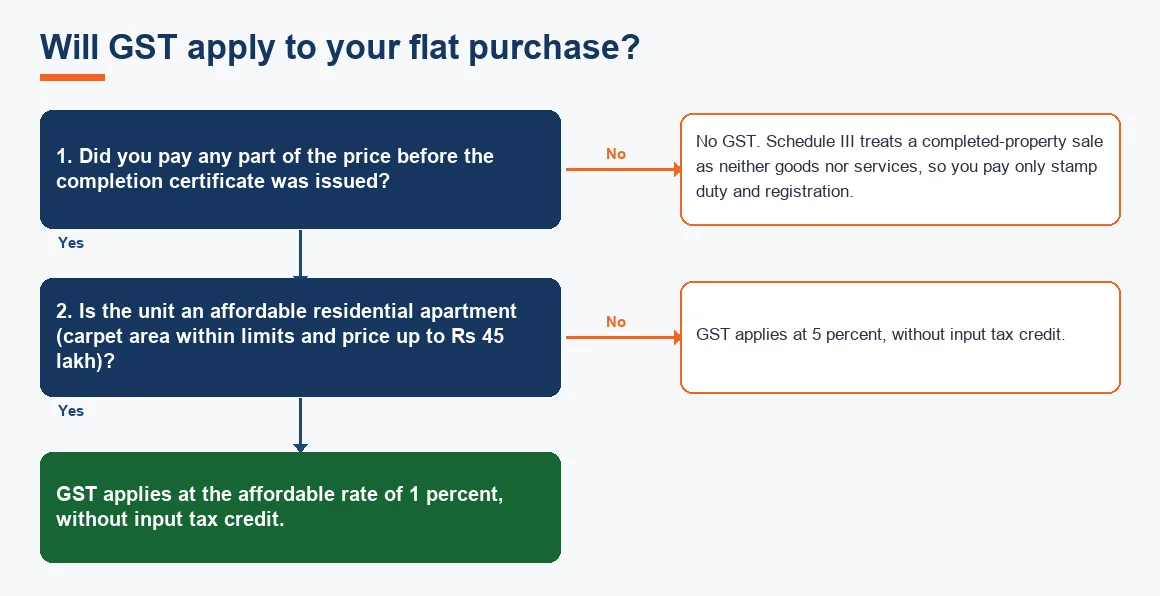
The Rs 45 lakh figure is not a threshold above which GST begins. GST applies to every under-construction flat regardless of price. What Rs 45 lakh decides is whether the 1 percent affordable rate or the 5 percent standard rate applies.
An affordable residential apartment must meet two tests at the same time: a carpet area up to 60 square metres in a metropolitan area or up to 90 square metres elsewhere, and a gross amount charged of up to Rs 45 lakh. Miss either test and the unit falls to 5 percent. Metropolitan areas for this purpose include the Mumbai Metropolitan Region, Delhi NCR, Bengaluru, Chennai, Hyderabad and Kolkata. So a compact flat priced at Rs 48 lakh is taxed at 5 percent, and a large flat priced at Rs 42 lakh is also taxed at 5 percent because it fails the carpet-area test.
What is the 80/20 rule for builders under GST?
The 80/20 rule is a procurement condition attached to the reduced residential rates, and it sits on the builder's side rather than the buyer's. To keep the 1 percent and 5 percent rates, a developer must buy at least 80 percent of its inputs and input services, by value, from registered suppliers in a financial year. If purchases from registered suppliers fall short of that 80 percent, the developer pays GST at 18 percent under reverse charge on the shortfall. Cement bought from an unregistered supplier is treated separately and always attracts reverse charge, and capital goods are outside the 80 percent count.
It matters to buyers only indirectly. A developer that manages its vendor base poorly carries an extra reverse-charge cost that eventually shows up in pricing. Developers that also operate under a joint development agreement have further GST layers on the land-owner share, and those that must ring-fence collections under the RERA 70 percent escrow rule have to reconcile tax outflows against a restricted account.
Can a builder charge GST after the completion certificate?
No. Once the completion certificate is issued, a sale of that unit is outside GST, and a builder who adds GST to a post-certificate sale is charging tax that is not due. If you are buying a ready flat and the demand note shows a GST line, ask for the completion certificate date and challenge it.
The builder's own position is the mirror image. Units still unsold on the date of the completion certificate carry no GST when sold afterwards, but the developer must reverse the input tax credit attributable to those unsold units under Rules 42 and 43, computed on a carpet-area basis. That reversal is a real cash cost and is the main reason unsold inventory at completion is expensive for a developer to hold. It is also why the base price of a ready flat is rarely a bargain once you net everything off.
Worked example: GST on an instalment demand
Take a non-affordable flat with an agreement value of Rs 80,00,000, where the builder raises a demand for 10 percent of the value at booking. The GST is charged on the demanded amount at 5 percent. The figures below are indicative and Exl GST is not relevant here because GST is the very line being computed.
| Item | Amount (Rs) |
|---|---|
| Agreement value of the flat | 80,00,000 |
| Booking demand at 10 percent | 8,00,000 |
| GST at 5 percent on the booking demand | 40,000 |
| Total payable on the booking demand | 8,40,000 |
| GST across the full agreement value (5 percent of 80,00,000) | 4,00,000 |
Had the same unit qualified as affordable at a price within Rs 45 lakh, the rate would be 1 percent, so a Rs 42,00,000 flat would carry Rs 42,000 of GST across the whole schedule. Had you instead bought either flat after the completion certificate, the GST line would be nil and only stamp duty and registration would apply.
How to calculate GST on your purchase, step by step
- Confirm whether any payment falls due before the completion certificate. If every rupee is paid after it, GST is nil.
- Classify the unit. Check carpet area against the 60 or 90 square metre limit and price against Rs 45 lakh to decide affordable (1 percent) or other (5 percent).
- Apply the rate to each demand as it is raised, on the amount demanded, not on the full value up front.
- Add GST to the instalment to get the total payable, and keep every tax invoice for your records.
- Remember stamp duty and registration are separate state levies that apply either way and are not GST.
Developers running these numbers across many units usually track them against wider Ind AS obligations, and tools such as the lease accounting calculator and the AS versus Ind AS comparison matrix help finance teams keep the reporting side aligned. Sector businesses with parallel service lines, from SaaS accounting and IT company accounting to startup accounting, face similar timing questions on when revenue and tax crystallise.
Key terms
- Percentage of Completion Method (POCM): recognising revenue in step with construction progress rather than at handover.
- Work-in-Progress (WIP) Valuation: valuing partly built units still on the developer's books.
- Joint Development Agreement (JDA): a land-owner and developer arrangement with its own GST treatment.
- RERA 70% Escrow Compliance: the rule ring-fencing buyer collections in a project account.
- GSTR-2B Input Tax Credit Matching: the return that governs which input credits a developer can actually claim.
Key takeaways
- GST applies before the completion certificate and stops after it, with no separate 45 lakh entry threshold.
- The residential rates are 5 percent standard and 1 percent affordable, both without input tax credit.
- The builder deposits the tax but the buyer bears it, and the buyer can never reclaim it.
- Unsold units at completion escape GST on sale but force an input tax credit reversal on the developer.
- Always compare the all-in cost of a ready flat against an under-construction one, not just the visible tax line.
For the statutory basis of these rules, the CGST Act and rate notifications are published on the CBIC GST portal, and return-side details sit on the GST portal. Where a transaction involves both an under-construction booking and later resale, take specific advice, because the completion-certificate date drives the whole outcome.
Decision guide