
In this guide
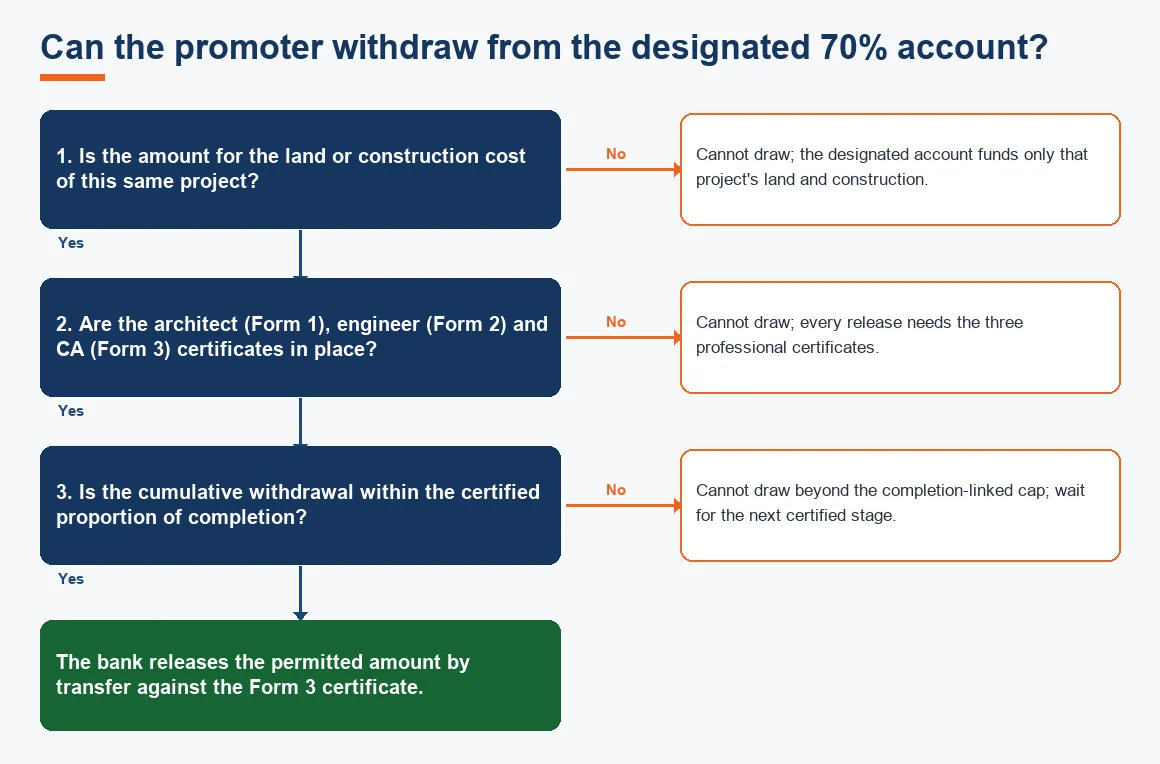
The RERA escrow account rules require a promoter to park 70 per cent of every amount realised from buyers of a real estate project into a separate account held with a scheduled bank, and to use that money only for the land cost and construction cost of the same project. The balance 30 per cent is free for other legitimate uses. Money can leave the designated account only in proportion to how much of the project is physically complete, and each release has to be certified by an engineer, an architect and a chartered accountant. This guide sets out the rule, the account structure, the withdrawal mechanism and a worked example, in plain terms for developers and their finance teams. It is an explainer, not a service pitch; if you want hands-on help, our Construction & Real Estate Accounting team handles the certificates and books end to end.
What is an escrow account as per RERA?
Under the Real Estate (Regulation and Development) Act, 2016, an escrow account (the Act calls it a separate or designated account) is a ring-fenced bank account into which a promoter must deposit 70 per cent of the amounts collected from allottees for a registered project. The purpose is simple: to stop the age-old practice of diverting one project's buyer money into land banking or into another site, which left flats half-built and buyers stranded. Because the account is tied to a single project registration, the funds cannot be swept into a group treasury or used to service unrelated debt.
The obligation is not a bank product you shop for; it is a statutory condition of registration. The money is legally earmarked for that project's land and construction cost, and the bank releases it only against the prescribed certificates. In substance it behaves like fund-based accounting: a defined pool of money that can be spent only on defined purposes and must be reported against those purposes.
The RERA 70/30 rule explained
The 70/30 rule is the arithmetic heart of the regime. Of every rupee collected from a buyer, 70 paise must reach the designated account and only 30 paise is free. On collections of Rs 10 crore, that means Rs 7 crore is locked to the project and Rs 3 crore is available for marketing, overheads, financing cost or margin. The 70 per cent figure is a statutory minimum, not a ceiling.
Several state authorities have tightened this. In a number of states every receipt is first routed through the designated account and withdrawals are then capped, so in practice the whole inflow touches the ring-fenced account before the free portion is released. Promoters should therefore read the central rule together with their own state RERA rules, because the state can be stricter than 70 per cent but never more lenient.
What are the three types of RERA accounts?
Most practitioners describe the flow as three accounts, though the number that are separate bank accounts depends on the state. The collection or main account receives buyer money; the designated 70 per cent account holds the ring-fenced portion; and the free or transaction account holds the 30 per cent the promoter may spend freely. The table below summarises how they differ.
| Account | What flows in | Permitted use | Withdrawal control |
|---|---|---|---|
| Collection / main account | All amounts realised from allottees | Pass-through; splits into 70 and 30 | Governed by state rule; often the account of first receipt |
| Designated 70% account | 70% of every receipt | Only land cost and construction cost of that project | Released in proportion to completion, on certificates |
| Free 30% account | Balance 30% of receipts | Marketing, admin, finance cost, margin | At the promoter's discretion |
The essential point is that the designated account is project-specific. Funds cannot cross-subsidise a second tower, a different phase or a group company, which is why single-project registration and clean ledger separation matter so much for developers running several sites.
How does a RERA escrow account work: the withdrawal mechanism
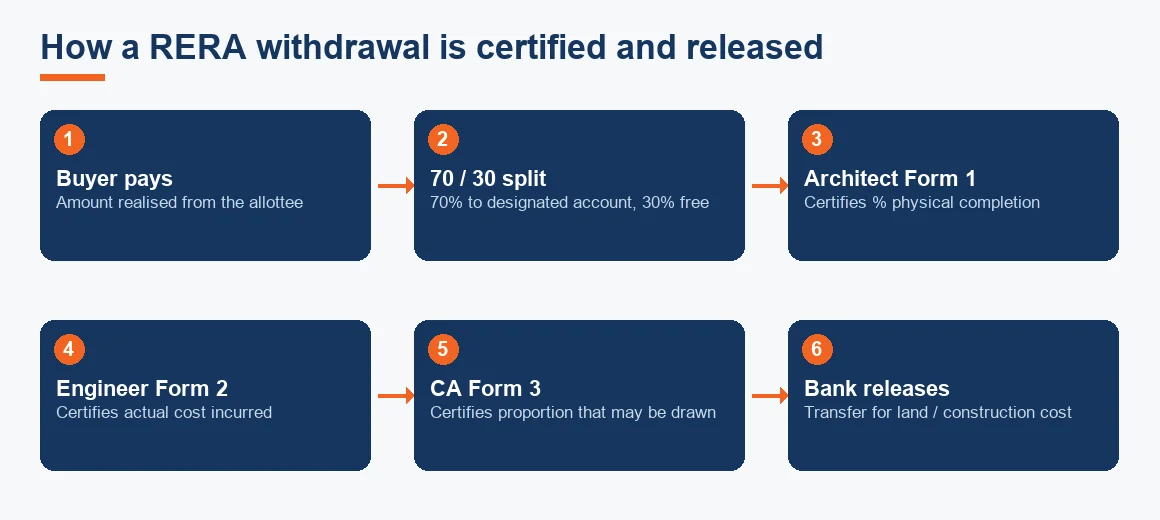
The RERA fund withdrawal rules turn on one idea: you can only take money out of the designated account as fast as you build. A promoter cannot draw against flats that are sold but not yet constructed. Each drawdown is supported by three professional certificates confirming physical progress and cost incurred.
- The architect certifies the percentage of physical completion of the project (commonly the Form 1 certificate).
- The engineer certifies the actual cost incurred on the work done (commonly the Form 2 certificate).
- The chartered accountant in practice certifies the proportionate cost and the amount that may be withdrawn (the Form 3 certificate).
- The bank releases the permitted amount from the designated account, by transfer, to meet land or construction cost.
Because the release tracks the stage of completion, the mechanism sits naturally alongside the percentage completion method for construction contracts and honest project and phase-wise WIP costing. If your books already measure cost incurred against total estimated cost, the certificate is largely a report from figures you maintain anyway. Getting the work-in-progress valuation right is what makes the whole withdrawal defensible.
Which certificate does a chartered accountant issue under RERA?
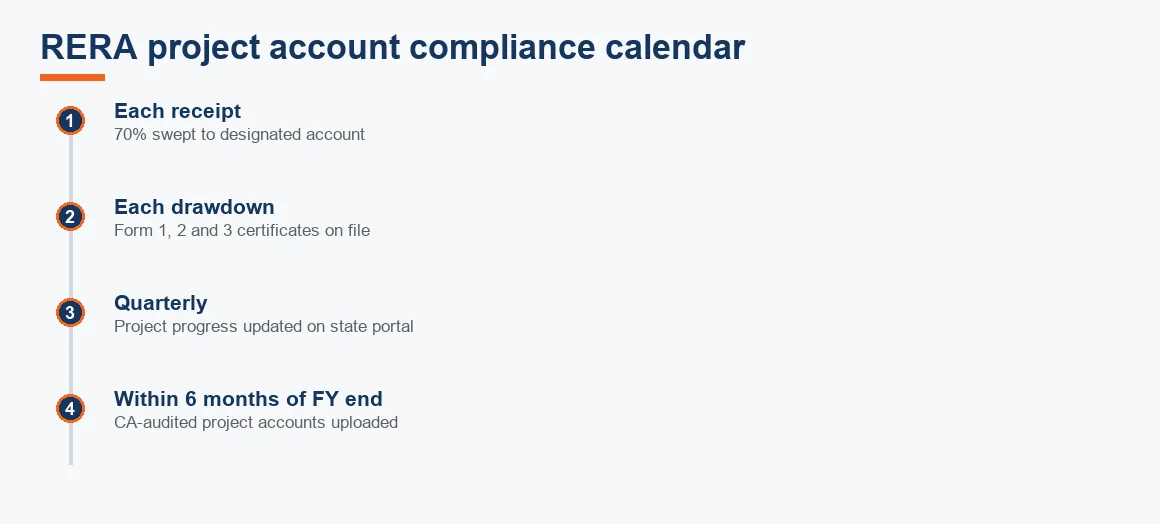
The practising chartered accountant issues the Form 3 certificate that supports each withdrawal, confirming the cost incurred against the estimated project cost and the proportion that may be drawn from the designated account. Separately, the CA certifies the project's annual audited accounts, typically in the annual report on statement of accounts, within six months of the close of each financial year. That annual certificate confirms that amounts withdrawn during the year matched the percentage of completion and that the 70 per cent rule was observed throughout. Both are uploaded to the relevant state RERA portal. The certificate must come from a CA in practice; the professional standards for such certification are set by the Institute of Chartered Accountants of India.
Worked example: computing a permissible withdrawal
Assume a single registered project. The figures below are illustrative and the exact permissible amount is what the Form 3 certificate states under your state rules, but the logic shows how completion caps the drawdown. All amounts are in rupees.
| Item | Amount / value |
|---|---|
| Estimated cost of the project (land + construction) | 50,00,00,000 |
| Amount realised from allottees, cumulative | 30,00,00,000 |
| Deposited in designated 70% account (70% of 30 cr) | 21,00,00,000 |
| Held in free 30% account | 9,00,00,000 |
| Cost incurred and certified, cumulative | 20,00,00,000 |
| Percentage of completion (20 cr / 50 cr) | 40% |
| Cumulative withdrawal permitted (40% of 21 cr deposited) | 8,40,00,000 |
| Already withdrawn in earlier periods | 5,00,00,000 |
| Fresh withdrawal available this period | 3,40,00,000 |
The developer has collected Rs 30 crore and ring-fenced Rs 21 crore, but at 40 per cent completion the cumulative draw from the designated account is capped at Rs 8.4 crore. Having already drawn Rs 5 crore, only Rs 3.4 crore is free to release now, against certified land and construction cost. The remaining ring-fenced money waits in the account until the next stage is built and certified.
Can we withdraw cash from a RERA account?
In practice, no. The designated account is not a petty-cash source. Releases move by bank transfer against the certified proportion, straight to project cost, so the question is less about cash and more about certification. Any attempt to sweep the account without the Form 3 support, or to spend it on anything other than that project's land and construction cost, is exactly the diversion RERA was written to stop and is the sort of thing a state authority acts on. The scheduled-bank requirement itself follows the banking framework overseen by the Reserve Bank of India.
Where the escrow rule sits in the law
The core obligation lives in Section 4(2)(l)(D) of the RERA Act, 2016, the clause a promoter accepts at the time of project registration. It fixes the 70 per cent deposit, the scheduled-bank requirement, the land-and-construction-only use, the completion-linked withdrawal and the three-professional certification. The operating detail, including the forms, the withdrawal formula and the audit timeline, comes from the rules notified by each state government, which is why practitioners often refer to a particular numbered rule (the numbering differs from state to state). Searches for a specific section or rule number usually trace back to this same design: Section 4 sets the duty, and the state rules carry the mechanics. When in doubt, read your project's registration certificate and your state RERA rules together rather than relying on a number quoted for another state.
What this means for a developer's books
The escrow rule reshapes how a developer accounts for a project. Buyer receipts are advances, not revenue, until the point recognition is due; the 70 per cent deposit and the certified withdrawals need their own clearly named ledgers; and the annual project audit has to reconcile all three. Get the underlying costing right and the compliance largely writes itself. That is where the related pieces connect: revenue timing under the percentage completion method, the GST treatment covered in GST on under-construction vs completed property, and land-owner arrangements in joint development agreement accounting and taxation. A joint development agreement adds its own wrinkle, because the promoter still has to route allottee receipts through the designated account even where land comes from a landowner. Developers who also run a proptech, SaaS or IT services arm, or who back early-stage ventures, will find the ring-fencing discipline familiar. If your reporting has moved to Ind AS, our Ind AS applicability checker is a quick first step before you decide how project revenue is recognised.
Key terms
- RERA 70% Escrow Compliance: the duty to deposit 70 per cent of allottee receipts in a designated account and draw only on certificates.
- Percentage of Completion Method (POCM): recognising revenue and cost by the stage of a project's completion.
- Work-in-Progress (WIP) Valuation: measuring cost incurred on partly built work, the basis for each drawdown.
- Fund-Based Accounting: tracking money that can be spent only on a defined purpose, as the designated account requires.
- Bank Reconciliation: matching the designated-account statement to the ledger, the everyday evidence for the audit.
Key takeaways
- Deposit at least 70 per cent of every allottee receipt into a project-specific designated account with a scheduled bank.
- Spend that money only on the land and construction cost of the same project; the 30 per cent is free.
- Withdraw in proportion to completion, on the architect, engineer and chartered accountant certificates.
- The CA issues the Form 3 drawdown certificate and audits the project accounts within six months of the year end.
- Read the central rule together with your state RERA rules, which can be stricter than 70 per cent.
Decision guide