In this guide
The percentage of completion method is a way of recognising revenue and profit on a long construction contract as the work progresses, instead of waiting until the building is handed over. If a contractor has finished 40% of a project, it books roughly 40% of the contract's revenue and its matching costs in that period. This matters because a large road, bridge or factory can take three or four years to complete, and reporting nothing until the final year would give a badly distorted picture of how the business is actually performing. Below we set out how the method works, how to calculate the percentage, when it is required in India, and how it compares with the completed contract approach.
What is the percentage of completion method?
The percentage of completion method (often shortened to POC or POCM) spreads a contract's revenue, costs and profit across the accounting periods in which the work is carried out. Each period, the contractor estimates how far along the contract is, applies that percentage to the total contract value, and recognises the resulting revenue. The costs incurred in the period are charged against it, so the profit reported tracks the real economic activity on site. It is an accrual accounting idea taken to its logical end: revenue is earned as performance happens, not when cash arrives or when the keys are handed over.
Because progress is recognised before the customer is formally billed for all of it, the method creates a balance sheet item usually described as unbilled revenue or contract work-in-progress. Getting that valuation right sits at the heart of clean construction accounts, and it is closely tied to work-in-progress (WIP) valuation. Contractors that want this handled end to end usually bring in a specialist for Construction & Real Estate Accounting rather than running it in-house.
Is AS 7 applicable to construction contracts, and when is the method mandatory?
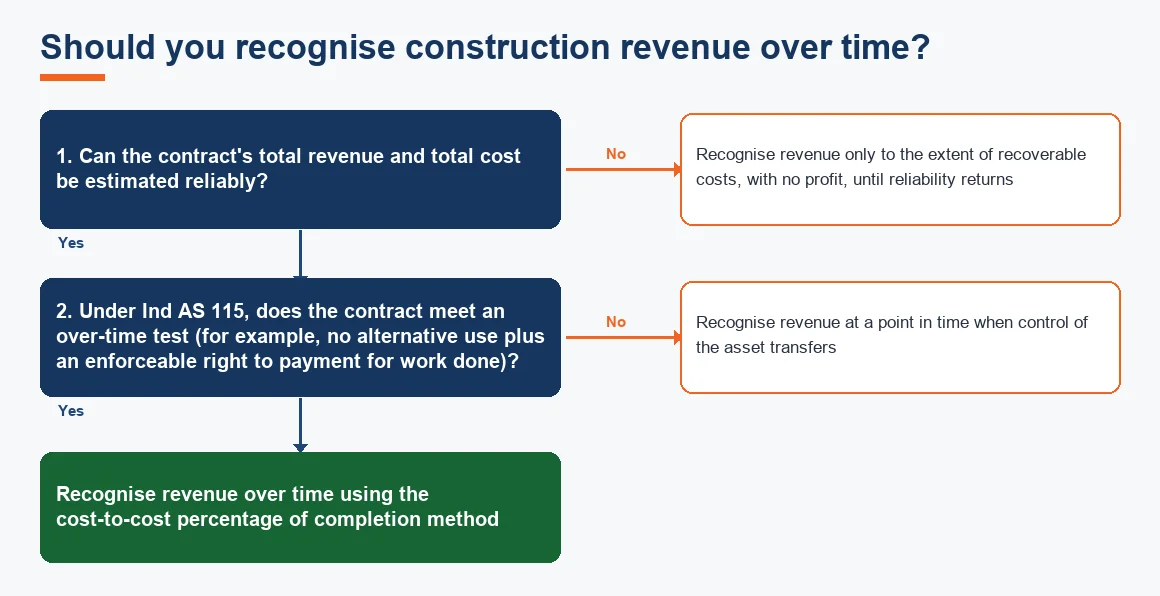
Yes. AS 7, Construction Contracts, issued by the ICAI, governs contractors that report under Accounting Standards. It makes the percentage of completion method mandatory, not optional, once the outcome of a contract can be estimated reliably. Where the outcome cannot yet be estimated, revenue is recognised only to the extent of contract costs that are probably recoverable, and no profit is taken until reliability returns.
Companies that have moved to Ind AS follow Ind AS 115 instead, notified by the MCA. It does not use the words "percentage of completion", but it reaches the same place: where a contract meets one of its over-time tests, revenue is recognised over time and progress is typically measured on a cost-to-cost basis. So whether a contractor is on AS 7 or Ind AS 115, a genuine construction contract to a customer's specification almost always recognises revenue as the work is done.
How to calculate the percentage of completion: the cost-to-cost formula
The most common way to measure progress is the cost-to-cost method, an input method that compares costs incurred so far against the total costs expected. The formula is straightforward:
Percentage complete = Contract costs incurred to date ÷ Estimated total contract cost
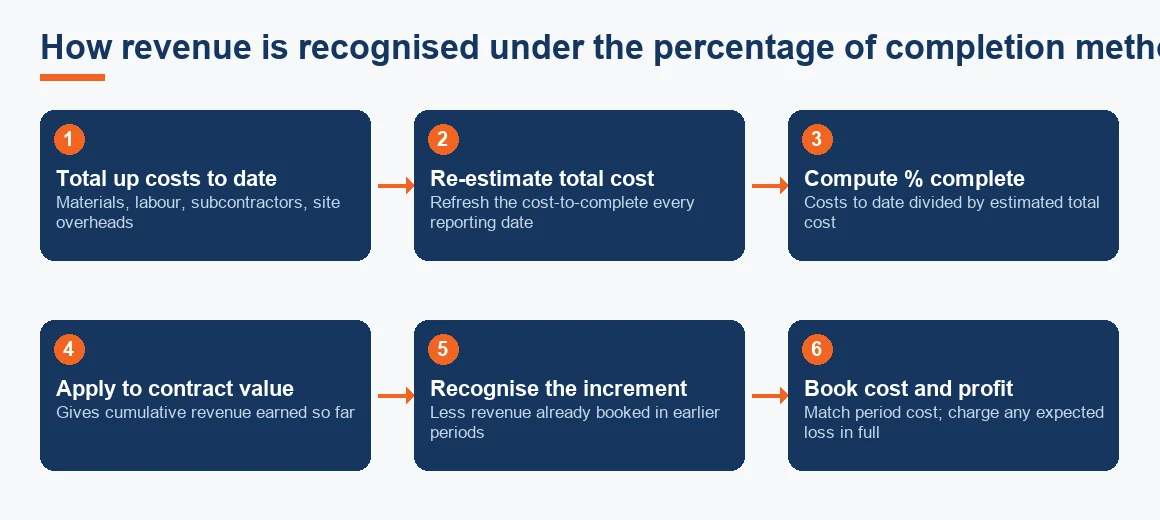
Once you have that percentage, revenue for the period follows in four steps:
- Add up the actual contract costs incurred to date (materials, labour, subcontractors, site overheads).
- Re-estimate the total cost to complete the whole contract, updating it for any changes.
- Divide costs to date by estimated total cost to get the percentage complete.
- Multiply that percentage by the total contract value to get cumulative revenue, then subtract revenue already recognised in earlier periods to get this period's figure.
The re-estimation in step 2 is the part that goes wrong most often. The percentage is only as honest as the total-cost estimate underneath it, so that number has to be revisited every reporting date, not set once at the start.
A worked example: recognising revenue on a Rs 130 crore contract
Take a three-year contract with a fixed value of Rs 130 crore and an estimated total cost of Rs 100 crore, so the expected profit is Rs 30 crore. Using the cost-to-cost method, the schedule below shows how revenue, cost and profit fall into each year as work progresses. All figures are in Rs crore.
| Year | Cumulative cost incurred | % complete | Cumulative revenue | Revenue this year | Cost this year | Profit this year |
|---|---|---|---|---|---|---|
| Year 1 | 30 | 30% | 39.0 | 39.0 | 30 | 9.0 |
| Year 2 | 75 | 75% | 97.5 | 58.5 | 45 | 13.5 |
| Year 3 | 100 | 100% | 130.0 | 32.5 | 25 | 7.5 |
| Total | 100 | 130.0 | 130.0 | 100 | 30.0 |
In Year 1, 30% complete on a Rs 130 crore contract gives cumulative revenue of Rs 39 crore, against Rs 30 crore of cost, for Rs 9 crore of profit. Each later year recognises only the increment over the cumulative figure already booked. The profit lands unevenly because the cost-to-cost percentage moves unevenly, which is exactly what the method is meant to reflect.
Percentage of completion vs completed contract method
The alternative is the completed contract method (CCM), which recognises no revenue or profit at all until the contract is substantially finished. The two produce very different profit profiles for the same project.
| Feature | Percentage of completion | Completed contract |
|---|---|---|
| Revenue timing | Recognised each period as work progresses | Recognised only when the contract is complete |
| Profit profile | Smoothed across the contract's life | Bunched into the final period |
| Balance sheet | Shows unbilled revenue and contract WIP | Shows accumulated cost as WIP, no profit |
| Reliability needed | Requires a reliable estimate of total cost | Works when the outcome cannot be estimated |
| Indian position | Mandatory under AS 7 / Ind AS 115 when outcome is estimable | Effectively a fallback when it is not |
Under Indian standards the choice is not a free preference. Once the outcome can be measured reliably, POC is required and CCM is not available as an accounting policy, unlike some older treatments elsewhere.
When to use percentage of completion versus completed contract
Use the percentage of completion method when you can reliably estimate total contract revenue and total contract cost, and progress can be measured, which describes most infrastructure and civil contracts built to a client's design. Fall back to recognising revenue only to the extent of recoverable cost (no profit) when the outcome genuinely cannot be estimated: early-stage contracts, disputed scope, or unpriced variations that dominate the job.
For companies on Ind AS 115, the test is more explicit. Revenue is recognised over time if any one of three conditions is met, the most relevant for construction being that the asset has no alternative use to the contractor and there is an enforceable right to payment for work completed to date. This is why a contractor building a specified bridge recognises over time, while a developer selling standard flats usually recognises at a point in time. The difference in tax and GST treatment between under-construction and completed property is a separate topic, covered in GST on under-construction vs completed property.
The four criteria for revenue recognition and the cost-to-cost method
Before any construction revenue is booked, four things generally have to hold: the contract is enforceable and its terms are agreed, total contract revenue can be measured reliably, it is probable the economic benefits will flow to the contractor, and both the costs to complete and the stage of completion can be measured reliably. If any of these fails, profit recognition waits.
The cost-to-cost method is the workhorse for the fourth criterion. Because it uses inputs (costs) rather than outputs, care is needed with costs that do not reflect progress: uninstalled materials sitting on site, or a large advance to a subcontractor, can inflate the percentage before any real work is done. Those items are stripped out of the numerator so the percentage stays honest. Contractors running several jobs at once should track this per project, which ties into project-wise profitability and disciplined project and phase-wise WIP costing.
How expected losses and retention money are handled
Two treatments trip contractors up. First, an expected loss on a contract is recognised in full and immediately, the moment the estimate turns negative, whatever stage the work has reached. If contract revenue is Rs 80 crore and the estimated total cost climbs to Rs 90 crore, the whole Rs 10 crore loss is booked at once, not spread over the remaining months. This is a prudence rule that applies under both AS 7 and Ind AS 115. Second, retention money, the slice the client withholds until defect-free completion, is included in revenue as work is certified and shown as a receivable, because the right to it is only conditional on performance. None of this changes a developer's RERA escrow obligations, which run on a separate track set out in the RERA 70% escrow rule.
Where land is contributed under a development arrangement rather than a straight construction contract, the accounting shifts again, and that is dealt with separately in Joint Development Agreement accounting and taxation. To pin down which standard set applies to your entity in the first place, the Ind AS Applicability Checker and the AS vs Ind AS comparison matrix are a quick way to start.
Key terms
- Percentage of Completion Method (POCM): recognising contract revenue and profit in proportion to work performed.
- Work-in-Progress (WIP) Valuation: valuing partly finished contract work carried on the balance sheet.
- Ind AS 115 Revenue Recognition: the over-time and point-in-time framework that replaced AS 7 for Ind AS companies.
- Unbilled Revenue: revenue earned by measured progress but not yet invoiced to the client.
- Accrual Accounting: recognising income and expense when earned or incurred, not when cash moves.
Getting the method right in practice
The percentage of completion method rewards discipline in two places: an honest, regularly refreshed estimate of total cost, and a clean split between what has been certified, billed and recognised. Contractors that keep those tight get a profit and loss account that actually tracks site activity, along with clean handling of retention, advances and expected losses. Those that treat the cost estimate as a set-and-forget number end up with lumpy, unreliable profits. If contract accounting sits alongside broader reporting needs, it usually connects into financial statement preparation and day-to-day accounting services. Businesses in adjacent sectors with their own revenue-recognition quirks, such as SaaS accounting, IT and software company accounting and startup accounting, face similar over-time versus point-in-time questions.
Key takeaways
- The percentage of completion method books revenue and profit as work is done, measured usually by the cost-to-cost formula.
- Percentage complete = costs incurred to date ÷ estimated total cost, applied to the contract value for cumulative revenue.
- AS 7 makes the method mandatory once a contract's outcome is reliably estimable; Ind AS 115 gets there through its over-time tests.
- Any expected loss is charged in full immediately; retention money stays in revenue as a receivable.
- Real estate developers selling standard units usually recognise at a point in time, not over time.
Decision guide