In this guide
JDA accounting and taxation for real estate developers turns on one idea: a joint development agreement is not a simple sale, so tax and books do not follow the date the papers are signed. A landowner contributes the land, the developer contributes the money and construction, and the finished building is split between them as area or as revenue. This guide explains when capital gains arises, how TDS and GST apply, and how a developer records the deal, all under current Indian rules. For the commercial engagement itself, see our Construction & Real Estate Accounting service.
What is a joint development agreement in real estate?
A joint development agreement is a contract in which a landowner grants development rights over a plot to a developer, who builds at its own cost and hands back an agreed share of the completed project. Ownership of the land is not sold outright at the start; instead, development rights are transferred and consideration flows as constructed area, cash, or both. This structure lets a landowner monetise a plot without funding construction, and lets a developer build without buying the land upfront.
Two forms are common in practice. In an area-share JDA, the landowner receives a fixed number of flats or a percentage of the built-up area. In a revenue-share JDA, the landowner instead receives an agreed percentage of the sale proceeds as units are sold. The distinction matters because it changes both the point of taxation and the accounting entries, as the comparison later in this article shows.
When is capital gains triggered under a JDA?
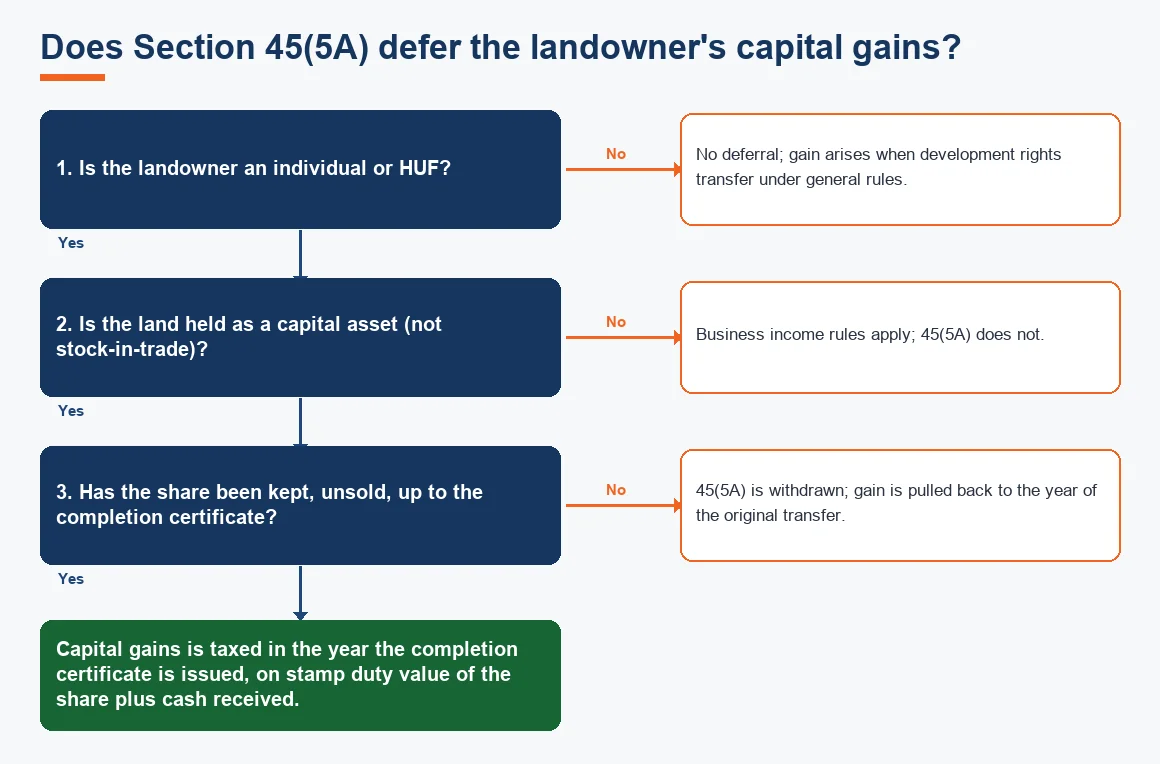
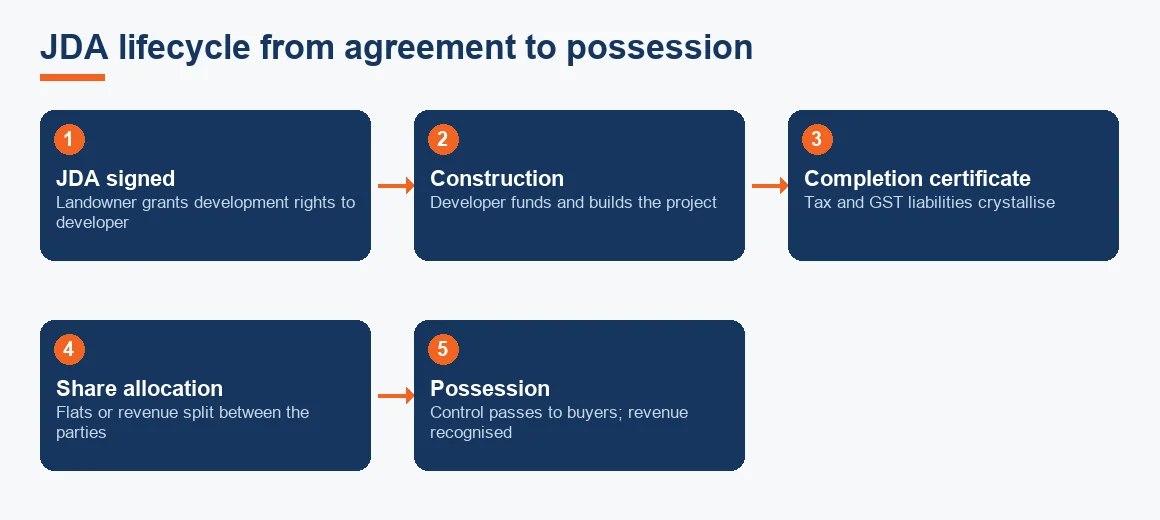
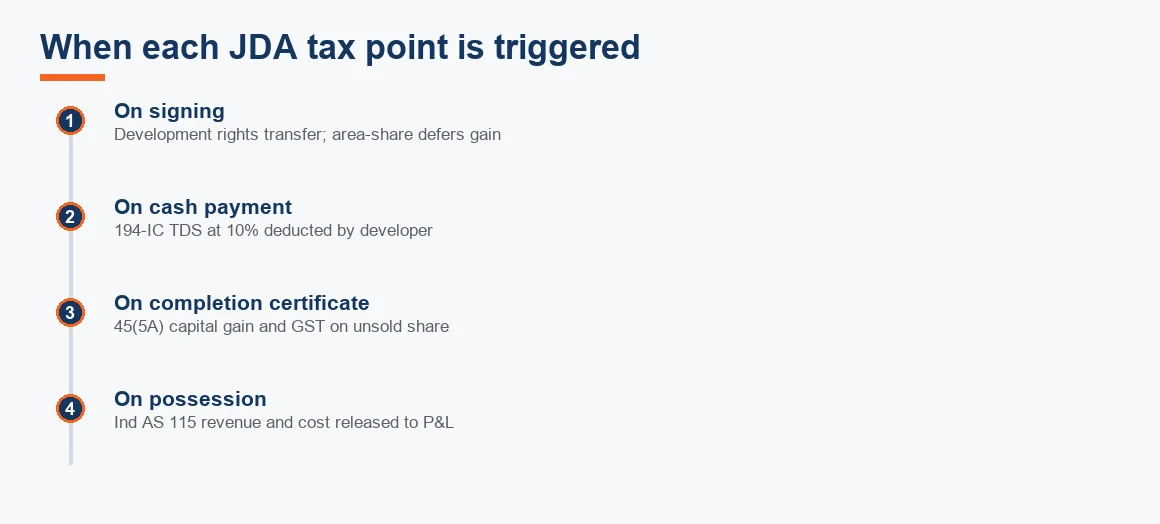
For a landowner who is an individual or a Hindu Undivided Family and holds the land as a capital asset, Section 45(5A) of the Income Tax Act defers capital gains to the previous year in which the competent authority issues the completion certificate for the whole or part of the project. So the gain is not taxed in the year the JDA is signed, which is the outcome most landowners assume incorrectly. The relief exists precisely because the landowner has not yet received anything liquid at signing.
The relief carries a strict condition. If the landowner transfers its share (the constructed area or its rights in it) to a third party before the completion certificate is issued, Section 45(5A) stops applying and the gain is pulled back to the year of the original transfer under the ordinary rules. Companies, firms and LLPs do not get this timing relief at all; for them the capital gain arises in the year development rights pass, following general principles. The official provision text is on the Income Tax Department portal.
How is capital gains taxed on a joint development agreement?
When the completion certificate is issued, the full value of consideration for an eligible landowner is the stamp duty value of the landowner's share of the project on that date, plus any monetary consideration received. From that you deduct the cost of acquisition of the land to arrive at the long-term capital gain. Following the July 2024 change, a long-term gain on land is taxed at 12.5% without indexation; an individual or HUF who acquired the land before 23 July 2024 may instead pay 20% with indexation if that computes to a lower tax. This treatment sits alongside the wider question of under-construction versus completed property, which we cover separately.
Because the taxable event is the completion certificate, the landowner must hold cash to pay a tax on flats that may not yet be sold. That mismatch is a real planning point: many landowners sell one or two units of their share soon after handover purely to fund the capital gains liability. The worked example below sets out the arithmetic.
How is TDS deducted on a JDA?
Where the developer pays any monetary consideration to a resident landowner under a registered JDA, Section 194-IC requires TDS at 10% on that money, and there is no threshold limit at all, so even a small cash top-up is covered. The constructed area share is not a money payment, so no TDS attaches to the flats themselves. The developer deposits the deducted tax by the 7th of the month following deduction and reports it in the quarterly TDS return.
Section 194-IC deliberately overrides Section 194-IA (the 1% TDS on immovable property purchases), so a JDA cash payment is not taxed twice. Landowners should confirm the deduction appears in their Form 26AS, since this credit offsets the capital gains liability that crystallises at completion.
Is GST applicable on joint development agreements?
Yes. The transfer of development rights (TDR) from landowner to developer is a supply, and GST on it is payable by the developer under reverse charge for projects that started on or after 1 April 2019. Crucially, the tax is exempt to the extent of flats sold before the completion certificate is issued, and applies only to the proportion of the landowner's share that remains unsold on the completion date. The liability crystallises on the date of the completion certificate, not the date of the agreement.
Separately, when the developer hands the landowner's flats over, that construction service also attracts GST at the applicable rate for the project (with the usual restriction that input tax credit is not available under the 1%/5% affordable and non-affordable schemes). The consolidated notifications sit on the CBIC GST portal. Because the mechanics interact with escrow discipline, read them together with the RERA 70% escrow rule.
What is the accounting treatment for a joint development agreement?
Under Ind AS 115, a developer recognises revenue when control of each flat passes to the buyer, which for most Indian residential projects means on possession. The older percentage of completion approach used under the erstwhile guidance no longer drives revenue for such sales, a shift we explain in the percentage completion method article. The developer measures the land cost as the fair value of the development rights obtained and capitalises it into project inventory rather than expensing it as construction proceeds.
The construction cost of the landowner's flats is treated the same way: it is added to project inventory as part of land cost, measured at the fair value of the development rights received on the agreement date, and charged to the statement of profit and loss only as the developer's own units are sold. Holding it in inventory rather than expensing it prevents an artificial loss in the early years, which links directly to disciplined WIP costing for real estate developers. Firms sizing up whether Ind AS even applies can start with the Ind AS Applicability Checker, and the timing differences it creates can be modelled in the Deferred Tax Calculator.
Step-by-step: how a developer records a JDA
- Value the development rights. Fix the fair value of the rights received from the landowner on the agreement date; this becomes the land cost.
- Capitalise into inventory. Record land cost and subsequent construction spend as project inventory (work in progress), not as period expense.
- Recognise the GST position. Set up the reverse-charge liability on transfer of development rights and track the sold-versus-unsold flat split to the completion date.
- Deduct TDS on cash. On any monetary payment to the landowner, deduct 10% under Section 194-IC and deposit by the 7th of the next month.
- Recognise revenue on possession. As each flat's control passes to a buyer, recognise sale revenue and release the matching inventory cost to profit and loss.
Area-share versus revenue-share JDA: how tax points differ
The two structures diverge on almost every compliance touchpoint. The table below summarises the key differences for the developer and the landowner.
| Aspect | Area-share JDA | Revenue-share JDA |
|---|---|---|
| Landowner receives | Fixed flats or built-up area | Agreed percentage of sale proceeds |
| Capital gains timing (individual/HUF) | Section 45(5A): year of completion certificate | Section 45(5A) where conditions met; else on transfer |
| Full value of consideration | Stamp duty value of flats plus cash | Revenue share received plus cash |
| TDS on cash to landowner | 194-IC at 10%, no threshold | 194-IC at 10%, no threshold |
| Developer land cost | Fair value of development rights, in inventory | Fair value of development rights, in inventory |
Worked example: capital gains for an individual landowner
Assume an individual landowner enters an area-share JDA, receives five flats plus Rs 50,00,000 in cash, and the completion certificate is issued in FY 2025-26. The stamp duty value of the five flats on the certificate date is Rs 2,50,00,000, and the indexed cost of the land is Rs 40,00,000. The computation under Section 45(5A) is set out below (amounts indicative).
| Particulars | Amount (Rs) |
|---|---|
| Stamp duty value of landowner's flats on completion certificate date | 2,50,00,000 |
| Add: Monetary consideration received | 50,00,000 |
| Full value of consideration (Section 45(5A)) | 3,00,00,000 |
| Less: Indexed cost of acquisition of land | (40,00,000) |
| Long-term capital gain | 2,60,00,000 |
| TDS deducted by developer on cash u/s 194-IC (10% of 50,00,000) | 5,00,000 |
The Rs 2,60,00,000 gain is taxed in FY 2025-26, the year of the completion certificate, and the Rs 5,00,000 already deducted shows in Form 26AS as a credit against the final liability. Because the tax falls due before most of the five flats are sold, the landowner typically plans to sell one or two units to fund it.
Key terms
- Joint Development Agreement (JDA): a landowner-developer contract sharing a built project as area or revenue.
- Ind AS 115 Revenue Recognition: recognises revenue when control of a unit passes to the buyer.
- Percentage of Completion Method (POCM): older progress-based revenue approach, largely displaced for flat sales.
- Work-in-Progress (WIP) Valuation: measuring project inventory before units are sold.
- RERA 70% Escrow Compliance: the rule ring-fencing 70% of buyer collections for the project.
Where JDA accounting sits in your wider books
JDA treatment is one strand of a developer's reporting, and it interacts with revenue recognition, inventory, GST returns and TDS filings across the year. The same discipline that governs project inventory here carries into sector-specific engagements such as Startup Accounting Services India and technology mandates like IT & Software Company Accounting Services and SaaS Accounting Services (IT & SaaS), where control-based revenue under Ind AS 115 raises similar questions. For real estate specifically, the entries feed the journal entry discipline behind clean project revenue reporting.
Key takeaways
- A JDA transfers development rights, not an outright land sale, so tax does not attach to the signing date.
- Section 45(5A) defers an individual or HUF landowner's capital gains to the completion certificate year, provided the share is not sold earlier.
- Section 194-IC deducts 10% TDS on cash paid to a resident landowner, with no threshold.
- GST on development rights is a developer reverse-charge liability, exempt for flats sold before the completion certificate.
- Under Ind AS 115 the developer capitalises land cost into inventory and recognises revenue on possession.
This article is general information, not advice on a specific transaction. JDA outcomes depend on the exact clauses, the landowner's status and project timelines, so have the agreement reviewed before you rely on any position.
Decision guide