In this guide
Bill of materials (BOM) and work in progress (WIP) accounting for a Manesar auto manufacturer means tracking cost through three inventory stages, raw material, work in progress and finished goods, instead of writing purchases straight to expense the way a trading business does. A manufacturing account collects material consumed, direct wages and factory overhead to arrive at cost of production, and closing stock at each stage is carried at the lower of cost and net realisable value as AS 2 requires. This explainer walks a Gurugram or IMT Manesar unit through the mechanics: the inventory stages, the BOM in Tally, WIP valuation, overhead absorption and the job-work and payroll rules that bite locally. If you want the service itself handled, that sits with our Manufacturing Accounting Services team.
Why manufacturing accounting differs on the Manesar shop floor
An auto-component or sheet-metal unit in IMT Manesar or Udyog Vihar buys steel, fasteners and consumables, converts them across a press shop, weld line and assembly, and only then has a saleable part. Between the purchase invoice and the sale invoice, value sits on the shop floor in a form the trading account cannot see. Manufacturing accounting exists to capture that middle: it splits cost into material, labour and factory overhead, and it parks partly finished value in a WIP account until the part is complete. Get this wrong and gross margin swings month to month for no real reason, usually because purchases were expensed in full while unsold stock quietly built up. The city service page, Manufacturing Accounting Services Gurugram, covers who does this for local units; this page is about how the numbers actually work.
The three inventory stages and three manufacturing costs
Two ideas sit at the centre of a manufacturing account. The three inventory stages describe where value rests, and the three manufacturing costs describe what goes into it. Raw material becomes work in progress when it is issued to the shop floor; work in progress becomes finished goods on completion; finished goods become cost of goods sold on despatch. The costs that accumulate along the way are direct material, direct labour and factory overhead. The table below summarises what each stage carries.
| Inventory stage | Cost it carries | AS 2 valuation basis |
|---|---|---|
| Raw material | Purchase price plus freight and non-creditable duties (landed cost) | Lower of cost and net realisable value |
| Work in progress | Material consumed plus labour and overhead absorbed to the stage reached | Lower of cost and net realisable value |
| Finished goods | Full cost of production per unit | Lower of cost and net realisable value |
For a longer treatment of how stock is valued when input prices move, see FIFO vs weighted average cost.
Setting up a bill of materials (BOM) in Tally
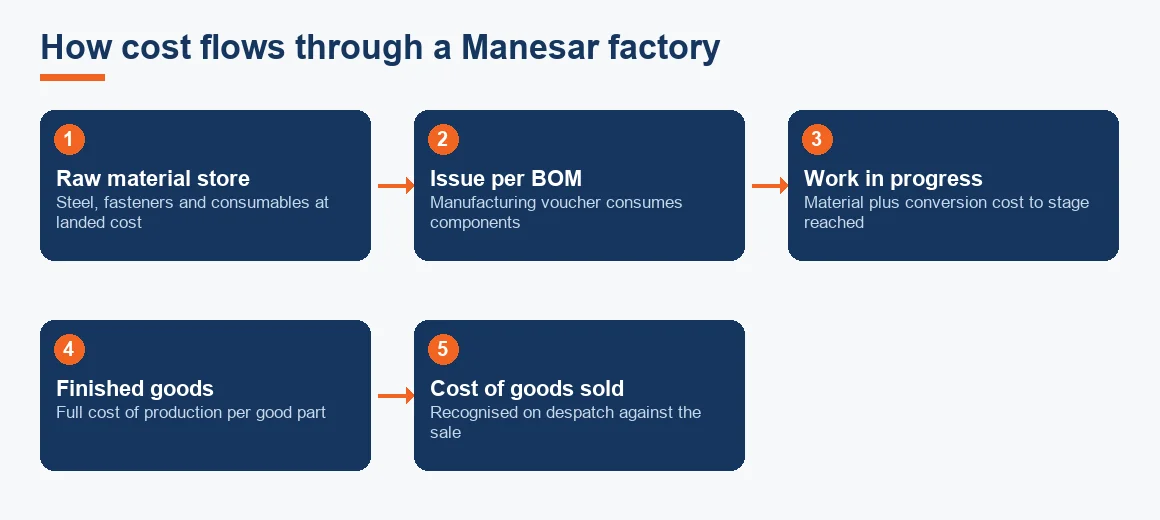
A bill of materials lists every component and the quantity that goes into one finished part. In Tally, it is created inside the finished-goods stock item under Set Components (BOM), and a manufacturing journal voucher then consumes the components and produces the finished item in a single entry. Godown-wise stock stays accurate between the stores and the shop floor, and scrap or process loss is entered on the same voucher so cost per unit stays honest. The flow below shows the movement from store to despatch.
The accounting mechanics behind a BOM are covered in Bill of Materials (BOM) Costing.
Valuing work in progress (WIP) at the year end
Work in progress carries full material cost from the point components are issued, but only the labour and factory overhead absorbed up to the stage the batch has reached. A press-shop batch that is half complete carries all of its steel but only half of its conversion cost. That figure is then compared with net realisable value and taken at the lower, exactly as AS 2 requires. The one trap to avoid: overhead that went unabsorbed because the plant ran below normal capacity does not belong in stock. It goes to the profit and loss account of the period. The full method sits in Work-in-Progress (WIP) Valuation.
Absorbing factory overhead on normal capacity
Factory overhead, supervision, power, factory rent, repairs and plant depreciation, is pooled and applied to output through a rate per machine hour, labour hour or unit. AS 2 is specific that fixed production overhead must be allocated on normal capacity, the production a plant is expected to achieve on average, so the cost of idle capacity is not dumped into inventory. Where a Manesar line runs two shifts against a three-shift normal capacity, the third shift's share of fixed cost is a period expense, not part of finished-goods value. The distinction between costs that attach to product and costs that do not is set out in Direct vs Indirect Factory Overheads. Plant and machinery depreciation feeding the overhead pool can be worked out with our Depreciation Calculator.
Worked example: cost of production for a Manesar press-shop batch
Take a Manesar unit running a batch of 10,000 stamped brackets. Factory overhead for the year is Rs 20,00,000 over a normal capacity of 40,000 machine hours, giving an absorption rate of Rs 50 per machine hour. The batch uses 8,000 machine hours. The statement below builds the cost of production and the cost per good part. All figures are indicative.
| Cost element | Basis | Amount (Rs) |
|---|---|---|
| Direct material consumed (steel, fasteners) | Per BOM, landed cost | 12,00,000 |
| Direct wages | Shop-floor labour on the batch | 4,00,000 |
| Prime cost | Material plus wages | 16,00,000 |
| Factory overhead absorbed | 8,000 hrs at Rs 50 per machine hour | 4,00,000 |
| Cost of production | Prime cost plus overhead | 20,00,000 |
| Good parts produced | After 4 per cent process loss on 10,000 blanks | 9,600 parts |
| Cost per good part | Rs 20,00,000 / 9,600 | 208.33 |
If, at year end, 3,000 of those brackets are still on the weld line at the half-complete stage, their WIP value is full material (Rs 3.60 lakh at Rs 120 material per part) plus half of the per-part conversion cost, not the full Rs 208.33. That is the AS 2 lower-of-cost discipline in practice.
Job work and Form ITC-04 for Manesar auto-component units
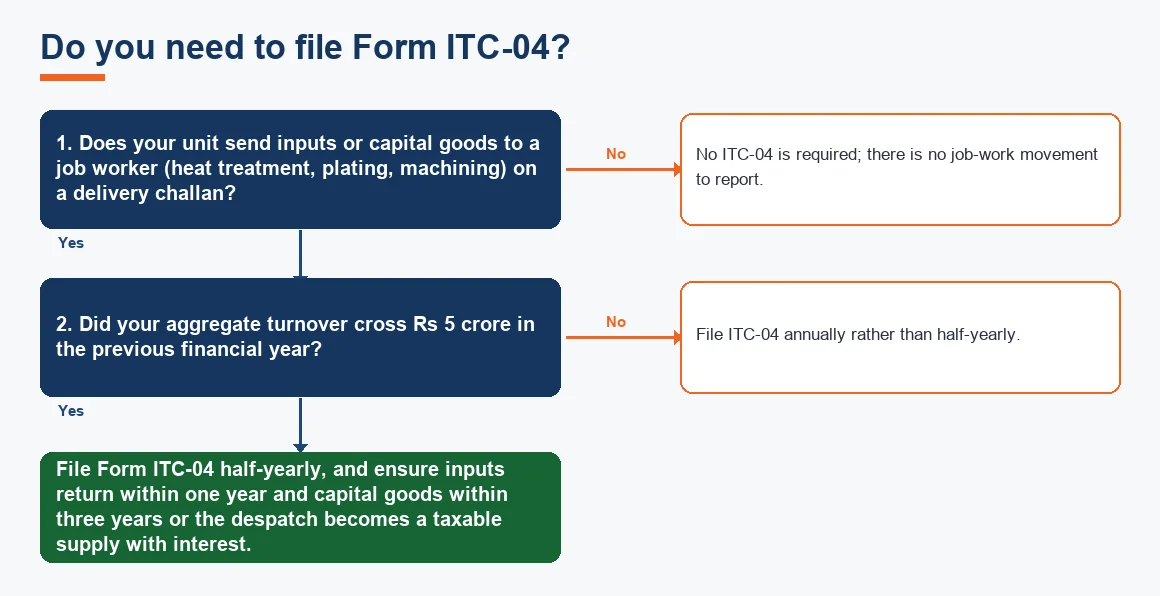
Auto-component work in the Gurugram belt leans heavily on job work: heat treatment, plating and specialised machining go out to a job worker and come back. Under Section 143 of the CGST Act these movements travel on a delivery challan, not a tax invoice, and are reported in Form ITC-04. Filing is half-yearly where aggregate turnover crossed Rs 5 crore in the previous year and annually below that. Inputs must return within one year and capital goods within three years; miss that window and the original despatch is treated as a taxable supply, with interest. The tracking discipline is covered in Form ITC-04 Job Work Tracking, and the statutory text sits with the CBIC. Where you pay a job worker or buy goods above the threshold, also watch Section 194Q TDS on Goods.
The Gurugram payroll angle: Haryana LWF and no professional tax
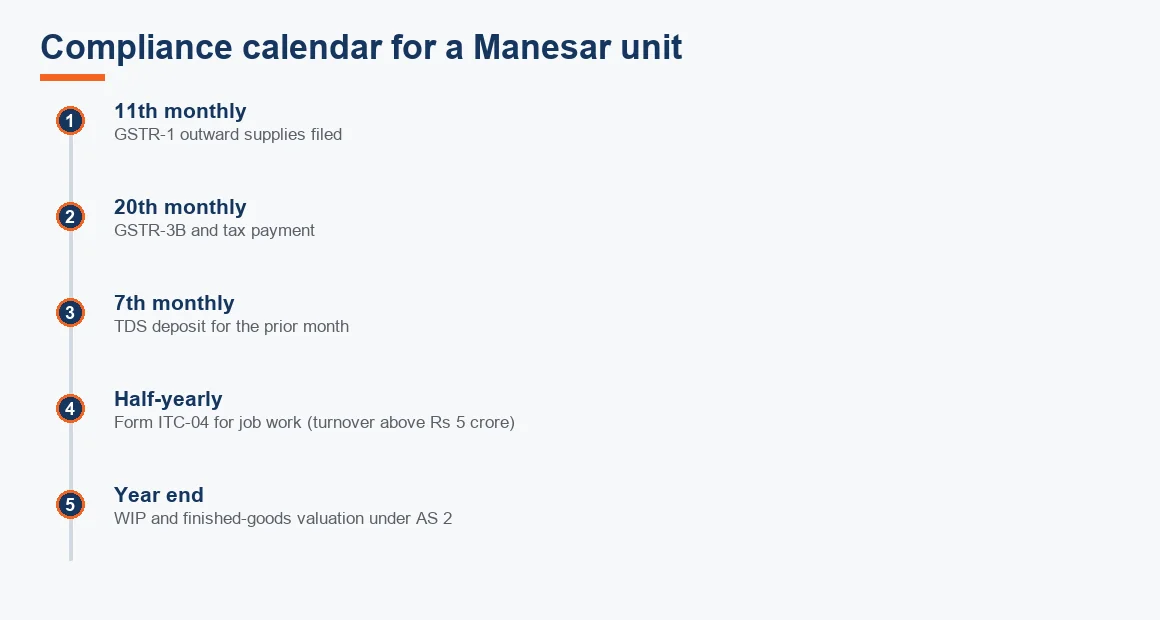
Two Haryana-specific points catch out units that moved in from another state. First, Haryana does not levy professional tax, so there is no monthly PT deduction on the payroll the way Maharashtra or Karnataka run it. Second, Haryana does levy a Labour Welfare Fund (LWF) contribution, which is deducted and deposited on the statutory cycle. The exact rate and cadence, and the Shops Act and registration side, are set out in our Haryana compliance for employers guide, so we will not repeat them here. Alongside payroll, a factory files GSTR-1, GSTR-3B and, where applicable, ITC-04; the calendar below shows the shape of a Manesar unit's month and half-year. TDS deposits and rates are on the Income Tax Department portal.
One more India-wide clock matters for a component maker buying from small vendors: Section 43B(h) MSME clock disallows a deduction for amounts owed to a registered micro or small enterprise beyond the agreed period (capped at 45 days), so payables ageing is a tax matter, not just a cash-flow one.
How this fits a wider finance setup
Costing is one part of a factory's books. Owners scaling a Gurugram unit tend to read our Virtual CFO and financial-ops checklist for Gurugram startups alongside this, weigh the cost side using Cost of outsourced accounting and Virtual CFO in Gurugram: 2026, and use how to choose an accountant in Gurugram when they hire. If the unit also runs a software or IoT arm, the revenue side is different again and sits with IT and software company accounting or SaaS accounting; an early-stage entity is served by startup accounting services. General books and bookkeeping for the city sit on the Gurugram accounting and bookkeeping page. The AS 2 standard itself is published by the ICAI.
Key terms
- Bill of Materials (BOM) Costing: the component list and quantities that build one finished part, used to consume stock and set standard cost.
- Work-in-Progress (WIP) Valuation: valuing part-finished stock at material plus conversion cost absorbed to the stage reached, at the lower of cost and NRV.
- Direct vs Indirect Factory Overheads: costs that attach directly to a product versus pooled factory costs absorbed through a rate.
- Form ITC-04 Job Work Tracking: the GST return reporting goods sent to and received back from a job worker under Section 143.
- IMT Manesar Industrial Costing: costing conventions specific to units in the IMT Manesar industrial estate.
Key takeaways
- Cost flows through three stages: raw material, WIP and finished goods, and each is carried at the lower of cost and net realisable value under AS 2.
- Absorb fixed factory overhead on normal capacity so idle-capacity cost stays in the profit and loss account, not in stock.
- Set the BOM inside the finished-goods item and consume it through a manufacturing journal voucher, with scrap built in.
- Report job-work movements in Form ITC-04 (half-yearly above Rs 5 crore turnover, annually below) and watch the one-year and three-year return windows.
- In Gurugram, plan for Haryana LWF and the Section 43B(h) MSME payment clock; there is no professional tax to deduct.
Decision guide