


Talk to an Expert
Talk to an Expert ✆ +91 945 945 6700
Trusted by 10,000+ Businesses
Gurugram, Haryana

E-Commerce Accounting Services in Gurugram

Reviewed by CA and CS Team, Patron Accounting LLP ICAI & ICSI Registered| 15+ Years Experience| Last Updated: July 2026 Verify Credentials →

Gross turnover you can defend: Your books carry gross sales, commission, shipping and returns as separate figures, so the turnover you report matches the portal.

TCS credit actually in hand: You claim the tax each marketplace collected once it shows in your electronic cash ledger.

Channel-wise contribution after deductions: You see commission, shipping, advertising, packaging and return costs sitting against the channel that incurred them.

Stock at fulfilment centres proved: We agree units lying at fulfilment centres to the operator's inventory report and show goods in transit apart.

15+ YearsIndustry Experience
CA & CSCertified Experts
4.9
Based on real Google reviews

Get Free Consultation

Talk to a CA/CS expert today

🇮🇳 +91

Our team will get back to you shortly. No spam.

Real Stories from Real People

Verified Google reviews from founders and businesses Patron works with across India.

Join 3,000+ Founders and Businesses on Patron

Rated 4.9 on Google - trusted for startup accounting since 2019.

Talk to an Expert
10,000+Businesses ServedGST compliance and litigation support across India.
15+Years ExperienceDeep expertise in IP registration, GST & business compliance.
50,000+Documents FiledReturns, appeals, and filings handled accurately.
4.9★Client RatingTrusted by entrepreneurs, startups, and growing businesses.
ISO CertifiedProfessional standards and documented processes.
SSL SecureYour financial and business data is fully protected.

What E-Commerce Accounting Costs and Covers for Gurugram Businesses

📌 TL;DR - E-Commerce Accounting Services at a Glance

Ecommerce accounting services in Gurgaon unpick each marketplace payout into commission, logistics and return deductions before any revenue is recognised. The TCS credit is pulled through GSTR-2B against a Haryana filing date of the 24th. Patron carries an RTO provision and tracks stock held at Manesar and Bilaspur warehouses. Ideal where a D2C brand is scaling across the NCR.

You keep pricing, buying and the marketplace panels. The ecommerce accounting work Patron takes on starts at the download: settlement files pulled channel by channel, commission and logistics deductions posted, then the ledger closed on a stated date. Stock lying in the Pataudi Road fulfilment parks is treated differently once a consignment leaving Haryana is a branch transfer rather than a sale, so the stock ledger stops agreeing with the revenue ledger. Sellers follow a D2C brand's monthly checklist.

By the end of the first month, historical settlements have been rebuilt payout by payout, unclaimed deductions traced, stock brought to a verified opening position, and every registered address checked against the Haryana taxation department records. After that, ecommerce accounting in Gurugram settles into a fixed monthly rhythm, and the load then rises with channel count, return volume and each extra warehouse feeding orders.

What Do E-Commerce Accounting Mean for Gurugram Businesses?

Everything here is kept to one standard: nothing is booked that the marketplace's own settlement statement cannot support. That evidence, not the seller's own dashboard, is the starting record. Ecommerce accounting services in Gurgaon build the ledger outward from it, matching each payout to its orders, its deductions and the tax the operator has already collected before any revenue is recognised.

Selling from the NCR adds a wrinkle a single-state seller never meets. A head office in Gurugram and a fulfilment centre across the Delhi or Uttar Pradesh line are distinct persons under GST. A stock movement between them is a supply to be recorded, not an internal transfer to be ignored, so the stock ledger splits by registration and the reconciliation doubles. Ecommerce accounting services in Gurgaon are scoped around that reality, holding a separate settlement and stock position for each registration so the numbers agree state by state.

Key Terms for E-Commerce Accounting:

What Is E-Commerce Accounting. Every marketplace settlement is a bundle of gross sales, commission, shipping in Gurugram

Who Needs E-Commerce Accounting in Gurugram: From Cyber Hub to Growing SMEs

Online sellers based in Gurugram need ecommerce accounting services in Gurgaon when the bank payout never equals the invoice raised. Once commission, shipping, TCS and returns sit between those figures, every marketplace settlement has to be broken down, not booked whole.

  • Amazon and Flipkart sellers around Udyog Vihar whose settlement report shows deductions they cannot tie to an order.
  • D2C brands on Shopify or WooCommerce matching Razorpay and COD remittances to dispatched orders.
  • Meesho and multi-marketplace sellers claiming the GST TCS credit parked in the electronic cash ledger.
  • Apparel and footwear labels where returned and RTO stock builds faster than the books record it.
  • Sellers holding inventory at fulfilment centres across several states, needing that stock proved and valued.
  • Online sellers on several GSTINs, filing across states every return cycle from one Gurgaon base.
  • Sellers where the operator deducts Section 194-O TDS at 0.1%, matched against booked sales.
  • Growing D2C brands nearing a lender who wants turnover defended in detail, as our e-commerce accounting guide sets out.

The software and platforms we work with

Amazon
Flipkart
Shopify
Meesho
Myntra
Nykaa

E-Commerce Accounting Included for Gurugram Businesses

ServiceWhat We Do
Marketplace settlement reconciliationSettlement files from every operator reconciled to order-level sales for sellers around Udyog Vihar, the heart of ecommerce accounting services in Gurgaon Monthly
Amazon seller ledger managementOrder, fee and payout data from your Amazon and other seller accounts booked cleanly, giving accounting for Amazon sellers in Gurgaon that reconciles to payouts Weekly, reviewed monthly
Returns and RTO provisioningRTO, courier returns and customer cancellations posted against the original supply, with a returns provision each period to keep net revenue honest Monthly
TCS and operator TDS creditsSection 52 GST TCS and Section 194-O TDS both reconciled to GSTR-8 data and Form 26AS, so operator-withheld amounts reach your ledgers as credit Monthly
Fulfilment centre stock controlInventory held across operator fulfilment centres tracked and valued per location, extending our E-Commerce Accounting Services to multi-warehouse sellers based in Cyber City Monthly
Channel-wise contribution reportingMonthly ecommerce bookkeeping services in Gurgaon rolled into a contribution report by channel, showing margin after commission, shipping and returns per marketplace Monthly
Our Process

How E-Commerce Accounting Works in Gurugram — Step by Step

How Patron delivers e-commerce accounting for Gurugram businesses, step by step.

Step 1

Settlement report reconciliation

Each marketplace settlement is broken back to gross sales, commission, shipping, TCS and returns, because the bank credit is only a net figure. Gross turnover in the books comes from the portal's tax report, never from the amount that landed.

Illustration for Settlement report reconciliation: Each marketplace settlement is broken back to gross sales, commission, in Gurugram
Step 2

Returns and RTO treatment

Returns, cancellations and RTO consignments are matched back to the original order so the credit note references the right supply. Goods that never physically came back are separated from goods received, because the two have different consequences.

Illustration for Returns and RTO treatment: Returns, cancellations and RTO consignments are matched back to the original in Gurugram
Step 3

TCS credit claim from operator

The tax collected by each operator under the e-commerce collection provisions is agreed to the statement it files, and the credit is then confirmed as accepted in the electronic cash ledger. Unaccepted or missing credit is taken back to the portal.

Illustration for TCS credit claim from operator: The tax collected by each operator under the e-commerce collection in Gurugram
Step 4

Operator TDS versus booked sales

Tax deducted by the operator on the gross amount of sales is compared with the turnover recorded per portal. A mismatch usually means the portal has reported sales the books have not picked up, and that difference is chased to the order.

Illustration for Operator TDS versus booked sales: Tax deducted by the operator on the gross amount of sales is compared in Gurugram
Step 5

Gateway and COD settlement matching

For own-website orders, gateway settlements are matched to orders with the discount charge shown as a cost rather than netted against revenue. Cash-on-delivery is tracked from courier remittance advice to bank, leaving unremitted collections visible.

Illustration for Gateway and COD settlement matching: For own-website orders, gateway settlements are matched to orders with in Gurugram
Step 6

Fulfilment centre stock control

Marketplace inventory is agreed to the operator's own report, and lost or damaged units to the reimbursement actually credited. A centre elsewhere in Haryana is added to the existing registration, whereas stock crossing into Delhi or Uttar Pradesh requires a separate registration in that state.

Illustration for Fulfilment centre stock control: Stock held at marketplace fulfilment centres is reconciled to the portal's in Gurugram
Step 7

Channel level contribution

Commission, shipping, platform advertising, packaging and return costs are pushed down to the channel and, where the data allows, the SKU. Only then does it become visible which listings are trading at a loss after all deductions.

Illustration for Channel level contribution: Commission, shipping, platform advertising, packaging and return costs are in Gurugram

Documents Required for E-Commerce Accounting

Haryana levies no profession tax, but its labour welfare contribution falls monthly rather than half-yearly, so the state layer is short and easily missed.

  • Marketplace settlement reports (Amazon Payments/Settlement report, Flipkart Seller Settlement, Meesho payment file)
  • Order-level sales register / MTR (Merchant Tax Report) or GST report from each portal
  • Returns, RTO and cancellation report (courier return / customer return files)
  • GST TCS statement from the operator (GSTR-8 data / TCS certificate) and the electronic cash ledger TCS credit
  • Form 26AS and AIS showing Section 194-O TDS deducted by the operator
  • Purchase invoices from suppliers and vendors
  • Bank statements for every current account, in PDF and Excel or CSV
  • Registration certificate (Form F) under the Punjab Shops and Commercial Establishments Act, 1958 as applicable to Haryana
  • Haryana Labour Welfare Fund MONTHLY contribution challan and the contribution statement
Client Portal

How You Work With Patron

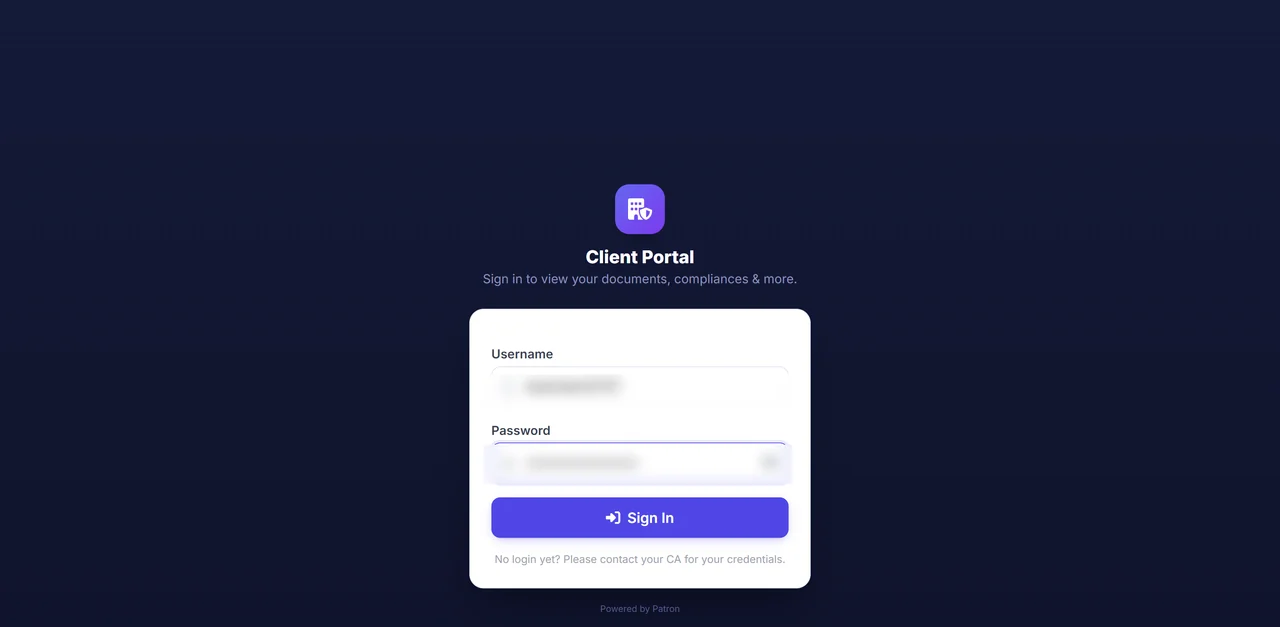
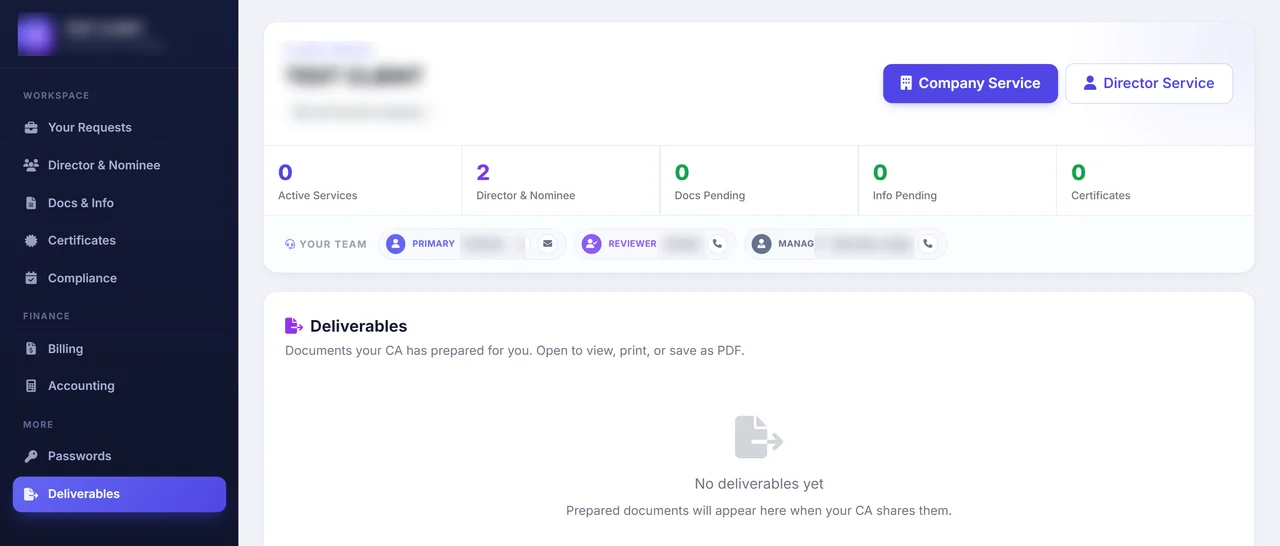
Everything happens in one secure login. You can see your active services, the Patron team on your account, and anything still pending. Once you raise a request, it moves through the same clear steps every time, so you always know exactly where your work stands.

Secure client portal login screen
1

Sign in securely

Your books, documents and requests all sit behind one private, password protected login. The team handling your account is shown on screen, so nothing sensitive ever needs to travel over email or WhatsApp.

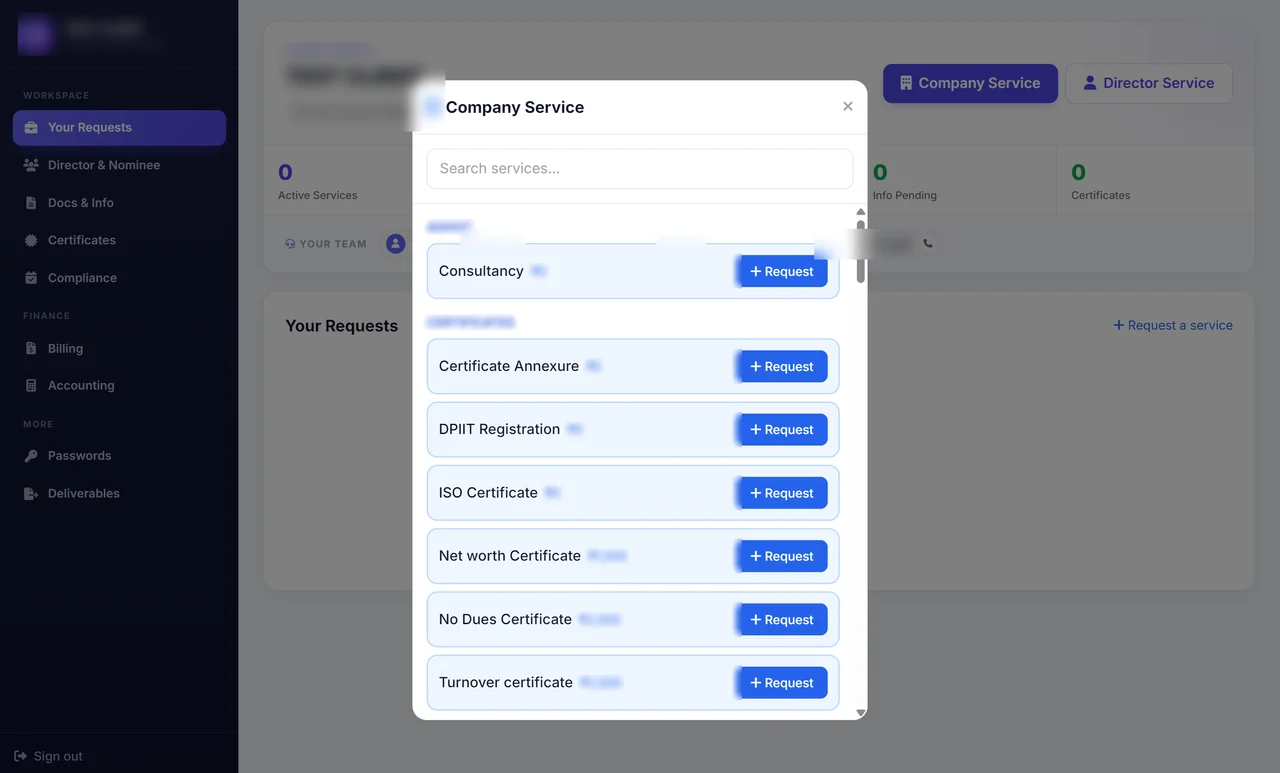
Service catalogue inside the client portal
2

Raise your request

Choose the service you need from the menu inside the portal, where the price is shown before you go ahead. Your request is logged the moment you send it, with no phone calls or reminder emails to wait on.

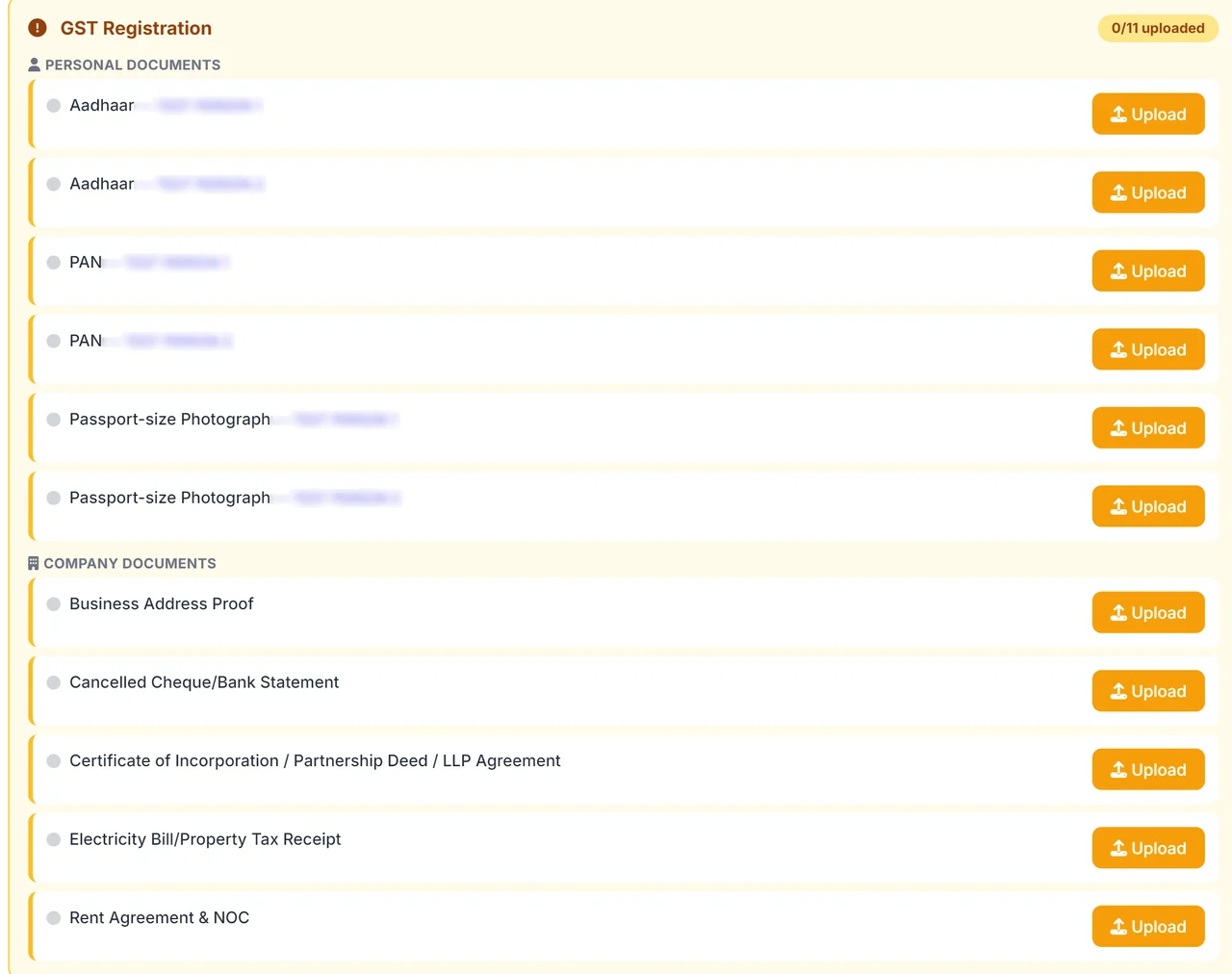
GST registration document checklist in the client portal, with an upload button beside each item
3

Share what the service asks for

For every service, the portal lists the exact documents it needs, each with its own upload button. The example shown here is the GST registration checklist. When a service needs nothing from you, it simply asks for nothing.

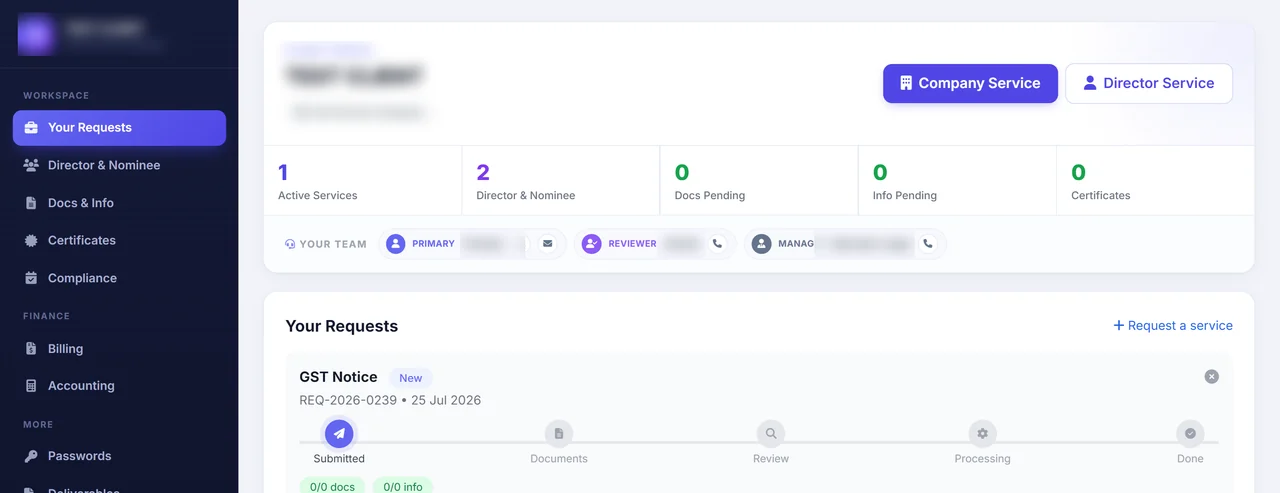
Live request tracker inside the client portal
4

We review, prepare and file

Once your documents are in, your team checks them, prepares the work and files it for you. A live tracker shows each stage as it happens, from review to processing to done, so you never have to ask where things stand.

Deliverables area of the client portal
5

Collect your finished work

Every completed return, computation and certificate is placed in your Deliverables area. You can open, print or download any of them as a PDF whenever you need a copy.

E-Commerce Accounting Challenges Specific to Gurugram: Udyog Vihar SEZ vs DTA, HSIIDC Plots and IMT Manesar Costing

ChallengeImpactHow Patron Accounting Solves It
SEZ-to-DTA supplies from a Udyog Vihar unit billed like ordinary salesZero-rated and DTA transactions blend, so ITC and reporting for the SEZ leg go wrongSplit SEZ-to-DTA billing onto a separate series and reconcile the DTA clearance value against the ledger
HSIIDC plot and IMT Manesar warehouse charges expensed in one lumpEstate lease, maintenance and allotment costs distort fulfilment cost per orderSeparate HSIIDC ground charges from operating cost and allocate Manesar warehouse cost per unit shipped
Fixed overhead not split from per-order cost across sales channelsContribution margin per channel stays unreadable, so pricing and channel-mix decisions run blind.We allocate fixed overhead to a cost centre apart from per-order logistics, so channel contribution reads clearly.
Revenue recognised at despatch, not on delivery or acceptanceGoods in transit at period-end count as sales, overstating revenue and understating the period-end cut-off adjustment.Patron aligns revenue to the delivery cut-off and defers in-transit orders, so period-end sales are not overstated.
Marketplace reserve and deferred payouts held back by platformsCash locked in reserves shows as receivable with no ageing, so collection risk hidesAge marketplace reserve balances by channel; our D2C accounting for Gurugram sellers keeps held funds visible

E-Commerce Accounting Fees in Gurugram

Fee ComponentAmount
Starter — one seller on a single marketplace with routine ordersINR 3,499 per month
Excl. GST & Government Charges
Growth — more marketplaces, higher order volume and added settlement linesOn quote
Managed — multi-entity seller books with custom settlement and margin reportingOn quote

Ecommerce accounting in Gurugram is priced by scope, not location, so the entry rate matches our national INR 3,499 per month for one seller on a single marketplace. More marketplaces, orders and settlement lines move it up. Local statutory registrations bill separately at actuals. Book a scope call on +91 94594 56700.

Fees exclude GST and government charges. Final quote confirmed after a scoping review.

All fees and charges listed are indicative only and do not constitute a binding offer. Final amounts may vary depending on the volume of work and the complexity involved.

Professional accounting and compliance charges are scoped to your number of entities, funding stage and monthly transaction volume, and are separate from statutory and government charges. Contact us for a detailed, fixed quote.

Get a free E-Commerce Accounting consultation - Call +91 945 945 6700 or WhatsApp us. No-obligation assessment.

E-Commerce Accounting Compliance Calendar 2026 for Gurugram Businesses

ComplianceDue DateApplies To
TDS / TCS deposit (Challan ITNS-281)7th of every month (30 April for March)Every business that deducts tax at source on salaries, rent, contractor or professional fees
TCS return by e-commerce operators (GSTR-8)10th of every monthE-commerce operators collecting 0.5% TCS (0.25% CGST + 0.25% SGST) on supplies
GSTR-1 (outward supplies)11th of every month for monthly filersGST-registered Gurugram businesses filing monthly returns
TDS under Section 194-O on e-commerce sales (0.1%)7th of the following monthE-commerce operators deducting TDS on participant sales
GSTR-3B (summary return and tax payment)20th monthly for turnover above Rs 5 crore; 24th quarterly under QRMP for turnover up to Rs 5 crore (Category Y)GST-registered businesses in Gurugram
Tax audit report (Form 3CA/3CB-3CD)30 September 2026Businesses crossing the Section 44AB turnover threshold
Income-tax return, audit cases31 October 2026Companies and audit-liable firms
Annual GST return GSTR-9 and reconciliation GSTR-9C31 December 2026GST-registered Gurugram businesses above the annual-return and audit thresholds

A Gurugram marketplace seller works to the GSTR-8 TCS on the 10th and the quarterly GSTR-3B on the 24th. Settlement reconciliation and the GSTR-2B TCS credit claim have to clear before filing. Haryana levies no professional tax, so GST and TDS set the local pace. Book a compliance review for ecommerce accounting services in Gurgaon on +91 94594 56700; see our local notes.

Key Benefits

Why Professional E-Commerce Accounting Matters

Gross turnover you can defend

Your books carry gross sales, commission, shipping and returns as separate figures, so the turnover you report matches the portal.

  • Figures taken from the portal tax report, not net bank credit
  • Order level sales register reconciled to settlement reports
  • Without the split, turnover understates what the operator already reported

TCS credit actually in hand

You claim the tax each marketplace collected once it shows in your electronic cash ledger.

  • Collected TCS agreed to the operator's GSTR-8 statement
  • Missing credit chased while the settlement file is still available
  • Without it, collected tax is quietly written off as cost

Channel-wise contribution after deductions

You see commission, shipping, advertising, packaging and return costs sitting against the channel that incurred them.

  • Costs tied to the channel and, where data allows, the SKU
  • True contribution shown even when the account payout looks positive
  • Without it, you scale listings that lose money every order

Stock at fulfilment centres proved

We agree units lying at fulfilment centres to the operator's inventory report and show goods in transit apart.

  • FBA and Flipkart Assured stock tied to the inventory report
  • Lost and damaged units matched to the reimbursement credited
  • Without it, unreimbursed shrinkage stays buried in cost of goods sold

Returns recorded against the right supply

We tie every return, cancellation and RTO to the order it reverses, so each credit note points at the right supply.

  • Goods that never came back kept apart from goods received
  • Without it, revenue holds sales that were reversed months ago

Operator TDS matched to sales

We compare the tax each operator deducted against the turnover your books recorded for that portal.

  • Section 194-O deduction at 0.1% checked against Form 26AS and AIS
  • Portal-reported sales chased to the order they belong to
  • Without it, portal-reported sales stay missing from your books

Why E-Commerce Accounting Services Clients in Gurugram Choose Patron Accounting

Five things a founder can check before handing over the books. Each is a claim with the proof behind it.

Marketplace settlements reconciled to the rupee

Every marketplace payout hides shipping, commission and RTO deductions. Over 15+ years our team has learned to reconcile Amazon and Flipkart settlements for D2C sellers, tying each credit back to the order behind it.

Section 194-O TDS at 0.1% and GST TCS at 0.5%

We credit the 0.5% GST TCS to your electronic cash ledger from the operator GSTR-8, and match the Section 194-O TDS at 0.1% to Form 26AS. Our 25,000+ filings make this monthly routine.

Amazon, Flipkart, Shopify and your 3PL feeding one ledger

Whether you use Zoho Books, Xero, Tally Prime or Odoo, we work inside it. We configure whichever tool you run so Amazon, Flipkart, Shopify and your 3PL feed one ledger.

Payout reconciliation closed every settlement cycle

We close each marketplace payout back to your Gurugram books every settlement cycle, matching commission, shipping and RTO deductions. This monthly discipline is part of our 25,000+ filings completed and 4.9 star rating.

D2C sellers backed from Cyber Hub to Sohna Road

Our Gurugram team works with online sellers around Cyber Hub, Sohna Road and Sector 29, all within the 3,000+ businesses served since 2019, backed by our 4.9 star Google rating.

Figures reflect Patron Accounting LLP engagements since 2019. Scope and turnaround are confirmed in your engagement letter.

Marketplace Panel Reports vs Reconciled Books: for Gurugram Businesses

CriterionMarketplace Panel ReportsReconciled Books
Basis of numbersFigures come from marketplace dashboards, netting fees and payouts into one settlement lineNumbers built from source invoices and bank credits, order by order
Revenue recognitionSales often booked net of commission, understating gross turnover reported to authoritiesGross sales recognised on supply, with commissions and TCS split out separately
TCS credit trackingThe 0.1% 194-O and GST TCS collections are hard to reconcile from panelsEvery operator TCS and 194-O credit matched to the underlying sale
SEZ and DTA salesPanel cannot separate SEZ and DTA orders for Udyog Vihar and Cyber City sellersSEZ and DTA sales split correctly for accurate GST and export records
Returns and RTOReturns and RTO vanish into net payouts, masking real channel profitabilityReturns and RTO booked to the right supply, showing true contribution
Tax defensibilityThin trail, so above the presumptive limit panels alone will not support an auditAudit-ready books with a turnover figure you can defend on assessment
VerdictFor Gurgaon D2C sellers spanning Udyog Vihar SEZ and DTA channels, reconciled books are the lawful basis and panels stay a raw feed. Above the presumptive limit reconciliation is mandatory, so ecommerce accounting services in gurgaon need specialist e-commerce accounting.

Gurugram Rules for E-Commerce Sellers — Haryana Zero PT and LWF, Section 194-O TDS

A Gurugram D2C or marketplace seller runs no profession tax on its warehouse staff but tracks Haryana's monthly Labour Welfare Fund contribution, a local line that sits over taxes the marketplace has already deducted from each payout. On the NCR edge, a fulfilment centre across the Delhi border is a distinct GST person.

So the books answer to Haryana and to the marketplace at once. The operator's TDS and TCS are reconciled to the seller's ledgers, and every payout is unwound to the orders behind it, which is why a disciplined Marketplace Settlement Reconciliation anchors the ledger. E-commerce accounting services in Gurgaon answer to the provisions below.

  • Section 194-O, Income-tax Act 1961 with Section 52, CGST Act 2017Deducts 0.1% under income-tax TDS and collects 0.5% GST TCS on net supplies (effective 10 July 2024), both matched to the seller’s ledgers.
  • No profession tax in Haryana; Haryana Labour Welfare FundWarehouse and support staff carry no profession tax but the monthly Labour Welfare Fund contribution is tracked.
  • Section 25(4), CGST Act 2017A Gurugram base and a fulfilment centre across the NCR border are distinct persons, so stock transfers are invoiced and valued.
  • Section 35(1), CGST Act 2017Input tax credit and output tax stay at the principal place of business, tied back to the settlement files.
  • Rule 3(1), Companies (Accounts) Rules 2014The audit trail stays enabled, so a corrected settlement is logged. Full national detail sits on the parent e-commerce page.

Official sources: Ministry of Corporate Affairs · Income Tax Department · GST Portal · Startup India (DPIIT)

Does an IMT Manesar 3PL warehouse have to be added to the Haryana GST registration?

Yes, any Manesar or Udyog Vihar warehouse holding your stock must be declared as an additional place of business on the Haryana GSTIN through an amendment in Form GST REG-14. Marketplaces validate the pickup address against your registration certificate, so an undeclared 3PL location triggers listing suspension and blocks e-way bill generation for dispatches from that site.

How is GST TCS deducted by Amazon and Flipkart recovered into Gurugram books?

Marketplaces deduct 0.5% GST TCS under Section 52, split as 0.25% CGST and 0.25% SGST on intra-Haryana supplies, and it reaches your electronic cash ledger only after the operator files GSTR-8. We match every settlement line to the TDS and TCS Credit Received statement on the portal before accepting it, because unaccepted entries sit idle and become permanent cash leakage.

How is Section 194-O TDS shown on marketplace payouts reconciled by a Gurugram seller?

Section 194-O TDS is 0.1% of the gross amount of sales, deducted by the operator before payout and visible in Form 26AS and the annual information statement. We reconcile it order by order against the settlement report each month, because operators deduct on gross order value including parcels later returned, leaving credit standing against sales your books never recognised as revenue.

Does professional tax apply to office and warehouse payroll in Gurugram?

No, Haryana levies no professional tax at all, so nothing is deducted from salaries at your Cyber City office or Manesar warehouse. What does apply is the Haryana Labour Welfare Fund contribution for covered establishments, deducted monthly from wages with an employer share added, plus Haryana Shops and Establishment registration for the office. Both run alongside the payroll journal each month.

When is GSTR-3B due for a Gurugram seller and how does that fit the settlement cycle?

Haryana falls in Category Y, so quarterly GSTR-3B under QRMP is due on the 24th of the month following the quarter, while sellers above Rs 5 crore turnover file monthly by the 20th. Marketplaces release settlement reports seven to fourteen days after dispatch, so we close reconciliation by the 15th and leave room for credit notes and corrections.

How do returns change when stock sits in Gurugram and also in a Delhi fulfilment centre?

Holding stock in Delhi needs a separate Delhi GST registration, because registration is state-wise and NCR is three states for GST purposes. A dispatch from Gurugram to a Delhi buyer is inter-state and carries IGST, while stock moved between your own warehouses travels on a delivery challan with an e-way bill and is not a sale. We keep warehouse-wise ledgers per GSTIN.

How should RTO and customer returns be provisioned in a D2C brand's books?

Return and RTO provisions must be raised in the same month as the sale, not when the parcel physically comes back, otherwise revenue stays overstated for thirty to forty-five days. We build the provision from your actual category-wise return rate, reverse the matching credit note in GSTR-1, and route damaged stock to a separate shrinkage ledger instead of saleable inventory.

Why does marketplace panel revenue never match what the bank receives?

Panel revenue is gross order value while the bank receives it net of commission, closing fee, shipping, advertising, penalties, TCS and TDS, so a twenty to thirty percent gap is normal rather than an error. We rebuild each payout from the settlement file, book every deduction to its own expense head with input credit claimed where the operator issues a tax invoice.

What does e-commerce accounting cost for a Gurugram seller?

Fees run as a monthly retainer set by the number of marketplaces and payment gateways reconciled, monthly order volume, SKU count and whether you hold stock in a second state, quoted in writing after a thirty-minute scoping call on your last three settlement files. A single-channel Gurugram seller sits well below a five-marketplace brand running Delhi and Haryana registrations together.

Do you work on-site in Gurugram or entirely remotely?

Work is handled remotely for Gurugram sellers, with on-site visits to Cyber City, Udyog Vihar or IMT Manesar arranged when stock counts or an auditor walkthrough need someone present. You share settlement files, gateway reports and bank statements through a shared drive, your Zoho Books or Tally file stays the single ledger, and month-end reports reach you by the 10th.

Quick Answers

You keep pricing, buying and the marketplace panels. The ecommerce accounting work Patron takes on starts at the download: settlement files pulled channel by channel, commission and logistics deductions posted, then the ledger closed on a stated date. Stock lying in the Pataudi Road fulfilment parks is treated.

E-Commerce Accounting Deadlines in Gurugram You Cannot Afford to Miss

TDS / TCS deposit (Challan ITNS-281) is due 7th of every month (30 April for March). TCS return by e-commerce operators (GSTR-8) is due 10th of every month. GSTR-1 (outward supplies) is due 11th of every month for monthly filers. Patron tracks each against your books so nothing is reconstructed after the fact. Call +91 94594 56700 to set up a filing-reminder schedule.

Start Your E-Commerce Accounting in Gurugram with Patron Accounting

Bookkeeping for a D2C brand is regularly confused with return filing, and the two are not the same job. Filing takes the numbers as given. Ecommerce accounting services in Gurgaon decide what the numbers are in the first place, which is why the settlement work sits ahead of any return, not after it.

An office on one side of the NCR border and a warehouse on the other are separate registered persons, so any recharge between them needs a tax invoice rather than a journal. Ecommerce accounting in Gurugram carries that rule for you, and the invoices are raised as part of the close.

First calls here usually start with the registration map: which addresses are on the GST certificate, and which warehouse actually despatches. Whether a marketplace listing address matches the one on record matters too, and our wider seller accounting work follows from that list.

Book a Free Consultation - No Obligation.

E-Commerce Accounting Across Key Cities

Your city is highlighted below — we run the same on-ground service across these cities too.

Reviewed by the CA & CS Team, Patron Accounting LLP
ICAI & ICSI registered  ·  15+ years in Indian accounting & compliance  ·  Last reviewed 23 July 2026  ·  Next review 23 October 2026