
In this guide
A bookkeeping checklist for an early-stage Pune startup is the short, repeatable list of records you open on the incorporation date and run every month: a chart of accounts, an automated bank feed into cloud books, a single inbox for vendor bills, statutory registers, payroll journals, and a monthly close that matches input tax credit before you file. It is not glamorous work, but it is the difference between books that survive investor diligence and eighteen months of receipts you scramble to reconstruct. This is an explainer for founders on the Hinjewadi, Kharadi and Baner corridor; when you want the commercial engagement, our Startup Accounting Services India and the local Startup Accounting Services in Pune page cover that.
Why Pune IT-corridor founders need books from day one
Most Pune startups begin as a private limited company or an LLP built to raise money and to bill overseas clients. Both of those goals put a premium on clean records early. A software or SaaS venture in Hinjewadi Phase 1 or a product team in Kharadi will usually invoice in dollars or pounds, which means foreign currency receivables, a bank realisation trail and export documentation from the very first contract. Units inside a notified SEZ can claim the Section 10AA export holiday, but only if the books separate export turnover cleanly and the paperwork is in order. Get the foundation wrong and you are not fixing a typo later, you are rebuilding a year of accounts under time pressure while a term sheet waits.
The local angle matters in a second way. The same corridor also hosts services firms, agencies and, out towards Chakan and Pimpri, component makers whose accounting looks nothing like a SaaS book; if that is you, the pattern in our note on costing for Pune Chakan-Pimpri auto-component makers is closer to your needs. Choose the treatment that fits your revenue, not the one a template hands you.
The day-one bookkeeping checklist, step by step
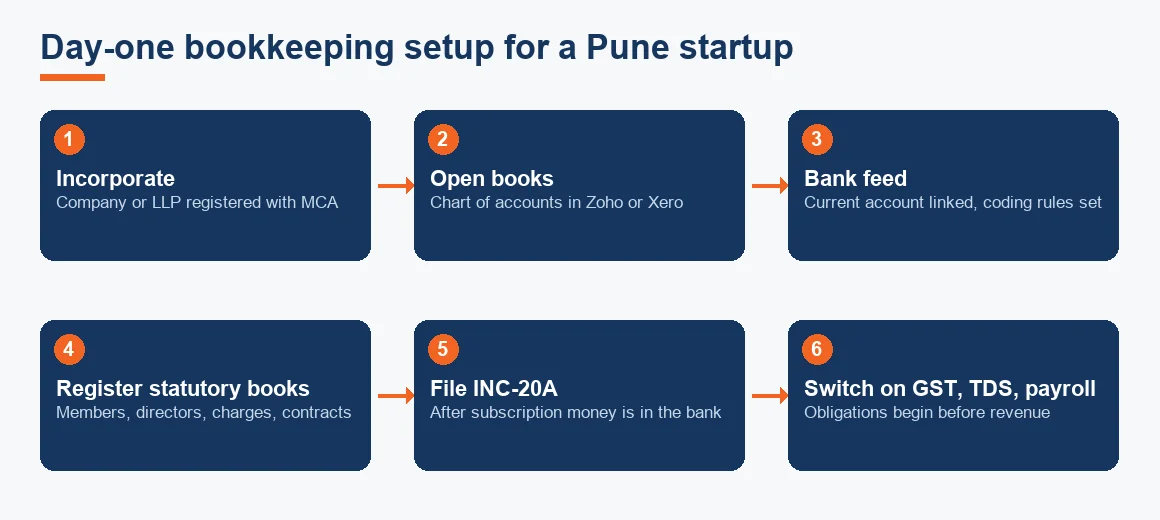
Work through these in order in the first month. Each one takes an hour or two and saves days later.
- Open the chart of accounts. Set up cloud books (Zoho Books or Xero) on double-entry principles, with separate ledgers for domestic and export income, statutory dues and founder reimbursements.
- Connect the bank feed. Link the current account so transactions flow in automatically. Automated bank feeds plus coding rules for rent, cloud hosting and salaries mean recurring items are never keyed twice.
- Route every bill to one inbox. A single email address for vendor invoices stops duplicate and missing entries.
- Register the statutory books. Members, directors, charges and related-party contracts, all dated from incorporation.
- File INC-20A. The declaration of commencement, once subscription money is actually in the bank.
- Switch on payroll. Even for two founders, so the salary journal, TDS and Maharashtra professional tax post from month one.
- Close month one. Reconcile the bank, match input tax credit and produce a one-page management summary.
Our monthly bookkeeping and MIS checklist for Pune businesses expands step seven into a full month-end routine, and if you are still deciding who runs it, the guide to choosing an accountant in Pune is a useful companion.
Statutory registers and INC-20A: what starts at incorporation, not at first revenue
A common founder assumption is that compliance waits for turnover. It does not. From the date the company is born, a Pune private limited must keep the register of members under Section 88, the register of directors and key managerial personnel with their shareholding, the register of charges, the register of related-party contracts under Section 189, and the minute books of board and general meetings. These live at the registered office and run from incorporation.
INC-20A, the declaration of commencement of business, must be filed within 180 days of incorporation, and no business may be started nor borrowing powers exercised until it is on record. The declaration confirms that every subscriber has paid the amount agreed on their shares, so the subscription money must genuinely reach the company bank account first. Late filing attracts Rs 50,000 on the company and Rs 1,000 per day on each officer in default. The current forms and thresholds are on the MCA portal.
Recording pre-incorporation expenses
Founders almost always spend before the company exists: incorporation fees, legal drafting, a feasibility study, the first cloud subscription. Book these as pre-incorporation or preliminary expenses in the first set of accounts and reimburse the founder against original invoices, with a board resolution approving the reimbursement. For tax, Section 35D lets specified preliminary expenses be amortised over five years within prescribed limits; the Income Tax Department portal carries the section text.
GST and TDS begin before revenue does
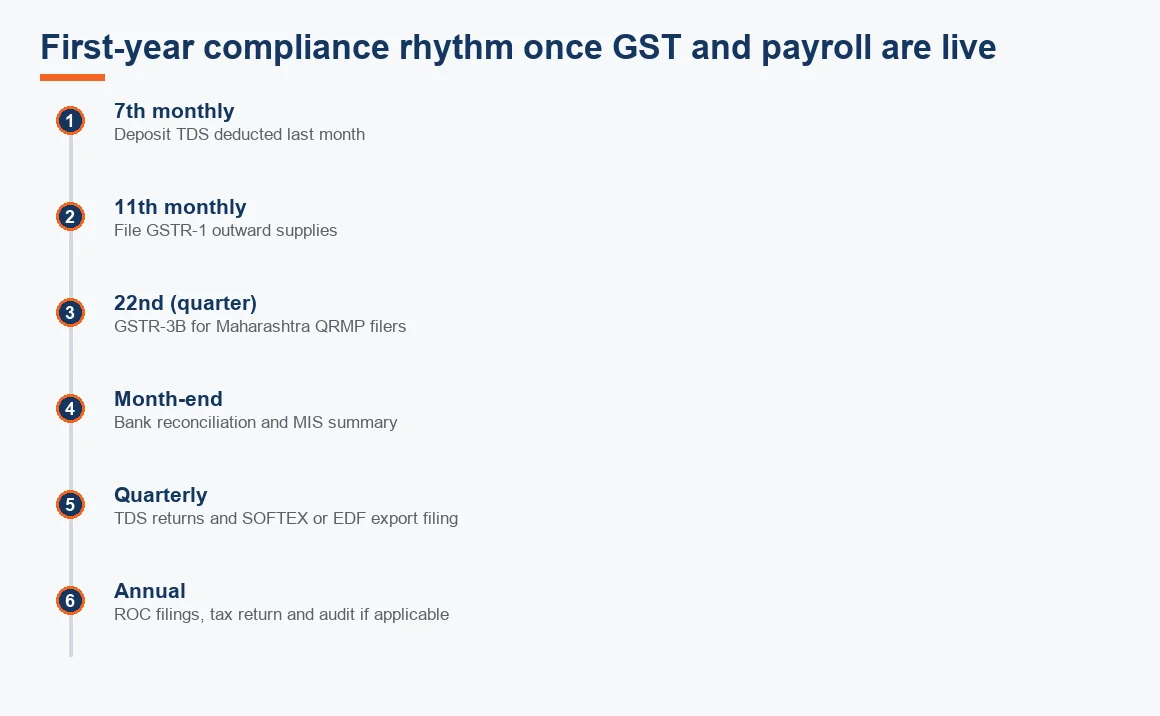
This is the point most founders underestimate. GST and TDS duties can start before a single rupee of income arrives. If you register for GST (voluntarily, or because you cross the Rs 20 lakh services threshold), returns fall due whether or not you have billed: GSTR-1 by the 11th and, for a Maharashtra QRMP filer, GSTR-3B by the 22nd of the month following the quarter. Every month you must run GSTR-2B input tax credit matching before claiming credit, a step automation speeds up but never removes. The statutory calendar sits on the CBIC GST portal.
TDS is the same story. The day you pay a contractor, a consultant under Section 194J, or rent above the threshold, you are a deductor with monthly deposit and quarterly return obligations. Paying salaries pulls in Section 192 and Maharashtra professional tax as well. None of this waits for your first invoice, which is precisely why the books have to open on day one.
Export revenue, SOFTEX and foreign currency on the corridor
For a Hinjewadi or Kharadi software exporter, a few extra records are not optional. Software export value is reported through SOFTEX filing, certified by STPI or your AD bank, and the export proceeds must be tracked to bank realisation. Under FEMA rules on the RBI site, SOFTEX remains the operative route until 30 September 2026, after which monthly EDF reporting takes over, so build your process to handle both. If you deal with a foreign parent or subsidiary, add transfer-pricing documentation to the list. The deeper treatment of dollar billing and revenue recognition lives on our SaaS accounting and IT and software company accounting pages, with the Pune-specific version at SaaS accounting in Pune. SaaS founders should also record deferred revenue correctly, because an annual plan billed upfront is not all this month's income.
Outsource or hire: the number that decides it
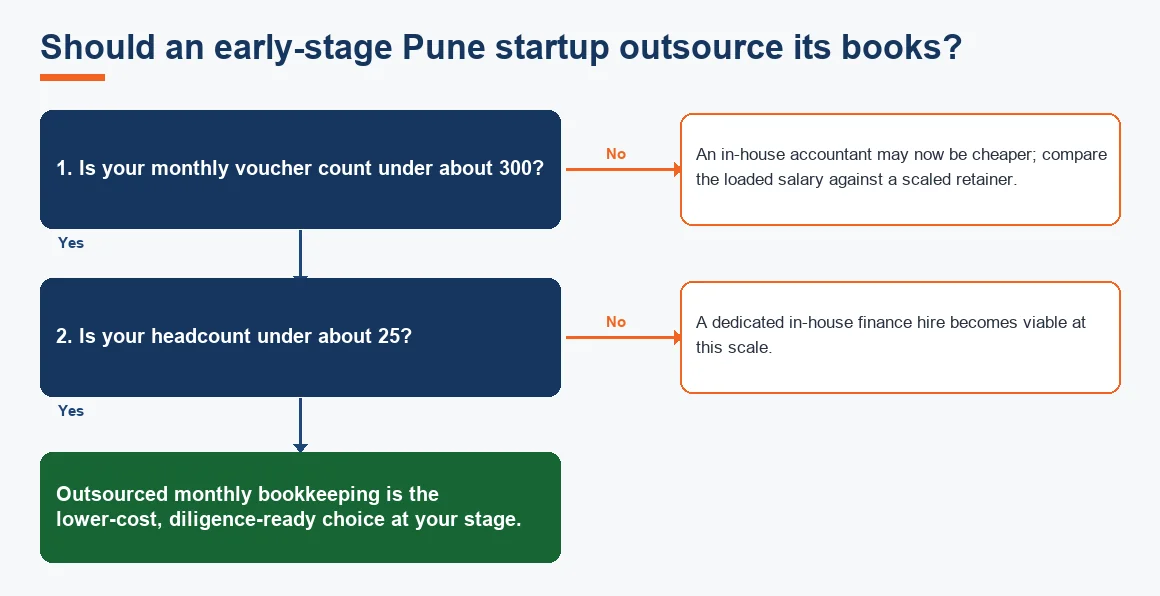
Founders ask whether to hire an accountant or outsource. The honest answer is a volume number, not a preference. Below roughly 300 vouchers a month or 25 people on payroll, an outsourced monthly service is cheaper than a loaded in-house salary, and it comes with review and cover built in. Above that, a dedicated hire starts to pay for itself. The table sets out the trade-off; for real Pune price points, see our 2026 cost benchmarks for accounting in Pune.
| Factor | Outsourced monthly bookkeeping | In-house hire |
|---|---|---|
| Best below | ~300 vouchers or 25 staff a month | Above that volume |
| Indicative monthly cost (Exl GST) | Fixed retainer, scales with volume | Salary plus PF, gratuity, seat, software |
| Review and cover | Built in; no single-person risk | You manage leave and attrition |
| Statutory knowledge | GST, TDS, ROC across a team | Depends on one person's depth |
| Diligence readiness | Standardised, audit-ready output | Varies with the individual |
Whichever you pick, run the general accounting and bookkeeping in Pune function to the same monthly discipline, and if you also sell on marketplaces, the settlement mechanics in e-commerce accounting apply on top.
Key terms
- Monthly Burn Rate: the net cash a startup consumes each month after revenue.
- Cash Runway Calculation: cash on hand divided by net burn, the months you can operate before raising again.
- GSTR-2B Input Tax Credit Matching: reconciling purchase credit against the auto-drafted GSTR-2B before filing.
- Software Export Revenue (Section 10AA SEZ): the export-income tax holiday available to eligible SEZ units.
Worked example: amortising pre-incorporation expenses under Section 35D
Suppose two founders spend Rs 5,00,000 on eligible preliminary items before incorporation: registration and stamp fees, legal drafting of the constitution, and a feasibility study. Assume the full amount qualifies within the Section 35D limits (broadly the lower of the actual spend or 5% of the cost of the project or capital employed). One-fifth is allowed each year for five years. All figures are indicative and Exl GST.
| Financial year | Opening unamortised (Rs) | Amortised this year (Rs) | Closing unamortised (Rs) |
|---|---|---|---|
| Year 1 | 5,00,000 | 1,00,000 | 4,00,000 |
| Year 2 | 4,00,000 | 1,00,000 | 3,00,000 |
| Year 3 | 3,00,000 | 1,00,000 | 2,00,000 |
| Year 4 | 2,00,000 | 1,00,000 | 1,00,000 |
| Year 5 | 1,00,000 | 1,00,000 | 0 |
The Rs 5,00,000 is reimbursed to the founders in year one against original invoices with a board resolution, but the tax deduction is spread as above. In the books it sits as a preliminary expense asset that writes down each year, so your accounting profit and your taxable profit will differ until year five closes it out. The depreciation calculator handles the parallel schedules for your fixed assets, and if you are unsure which reporting framework binds you, the Ind AS applicability checker settles it in a minute.
First-year compliance calendar at a glance
The recurring dates that a Pune startup carries in its first year, once GST and payroll are live, follow a predictable rhythm.
Key takeaways
- Open the books on the incorporation date; statutory registers and INC-20A run from day one, not from first revenue.
- File INC-20A within 180 days after the subscription money reaches the bank, or face Rs 50,000 plus Rs 1,000 per day per officer.
- GST and TDS obligations can begin before you bill, so register the calendar and match GSTR-2B every month.
- Pune corridor exporters must keep SOFTEX or EDF filing and foreign currency realisation clean, and SEZ units guard the Section 10AA holiday with segregated export books.
- Outsource below roughly 300 vouchers or 25 staff a month; hire above it, and reimburse founder spend against invoices with 35D amortisation.
Decision guide