
In this guide
A chart of accounts setup means designing the structured, numbered list of every ledger your business will post to, organised into five account types (assets, liabilities, equity, income and expenses) so that each transaction lands in a predictable place. In India the exercise is only half finished if the list stops there: a workable chart also has to map to the Schedule III balance sheet heads and carry the GST and TDS ledgers you are legally required to report against. Get the structure right at the start and every trial balance, return and management report for the life of the business flows out mechanically. Get it wrong and you spend years reclassifying entries. This guide walks through how to set up a chart of accounts from the first ledger, with the numbering, the account types and the Indian tax ledgers that most templates leave out. For the underlying concept and terminology, our companion explainer on what a chart of accounts is covers the basics.
What is a chart of accounts setup?
A chart of accounts is the master index of your general ledger. Every voucher, invoice and bank entry is posted to one of its accounts, and the sum of those accounts is your trial balance. Setting it up is the act of deciding, in advance, which ledgers exist, what they are called, how they are coded and how they roll up into the financial statements. Because it sits under the accounting cycle at the point where transactions are classified, the chart quietly decides how everything downstream is reported. A rushed setup is the single most common reason a growing business finds its books unusable at audit time.
What are the 5 main account types in the chart of accounts?
Every ledger belongs to exactly one of five types. These are the top level of the chart and the order in which they appear:
- Assets: what the business owns or is owed, from bank balances and receivables to fixed assets.
- Liabilities: what the business owes, including payables, loans and unpaid GST or TDS.
- Equity: the owners' stake, being capital introduced plus retained profits.
- Income: revenue from sales and other operating and non-operating gains.
- Expenses: cost of goods sold, salaries, rent and every other cost of running the business.
The balance sheet is built from the first three (assets, liabilities and equity) and the profit and loss statement from the last two (income and expenses). When people ask what is listed first in a chart of accounts, the answer is assets, because the chart follows the balance sheet order before moving to the income statement.
What are the 7 basic accounting categories?
The five types are sometimes expanded to seven categories by splitting income into revenue and gains, and expenses into expenses and losses. It is a useful lens but not a different chart: a one-off profit on sale of an asset is a gain rather than trading revenue, and a fire loss is a loss rather than an operating expense. Keep them as sub-groups under income and expenses so the top level stays at five types. The important discipline is that no ledger ever sits in two categories at once.
How should a chart of accounts be numbered?
Numbering is what turns a list into a system. Use a block structure that reserves a thousand-series for each account type and leaves gaps of ten between individual codes so you can insert new ledgers later without renumbering everything.
The standard block structure
| Code block | Account type | Maps to Schedule III head | Example ledgers |
|---|---|---|---|
| 1000–1999 | Assets | Non-current and current assets | Bank, Trade Receivables, Plant & Machinery |
| 2000–2999 | Liabilities | Non-current and current liabilities | Trade Payables, GST Payable, TDS Payable |
| 3000–3999 | Equity | Equity and other equity | Share Capital, Reserves & Surplus |
| 4000–4999 | Income | Revenue from operations, other income | Product Sales, Interest Income |
| 5000–5999 | Expenses | Cost of materials, employee benefits, other expenses | Purchases, Salaries, Rent |
Larger businesses extend this to a 7-digit chart, where the first digit is the entity or segment, the next two the department, and the last four the account itself. That is worthwhile only once you genuinely have multiple segments to report; for most small companies a four-digit code is cleaner and less error-prone. Our guide to numbering systems goes deeper into hierarchical and departmental codes if you expect to grow into segments.
What are the golden rules for building the chart?
The traditional golden rules (debit the receiver and credit the giver, debit what comes in and credit what goes out, debit expenses and losses and credit incomes and gains) tell you how to post to an account. The modern equivalent, which most software follows, works directly off the five types: debit increases assets and expenses, credit increases liabilities, equity and income. When you design the chart, the practical rule is simpler still. One economic concept gets exactly one ledger, that ledger has one natural balance side, and it rolls up to one Schedule III line. Every departure from that rule is a future reconciliation problem.
How to set up a chart of accounts step by step
Setting up the chart is a short, ordered exercise. Do it once, deliberately, before you record a single live transaction.
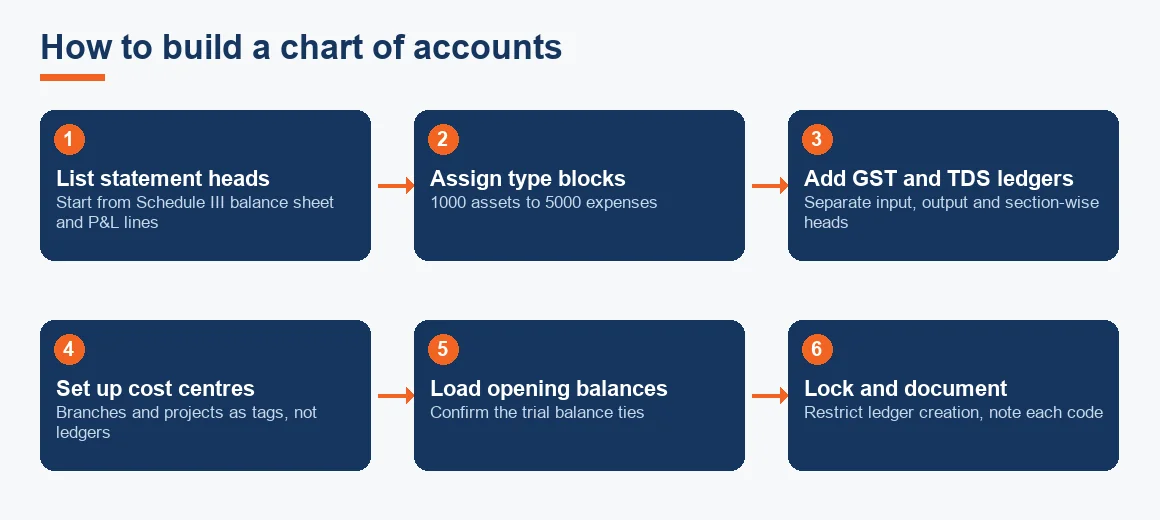
- Start from the financial statements you must file. List the Schedule III balance sheet and profit and loss heads first, because the chart exists to feed them. This anchors your Schedule III balance sheet mapping from day one.
- Assign the five type blocks. Allocate the 1000 to 5000 series and confirm each block maps to a statement head.
- Add the tax ledgers India requires. Create separate input CGST, SGST, IGST and cess ledgers, matching output ledgers, a GST payable control and one TDS payable ledger per section.
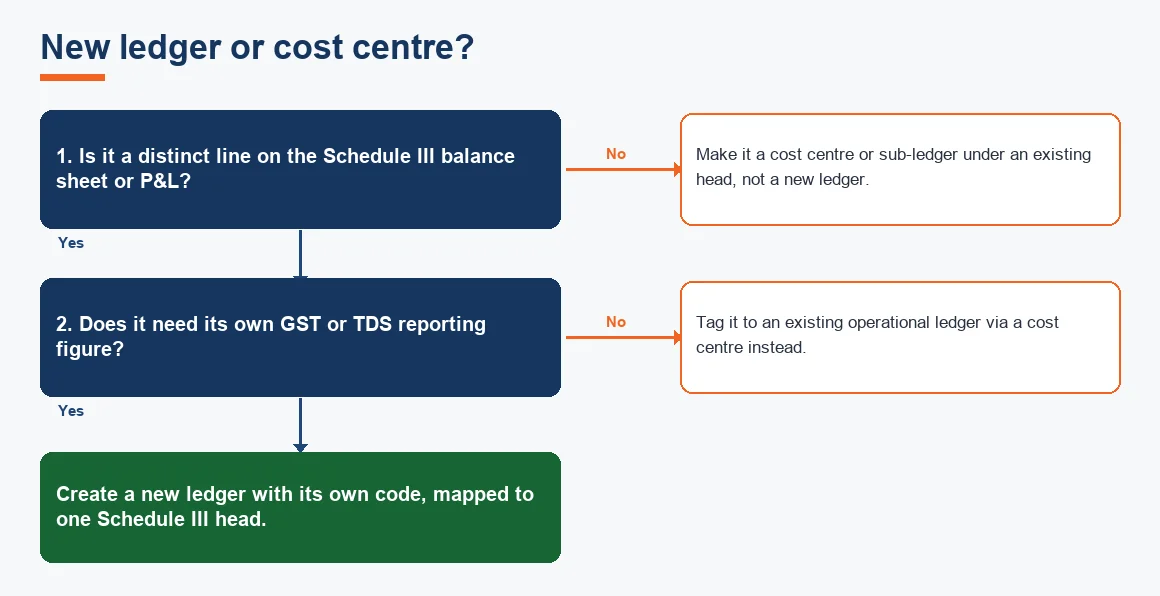
- Set up cost centres, not duplicate ledgers. Configure branches, departments and projects as cost centres so one Rent ledger serves every location.
- Load opening balances. Enter the closing figures from the prior year against each ledger and confirm the trial balance ties.
- Lock and document it. Restrict who can create new ledgers and keep a one-line note against each code so the logic survives staff changes.
If you are inheriting messy or incomplete books rather than starting fresh, a structured backlog bookkeeping and catch-up exercise should rebuild the chart before you attempt to reconcile anything.
Which GST and TDS ledgers must an Indian chart include?
This is the step generic international templates skip, and it is not optional. On the GST side, keep separate ledgers for input CGST, SGST, IGST and cess, a mirrored set of output ledgers, an electronic cash ledger control account and a GST payable account for each registration you hold. Because each GSTIN is a separate assessable person, a group with registrations in several states needs a separate tax ledger set per registration; the reporting rules are set out by the Central Board of Indirect Taxes and Customs. On the TDS side, create one payable ledger per section you deduct under, such as 194J for professional fees, 194C for contractors and 192 for salary, so the monthly challan and the quarterly return reconcile without further analysis; the current sections and rates are published by the Income Tax Department. Keeping these ledgers granular from the start is what lets you file returns from the trial balance rather than from a spreadsheet.
Should branches and departments get their own ledgers?
No. This is the fastest way to bloat a chart into something unusable. If you open a "Rent Mumbai", "Rent Pune" and "Rent Delhi" ledger, your chart multiplies by the number of locations and your comparative figures break, because a new branch means a new ledger that has no prior-year equivalent. Keep one Rent ledger and tag each posting to a cost centre in TallyPrime or a location in Zoho Books. The only genuine exception is GST: because each registration is a separate assessable entity, its tax ledgers are legitimately separate. Everything operational belongs in a cost centre. This same discipline is why accounts payable and accounts receivable processes stay clean: one control ledger, many sub-ledgers, not many parallel heads.
Worked example: posting a purchase against the chart
Here is how a single intra-state purchase flows through a correctly designed chart. A Maharashtra business buys office supplies worth 50,000 (indicative, Exl GST) at 18% GST, split as 9% CGST and 9% SGST. Watch how each ledger, and its code, catches its own slice of the entry through double-entry.
| Code | Ledger | Type | Debit (INR) | Credit (INR) |
|---|---|---|---|---|
| 5100 | Office Supplies (Purchases) | Expense | 50,000 | - |
| 1210 | Input CGST @ 9% | Asset | 4,500 | - |
| 1220 | Input SGST @ 9% | Asset | 4,500 | - |
| 2100 | Trade Payables (Vendor) | Liability | - | 59,000 |
| Total | 59,000 | 59,000 | ||
Because the input CGST and SGST sit in their own asset ledgers, the 9,000 of credit is already isolated and ready to set off against output tax in the GST return. Had the whole 59,000 gone to a single "Purchases" ledger, that input credit would be invisible until someone unpicked the invoice by hand. The chart did the reporting work automatically, which is the entire point of designing it properly.
Key terms
- General Ledger: the complete set of accounts the chart indexes, holding every posted transaction.
- Trial Balance: the list of all ledger balances, which must tie before statements are drawn.
- Schedule III Balance Sheet: the Companies Act format your chart's asset, liability and equity heads must map to.
- Double-Entry Bookkeeping: the rule that every transaction debits one account and credits another for the same amount.
- Journal Entry: the record of a transaction showing the ledgers and amounts on each side.
Tools and templates to speed up the setup
Once the structure is decided, most accounting software ships a default chart you can adapt rather than build from scratch. Start from that, delete the ledgers you will never use, and add your GST and TDS ledgers before going live. A ready-made chart of accounts template for Indian businesses with GST ledgers gives you a compliant starting point. For the asset side, a depreciation calculator helps you set Schedule II useful lives against your fixed-asset ledgers, and if you report under Indian Accounting Standards the AS versus Ind AS comparison matrix flags where your income and expense heads need extra granularity. The Companies Act formats these all feed into are notified by the Ministry of Corporate Affairs.
Key takeaways
- A chart of accounts setup organises every ledger into five account types and codes them so reporting is mechanical.
- Use a 1000-to-5000 block numbering system with gaps of ten and one spare block for growth.
- Map every account to a Schedule III head, and build separate GST and TDS ledgers from the first entry.
- Keep branches, departments and projects in cost centres, never in duplicated ledger heads.
- Design the chart once, deliberately, because every future return and report depends on these codes.
Setting up a chart of accounts is a small job with a long shadow: an afternoon of careful design saves years of reclassification. If you would rather have the structure built and locked correctly for your entity, including the Schedule III mapping and the full GST and TDS ledger set, our Chart of Accounts Setup service handles it end to end.
Decision guide