In this guide
A chart of accounts template for India is a ready made list of ledgers, organised under the five account classes (assets, liabilities, equity, income and expenses), numbered with a consistent code and mapped to the GST tax heads and the Schedule III groupings a business will eventually report under. Set it up once at the start and every invoice, payment and journal falls into a place that already agrees with your GST returns and your financial statements. This guide sets out the structure, the GST ledgers you must not miss, how to build the template in Excel, and a worked example showing the numbers flow through.
What a chart of accounts template actually contains
The chart of accounts is the master index of every ledger in your books. If you want the underlying concept, our explainer on what a chart of accounts is and how it is structured covers the theory; here we stay on the ready to use template and the India specific parts. In practice a template holds four things for each ledger: a code, a ledger name, the account class it belongs to, and the reporting group it rolls up into. The GST version adds a fifth column linking tax ledgers to their head so that output tax, input tax and cash movements can be reconciled against the return without splitting balances by hand.
Every ledger in the template feeds the general ledger, and because the books run on double-entry bookkeeping, each transaction touches at least two of these accounts. Get the list right at the start and the trial balance stays clean for years.
The five types of accounts in a chart of accounts
People often ask what the five types of accounts are. Every ledger sits in exactly one of these classes, and the class decides its normal balance and where it appears in the statements.
| Account class | Code block | Normal balance | Reports in |
|---|---|---|---|
| Assets | 1000-1999 | Debit | Balance sheet |
| Liabilities | 2000-2999 | Credit | Balance sheet |
| Equity | 3000-3999 | Credit | Balance sheet |
| Income | 4000-4999 | Credit | Profit and loss |
| Expenses | 5000-5999 | Debit | Profit and loss |
This is also where the golden rules of accounts apply: debit the receiver and credit the giver for personal accounts, debit what comes in and credit what goes out for real accounts, and debit expenses and losses while crediting incomes and gains for nominal accounts. The five class structure simply organises those rules into a navigable index.
Chart of accounts format and numbering
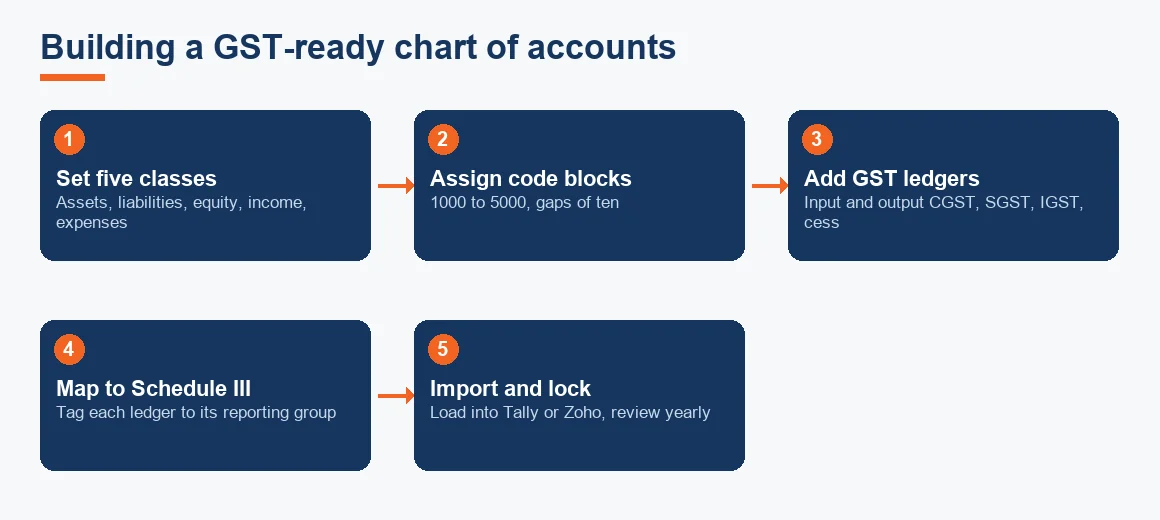
The usual format is a four digit block system with gaps of ten between codes, so a new ledger can be slotted in without renumbering the whole book. Assets start at 1000, liabilities at 2000, equity at 3000, income at 4000 and expenses at 5000. Within a block you leave room: 1010 for cash in hand, 1020 for the current account, 1100 onwards for debtors, and so on. We keep the detailed conventions in a separate piece on the chart of accounts numbering system and best practices, and if you are wiring this up for a fresh entity the walkthrough on setting up a chart of accounts for a small business in India takes it step by step.
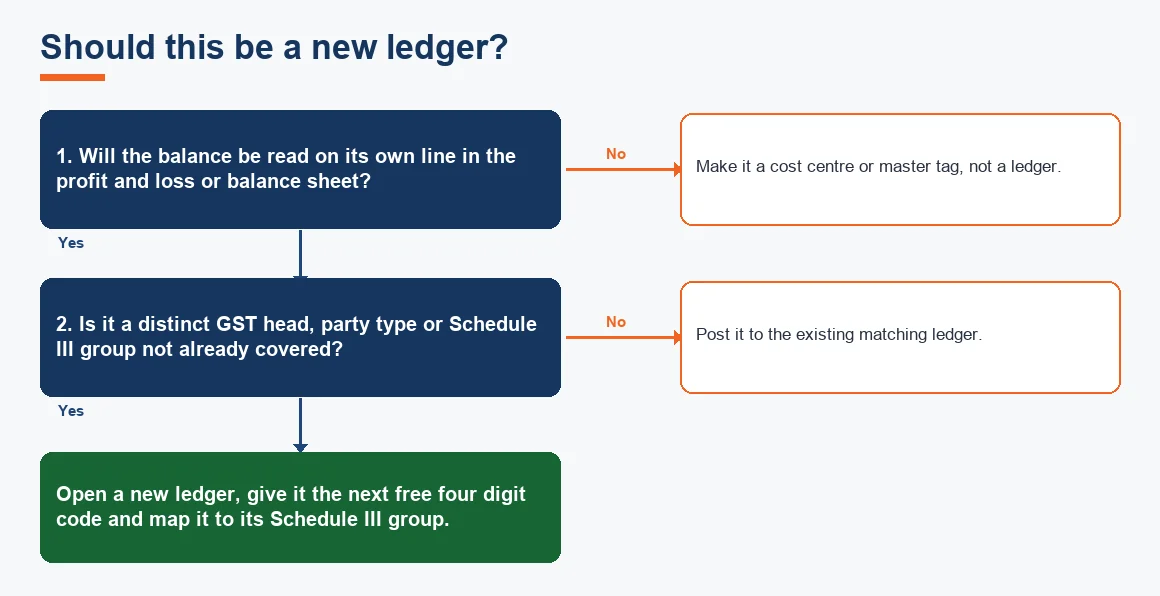
On the question of how many ledgers to hold, sixty to one hundred and twenty active ledgers covers most Indian small businesses. Beyond that you are usually repeating analysis that belongs in a cost centre, an item master or a customer master. The working test is simple: will this ledger ever be read on its own line in the profit and loss account? If not, it is a cost centre tag, not a ledger.
The GST ledgers your chart of accounts must include
This is where an Indian template differs from a generic one. GST credit is set off head by head under sections 49, 49A and 49B, and credit of one head cannot be freely moved to another, so the tax heads have to live in separate ledgers. At a minimum you need eight tax ledgers, split between input (on purchases) and output (on sales):
- Input CGST, Input SGST, Input IGST and Input Cess, grouped under Duties and Taxes on the asset side.
- Output CGST, Output SGST, Output IGST and Output Cess, grouped under Duties and Taxes on the liability side.
Alongside those, hold an Electronic Cash Ledger account and an Electronic Credit Ledger account so the balances reconcile against the portal, and a GST Payable (net) account where the monthly set off lands. Separate ledgers let GSTR-3B table 4 and the electronic credit ledger be checked against your books without unpicking a merged balance. The head wise utilisation order is set out in the CBIC guidance at cbic-gst.gov.in and the ledgers themselves sit on your dashboard at gst.gov.in.
Two more India specific accounts earn their place. If you sell through marketplaces, add a receivable ledger for Section 52 TCS collected by the operator (0.5 per cent of the net taxable supply, split evenly across CGST and SGST) so the credit in your cash ledger is tracked. And if you buy from vendors above the threshold, a TDS on purchases ledger keeps GSTR-2B input tax credit matching clean. Where you run more than one GSTIN, give each registration its own set of output, input and cash ledgers, because credit is pooled state by state and stock moved between two GSTINs of the same company is itself a taxable supply.
How to prepare a chart of accounts in Excel
You do not need software to design the template; a single Excel sheet is enough to plan it before it goes into TallyPrime, Zoho Books or any ERP. Build it in this order.
- Create five column headings: Code, Ledger Name, Account Class, Schedule III Grouping and GST Head.
- Enter the five class blocks as section rows (1000, 2000, 3000, 4000, 5000) so the sheet is navigable.
- List each ledger under its class, leaving gaps of ten in the codes.
- Map every ledger to its Schedule III group in column four (for example, trade receivables, trade payables, other current liabilities).
- Tag the GST ledgers in column five with their head (Output CGST, Input IGST and so on); leave it blank for non tax ledgers.
- Freeze the header row, sort by code, and import the finished list into your accounting system.
Keep the Excel version as the source of truth. When someone wants a new ledger, they add a row here first, which forces the code, class and grouping to be decided before it hits the live books. On the question of SAP, its chart of accounts works on the same idea but adds an operating chart, a group chart and a country chart so that one entity can report locally and roll up to a global parent; for a single India entity the five class template above is all you need.
Mapping ledgers to Schedule III
The five classes are how you run the books day to day; Schedule III of the Companies Act is how the balances must be presented in the published statements. The template bridges the two through the grouping column, so month end needs no reclassification. Trade receivables and trade payables, short term borrowings, other current liabilities and the split of tangible and intangible fixed assets all follow the Schedule III face and notes. The format is prescribed by the Ministry of Corporate Affairs at mca.gov.in, and mapping to it early is what turns a tidy trial balance into a compliant Schedule III balance sheet without a scramble in September.
Worked example: an intra-state GST sale through the ledgers
Take a Maharashtra business selling goods worth 1,00,000 (indicative, Exl GST) to a Maharashtra customer, taxed at 18 per cent GST. Because supplier and customer are in the same state, the tax splits into CGST at 9 per cent and SGST at 9 per cent. Here is how the single invoice lands across the template ledgers as a journal entry.
| Ledger (code) | Class | Debit | Credit |
|---|---|---|---|
| Trade Receivable (1100) | Asset | 1,18,000 | |
| Sales (4000) | Income | 1,00,000 | |
| Output CGST (2410) | Liability | 9,000 | |
| Output SGST (2420) | Liability | 9,000 | |
| Total | 1,18,000 | 1,18,000 |
The debtor rises by the full 1,18,000, revenue is recognised at 1,00,000, and the two output tax ledgers each carry 9,000 until the monthly set off moves them to GST Payable. Had the customer been in another state, a single Output IGST ledger at 18 per cent (18,000) would replace the two. Because each head has its own ledger, the CGST and SGST balances reconcile straight to GSTR-3B without any manual split.
Keeping the template stable over time
The commonest failure is not the design, it is the drift: staff add near duplicate ledgers month after month until the trial balance is unreadable. Guard against it with a rule that a new ledger is only opened when it will be reported on its own line, everything else being a cost centre or a customer tag. If your books are already cluttered, a one off clean up under backlog and catch-up bookkeeping resets the structure, and once the payables and receivables cycles are heavy, a proper chart is what makes accounts payable outsourcing and accounts receivable outsourcing run without constant reclassification. If you would rather have the whole structure designed, mapped and imported for you, that is exactly what a chart of accounts setup engagement delivers.
Key terms
- General Ledger: the complete record of all accounts, fed by every ledger in the chart.
- Double-Entry Bookkeeping: the method where each transaction posts equal debits and credits.
- Trial Balance: the summary that proves total debits equal total credits before statements are drawn.
- Schedule III Balance Sheet: the Companies Act format that governs how balances are grouped for reporting.
- Journal Entry: the debit and credit record of a single transaction across ledgers.
Key takeaways
- A good India template = five account classes + four digit codes + GST heads + Schedule III grouping, decided once.
- Hold at least eight GST tax ledgers so head wise credit set off and GSTR-3B reconcile cleanly.
- Sixty to one hundred and twenty active ledgers is plenty; push finer detail into cost centres.
- Design it in Excel first, then import, and keep the Excel sheet as the source of truth.
- Give each GSTIN its own tax ledgers, since GST credit is pooled state by state.
Decision guide