
In this guide
A chart of accounts numbering system assigns every ledger a fixed numeric code so that accounts group, sort and report in a predictable order. The standard approach reserves one leading digit for each account type: the 1000 series for assets, 2000 for liabilities, 3000 for equity, 4000 for income and 5000 for expenses. Within each block, sub-ranges separate related ledgers, and unused numbers are left free so the scheme can grow. Done once, at the start, a clean numbering scheme still works when you add a division, a branch or a new revenue stream years later.
Why are accounts coded or numbered?
A code does three jobs a name cannot. It forces every ledger into a defined group, so the software knows an account is an asset or an expense before anyone reads the label. It fixes the reporting order, because reports sort by number, not alphabetically, which keeps the balance sheet and profit and loss in the sequence a reader expects. And it gives each account a short, stable reference for journal entries, bank rules and import templates, so the same ledger is not created twice under two slightly different names. Underneath, the codes simply tag the accounts that double-entry bookkeeping already relies on; the numbering makes that structure legible to people and to systems.
The five account types and their leading digits
Almost every chart of accounts is built on five basic types, and a numbering system normally gives one leading digit to each. This is the order in which accounts are listed, and it mirrors the balance sheet followed by the profit and loss:
- 1000 to 1999: Assets. Cash, bank, debtors, stock, fixed assets. These are the accounts a depreciation calculator touches when you charge wear on plant or equipment.
- 2000 to 2999: Liabilities. Creditors, GST payable, TDS payable, loans, provisions.
- 3000 to 3999: Equity. Capital, reserves, retained earnings, partner or shareholder accounts.
- 4000 to 4999: Income. Sales, service revenue, other operating income, interest earned.
- 5000 to 5999: Expenses. Purchases, direct costs, salaries, rent, professional fees, depreciation.
A general ledger account starting with 1 is therefore an asset by design, which is why a code beginning 1 usually points to cash, bank or a receivable. Some businesses split expenses into two blocks, using 5000 for cost of sales and 6000 for overheads, giving a six-block layout, but the leading-digit logic is the same. For the fuller conceptual picture, our explainer on what a chart of accounts is walks through the structure before you commit to codes.
How many digits should an account code have?
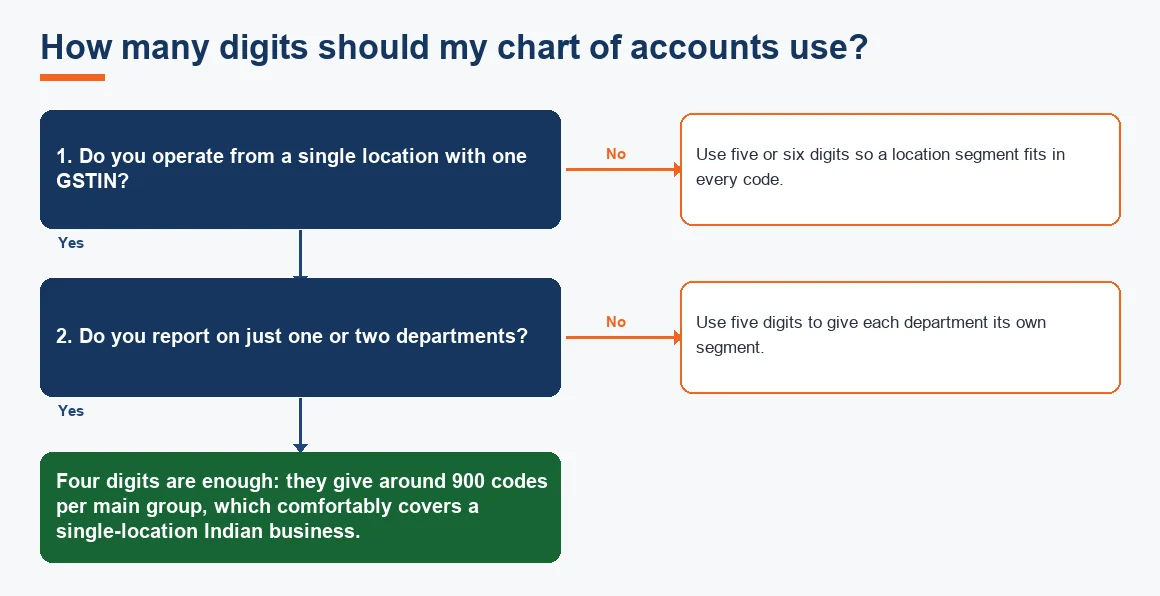
The right digit count is the single decision that shapes the whole scheme, and it depends on how many segments you need. Four digits give 900 usable codes inside each main group, which is ample for most single-location businesses. Five or six digits add room for a department or location segment, and a seven-digit code suits a multi-state group that wants branch and cost-centre built into the number itself. Fewer than four digits runs out of room within a year or two. Whatever you pick, keep the digit count identical across every code so the trial balance and every report sort cleanly.
| Digit count | Codes per main group | Best suited to | Segment it supports |
|---|---|---|---|
| 4 digits (e.g. 4010) | Around 900 | Sole proprietors, small and mid-sized firms, single GSTIN | Type and sub-group only |
| 5 digits (e.g. 40100) | Around 9,000 | Growing firms with a few departments | Type, sub-group and department |
| 6 digits (e.g. 401001) | Around 90,000 | Multi-branch or multi-state GST operations | Type, sub-group and location |
| 7 digits (e.g. 4010010) | Around 900,000 | Large groups needing branch plus cost centre in the code | Type, sub-group, location and cost centre |
The 7-digit chart of accounts often quoted online is simply this last case: a base account code plus a location or cost-centre suffix, so the same expense ledger can be read per branch without opening a separate account for each one. Most Indian businesses will never need it. If you find yourself reaching for it early, a segmented chart of accounts using separate tracking fields is usually cleaner than stuffing everything into the number.
Step by step: how to design your numbering scheme
Design the scheme once, on paper, before you create a single ledger in the software. The sequence below keeps the structure sound and future-proof.
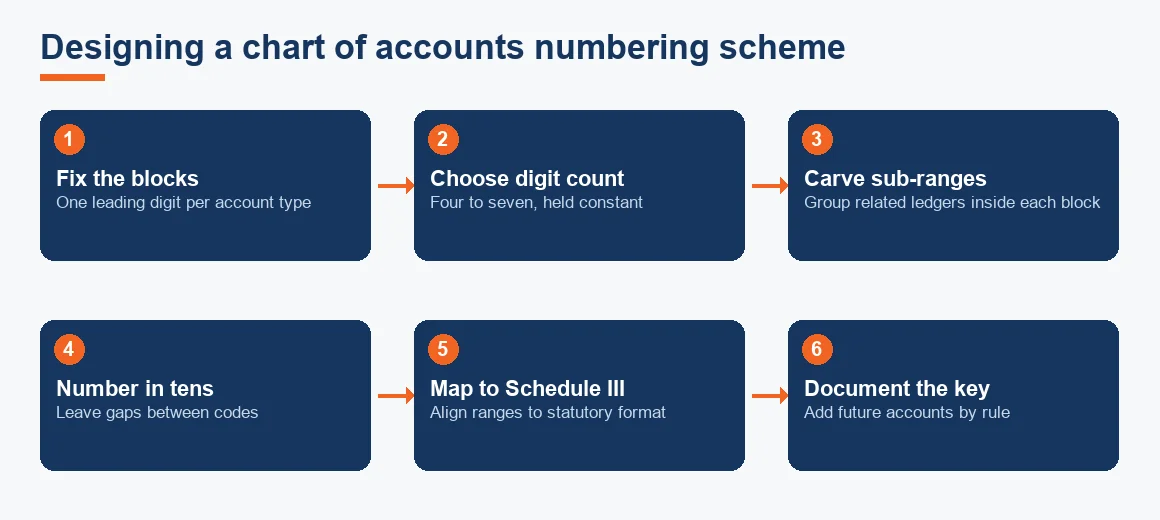
- Fix the blocks. Assign the leading digit for each account type: 1 asset, 2 liability, 3 equity, 4 income, 5 expense.
- Choose the digit count. Decide four, five, six or seven digits based on how many locations and departments you must track, and hold it constant everywhere.
- Carve sub-ranges. Inside each block, reserve ranges: for example 1000 to 1099 for cash and bank, 1100 to 1199 for receivables, 1200 to 1299 for stock.
- Number in tens or hundreds. Allocate the first ledgers as 4010, 4020, 4030 rather than 4001, 4002, 4003, leaving room between them.
- Map to Schedule III. Line up each sub-range with its balance sheet or profit and loss grouping so the statutory format falls out automatically.
- Document it. Record the ranges in a numbering key so the next person adds accounts by rule, not by guess.
If your existing books are behind and you are numbering them for the first time while catching up, the same discipline applies during a backlog bookkeeping and catch-up exercise; get the codes right once so the reconstructed year and the current year share a structure. A practical, India-specific run-through is set out in our guide on setting up a chart of accounts for a small business in India.
Leaving gaps so the scheme survives growth
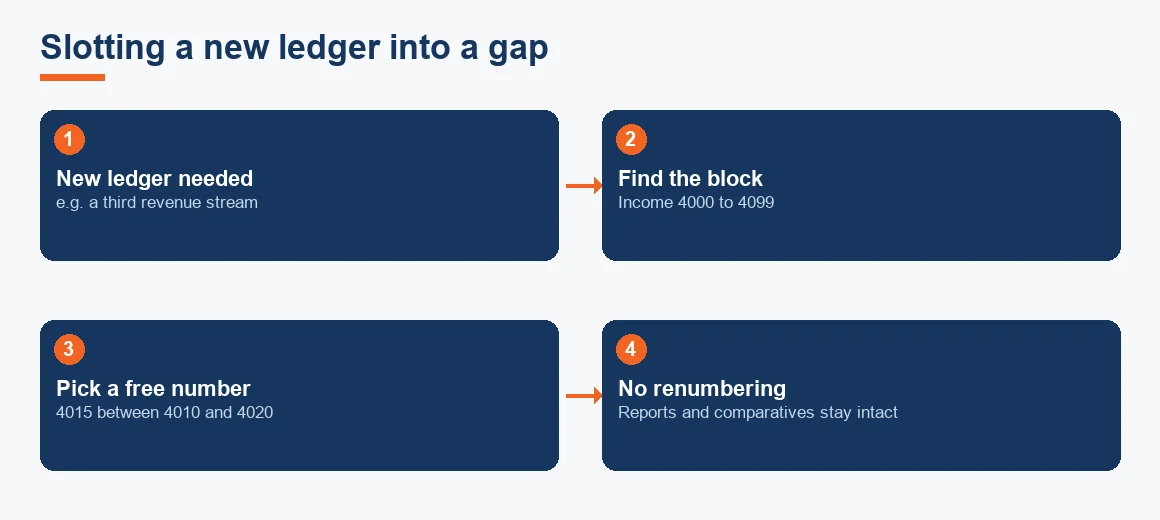
The most common reason a numbering scheme fails is that it was packed too tightly at the start. Leave unused numbers between codes so a new ledger can be slotted into the correct group later without renumbering anything. Numbering in tens or hundreds works well: 4010, 4020 and 4030 for three separate revenue streams, with roughly half of each block left free. When a fourth stream appears, it becomes 4015 or 4025 and lands in the right place in every report. Gaps keep report groupings stable and, just as importantly, keep prior-year comparative figures usable.
Worked example: a numbered chart of accounts extract
The extract below shows a four-digit scheme for a small services firm. Notice the gaps: only one of the ten available receivable codes is used, so a new debtor sub-ledger can slot in as 1120 without disturbing anything. Every account also carries its Schedule III grouping, which is how the statutory balance sheet assembles itself.
| Code | Account name | Type | Sub-range | Schedule III grouping |
|---|---|---|---|---|
| 1010 | Cash in hand | Asset | 1000 to 1099 Cash and bank | Current assets, cash and equivalents |
| 1020 | HDFC current account | Asset | 1000 to 1099 Cash and bank | Current assets, cash and equivalents |
| 1110 | Trade receivables, domestic | Asset | 1100 to 1199 Receivables | Current assets, trade receivables |
| 1510 | Office equipment | Asset | 1500 to 1599 Fixed assets | Non-current assets, PPE |
| 2010 | Trade payables | Liability | 2000 to 2099 Creditors | Current liabilities, trade payables |
| 2110 | Output GST payable | Liability | 2100 to 2199 Statutory dues | Current liabilities, other |
| 3010 | Partners' capital | Equity | 3000 to 3099 Capital | Equity, capital account |
| 4010 | Consulting revenue | Income | 4000 to 4099 Operating income | Revenue from operations |
| 4020 | AMC revenue | Income | 4000 to 4099 Operating income | Revenue from operations |
| 5010 | Salaries and wages | Expense | 5000 to 5099 Employment cost | Employee benefits expense |
| 5210 | Rent | Expense | 5200 to 5299 Occupancy | Other expenses |
Because every code is four digits and sorts by number, this list appears in report order automatically: assets, then liabilities, then equity, then income, then expenses. Add a bank account tomorrow and it becomes 1030; add an export revenue stream and it becomes 4030. Nothing above or below has to move.
Keeping the scheme aligned with GST and Schedule III
An Indian numbering scheme has to serve two masters beyond internal reporting: the GST return and the Schedule III presentation. On the liability side, keep separate codes for output CGST, SGST and IGST, and for the input tax credit ledgers, so the GST payable and credit positions read straight off the trial balance rather than needing a working. On presentation, map each sub-range to its Schedule III line, prescribed under the Companies Act, 2013, so current and non-current items are already separated before you draft the accounts. This matters for two practical accounts your scheme should carry from day one: separate accounts payable and accounts receivable control ledgers, each with its own sub-range, so the vendor and customer sub-ledgers reconcile cleanly to a single number on the balance sheet.
One statutory point on the codes themselves: the numbering of your ledgers is internal and unregulated, but the numbering of your tax invoices is not. Rule 46 of the CGST Rules caps an invoice number at 16 characters, allows only letters, digits, hyphen and slash, and requires a unique, consecutive series for each financial year. Keep the two systems separate in your mind: internal account codes are for grouping, invoice serials are for compliance. For a ready-made starting point that already has the GST ledgers built in, see our chart of accounts template for Indian businesses.
Key terms
- General Ledger: the master record of every account, which the numbering system organises and orders.
- Trial Balance: the list of all ledger balances by code, which only sorts correctly if the digit count is uniform.
- Segmented Chart of Accounts: a scheme that carries location or department information in separate segments rather than in one long code.
- Schedule III Balance Sheet: the statutory presentation format your sub-ranges should map to.
Key takeaways
- Give one leading digit to each of the five account types and list accounts in that order.
- Four digits suit most Indian businesses; add digits only when you genuinely need location or department segments.
- Number in tens or hundreds so new ledgers slot into gaps without renumbering.
- Keep the digit count identical everywhere, or reports and the trial balance sort wrongly.
- Renumber only from 1 April, keep a mapping sheet, and retain retired codes as inactive.
Numbering is a one-time design choice with a long tail: get the blocks, the digit count and the gaps right at the start and the scheme quietly carries the business for years. If you would rather have the structure built and mapped to Schedule III and GST for you, our chart of accounts setup service does exactly that.
Decision guide