
In this guide
Retail accounting for a Pune store is the routine of turning point-of-sale data into clean books: every sale at the till must reduce stock, record cost of goods sold and post the right GST, and the day's takings must match what actually lands in the bank. Get the POS, the inventory ledger and the GST return talking to each other and month-end stops being a scramble. This guide explains how a Pune shop or franchise outlet should organise that flow, what the local Maharashtra rules mean in practice, and where owners most often lose money. It is an explainer, not a sales pitch: if you want the commercial engagement, that sits with our Retail Accounting Services in India Pune page.
What retail accounting means for a Pune store
At its simplest, retail accounting records what you bought, what you sold, what is still on the shelf and what tax you owe on the difference. The complication is volume: a single apparel or grocery outlet in Kothrud or Hadapsar can ring up several hundred bills a day across cash, card and UPI, each carrying its own GST rate. Three ledgers have to stay in step. The sales ledger captures revenue and output GST. The inventory ledger tracks quantity and cost per SKU. The bank ledger records what settled. When these three reconcile daily, your Retail Accounting Services in India workflow produces a trustworthy profit figure; when they drift, you are guessing.
The same discipline underpins accounting in every sector, whether it is a Startup Accounting Services India setup or a IT & Software Company Accounting Services practice. Retail is distinctive only because the transaction count is high and inventory sits at the centre of the numbers.
How a POS inventory system feeds your books
A point-of-sale inventory system links every billing terminal to the stock ledger, so each sale reduces item quantity in real time and each goods receipt increases it. That is perpetual inventory: the system always knows, in theory, how many units of each SKU you hold. For accounting to work, three things must line up before you go live.
- One SKU, one item code, one HSN. Map each POS barcode to exactly one accounting item and one HSN code. Duplicate codes are the single biggest cause of wrong GST summaries.
- Correct tax rate per item. Apparel priced below Rs 2,500 and above Rs 2,500 carry different GST slabs; a mis-set rate flows straight into GSTR-1.
- A cost method. Decide between FIFO and weighted average cost and keep it consistent, because it drives both closing stock value and gross margin.
Integration usually runs as a two-way sync every few minutes through an API: item master, price and tax flow from the accounting software to the POS, while sales, returns and stock adjustments flow back. The accounting standard for reading physical stock against system count is the retail inventory method, which many stores use for interim valuation between full counts.
The day-end POS close, step by step
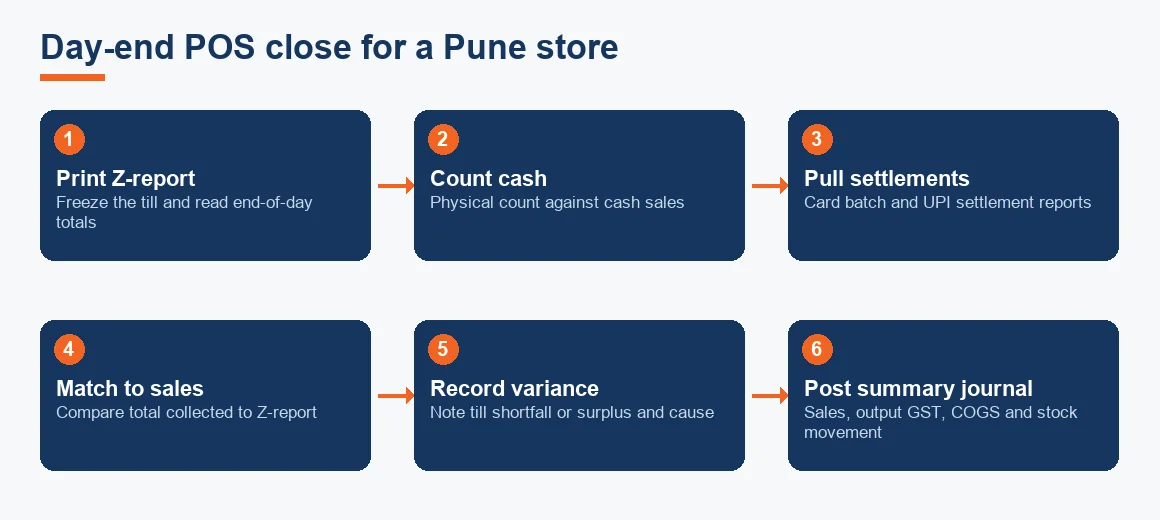
The heart of retail accounting is the day-end close. Done every trading day, it catches errors while they are small. Follow the same sequence each evening.
- Print the Z-report (the terminal's end-of-day totals) and freeze the till.
- Count physical cash and record it against the cash sales figure.
- Pull the card machine batch settlement and the UPI settlement report.
- Add cash, card and UPI collected and compare the total to the Z-report sales.
- Record any difference as a till variance and note the likely cause.
- Post the day's summary journal: sales, output GST, cost of goods sold and the movement in stock.
- Adjust inventory for any known breakage, damage or returns.
The formal control here is the point-of-sale day-end audit. A recurring small shortfall is rarely theft; it is usually a rounding setting, an un-swiped card tip or a UPI payment taken outside the till. A recurring surplus is just as worth chasing, because it often hides a sale that was collected but never billed, which understates your GST.
GST for Pune retailers: HSN, GSTR-1 and GSTR-3B
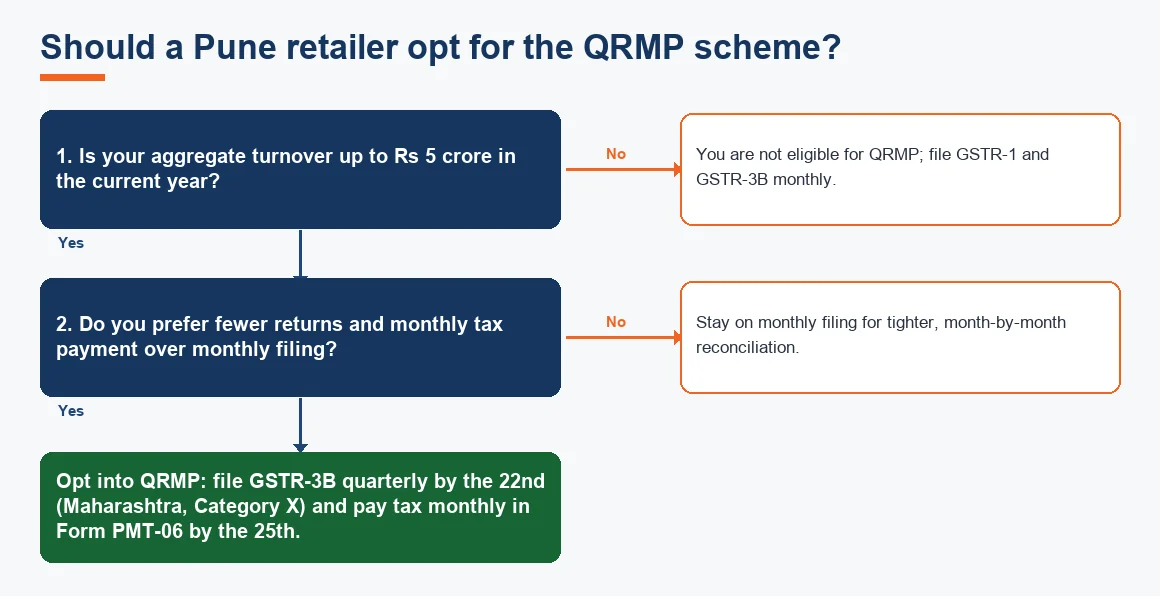
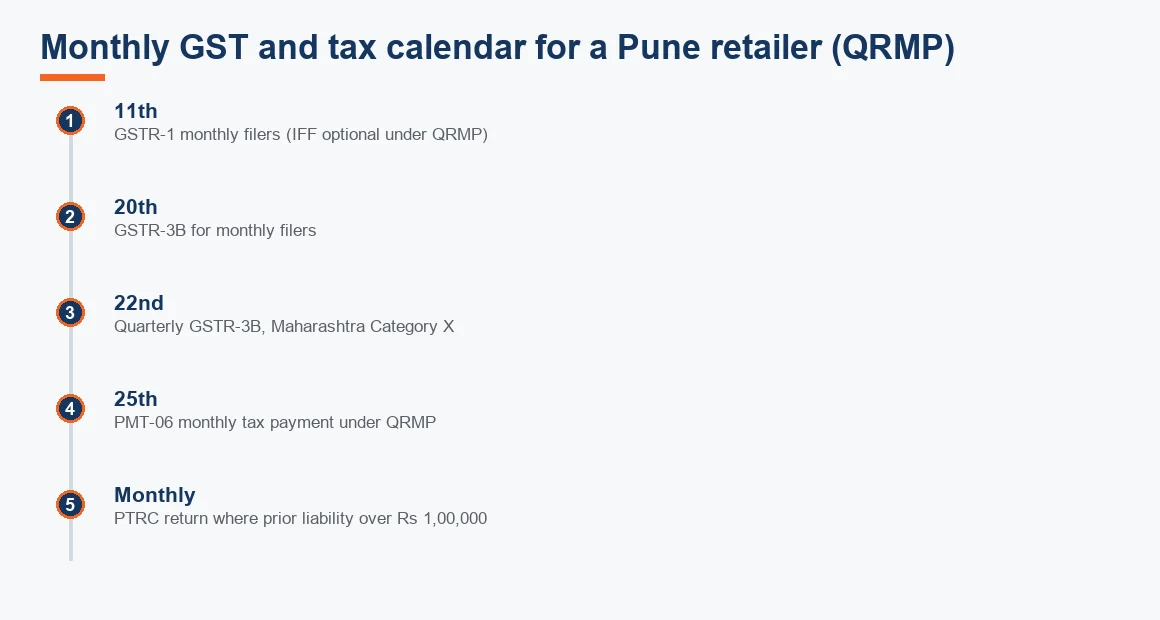
Your POS must produce the HSN-wise tax summary that GSTR-1 requires each month. Monthly filers submit GSTR-1 by the 11th and pay and file GSTR-3B by the 20th of the following month. Most single-outlet Pune retailers fall under the QRMP scheme because turnover is up to Rs 5 crore, which changes the rhythm. Because Maharashtra sits in the first staggered group (Category X), a QRMP retailer files GSTR-3B quarterly by the 22nd of the month after the quarter, while paying tax monthly in Form PMT-06 by the 25th. Confirm the current due dates on the GST portal and the HSN reporting thresholds on the CBIC website before each cycle.
On the purchase side, claim input tax credit only for invoices that appear in your auto-drafted statement. The monthly GSTR-2B input tax credit matching exercise is what protects you from claiming credit a supplier never actually reported.
Monthly filing versus QRMP
The choice affects cash flow and workload rather than the tax owed. This summary compares the two for a Pune store.
| Feature | Monthly filing | QRMP (Pune, Category X) |
|---|---|---|
| Turnover ceiling | No upper limit | Up to Rs 5 crore |
| GSTR-1 | Monthly, by 11th | Quarterly by 13th (IFF optional monthly) |
| GSTR-3B | Monthly, by 20th | Quarterly, by 22nd |
| Tax payment | With monthly 3B | Monthly in PMT-06 by 25th |
| Best suited to | High-volume or credit-heavy sellers | Smaller stores wanting fewer returns |
Franchise royalty accounting and TDS
If your Pune outlet trades under a franchise brand, royalty is a monthly expense, not a one-off. Charge it to the profit and loss account in the same period as the sales it is calculated on, normally a percentage of net sales excluding GST. Two deductions apply. TDS is deducted at 10 percent under section 194J, which covers royalty, and the franchisor charges GST at 18 percent on the royalty and any brand licence fee, which you claim back as input tax credit. Keep the royalty computation, the TDS challan and the GST invoice filed together so the numbers reconcile at year-end. The TDS rates and sections are set out by the Income Tax Department.
Larger stores buying stock from a single supplier above Rs 50 lakh in a year should also watch section 194Q TDS on goods, which puts a 0.1 percent deduction obligation on the buyer. It is easy to miss because it sits on purchases, not sales.
Inventory valuation and shrinkage
Stock is where retail profit is made or lost. Two accounting points matter most. First, value closing stock consistently on your chosen cost basis so gross margin is comparable month to month. Second, recognise that physical stock is almost always lower than the system count because of theft, damage, expiry and mis-scans. That gap is shrinkage, and it should be provided for rather than ignored. Booking an inventory shrinkage provision after each stock count keeps your balance sheet honest and flags problem categories early. For fixtures, shelving and the POS hardware itself, run depreciation through our Depreciation Calculator rather than expensing the lot in one year.
Worked example: a day-end reconciliation
Assume a Pune apparel store closes the day with the figures below. The Z-report shows total sales including GST; the tenders are what was actually collected. All amounts are in rupees and indicative.
| Item | Amount (Rs) |
|---|---|
| Z-report total sales (incl GST) | 1,47,500 |
| Cash counted in till | 41,700 |
| Card machine batch settlement | 61,500 |
| UPI settlement report | 44,000 |
| Total collected | 1,47,200 |
| Till variance (collected minus sales) | -300 |
The store is short by Rs 300. On investigation it splits into Rs 180 of rounding on cash bills and a Rs 120 card tip that was keyed as sales. The Rs 120 is corrected in the POS, and the Rs 180 is posted to a till-variance expense. The clean daily journal then records sales net of GST, the output GST payable, cost of goods sold against the stock ledger, and the settled tenders against the bank clearing account. Because the shortfall was found the same evening, it is a two-minute fix rather than a month-end mystery.
Pune-specific compliance: professional tax
Maharashtra levies professional tax, so a Pune shop needs PTEC for the proprietor, partners or directors and PTRC once it pays salaries above the exemption limit. PTEC is Rs 2,500 a year and is payable by 30 June. PTRC returns are filed monthly where the previous year's liability exceeded Rs 1,00,000 and annually below that. This is a small amount that carries disproportionate late-fee risk, so diarise it. For the wider month-end routine, our Monthly Bookkeeping & MIS Checklist for Pune Businesses sets out the full sequence, and if you are still choosing a firm, the guide on how to choose an accountant in Pune covers what to look for across Hinjewadi, Kharadi and Baner.
Key terms
- Point-of-Sale (POS) Day-End Audit: the daily check matching Z-report sales to cash, card and UPI actually collected.
- Retail Inventory Method: an interim way of valuing stock using retail prices and margin between full physical counts.
- Inventory Shrinkage Provision: the accounting entry for stock lost to theft, damage, expiry or mis-scans.
- FIFO vs Weighted Average Cost: the two common bases for valuing what a sold or held unit cost.
- GSTR-2B Input Tax Credit Matching: reconciling purchase invoices to the auto-drafted statement before claiming credit.
Related reading for Pune retailers
Costs and benchmarks vary by locality; our note on the cost of accounting and bookkeeping in Pune for 2026 gives current ranges. Stores that also sell online should read how omnichannel changes the numbers on the E-Commerce Accounting Services Pune page, and general bookkeeping sits with Accounting & Bookkeeping Services Pune. Retailers moving into light assembly or private-label manufacture will find the costing and inventory guide for Pune's Chakan-Pimpri makers useful, and subscription-led brands can compare notes with SaaS Accounting Services (IT & SaaS).
Key takeaways
- Close the till every day: match the Z-report to cash, card and UPI, then post one summary journal.
- Map each SKU to one item code and one HSN so your GSTR-1 tax summary is right first time.
- On QRMP, a Pune store files GSTR-3B quarterly by the 22nd and pays monthly via PMT-06 by the 25th.
- Franchise royalty carries 10 percent TDS under section 194J and 18 percent GST that you reclaim as input credit.
- Provide for shrinkage after each count and diarise PTEC by 30 June to avoid late fees.
Decision guide