In this guide
Retail accounting for a Mumbai store is the discipline of turning what happens at the counter, the POS terminal and the stockroom into books that reconcile: daily sales split by cash and card, inventory that moves in and out, discounts and returns, mall or high-street rent, and the GST on all of it. It sounds simple until you notice that a Kalbadevi wholesale trader and a mall outlet in Lower Parel record the same rupee of sale in two very different ways. This explainer walks through what applies, what does not, and the one number that usually decides each treatment. For the commercial side of engaging a firm, the Retail Accounting Services in India Mumbai page covers scope and pricing; here we stay on the how.
What retail accounting actually means for a Mumbai store
Retail accounting is not a separate law. It is ordinary double-entry bookkeeping applied to a business where a large number of small-value sales happen fast, are paid for in mixed tender, and draw down physical stock. The three things that make it distinct are volume (you post day-end summaries, not one entry per bill), inventory (your cost of goods sold is only as accurate as your stock count), and tender mix (cash, card, UPI and wallet each settle differently). Get those three right and the rest of the accounts fall into line.
For a general commercial retail engagement across India, the Retail Accounting Services in India page is the right starting point. If your Mumbai business is not pure retail (say you are an early-stage founder building the store into something larger), the sector-specific Startup Accounting Services India page will fit your books better than a retail template.
Kalbadevi wholesale versus mall retail: two different sets of books
This is the local angle that trips up most first-time owners. A wholesale trader in Kalbadevi or Bhuleshwar sells in bulk, on credit, against a tax invoice per buyer, and lives on tight margins and 30 to 60 day receivables. A mall or high-street retail outlet in Phoenix Palladium or Colaba sells in ones and twos, gets paid instantly by card or UPI, and records a single day-end POS summary. The compliance is the same GST law; the bookkeeping shape is not.
| Item | Kalbadevi wholesale trader | Mall / high-street retail outlet |
|---|---|---|
| Sales recording | One tax invoice per buyer, credit terms | Day-end POS Z-report summary, instant payment |
| Typical tender | Cheque, RTGS, some cash | Card, UPI, wallet, cash mix |
| Discounts | Trade discount on invoice face, scheme-based | Point-of-sale markdowns and festival offers |
| Rent | Fixed shop rent, often owned premises | Revenue-share: higher of minimum guarantee or percentage of sales |
| Stock method | Weighted average, batch-tracked | Retail inventory method, SKU-level |
| Receivables | Central to the business, needs an aging schedule | Near nil; card settlement in transit instead |
Neither is harder, but a chart of accounts built for one will misreport the other. A wholesale ledger tuned for receivables will have no clean home for card settlement timing; a retail ledger will have no place to age a wholesale debtor.
POS and inventory: the day-end close
The heart of retail bookkeeping is the day-end close. At shutter-down you reconcile three things against each other: the POS Z-report (what the till says you sold), the physical cash counted, and the card and UPI batch totals. The flow below is the same whether you run one Zoho POS till or twelve.
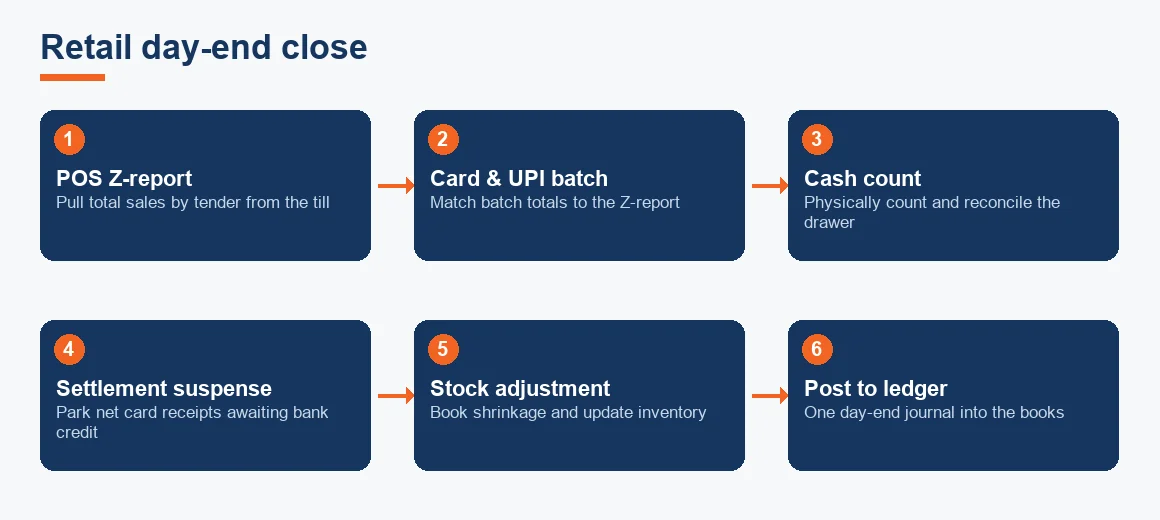
Two retail-specific stock issues sit inside this close. First, inventory shrinkage: the gap between book stock and counted stock from theft, damage and mis-scans. In apparel and FMCG a shrinkage provision of a small percentage of sales is normal, and it must be booked, not ignored, or your COGS is understated. Second, the retail inventory method versus FIFO or weighted average cost: many Mumbai stores value stock at retail price less margin for speed, then true it up to cost at month-end. Both are acceptable; the point is to pick one and apply it consistently.
Recording discounts, returns and goods sent on approval
Discounts are where GST quietly bites. A discount shown on the face of the invoice reduces the taxable value directly, no questions asked. A post-sale discount (a later credit for volume or a scheme) reduces GST only where all four conditions of Section 15(3) of the CGST Act are met: it was agreed before or at the time of supply, it is linked to specific invoices, it is passed through a credit note, and the buyer reverses the matching input credit. Miss any one and you may reduce the price commercially but not the tax.
Counter returns are handled by a credit note, and the tax adjustment on that note lapses after 30 November following the close of the financial year, per Section 34 of the CGST Act. Goods sent on approval (common in jewellery and boutique apparel around Zaveri Bazaar) move under a delivery challan, not a tax invoice, plus an e-way bill where the value crosses the Maharashtra limit; the tax invoice is raised only when the buyer accepts or at six months from dispatch, whichever is earlier. Until then the stock stays in your books and in closing inventory.
Card machines, gateways and the settlement suspense ledger
When a customer pays INR 1,000 by card, you do not receive INR 1,000, and you do not receive it today. The acquiring bank deducts a merchant discount rate (MDR), charges GST on that fee, and credits the net two or three days later. The correct treatment records the full bill value as sales, the MDR as bank charges, the GST on the MDR as input credit, and routes the timing gap through a card settlement suspense ledger so daily counter collections can be matched to bank credits as they land.
This suspense ledger is not optional in a card-heavy Mumbai store. Without it, your bank reconciliation never ties, because the cash book shows gross sales on day one and the bank shows net receipts on day three. The Excel template attached to this article is the exact working sheet we use to reconcile it.
Key terms
- Point-of-Sale (POS) Day-End Audit: the daily tie-out of till Z-report, cash counted and card or UPI batch totals.
- Inventory Shrinkage Provision: the booked allowance for the gap between book stock and physical stock.
- Retail Inventory Method: valuing stock at retail price less a normal margin, trued to cost periodically.
- FIFO vs Weighted Average Cost: the two accepted ways to cost inventory as it sells.
Mall rent: revenue-share, GST and TDS
Mall agreements almost never charge flat rent. They charge the higher of a minimum guarantee (MG) and a percentage of net sales. The bookkeeping: post the MG monthly as rent, add the excess percentage in any month sales cross the trigger, claim input credit on the 18 percent GST the mall charges, and deduct TDS at 10 percent under Section 194-I on the rent component. From FY 2025-26 the Section 194-I deduction threshold is INR 50,000 per month, so any real mall rent is well inside it. This mall lease is also a right-of-use asset question under Ind AS 116 if you report under Ind AS; the Lease Accounting Calculator works out the ROU figures, and the Depreciation Calculator handles the store fit-out.
Worked example: one month of revenue-share mall rent
Take a Lower Parel apparel outlet with a minimum guarantee of INR 2,00,000 per month and a revenue share of 8 percent of net sales. In a strong month it does INR 35,00,000 of net sales. All figures are indicative and Exl GST on sales; the GST shown is on the rent charged by the mall.
| Line | Working | Amount (INR) |
|---|---|---|
| Minimum guarantee | Fixed monthly floor | 2,00,000 |
| Revenue share | 8% of 35,00,000 | 2,80,000 |
| Rent payable (higher of the two) | Revenue share wins | 2,80,000 |
| GST on rent (input credit) | 18% of 2,80,000 | 50,400 |
| TDS under Section 194-I | 10% of 2,80,000 | 28,000 |
| Net paid to mall | 2,80,000 + 50,400 − 28,000 | 3,02,400 |
So the rent expense hitting the P&L is INR 2,80,000, the INR 50,400 GST is recoverable input credit (not a cost), and INR 28,000 is withheld and deposited with the Income Tax Department by the 7th of the next month. Book the INR 2,00,000 MG as rent every month; only the extra INR 80,000 gets added in a month sales cross the trigger.
Do you need a second GST registration for a new outlet?
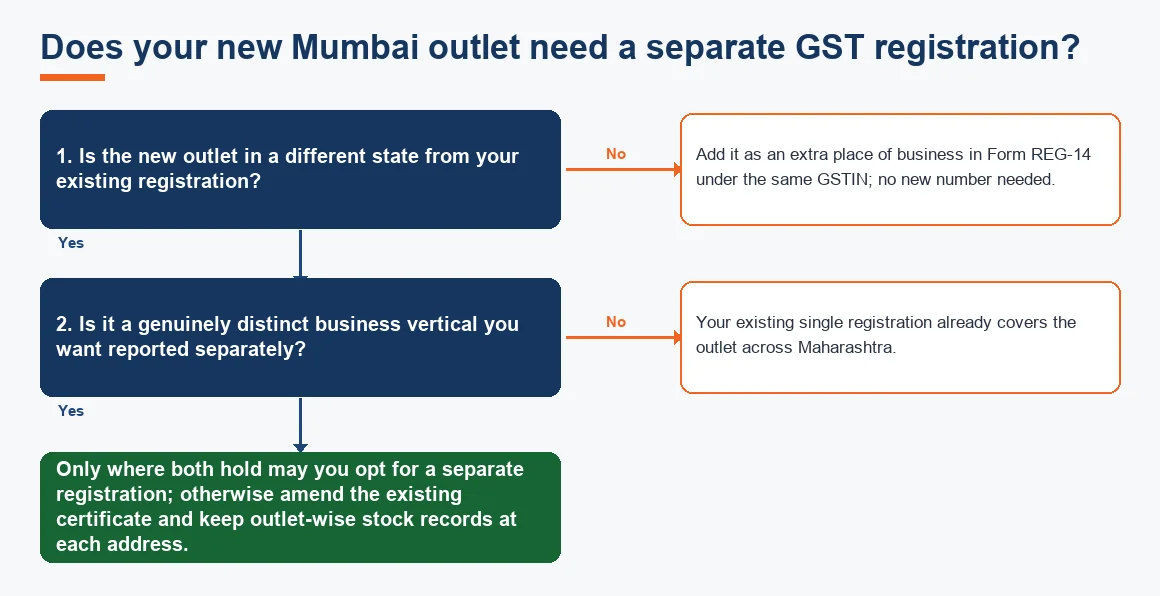
When a Mumbai retailer opens a second or third store in the same state, the reflex is to apply for a new GST number. In almost every case that is wrong and creates needless filing. One registration per state covers every outlet in Maharashtra; the additional shops are added to the certificate as extra places of business through an amendment in Form REG-14. A separate registration is optional only where you run genuinely distinct business verticals you want reported apart. Each outlet still keeps its own stock records at its own address, which the department can inspect.
For the wider compliance picture that sits alongside this, the Maharashtra Professional Tax & Shops Act guide covers PTRC and PTEC and the Shops Act registration each outlet needs.
GST and month-end calendar for a Mumbai retailer
Retail generates a lot of small transactions, so the discipline is monthly, not annual. Maharashtra falls in the earlier QRMP category, which shifts the quarterly GSTR-3B date to the 22nd. The timeline below is the rhythm a Mumbai store runs to.
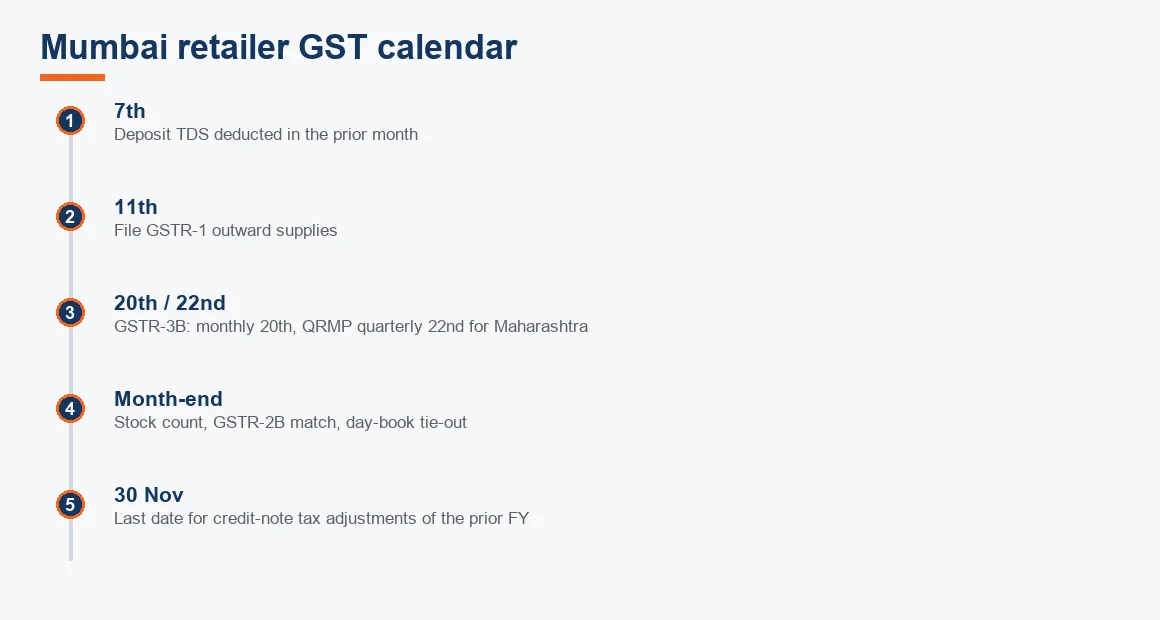
Two matching jobs sit under this calendar. Reconcile purchases against GSTR-2B before you claim input credit, and watch Section 194Q TDS on goods if your purchases from any single supplier cross INR 50 lakh in the year. For a sense of what outsourcing this monthly load costs locally, the Cost of Outsourced Accounting in Mumbai 2026 benchmarks set indicative ranges, and how to choose an accountant in Mumbai covers what to look for. Before any year-end review, the audit-readiness and book-cleanup checklist is worth a run-through.
Key takeaways
- Post day-end POS summaries, not per-bill entries, and reconcile till, cash and card batches the same evening.
- Route card and UPI receipts through a settlement suspense ledger so the timing gap does not break your bank reconciliation.
- Post-sale discounts cut GST only under all four Section 15(3) conditions; credit-note tax adjustments lapse after 30 November following the financial year.
- Mall revenue-share rent is the higher of the minimum guarantee and the sales percentage, with 18 percent GST input credit and 10 percent Section 194-I TDS.
- A second Maharashtra outlet is added under the same GSTIN via Form REG-14, not a new registration.
Sources: CBIC GST for Sections 15(3), 31(7) and 34 of the CGST Act; the GST portal for registration amendments and QRMP filing dates; and the Income Tax Department for Section 194-I and 194Q thresholds and deposit dates. Verify current rates against these before filing.
Decision guide