
In this guide
Retail accounting for a Gurugram mall store is the discipline of turning high-volume point-of-sale data, a footfall-linked lease and fast-moving stock into books that satisfy AS 2, the GST law and your landlord's revenue-share clause. A counter in Ambience Mall or a kiosk in DLF Cyber Hub rings up hundreds of small tickets a day, pays rent as the higher of a minimum guarantee or a percentage of sales, and loses a little stock to shrinkage every quarter. This guide explains how each of those moving parts is recorded. For the commercial engagement itself, see our Retail Accounting Services in India and the Gurugram retail page; here we stay strictly on the how-to.
What retail accounting means for a mall store
Retail accounting is a set of methods built for businesses that sell many low-value items rather than a few large invoices. Instead of costing every lipstick or T-shirt individually, it groups stock by margin, values it at selling price and works back to cost. Alongside that sits daily cash and card reconciliation, GST output on every bill, and a lease that behaves like no ordinary rent. A store in a Gurugram mall is a good example: the volume is high, the ticket size is small, and the landlord participates in your turnover. The books therefore have to be closed daily at the till and monthly at the ledger, not just at year end.
Most Gurugram stores now run an omnichannel model, so a physical counter and an online listing feed the same ledger. If yours does, the marketplace side is covered separately under e-commerce accounting for Gurugram; keep the two revenue streams tagged so the reconciliation stays clean.
The retail inventory method: valuing thousands of SKUs
When a store holds thousands of small items, tracking cost line by line is impractical. The retail inventory method solves this: closing stock is counted at selling price, then reduced by the average gross margin to arrive at cost. If a section sells at a uniform 40 per cent gross margin and the counted stock tags to Rs 10,00,000 at retail, the cost is roughly Rs 6,00,000. The method only holds where margins are broadly even across a category, so seasonal markdowns and clearance lines are stripped out and valued separately first.
AS 2 has the final word: whatever the retail method produces, closing stock is carried at the lower of that cost and net realisable value. End-of-season fashion that will only clear at half price is written down accordingly, which is where the cost of goods sold for the period gets its final shape.
Minimum guarantee versus revenue-share rent in a mall
A mall lease rarely names one rent. It names two: a minimum guarantee (MG) that you pay whatever happens, and a revenue share, usually a fixed percentage of net sales. Each month you pay the higher of the two. In an accounting sense they are not the same animal. Under Ind AS 116 the minimum guarantee is a fixed lease payment that enters the lease liability and the right-of-use asset; the sales-linked top-up above the guarantee is a variable lease payment, expensed as incurred and never capitalised. Smaller stores on AS 19 still separate the fixed floor from the turnover-linked excess for the same reason.
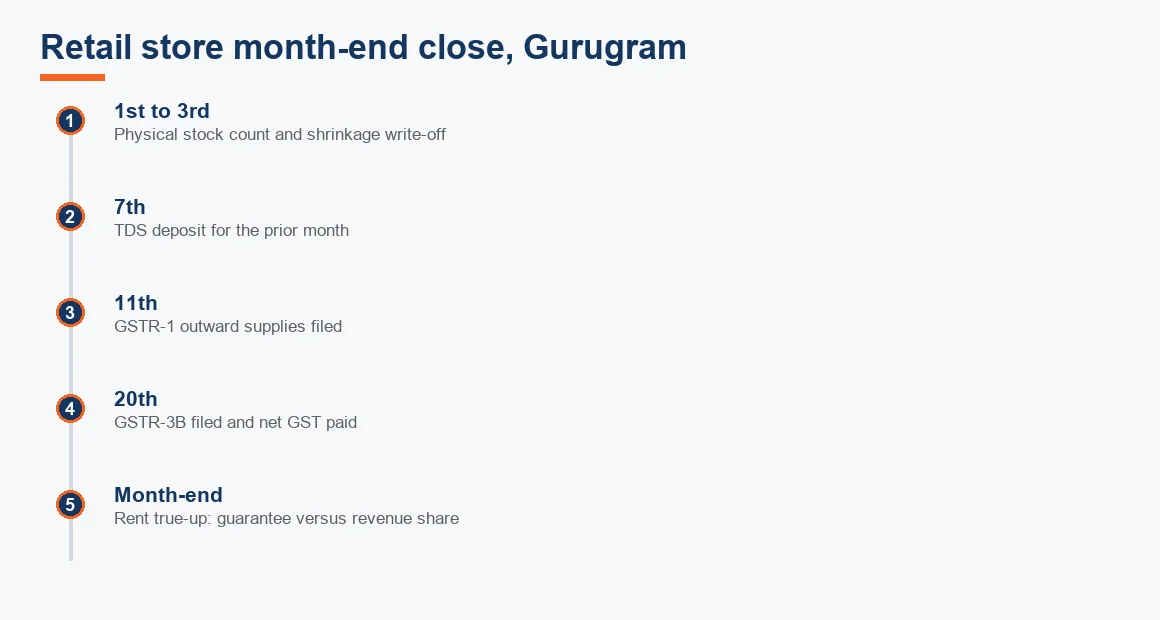
The practical routine is a monthly true-up: compute the revenue share, compare it with the guarantee, book the higher figure and accrue the excess whenever turnover runs hot. Festive months in Gurugram malls routinely push the revenue share above the guarantee, so the accrual is real, not theoretical. Our Ind AS 116 lease calculator handles the fixed-payment side of the split.
GST on common area maintenance and mall billing
Malls bill more than rent. Common area maintenance (CAM), the charge for lifts, air-conditioning, security and housekeeping in shared spaces, is a taxable supply of services at 18 per cent, usually invoiced separately from rent by the mall or its maintenance agency. A registered store claims full input tax credit on both rent and CAM, provided each invoice carries the store's GSTIN and the credit is not blocked. The Haryana state code 06 must appear correctly, because an NCR group with sister outlets in Delhi and Noida can otherwise pick up the wrong place of supply.
Electricity is the exception. Where the mall recovers power at actual metered cost on a pure-agent basis, that recovery stays outside the taxable value and carries no GST, so there is no credit to claim on it. Match every rent and CAM invoice against your GSTR-2B before claiming; a credit that does not appear there is not yours to take yet. The CBIC guidance on taxable value and pure agent is set out on the CBIC GST site.
Gift vouchers: a liability, not revenue
A gift voucher sale does not earn revenue. Cash comes in, but the store still owes goods, so the receipt sits as a liability, a form of deferred revenue, until the voucher is redeemed or lapses. Revenue is recognised only on redemption, against the specific goods handed over. GST timing follows Section 12(4) of the CGST Act: tax falls due on the date of issue where the supply is clearly identifiable at that point, and otherwise on redemption. Unredeemed vouchers are taken to income only when the right to redeem has demonstrably expired under the voucher's own terms, not on a convenient round date.
For a mall store running festive voucher campaigns, this matters to both the profit figure and the GST return. Booking voucher sales as revenue on day one overstates turnover and can trigger tax on a supply that has not happened.
Stock shrinkage and the input tax credit reversal
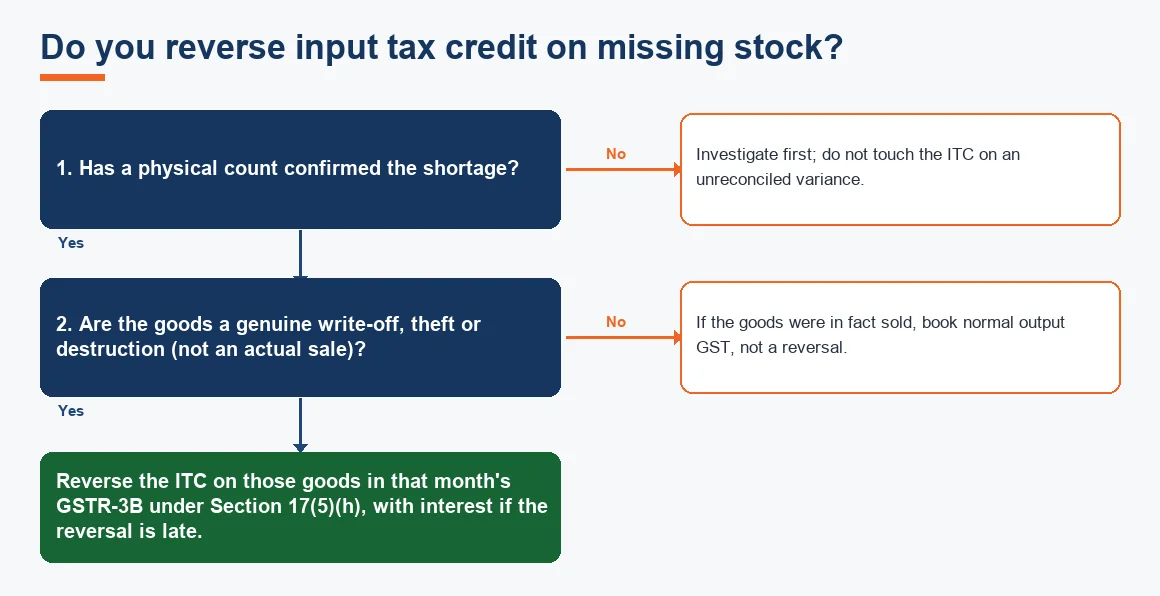
Every retailer loses stock: theft, damage, expiry, miscounts. Shrinkage is the gap between book stock and the physical count. Once the difference is investigated and approved, it is written off to a shrinkage or stock-loss account through an inventory shrinkage provision. The tax consequence is the part stores forget: Section 17(5)(h) of the CGST Act blocks input tax credit on goods lost, stolen, destroyed or written off. The credit originally taken on those goods must be reversed in that month's GSTR-3B, with interest if the reversal is late.
So a single missing carton has two entries: the cost written off to the profit and loss account, and the GST credit reversed on the return. Skip the second and you have an understated tax liability sitting in the books. The statutory text lives on the GST portal.
POS day-end audit: closing the till to the ledger
The single most important daily routine is the POS day-end audit: proving that the cash drawer, card settlements and UPI collections together equal what the point-of-sale system says was sold. The steps are always the same.
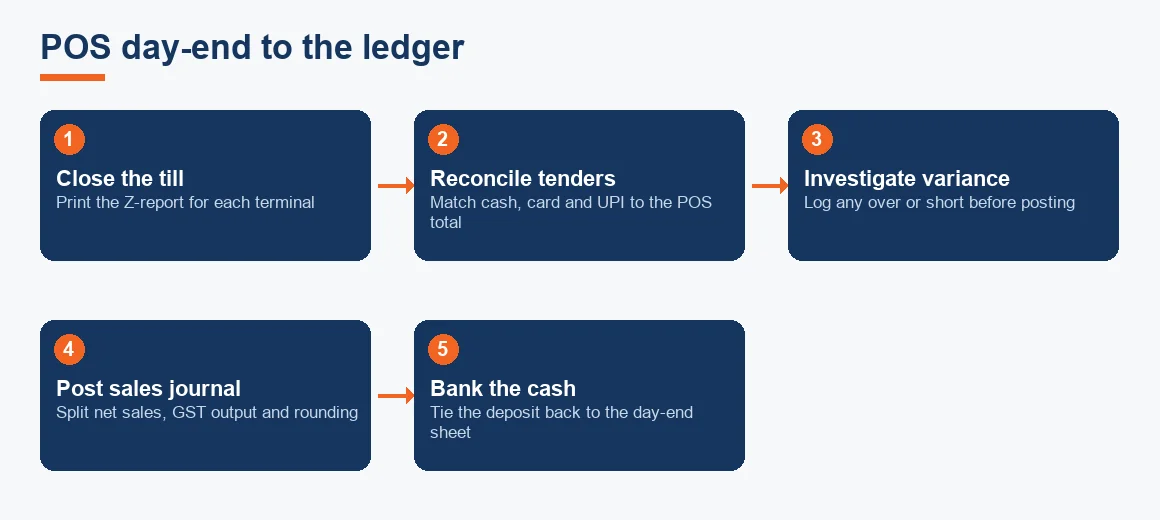
- Print the Z-report for each terminal to lock the day's sales total.
- Reconcile every tender, cash, card and UPI, against that total.
- Investigate and log any over or short before anything is posted.
- Post the sales journal, splitting net sales, GST output and rounding.
- Bank the cash and tie the deposit slip back to the day-end sheet.
Do this daily and month-end becomes a formality. Skip it and a fortnight of unexplained variances turns the close into a forensic exercise. For a deeper look at the compliance rhythm, our Gurugram financial-ops checklist maps the wider month.
The Gurugram and Haryana angle
Two local points shape a Gurugram store's books. First, Haryana levies no professional tax, so there is no monthly PT deduction from salaries, unlike Maharashtra or Karnataka. The employer obligations that do apply, the Haryana Shops and Commercial Establishments Act registration and Labour Welfare Fund contributions, are covered in our Haryana employer compliance guide. Second, Gurugram sits inside the NCR, so a store with outlets across Delhi, Noida and Gurugram must keep place-of-supply and GSTIN mapping tight to avoid mismatched input credit across state lines.
Beyond that, retail accounting in Gurugram is retail accounting anywhere: the mall lease, the POS discipline and the shrinkage rules are the same in Ambience as in any Tier-1 mall. If you are weighing whether to bring this in-house or outsource it, the 2026 cost guide for Gurugram and our note on choosing an accountant in Gurugram both help. Multi-format groups that also run a services or SaaS arm can look at SaaS accounting, IT and software company accounting or startup accounting for the non-retail entities, and use the general Gurugram bookkeeping page for a mixed group.
| Mall charge | GST treatment | How it hits the books |
|---|---|---|
| Minimum guarantee rent | 18 per cent, full ITC | Fixed lease payment (Ind AS 116 liability plus ROU asset) |
| Revenue-share top-up | 18 per cent, full ITC | Variable lease payment, expensed as incurred |
| Common area maintenance | 18 per cent, full ITC | Operating expense; needs GSTIN on the invoice |
| Electricity (pure agent) | Outside GST | Reimbursement at actual cost, no ITC |
| Gift voucher sold | Section 12(4) timing | Liability until redeemed or lapsed |
| Stock shrinkage | ITC reversed u/s 17(5)(h) | Written off to a stock-loss account |
Worked example: rent when sales beat the guarantee
Take a store in a Gurugram mall on a minimum guarantee of Rs 4,00,000 per month and a revenue share of 15 per cent of net sales (Exl GST). The store pays the higher of the two each month. The table shows three months across a year, and how the variable excess builds only when turnover runs above the guarantee.
| Month | Net sales (Exl GST) | Revenue share at 15% | Minimum guarantee | Rent payable | Variable excess |
|---|---|---|---|---|---|
| Apr 2026 (lean) | Rs 22,00,000 | Rs 3,30,000 | Rs 4,00,000 | Rs 4,00,000 | Nil |
| Aug 2026 (steady) | Rs 30,00,000 | Rs 4,50,000 | Rs 4,00,000 | Rs 4,50,000 | Rs 50,000 |
| Oct 2026 (festive) | Rs 42,00,000 | Rs 6,30,000 | Rs 4,00,000 | Rs 6,30,000 | Rs 2,30,000 |
In April the revenue share falls short, so the guarantee is the rent and nothing variable is accrued. In August and October the share wins, and only the amount above Rs 4,00,000 is treated as a variable lease payment. On the October rent, GST at 18 per cent is Rs 6,30,000 multiplied by 0.18, that is Rs 1,13,400, and the full credit is available against output tax. Figures are indicative and Exl GST.
Key terms
- Retail Inventory Method: values closing stock at selling price less the average margin, for shops with too many SKUs to cost individually.
- POS Day-End Audit: the daily proof that cash, card and UPI takings equal what the till says was sold.
- Inventory Shrinkage Provision: the write-off for the gap between book stock and the physical count.
- Deferred Revenue: cash received before the goods are delivered, such as a gift voucher, held as a liability until redeemed.
Key takeaways
- Value stock by the retail inventory method within uniform margin bands, then apply the AS 2 lower-of-cost-or-NRV test.
- Book the higher of minimum guarantee and revenue-share rent each month; treat the excess as a variable lease payment.
- Claim full input tax credit on 18 per cent rent and CAM, but keep pure-agent electricity outside GST.
- Hold gift-voucher receipts as a liability and follow Section 12(4) for the GST timing.
- Reverse input tax credit on any written-off shrinkage under Section 17(5)(h), with interest if late.
Decision guide