In this guide
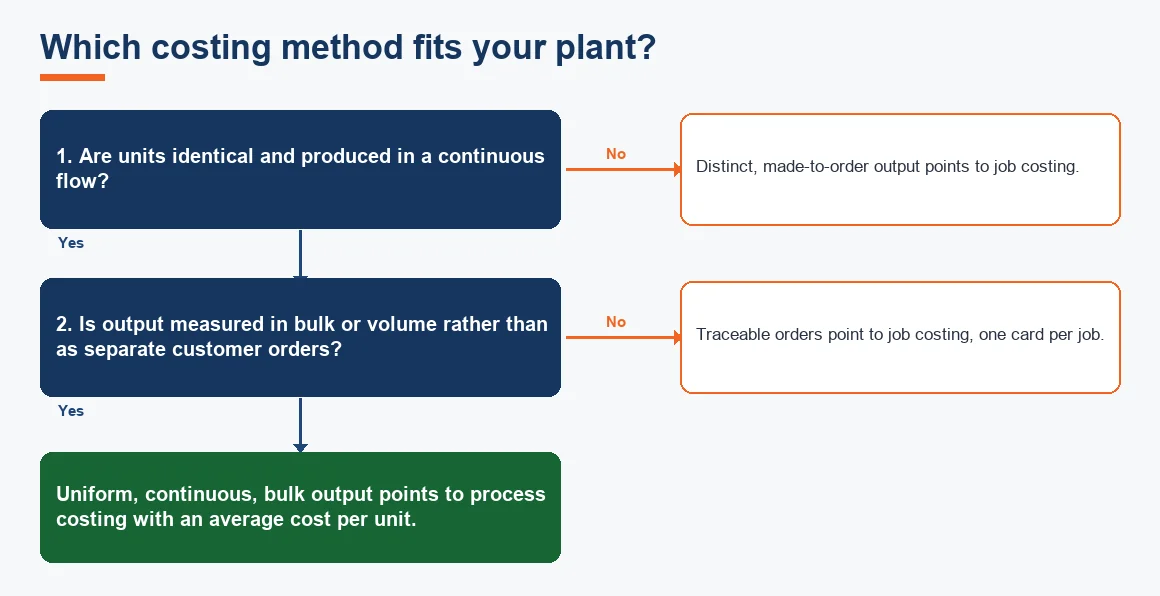
Process costing versus job costing comes down to a single question about how your factory makes things. If output moves in a continuous flow and every unit is identical, such as litres of paint or bags of cement, you use process costing and work out an average cost per unit for the period. If output is a set of distinct, identifiable orders, such as a fabricated steel structure or a print run, you use job costing and build the cost up job by job. Both methods sit on the same double-entry books; they only differ in where the cost is collected before it lands in the profit and loss account.
What is the key distinction between job costing and process costing?
The key distinction is the unit of cost collection. Job costing treats each job, order or batch as the cost object, so the cost of one unit of output can legitimately differ from the next because the jobs themselves differ. Process costing treats a process or department as the cost object for a period, collects everything spent there, and divides by output to give one average figure, because the units cannot be told apart. Everything else, from how overhead is absorbed to how work in progress is valued at the year end, follows from that one choice.
A useful test: could a customer point at a specific unit and ask what that exact one cost to make? In a fabrication unit the answer is yes, and job costing gives it. In a sugar mill the answer is no, because one crystal is no different from another, and process costing gives a sensible average instead. Get this right and the rest of your inventory and costing records fall into place.
What is job costing, with an example?
Job costing accumulates direct material, direct labour and factory overhead against each identifiable job on a job card. It suits fabrication shops, printing presses, tool rooms, construction contracts and professional assignments, where no two orders are quite the same. Unfinished jobs at the balance sheet date sit in work in progress; completed but unsold jobs sit in finished goods.
Take a fabrication unit that accepts an order for a custom conveyor frame. It opens a job card, posts Rs 1,80,000 of steel and fittings, Rs 90,000 of welding and machining labour, and absorbs Rs 54,000 of overhead at a fixed percentage of labour. The job cost is Rs 3,24,000, and if the quoted price was Rs 4,05,000 the job earned Rs 81,000. A second order the same week may look nothing like it. That is job costing working exactly as intended.
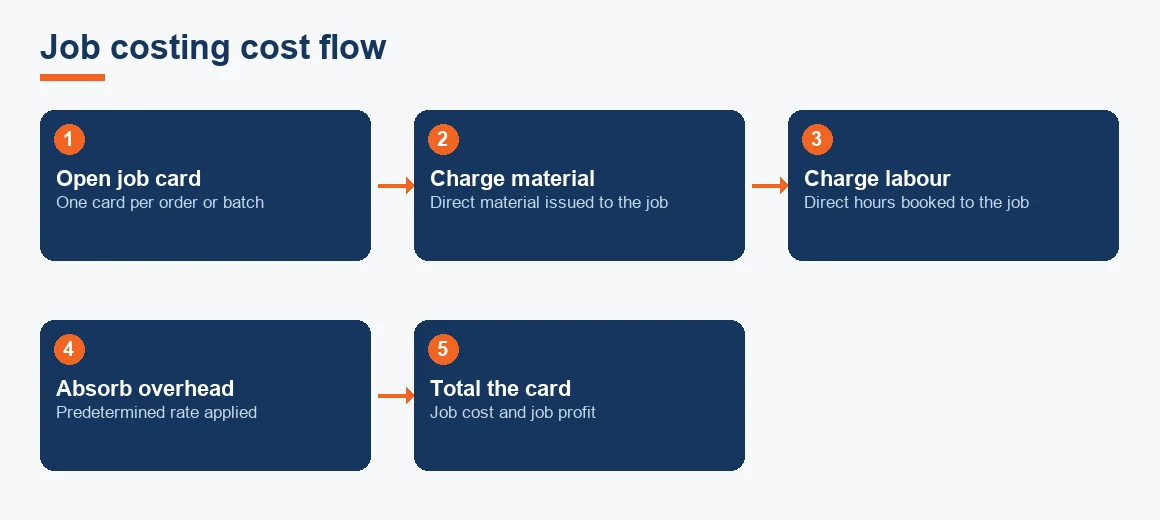
The commonly cited seven steps of job costing are: identify the job, open a job card, charge direct materials, charge direct labour, absorb production overhead using a predetermined rate, add any outside processing or job-work cost, and finally total the card to arrive at job cost and profit. If your job involves sending goods out for job work, the movement is also a GST job-work and ITC-04 matter, which we cover separately.
What is process costing, with an example?
Process costing accumulates cost by process or department for a period and divides it by output to give an average cost per unit. Cost transfers from one process to the next, so the output of Process I becomes an input cost of Process II, and normal loss is quietly absorbed by the good units that survive. It suits chemicals, cement, textiles, sugar, paint and food processing, where output is continuous and units are interchangeable.
Consider a paint plant. In a month the mixing process consumes Rs 4,00,000 of pigment and solvent, Rs 2,40,000 of labour and Rs 1,60,000 of overhead to produce 3,900 good litres after a small normal evaporation loss. The plant does not ask what one particular litre cost; it spreads the total across the good litres. The averaging is the whole point, and it is why a paint maker and a job shop keep their books so differently even though both are manufacturers.
What are the three types of process costing?
Process costing is usually applied in one of three ways. Weighted average process costing blends opening work in progress with current cost and averages over all equivalent units. FIFO process costing keeps opening work in progress separate and costs current production on its own, which matters when input prices move; this is the same tension you see in FIFO versus weighted average stock valuation. Standard-cost process costing runs the process against pre-set standards and books the difference as a variance. The averaging idea also gives process costing its other names: continuous costing, operation costing and, where processes run in sequence, sequential process costing.
What are the five steps of process costing?
Process costing follows a settled five-step sequence for each process in each period. The steps convert messy part-finished output into a clean cost per unit.
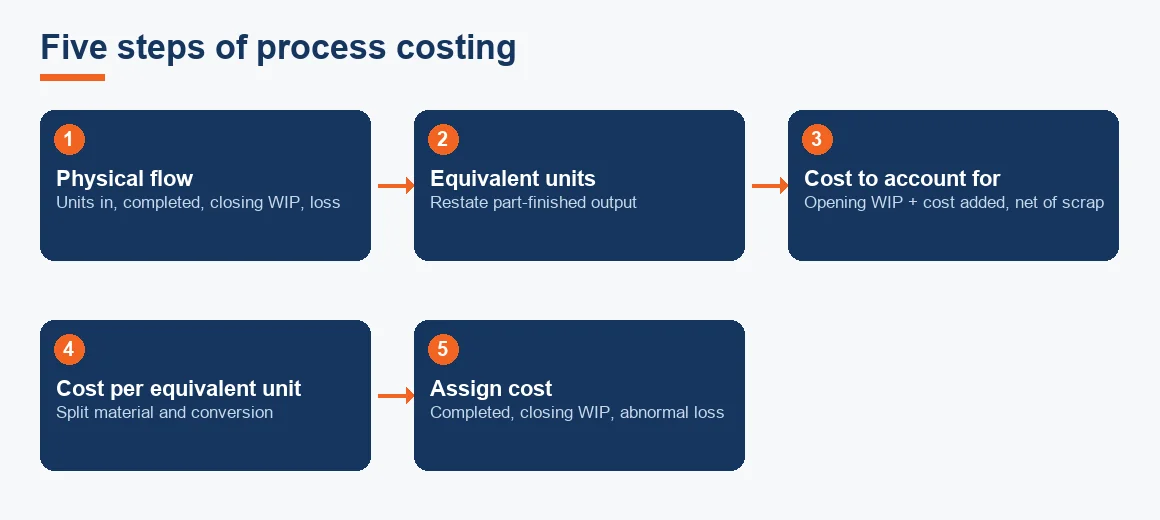
- Summarise the physical flow: units introduced, units completed and transferred, units in closing work in progress, and normal or abnormal loss.
- Compute equivalent units: restate part-finished output in finished-unit terms, separately for material and for conversion cost, because material is often fully added while labour and overhead are not.
- Total the cost to account for: opening work in progress plus cost added in the process during the period, net of the scrap value of normal loss.
- Work out cost per equivalent unit: divide the cost pool by equivalent units for material and conversion.
- Assign the cost: value completed units, closing work in progress and any abnormal loss at the cost per equivalent unit.
What is the formula for process costing?
The core formula is short. Cost per unit equals total process cost for the period, less the scrap value realised on normal loss, divided by the number of good units produced. Where closing stock is only part finished, the denominator becomes equivalent units rather than physical units. Abnormal loss is then valued at that same cost per unit, which keeps the arithmetic honest.
In symbols: cost per unit = (total process cost - scrap value of normal loss) / good units (or equivalent units). This average is what feeds your cost of goods sold and closing inventory, and it is the figure a process manufacturer watches month on month. For the full journey from factory cost to COGS, see our note on calculating COGS in a manufacturing business.
Job costing versus process costing at a glance
The table below summarises where the two methods part company. Most Indian factories land clearly on one side; a few, such as an assembly plant that customises standard modules, use a hybrid or operation costing that borrows from both.
| Feature | Job costing | Process costing |
|---|---|---|
| Cost object | Each job, order or batch | A process or department for a period |
| Nature of output | Distinct, made to order | Uniform, produced continuously |
| Cost per unit | Can differ job to job | Average for the period |
| Cost record | Job card per order | Process cost statement per period |
| Work in progress | Value of unfinished jobs | Equivalent units in the process |
| Typical industries | Fabrication, printing, construction, tool rooms | Chemicals, cement, sugar, textiles, paint, food |
| Loss treatment | Charged to the specific job | Normal loss absorbed; abnormal loss written off |
Worked example: a single-process cost statement
Here is the paint-plant mixing process worked in full for one month. Input is 4,000 litres, normal loss is 100 litres (2.5 percent) with a scrap realisation of Rs 200 a litre, and actual good output is 3,900 litres, so there is no abnormal loss. All figures are indicative.
| Line | Particulars | Amount (Rs) |
|---|---|---|
| A | Direct material | 4,00,000 |
| B | Direct labour | 2,40,000 |
| C | Production overhead | 1,60,000 |
| D | Total process cost (A+B+C) | 8,00,000 |
| E | Less: scrap value of normal loss (100 x 200) | 20,000 |
| F | Net cost to be absorbed (D-E) | 7,80,000 |
| G | Good units produced | 3,900 litres |
| H | Cost per unit (F / G) | 200 per litre |
The cost per litre of Rs 200 values the 3,900 litres transferred to the next process, or to finished stock, at Rs 7,80,000. Had actual output been only 3,850 litres, the shortfall of 50 litres would be abnormal loss valued at Rs 200 each, Rs 10,000, and taken straight to the profit and loss account rather than left in inventory. This is the discipline behind sound inventory valuation under AS 2, which the ICAI standard requires you to state cost at the lower of cost and net realisable value.
When to use job order versus process costing
Decide by looking at the output, not the industry label. Ask whether the units are distinct and traceable to a customer order, or uniform and produced in a flow. Distinct and traceable points to job costing; uniform and continuous points to process costing. Where a plant does both, for example a foundry that pours standard grades but also takes bespoke castings, run job costing on the bespoke line and process costing on the standard line rather than forcing one method on everything.
This choice is a bookkeeping decision, not a sales one. If you are weighing up which method to set up, or you need the cost records built and maintained, that is work for our Manufacturing Accounting Services team, or the broader accounting services desk for a mixed operation. Product companies outside manufacturing, such as a funded startup, a software company or a SaaS business, rarely need either method and are usually better served by project or service costing. Cash-flow strain from delayed customer payments, meanwhile, is a separate discipline covered in our guide to the Section 43B(h) MSME 45-day rule.
A quick sense of the numbers helps too. Our depreciation calculator and the AS versus Ind AS matrix can flag how plant depreciation and standard choices flow into the overhead you absorb under either method.
Key terms
- Work-in-Progress (WIP) Valuation: the value of partly finished output at period end, stated in equivalent units under process costing.
- Cost of Goods Sold: the cost of units sold in the period, fed by either job cost or process cost per unit.
- Bill of Materials (BOM) Costing: the itemised material cost of a product, a key input to both methods.
- Direct vs Indirect Factory Overheads: the split that decides what is charged directly and what is absorbed by a rate.
- Standard Cost Variance: the gap between standard and actual cost, booked separately in standard-cost systems.
Key takeaways
- Use job costing for distinct, made-to-order output; use process costing for uniform, continuous output.
- Process cost per unit = (total cost - scrap value of normal loss) / good units, using equivalent units for part-finished stock.
- Normal loss is absorbed by good units; abnormal loss is valued at full cost and written off.
- Process costing has three flavours: weighted average, FIFO and standard cost.
- A plant that makes both bespoke and standard output can run both methods side by side.
Decision guide