
In this guide
Form ITC-04 is the intimation that a registered manufacturer, called the principal under GST, files to declare the inputs and capital goods it has sent to a job worker and received back during a period. It exists because those goods move out of the factory without a tax invoice and without any GST, so the department needs a running record that stock lying at a job worker's premises is accounted for and will come home within the time the law allows. This guide sets out what job work means, the GST rate that applies, who must file ITC-04 and by when, how to file it, and a full worked cycle you can copy for your own castings, fabrics or components.
What is meant by job work under GST?
Job work is defined in Section 2(68) of the CGST Act as any treatment or process undertaken by one person on goods belonging to another registered person. The owner of the goods is the principal, the person doing the work is the job worker, and the arrangement covers everyday factory outsourcing: sending rough castings out for machining, cloth for dyeing, components for plating or painting, or metal for heat treatment. The goods remain the property of the principal throughout. Because there is no sale, the goods travel on a delivery challan rather than a tax invoice, and no GST is charged on that movement. The legal machinery for the whole arrangement sits in Section 143 of the CGST Act, published by the Central Board of Indirect Taxes and Customs.
This is squarely a manufacturing concern. A dyeing house working on a garment maker's fabric is doing job work; a software firm rarely touches these rules, which is why compliance for an IT and SaaS business or an early-stage startup looks nothing like a factory's. If you run a plant, the wider bookkeeping belongs with manufacturing accounting.
Is GST applicable on job work, and is the rate 12%?
GST is applicable, but only on the job work service, never on the value of the goods handed over. For services supplied to a registered principal the general rate is now 18%, with 5% retained for certain specified sectors such as some textile and food processing. The 12% job work slab that many still quote was withdrawn from 22 September 2025, when the GST rates were rationalised, so the common belief that job work is 12% is now out of date: the rate turns on the process and the sector, not on a single headline figure.
The principal takes full input tax credit of whatever the job worker charges, provided the job worker's tax invoice appears in the principal's GSTR-2B. That credit is one reason accurate reporting matters: the tax is not a cost, it is a claim, and it only flows if the invoice and the challan trail agree.
What is the purpose of Form ITC-04 for job work under GST?
The purpose of Form ITC-04 is to give the department a periodic statement of goods that have left the factory for processing but have not been sold. Because these despatches carry no invoice and no tax, ITC-04 is the only formal thread tying the challan out to the challan back. Table 4 captures goods sent to the job worker, with challan number and date, and Table 5 captures goods received back or supplied directly from the job worker's premises. Filed together, the two tables prove that the input tax credit the principal has already taken on those raw materials is safe.
Who must file ITC-04, and what are the due dates?
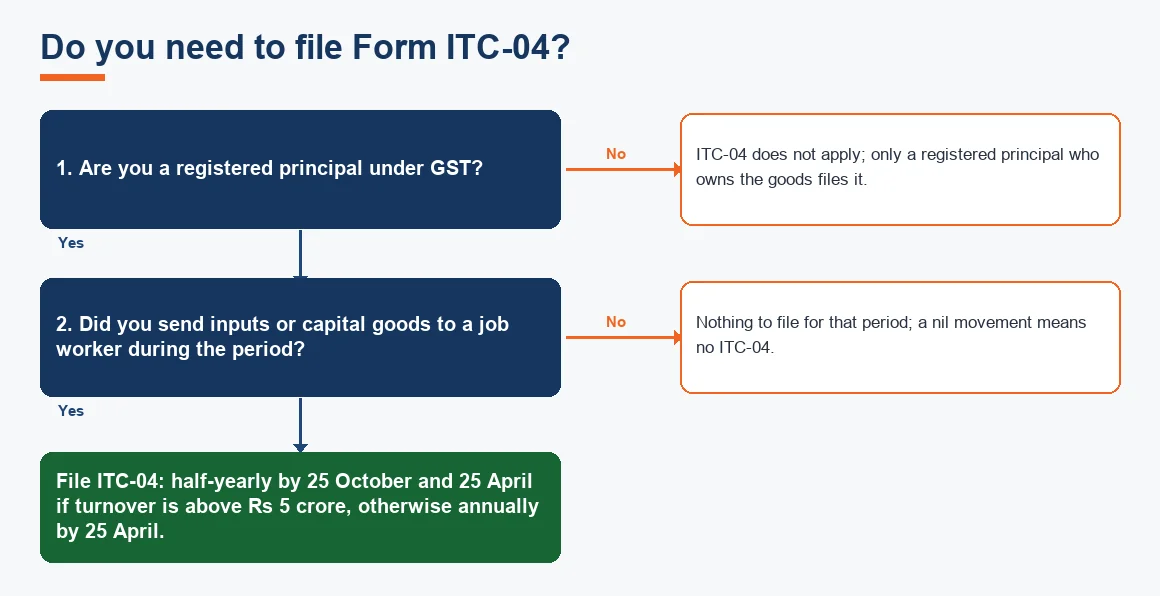
Any registered principal who sends inputs or capital goods for job work must file ITC-04. The frequency was eased from October 2021 and now turns on aggregate turnover, as set out in the table. A manufacturer with no job work movement at all during a period has nothing to file for that period.
| Aggregate turnover | Filing frequency | Period covered | Due date |
|---|---|---|---|
| Above Rs 5 crore | Half-yearly | April to September | 25 October |
| Above Rs 5 crore | Half-yearly | October to March | 25 April |
| Up to Rs 5 crore | Annual | Full financial year | 25 April |
Every deadline lands 25 days after the period closes, which makes it easy to fold into the month-end routine rather than treat as a separate event.

How to file a job work return in GST, step by step
Filing ITC-04 is a portal task, and the sequence is the same every period. The effort sits in keeping a clean challan register through the period, not in the filing itself.
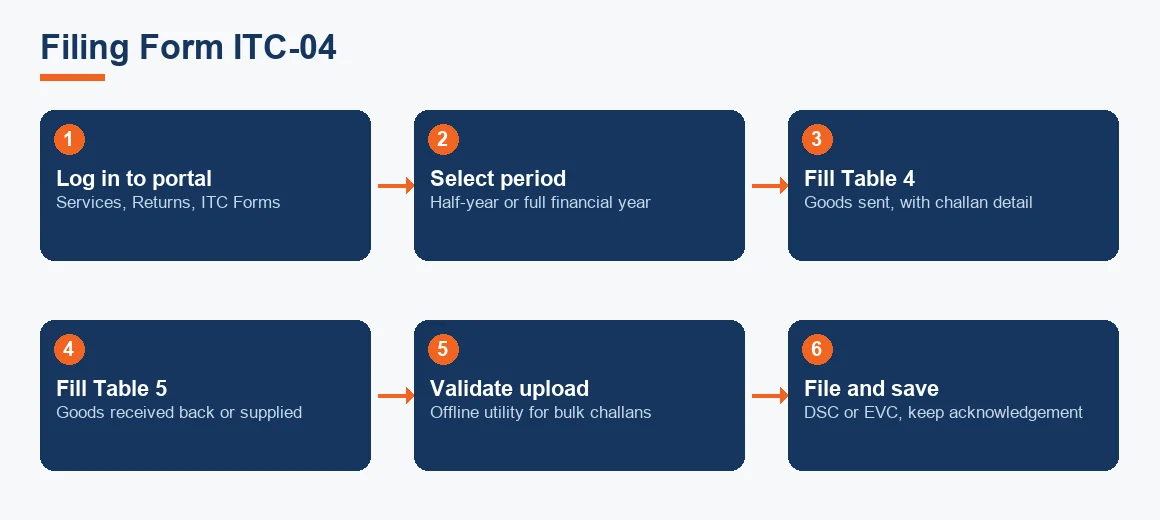
- Log in to the GST portal and go to Services, then Returns, then ITC Forms, on the GST portal.
- Select ITC-04 and the correct period, the half-year or the financial year that applies to you.
- Fill Table 4 with goods sent to each job worker: GSTIN, challan number, date, description, quantity and taxable value.
- Fill Table 5 with goods received back or supplied directly from the job worker, linking each to the original challan.
- Use the offline Excel utility to upload challans in bulk if you run a high volume, then validate.
- Preview, then file with DSC or EVC, and save the acknowledgement against your records.
The one-year and three-year return limits
Section 143 sets a clock the day goods leave the factory. Inputs must return, or be supplied directly from the job worker's premises, within one year; capital goods must return within three years. Moulds, dies, jigs, fixtures and tools are outside these limits, so a die sent to a job worker does not trip the deadline. If inputs are not back within a year, or capital goods within three, the original despatch is treated as a supply from the principal to the job worker on the day the goods were first sent out, and the principal must pay tax with interest on that deemed supply. The Commissioner can extend the one-year limit by a further year and the three-year limit by a further two years, but only on application.
Capital goods sent for job work still sit on your fixed asset register and keep depreciating on schedule; our depreciation calculator handles the Schedule II working while the machine is away. The stock at the job worker, meanwhile, is still your work in progress and belongs in your closing inventory, a point we expand on in the guide to inventory valuation under AS-2 and Ind AS 2.
Is job work covered under RCM, and is it manufacturing?
Job work itself is a forward-charge supply: the job worker raises a tax invoice and pays the GST, so it is not a reverse-charge transaction. The reverse charge that shows up around a factory is a separate matter, most often on freight, where a goods transport agency moving the castings to and from the job worker can attract RCM in the principal's hands. Keep the two apart in your ledgers.
On the second question, job work is not the same as manufacture. Manufacture produces a new product with a distinct name, character and use; job work is a process on someone else's goods and may or may not amount to manufacture. A job worker who powder-coats a frame has not manufactured anything, while one who converts sheet metal into a finished part might have. The distinction affects HSN and, occasionally, the rate, so settle it with your bill of materials in front of you.
How to make a job work challan and invoice in GST
Two documents run the cycle. When goods go out, the principal raises a delivery challan under Rule 45, in triplicate, showing the challan number and date, the GSTIN of both parties, a description and quantity of goods, and the taxable value, but no GST. When the work is done, the job worker raises a normal tax invoice for the job work value with GST at the applicable rate. Goods can also be supplied straight to the customer from the job worker's premises, in which case the principal invoices the customer. The delivery challan, not a tax invoice, is always the document for the goods leg.
Worked example: one job work cycle end to end
Take a manufacturer sending steel castings worth INR 6,00,000 to a job worker for machining, then receiving them back within the year. The job work charge is INR 90,000 at 18% GST. The table rebuilds the cycle document by document. All figures are indicative and the job work charge is Exl GST.
| Step | Document | Value (INR) | GST (INR) |
|---|---|---|---|
| Castings sent to job worker | Delivery challan (Rule 45), Table 4 | 6,00,000 | Nil |
| Machining charge | Job worker tax invoice | 90,000 | 16,200 |
| Invoice total to principal | Job worker tax invoice | 1,06,200 | - |
| Input tax credit claimed | Via GSTR-2B | - | 16,200 |
| Machined castings returned | Return challan, Table 5 | 6,00,000 | Nil |
The GST cost of the cycle is nil in net terms: the principal pays INR 16,200 and reclaims the same INR 16,200 as input credit. The only real expense is the INR 90,000 machining charge, which flows into the product's cost of goods sold. Had the castings not returned within one year, the INR 6,00,000 despatch would have become a taxable supply dated to the day it left, turning a paperwork gap into a genuine tax bill.
Key terms
- Form ITC-04 Job Work Tracking: the periodic intimation of goods sent to and received from a job worker.
- Work-in-Progress (WIP) Valuation: valuing stock still being processed, including goods lying at a job worker.
- GSTR-2B Input Tax Credit Matching: the statement that supports the principal's claim of the job worker's GST.
- Goods Transport Agency (GTA) RCM: reverse charge on freight, distinct from the job work charge itself.
- Bill of Materials (BOM) Costing: the component build that helps decide whether a process amounts to manufacture.
Where ITC-04 sits in the wider factory books
ITC-04 reads best next to the costing and payment rules it touches. The machining charge above is the kind of conversion cost picked up in calculating COGS in a manufacturing business, and if your job worker is an MSME the Section 43B(h) 45-day payment rule governs when you must clear that invoice to keep the deduction. Whether your factory tracks costs by process or by job also shapes how returned stock is absorbed. Commercial questions about outsourcing your whole compliance belong on our manufacturing accounting and IT and software company accounting pages rather than in this workflow.
Key takeaways
- ITC-04 declares inputs and capital goods sent to, and received back from, a job worker; the movement travels on a delivery challan with no GST.
- File half-yearly (25 October and 25 April) above Rs 5 crore turnover, and annually (25 April) at or below Rs 5 crore.
- Job work is generally 18% GST since the 12% slab was withdrawn in September 2025 (5% for specified sectors), charged on the job work value only, and the principal claims it in full through GSTR-2B.
- Return inputs within one year and capital goods within three, or the original despatch becomes a taxable supply dated to the day it left.
- Always capture the return leg in Table 5, and keep the challan register clean through the period so filing is a formality.
Decision guide