In this guide
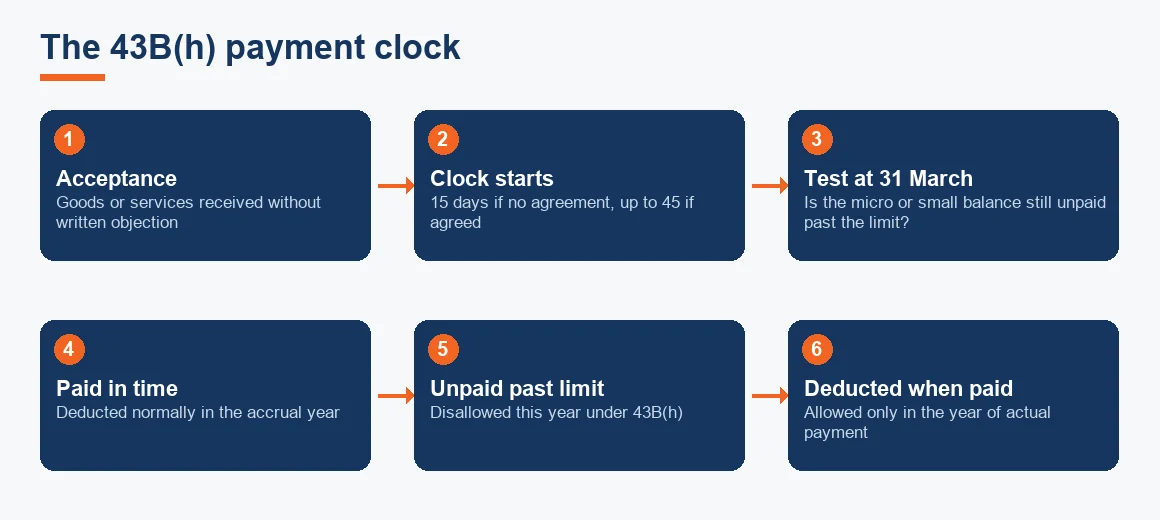
The 43B(h) MSME payment rule says that where a buyer owes a registered micro or small supplier and does not pay within the time limit fixed by the MSMED Act, the expense cannot be deducted in the year it accrues. It becomes deductible only in the year the money is actually paid. The provision, clause (h) of Section 43B of the Income Tax Act, was inserted by the Finance Act 2023 and has applied since assessment year 2024-25. This explainer sets out who it covers, how the deadline is counted and what the disallowance costs, with the working alongside the rule. If you want the commercial engagement rather than the explanation, our Manufacturing Accounting Services team handles supplier ageing end to end.
What is Section 43B of the Income Tax Act for MSMEs?
Section 43B lists expenses that a business may deduct only when they are actually paid, not merely when they are booked on an accrual basis. Taxes, provident fund, bank interest and leave encashment already sat in that list. The Finance Act 2023 added clause (h), which brings in any sum payable to a micro or small enterprise beyond the limit set by Section 15 of the Micro, Small and Medium Enterprises Development Act 2006. In plain terms, an unpaid invoice from a qualifying small supplier stops being a tax-deductible cost until it is settled. The full text sits on the Income Tax Department portal.
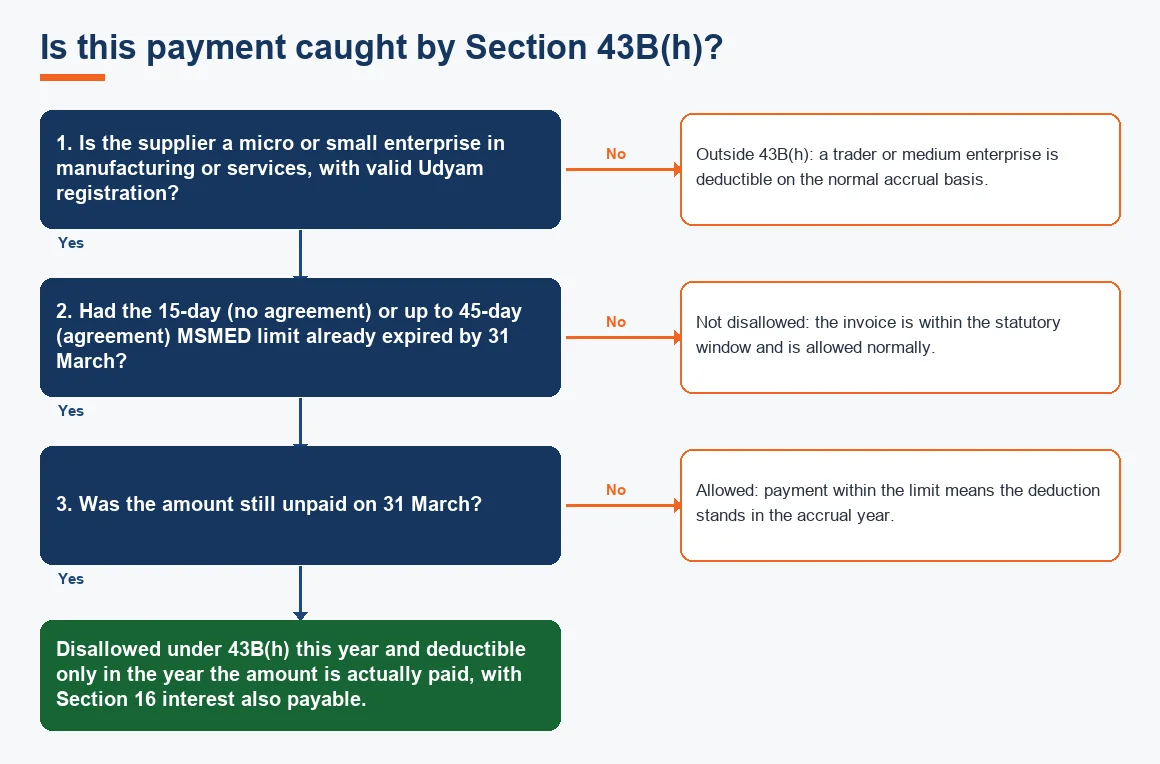
One feature makes clause (h) harsher than the rest of the section. Every other item in Section 43B carries a proviso: pay before the due date for filing your return and you keep the deduction in the accrual year. Clause (h) has no such proviso. If the money is not with the supplier by 31 March, and the MSMED limit had already lapsed, the deduction is gone for that year regardless of when you file.
Section 43B(h) applicability: who is actually covered
The rule tests two parties differently. On the buyer's side there is no turnover threshold at all. A proprietor, a partnership, an LLP or a company is caught the same way, whether books are audited or not. What matters is the supplier's status.
On the supplier's side, only a micro or small enterprise engaged in manufacturing or in providing services, and holding a valid Udyam registration, brings the clause into play. Two categories fall outside:
- Medium enterprises. The disallowance stops at small. A medium supplier's overdue invoice is deductible on the normal accrual basis.
- Traders. Wholesalers and retailers can register on Udyam for priority-sector lending, but trading is not covered by Section 15 of the MSMED Act, so 43B(h) does not touch payments to a pure trader.
This is why the answer to "is the MSME 45-day rule applicable to traders" is no, and why a supplier's Udyam certificate has to be read for its category and activity, not merely for the fact that it exists. Collecting and filing those certificates is the first control any accounts-payable function should build. Sector desks such as our SaaS Accounting Services (IT & SaaS), IT & Software Company Accounting Services and Startup Accounting Services India apply the same vendor-vetting discipline across their vendor books.
What is the MSME 45-day payment rule?
The "45 days" figure comes from Section 15 of the MSMED Act, not from the Income Tax Act. It sets two limits, and the shorter one usually applies:
| Scenario | Time limit to pay | Clock runs from |
|---|---|---|
| No written agreement | 15 days | Day of acceptance of goods or services |
| Written agreement exists | As agreed, but capped at 45 days | Day of acceptance of goods or services |
| Contract states 60-day terms | Still 45 days | The statutory cap overrides the contract |
The point that catches most buyers is the last row. You cannot negotiate your way past 45 days. A purchase order that promises 60 or 90 day terms is tested against the statutory cap, and the excess period is treated as overdue for 43B(h). Where there is no written agreement at all, the window is only 15 days, which is far tighter than most factory payment cycles assume.
How to calculate the 45 days for MSME payment
The count starts from the day of acceptance, or deemed acceptance, not the invoice date and not the dispatch date. Acceptance is the day the goods or services are received without a written objection. If you raise a written objection about quality or quantity within 15 days of delivery, the clock starts from the day that objection is resolved.
So the sequence is simple: fix the acceptance date, add 15 days if there is no agreement or the agreed period (up to 45) if there is one, and that is your deadline. For year-end purposes the question is narrower still: for every micro and small supplier balance open on 31 March, had the 15 or 45 day limit already expired? If yes and it is unpaid, it is disallowed. Getting the acceptance date right needs a working three-way match between the purchase order, the goods receipt note and the invoice.
The 43B(h) disallowance: what happens if an MSME is not paid in 45 days
If a qualifying supplier is unpaid past the limit as at 31 March, the amount is added back to your taxable profit for that year. You pay tax on income you have not actually saved in cash, because the cost sits in your books but is denied for tax. The deduction returns only in the previous year in which payment is actually made.
There is a second, quieter effect. The add-back is a timing difference, not a permanent loss, so it usually creates a deferred tax asset in the accounts. If you maintain deferred tax workings, our Deferred Tax (DTA/DTL) Calculator helps you size that entry. The practical damage, though, is the cash cost of the extra tax in the disallowance year, which is why the rule is really a working-capital rule dressed as a tax rule.
Interest on delayed MSME payment
Missing the deadline does more than defer a deduction. Section 16 of the MSMED Act makes the buyer liable to compound interest with monthly rests at three times the bank rate notified by the Reserve Bank of India, running from the appointed day. It is payable whether or not the supplier asks for it. With the bank rate published by the RBI at 5.5 per cent, three times works out to 16.5 per cent compounded monthly, a punitive figure.
Worse for the tax computation, Section 23 of the MSMED Act expressly disallows this interest as a deduction. So the interest hits your profit and is then added back, giving no tax shelter at all. The Institute of Chartered Accountants of India has published guidance on presenting these amounts and the related disclosures; the note is available on the ICAI website.
Worked example: the cost of one late MSME invoice
Take a company buying components worth Rs 12,00,000 (indicative, Exl GST) from a small manufacturer, under a written agreement with 45-day terms. The invoice is accepted on 5 February 2026 and remains unpaid at the year end.
| Particular | Amount / Date |
|---|---|
| Invoice value (goods) | Rs 12,00,000 |
| Date of acceptance | 5 February 2026 |
| Statutory limit (written agreement) | 45 days |
| Due date | 22 March 2026 |
| Position on 31 March 2026 | Unpaid, limit already breached |
| Disallowed under 43B(h) in FY 2025-26 | Rs 12,00,000 |
| Extra tax at 25% plus 4% cess (26%) | Rs 3,12,000 |
| Actual payment date | 24 May 2026 |
| Deduction allowed in FY 2026-27 | Rs 12,00,000 |
The company carries an unplanned Rs 3,12,000 tax outflow in 2025-26 and recovers the deduction only a year later, in 2026-27, plus it owes Section 16 interest that gets no relief at all. The full Rs 12,00,000 is not lost, but the cash timing hurts. A tighter payables cycle, the sort described in our note on how to calculate COGS in a manufacturing business, would have avoided the whole entry.
A step-by-step process to stay compliant
The rule rewards process over heroics at year end. A repeatable routine looks like this:
- Flag your suppliers. Collect Udyam certificates and tag each vendor master as micro, small, medium or trader. Only micro and small manufacturing or service suppliers carry the 43B(h) risk.
- Record the acceptance date. Capture the goods receipt or service completion date on every bill, because that, not the invoice date, starts the clock.
- Set the deadline in the ledger. Put a 15 or 45 day due date on each flagged invoice so the system, not a person, tracks the limit.
- Run an ageing check before 31 March. Pull every open micro and small balance and clear anything past its limit before the year closes.
- Confirm balances. A vendor balance confirmation at year end catches invoices sitting in dispute or missed in the ledger.
Sector-specific compliance layers sit on top of this base. Manufacturers juggling job-work stock should read our guide to ITC-04 and job work under GST, while factories choosing a costing method will find our comparison of process costing versus job costing and the note on inventory valuation under AS-2 / Ind AS 2 useful. Where the payables volume is high, some businesses move the whole cycle to accounts payable outsourcing or a broader accounting services engagement so the 43B(h) checkpoint runs automatically each month.
When was the MSME 45-day rule implemented?
The 45-day norm itself is not new. Section 15 of the MSMED Act has fixed the payment window since the Act came into force in 2006. What changed is the tax consequence. The Finance Act 2023 inserted clause (h) into Section 43B, effective from assessment year 2024-25, meaning it first bit on expenditure of financial year 2023-24. So businesses have faced the disallowance from their FY 2023-24 tax computation onwards, and every year end since then carries the same 31 March test.
Key terms
- Section 43B(h) MSME Clock: the running count of days from acceptance that decides whether a micro or small supplier payment is deductible.
- Accounts Payable: the ledger of amounts owed to suppliers, where the 43B(h) ageing check lives.
- Accrual Accounting: booking expenses when incurred, which is exactly what 43B(h) overrides for unpaid MSME dues.
- Three-Way Matching: reconciling purchase order, goods receipt and invoice to fix a reliable acceptance date.
- Vendor Balance Confirmation: a year-end reconciliation with the supplier that surfaces overdue balances.
Key takeaways
- Section 43B(h) has applied since assessment year 2024-25 and disallows unpaid micro and small supplier dues until they are actually paid.
- The limit is 15 days without a written agreement and up to 45 days with one; a longer contractual term is overridden by the statutory cap.
- Only micro and small enterprises in manufacturing or services are covered; traders and medium enterprises are outside the rule.
- Unlike the rest of Section 43B, there is no relief for paying before the return filing date, so 31 March is a hard line.
- Delayed payment also triggers compound interest under Section 16 that Section 23 disallows, so run a monthly ageing check rather than a year-end scramble.
Decision guide