In this guide
The month-end close process is the ordered checklist a finance team follows to shut one accounting month the same way every time: freeze the cut-off, post accruals and prepaids, reconcile every control account, review the numbers against budget and prior month, then lock the ledger so the figures can be reported. Done well it produces a trial balance you can trust within a fixed number of working days. This guide sets out what the close involves, the steps and checklist behind it, how long it should take, and how to improve and automate it, written for Indian SMEs. If you want the close written up as a formal procedure with owners and controls, that is the job of a SOP drafting and implementation engagement rather than this article.
What is the month-end close process?
The month-end close is the block of work that converts a month of raw transactions into a set of reliable, reportable numbers. Every sale, purchase, payment and receipt for the period is captured and posted, adjusting entries bring the accrual position up to date, and each control account (bank, debtors, creditors, GST, TDS, inventory) is reconciled to an independent source. Only then is the general ledger considered closed and the trial balance final.
In record-to-report language the close sits in the middle: transaction capture feeds it, and financial reporting draws from it. In Indian shared service centres the close normally carries GST and TDS reconciliation as named sub-processes with their own owners, because those two feed statutory returns on fixed dates. The discipline is less about doing anything clever and more about doing the same things in the same order, so the result is repeatable. That is why so many firms treat their close as a standard operating procedure, a theme we cover in why every growing business needs financial SOPs.
What is the purpose of the month-end close process?
The purpose is threefold. First, accuracy: adjusting for what has been earned or incurred but not yet invoiced gives a true monthly profit rather than a cash snapshot. Second, control: reconciling each account catches errors, omissions and fraud early, while a preparer-and-reviewer split on every line enforces segregation of duties. Third, timeliness: management needs numbers early enough in the following month to act on them, and statutory returns depend on the same underlying ledger being right.
What are the month-end close process steps?
The steps below are the backbone of most Indian SME closes. Work through them in order; skipping ahead usually means reopening a period you thought was done.
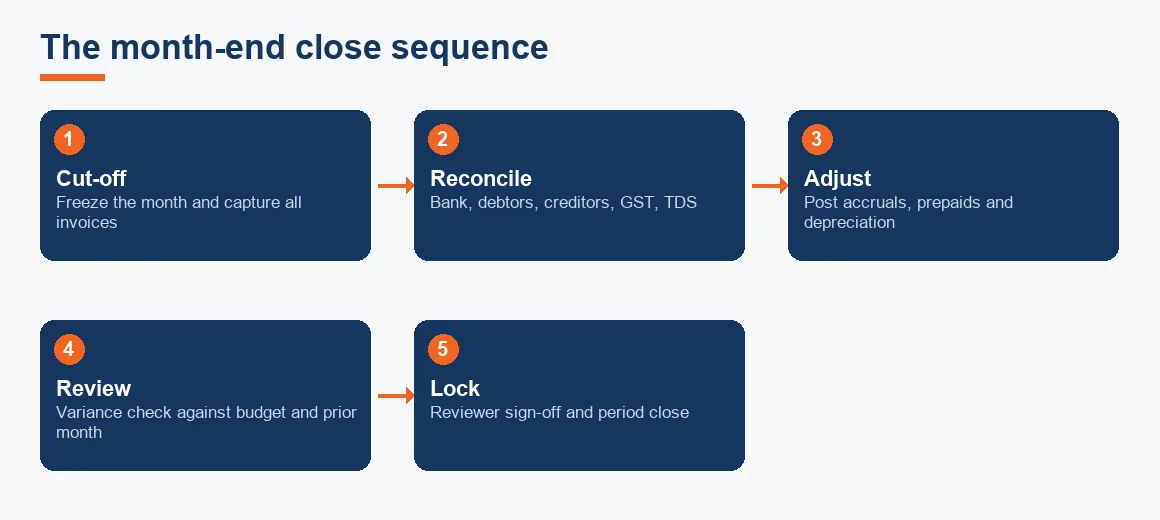
- Cut-off and capture: stop postings to the closing month, confirm all sales and purchase invoices for the period are booked, and park anything that belongs to the next month.
- Bank and cash: complete the bank reconciliation for every account so the ledger balance ties to the statement, with outstanding items listed.
- Payables and receivables: agree supplier and customer ledgers to statements and ageing, chase mismatches, and confirm the accounts payable and accounts receivable control accounts.
- Accruals and prepaids: post accrued liabilities for costs incurred but not billed and prepaid expense amortisation for costs paid in advance.
- Statutory reconciliations: match GSTR-2B against the purchase register before claiming input tax credit, reconcile GSTR-1 to the sales ledger, and check TDS deducted against payments made.
- Fixed assets and inventory: post depreciation, capitalise additions, and value closing stock.
- Review and post closing entries: run a variance review, post final closing journal entries, obtain reviewer sign-off, and lock the period.
What is a month-end closing checklist?
A month-end closing checklist is the single document that lists every task in the close, who owns it, who reviews it, and when it is due. It converts the process from something held in one person's head into something the whole team can run, and it gives the reviewer a clear view of what is outstanding. A good checklist names a preparer and a reviewer on each line, records the due working day, and leaves a column for status and notes so a half-finished close can be picked up by anyone.
The checklist is where a standard operating procedure becomes practical. If you are building one from scratch, our companion pieces on how to write an accounting SOP and SOP format and structure walk through the parts, and the accounts payable SOP template shows the same idea applied to one sub-process.
How many days should a month-end close take?
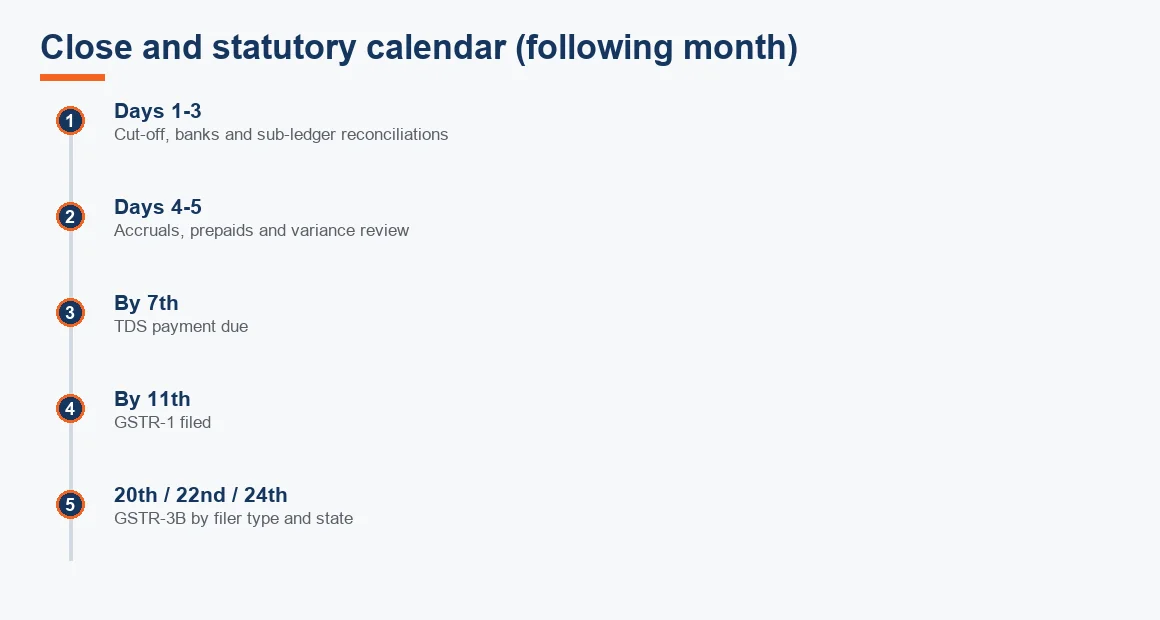
Five to seven working days is typical for an Indian SME, and two to three days for a well-run mid-sized company with automated bank feeds and clean sub-ledgers. The reason the close cannot drift is that statutory dates cap it. TDS deducted in a month must be paid by the 7th of the following month, GSTR-1 is due by the 11th, and GSTR-3B falls on the 20th for monthly filers or the 22nd or 24th for QRMP filers depending on state. Because those returns draw on closed ledgers, the practical deadline for finishing the books is around the 10th.
You can verify the current return due dates on the GST portal and the TDS payment schedule on the Income Tax Department site, both of which change from time to time and should be confirmed each year.
Worked example: accruals and prepaids for a March close
Assume a services company closing March 2026. Two adjustments are outstanding: an electricity bill of 40,000 for March that will only be invoiced in April, and an annual software subscription of 1,20,000 paid on 1 January 2026 covering twelve months, of which the January to March portion must be recognised. The accrual books the unbilled cost; the prepaid releases three months of the subscription (1,20,000 divided by 12, times 3, being 30,000). Figures are illustrative.
| Date | Account | Debit (INR) | Credit (INR) |
|---|---|---|---|
| 31 Mar 2026 | Electricity expense | 40,000 | - |
| 31 Mar 2026 | Accrued liabilities | - | 40,000 |
| 31 Mar 2026 | Software subscription expense | 30,000 | - |
| 31 Mar 2026 | Prepaid expenses | - | 30,000 |
| Net charge to March profit | 70,000 | ||
Without these two entries March profit would be overstated by 40,000 (the missing electricity cost) and the prepaid would sit unreleased on the balance sheet. The reversing accrual is then cleared in April when the actual electricity invoice arrives, so the cost is not double counted.
How to improve the month-end closing process?
Most closes are slow for the same handful of reasons: late invoices, unreconciled banks, and one person who holds all the knowledge. The improvements that move the needle are unglamorous. Pull the cut-off forward by chasing vendor invoices before month-end rather than after. Reconcile the bank weekly so the month-end reconciliation is a formality, not a hunt. Standardise the accrual list so the same recurring items are posted every month without rediscovery. Move recurring journals to templates. And keep a rolling record of what caused each delay, so the checklist gets tightened rather than repeated.
If historic months are unreconciled and dragging the close, that is a catch-up problem rather than a process one, and is better handled as a one-off backlog bookkeeping and catch-up exercise before you try to tighten the monthly rhythm. Ongoing reconciliation discipline sits with accounts reconciliation and audit, and the year-end tie-out that the monthly close feeds is covered under year-end closing and finalisation.
How to automate the month-end close process
Automation does not replace the close; it removes the manual steps that make it slow and error-prone. The highest-value moves for an SME are automated bank feeds so transactions import and pre-match, bank rules that code recurring items on arrival, and recurring journals for depreciation, prepaids and standard accruals. GST reconciliation tools that pull GSTR-2B and match it to the purchase register save the single most tedious statutory step. A depreciation schedule maintained in a depreciation calculator keeps that entry consistent month to month.
What automation cannot do is decide whether an estimate is reasonable or a variance is acceptable; that judgement, and the reviewer sign-off, stays human. The realistic target for a well-automated SME close is the trial balance being final by the third or fourth working day, leaving room to clear the statutory returns comfortably before their due dates.
Soft close versus hard close
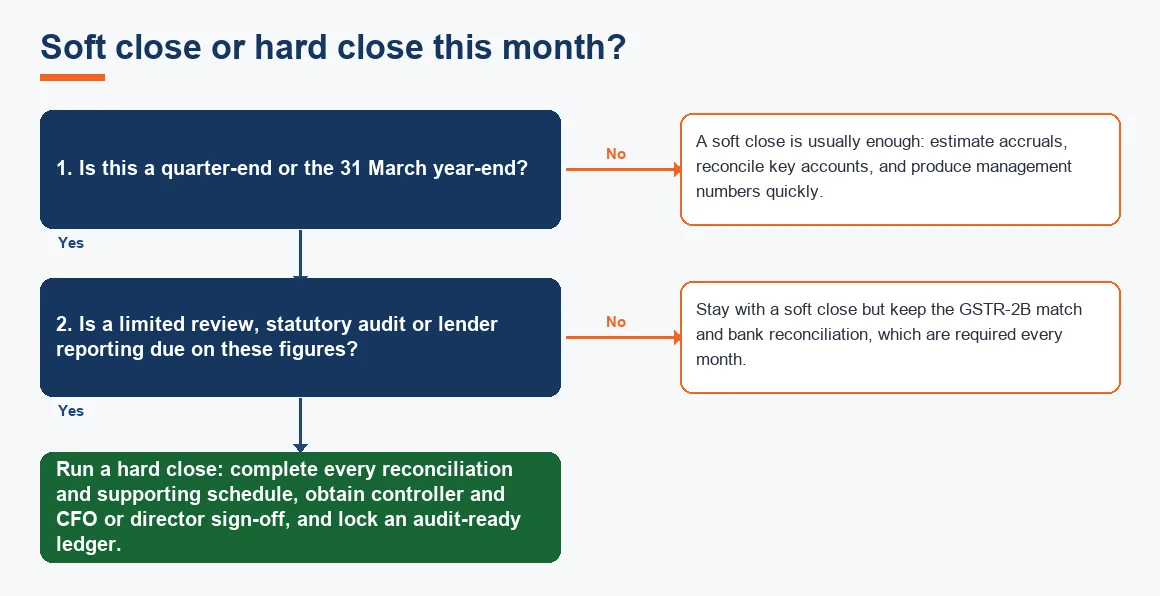
Not every month needs the same rigour. A soft close estimates accruals and skips full reconciliation to produce management numbers quickly; a hard close completes every reconciliation, schedule and supporting document so the ledger can be audited without rework. Most companies hard close at each quarter-end for the limited review and at 31 March for the statutory audit, and soft close in the intervening months.
| Aspect | Soft close | Hard close |
|---|---|---|
| Purpose | Quick management numbers | Audit-ready, final figures |
| Accruals | Estimated | Fully computed and supported |
| Reconciliations | Key accounts only | Every control account |
| Supporting schedules | Partial | Complete |
| Typical timing | Interim months | Quarter-end and 31 March |
| Sign-off | Controller | Controller and CFO or director |
The one non-negotiable in both is the GST input tax credit position: credit is available only on invoices the supplier has reported in GSTR-2B, under section 16(2)(aa) of the CGST Act, so that match happens every month regardless of how soft the rest of the close is. The provision text is on the CBIC GST site, and the directors' responsibility statement under section 134(5) can be checked on the MCA portal.
Key terms
- Month-End Close Checklist: the ordered list of close tasks with owner, reviewer and due day.
- Bank Reconciliation: matching the ledger bank balance to the bank statement, listing timing differences.
- Accrued Liabilities: costs incurred in the month but not yet invoiced, booked so profit is complete.
- GSTR-2B Input Tax Credit Matching: comparing GSTR-2B to the purchase register before claiming credit.
- Closing Journal Entries: the final adjusting entries posted before a period is locked.
Key takeaways
- The close is an ordered, repeatable sequence: cut off, reconcile, adjust, review, lock.
- A written checklist with a named reviewer on every line is what turns the close into a control.
- Statutory dates cap the timeline, so a healthy SME close lands within five to seven working days.
- Accruals and prepaids give a true monthly profit; the worked example shows a 70,000 net charge that would otherwise be missed.
- Automate the mechanical steps, keep judgement and sign-off human, and soft close in interim months while hard closing at quarter-ends and 31 March.
Decision guide