In this guide
The importance of an SOP in accounting comes down to a simple test: if the person who runs your payments, GST returns or month-end close resigned tomorrow, could someone else pick up the work from a written document rather than from memory? A standard operating procedure is the record of who does each financial task, in what order, and where the check sits. It is what turns a founder-run finance function into a system that keeps working as the business grows, and it is the first thing a statutory auditor looks for when testing your internal financial controls.
What is an SOP and why it matters in accounting
A Standard Operating Procedure (SOP) is a written instruction that describes how a recurring task is performed: the trigger, the steps, the person responsible, the approval limit, and the evidence retained. In accounting the value is not theory, it is repeatability. When a supplier payment always follows the same route, when every expense claim is checked against the same rule, and when the month-end close runs off the same checklist, errors fall and fraud has fewer places to hide. The document is only useful if it names a person and embeds a check; a procedure that describes work but contains no control is just a description, not a safeguard.
Most growing Indian companies do not fail an audit because the numbers are wrong. They struggle because the process lives in one person's head, and when that person is on leave or has left, the knowledge goes with them. Writing it down is the cheapest insurance a finance function can buy. If your books are already behind because process was never documented, a Backlog Bookkeeping / Catch-Up exercise usually comes before the SOP, because you cannot standardise a process you have not yet caught up on.
Why SOPs are important in a growing business
The benefits of an SOP in a business are easiest to see at the point of growth, when headcount rises and the founder can no longer watch every rupee. Four things improve at once. First, onboarding gets faster, because a new hire reads the procedure instead of shadowing someone for a month. Second, quality becomes consistent, because the same rule applies whoever is on the desk. Third, accountability is clear, because each step names an owner. Fourth, the business becomes auditable and fundable, because a diligence team or a lender can see a controlled process rather than an improvised one.
SOPs also protect the owner personally. Where duties are split so that the person who enters a vendor cannot also approve its payment, the risk of an internal fraud drops sharply. That split is called Segregation of Duties (SoD), and it is one of the few controls that costs nothing but discipline to implement.
What is the purpose and main objective of an SOP in finance
The purpose of an SOP in finance is to make a control repeatable and provable. The main objective is not documentation for its own sake; it is to convert an intention ("we always check the bank details before we pay") into a step that happens every time and leaves evidence behind. In practice that means each financial SOP should answer four questions: what triggers this task, who performs and who approves it, what check protects it, and what record proves it ran. A good SOP folds statutory dates into the process itself, so that filing TDS by the 7th of the following month and GSTR-1 by the 11th are steps in the close, not reminders someone might forget.
This is where an SOP and an Financial Internal Controls framework meet. The SOP is the narrative; the control is the checkpoint inside it. We separate the two properly in a section below, because the distinction matters during audit.
Which financial processes need an SOP first
You do not need to document everything at once. Start where money leaves the business and work outward, because that is where error and fraud exposure is highest. A sensible sequence is:
- Vendor onboarding and bank payments. Verify the vendor, lock the bank details, and require a second approval above a set limit. This is the single highest-value SOP for most companies; our Accounts Payable SOP: A Template and Checklist walks through it step by step.
- Employee expense claims. A fixed claim format, a policy cap, and one approver above the manager's own limit.
- Customer credit and collections. Credit terms, an ageing review, and a defined follow-up cadence to keep Days Sales Outstanding (DSO) under control.
- The month-end close. A dated checklist that ends with reconciliations signed off and returns filed; see Month-End Close SOP: A Step-by-Step Process for the full sequence.
Those four cover most of the risk in a growing company. For the payables and receivables cycles specifically, many businesses hand the running of the process to a specialist once the SOP is written, through Accounts Payable Outsourcing or Accounts Receivable Outsourcing, so the control operates the same way every month.
SOP versus internal control: the difference that matters
People use the two words loosely, and it causes trouble at audit. An internal control is the checkpoint that prevents or detects an error, for example dual authorisation on any payment above Rs 1 lakh. The SOP is the document that describes where that checkpoint sits in the process and who performs it. One control can appear in several SOPs, and, as noted, an SOP with no control inside it is only a description of work. When an auditor tests "the payment control", they are testing the checkpoint; the SOP is the evidence that tells them where to look and what the expected behaviour is.
| Financial process | Recurring risk without an SOP | Control the SOP embeds |
|---|---|---|
| Vendor payments | Payment released on a single approval; bank details changed by email | Dual authorisation above Rs 1 lakh; bank-detail change verified by callback |
| Input tax credit | ITC claimed on invoices the supplier never reported | GSTR-2B Input Tax Credit Matching before the return is filed |
| Expense claims | Self-approved or duplicated claims | Policy cap plus an approver above the claimant |
| Month-end close | Books closed before reconciliations are done | Bank Reconciliation signed off before the ledger is locked |
| System access | One person holds every password | Segregation of duties and named access rights |
Do financial SOPs help during a statutory audit
Yes, and the link is statutory. Auditors of companies report on the adequacy and operating effectiveness of internal financial controls under section 143(3)(i) of the Companies Act, 2013 (see the Ministry of Corporate Affairs). A documented SOP with evidence of sign-off is the primary support for that opinion. Written procedures also shorten fieldwork, because the auditor can test a defined control instead of vouching every transaction. The reverse is expensive: where controls are absent, the auditor has to expand testing, and the audit takes longer and costs more.
SOP compliance matters for a harder reason too. If an auditor identifies a fraud of Rs 1 crore or more, it has to be reported to the central government under section 143(12) of the Companies Act, and smaller amounts to the audit committee. The recurring failures that lead there are familiar: payments on a single approval, vendor bank details changed on an emailed instruction, ITC claimed on unreported invoices, and one person holding every password. Each of those is a missing control that a simple SOP would have caught.
Worked example: the cost of a missing payment control
The value of a control is easiest to see in rupees. Take a company that pays a vendor twice for the same supply because there is no Three-Way Matching step and no duplicate-invoice check in its payables SOP. The figures below are indicative and Exl GST.
| Item | Amount (Rs) |
|---|---|
| Original vendor invoice | 4,00,000 |
| Duplicate invoice paid (same PO, no match check) | 4,00,000 |
| Cash out the door | 8,00,000 |
| Recoverable on later reconciliation | 4,00,000 |
| Written off (vendor unresponsive, cash-flow cost) | Up to 4,00,000 |
| Cost of the SOP step that would have caught it | Near zero |
The three-way match (invoice against purchase order against goods-received note, within tolerance) and a duplicate-invoice flag are two lines in a payables SOP. They cost nothing to run and, in this case, protect up to Rs 4,00,000 of working capital. That ratio is why the payables SOP is almost always the first one worth writing.
Who creates SOPs and how long records must be kept
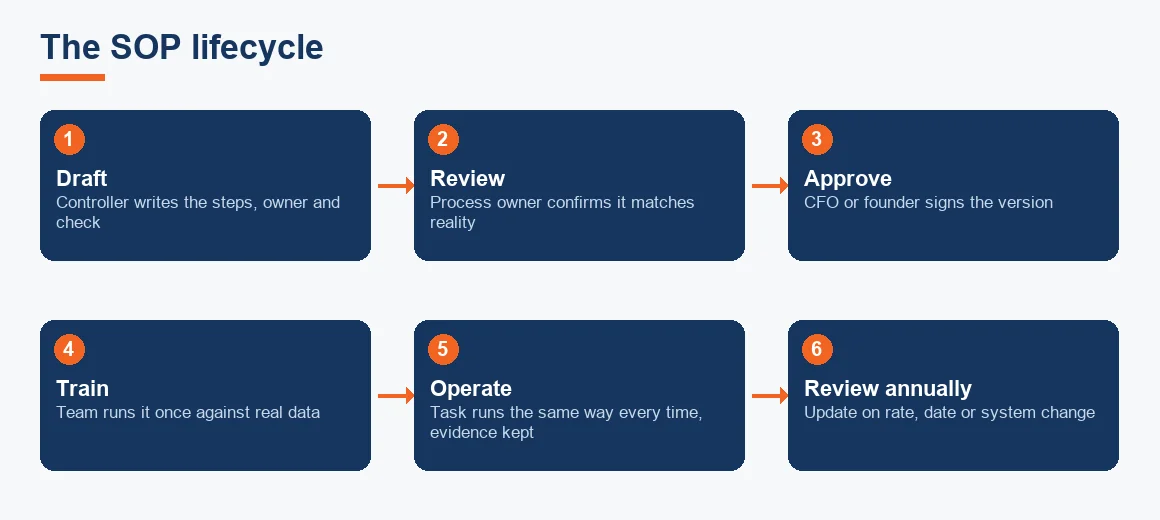
In most growing companies the finance controller or the outsourced accounting team drafts the SOP, the process owner reviews it, and the founder or CFO approves it. The rule of thumb is that the person who runs the task should not be the only person who writes the rule for it, because a procedure written to fit current habits often documents the gap rather than the control. Once written, the SOP should be reviewed at least annually and whenever a statutory rate, a due date or the accounting system changes. For the structure of the document itself, our guide on SOP Format and Structure: The 5 Essential Parts and the walk-through in How to Write an SOP for Your Accounting Department cover the drafting mechanics.
Every SOP should also state how long its records survive, because the retention periods differ by law: eight financial years immediately preceding the current year under section 128(5) of the Companies Act (per the MCA), 72 months from the due date of the annual return under GST (see CBIC), and six years from the end of the relevant assessment year under Rule 6F of the Income Tax Rules (see the Income Tax Department). Where an investigation is ordered, the central government can direct a longer period. Folding the longest applicable period into your document-retention SOP keeps you covered on all three at once.
When you are ready to build the documents formally across the finance function, that is a distinct exercise from writing content about them: the drafting, review and roll-out is what SOP Drafting & Implementation covers end to end.
Key terms
- Standard Operating Procedure (SOP): a written instruction defining who does a task, in what order, and with what check.
- Financial Internal Controls: the checkpoints that prevent or detect financial error and fraud.
- Segregation of Duties (SoD): splitting a task so no single person both records and approves it.
- Three-Way Matching: checking an invoice against its purchase order and goods-received note before payment.
- Month-End Close Checklist: the dated list of steps that closes a period with reconciliations signed off.
Key takeaways
- An SOP matters because it moves the process out of one person's head and into a document anyone can follow.
- Document the four highest-risk processes first: vendor payments, expense claims, collections and the month-end close.
- An SOP is the narrative; the internal control is the checkpoint inside it. An SOP with no control is only a description.
- Written SOPs with sign-off evidence directly support the auditor's opinion on internal financial controls under section 143(3)(i).
- State record-retention inside the SOP: eight years (Companies Act), 72 months (GST), six years (Income Tax Rules).
Decision guide