In this guide
The SOP for accounts payable is a written procedure that sets out exactly how a supplier bill moves from the inbox to the bank, and who is responsible at each step. A workable version covers seven stages: receive and log the invoice, verify the GSTIN and invoice number, match the bill to the purchase order and goods receipt note, code it to the right ledger and cost centre, deduct any TDS that applies, route it through an approval matrix, and schedule the payment. Writing this down turns accounts payable from a set of habits in one person's head into a repeatable process the whole team can follow.
What is an accounts payable SOP, and why does it matter?
A standard operating procedure (SOP) for payables is the single reference that answers a simple question: how do we pay a supplier correctly, every time? Without it, invoices get paid twice, discounts lapse, TDS is missed, and input tax credit is claimed on bills that never appear in the return. With it, a new joiner can process a batch on day two, an auditor can trace any payment back to its approval, and the owner can go on leave without the payment run stalling.
An SOP matters most as a business grows past the point where one trusted person can hold the whole cycle in memory. It also protects cash: a documented process catches duplicate bills and enforces the Section 43B(h) MSME clock, under which sums owed to a registered micro or small enterprise are only deductible in the year of payment if settled within the agreed window, and within 45 days at the outside. If your books carry a backlog before you can even think about an SOP, clearing it first through Backlog Bookkeeping / Catch-Up gives the procedure a clean base to sit on.
What is included in an accounts payable SOP?
A complete payables SOP is built from a handful of standard parts. The general shape of these parts is common to every financial SOP, so if you are drafting your first one it helps to read our note on SOP format and the five essential parts alongside this. For accounts payable specifically, the document should contain:
- Purpose and scope: which bills the SOP covers (trade suppliers, utilities, expense claims) and which sit outside it.
- Roles and the approval matrix: who logs, who matches, who approves at each value band, and who releases the bank payment.
- The step-by-step procedure: the invoice-to-payment sequence, written so a new joiner can follow it unaided.
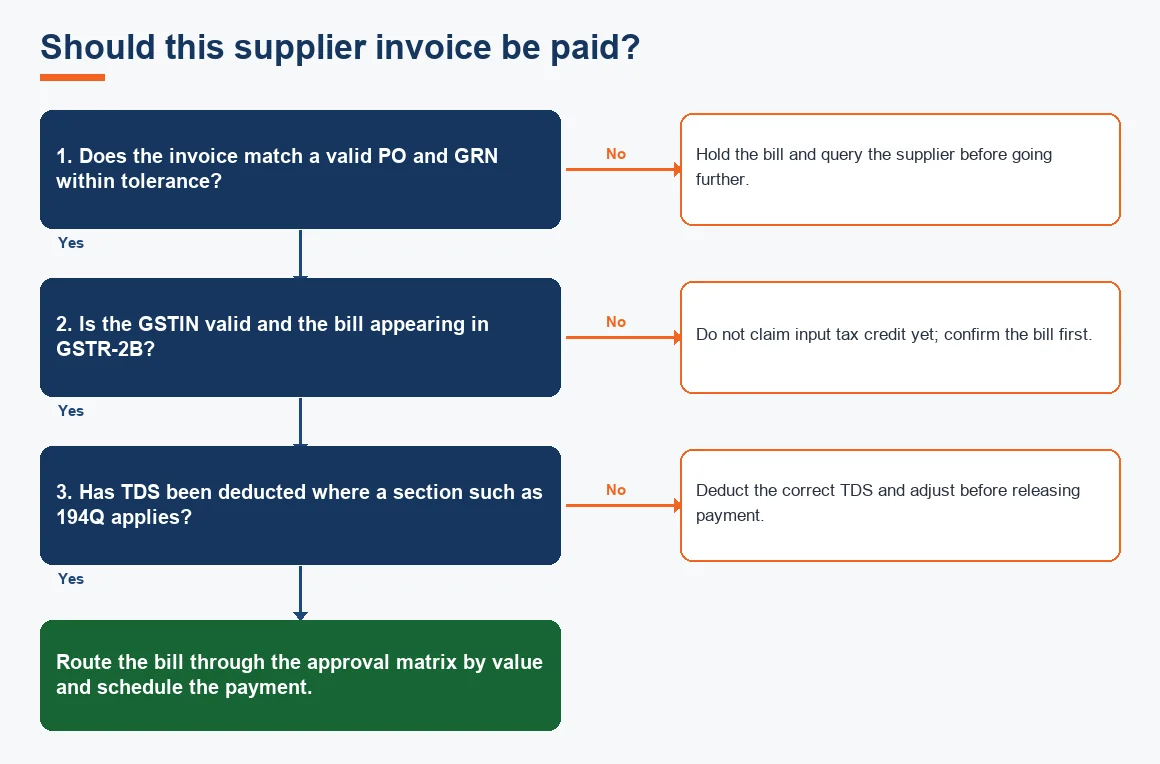
- Control points: the three-way match, GSTIN and GSTR-2B input tax credit matching, TDS tagging and the duplicate-bill check.
- Records and retention: where scanned bills, GRNs and approvals are stored, and for how long.
What are the steps in the accounts payable process?
The heart of the SOP is the process itself. The sequence below is the one most Indian teams settle on, and it is worth writing each step as an instruction rather than a description.
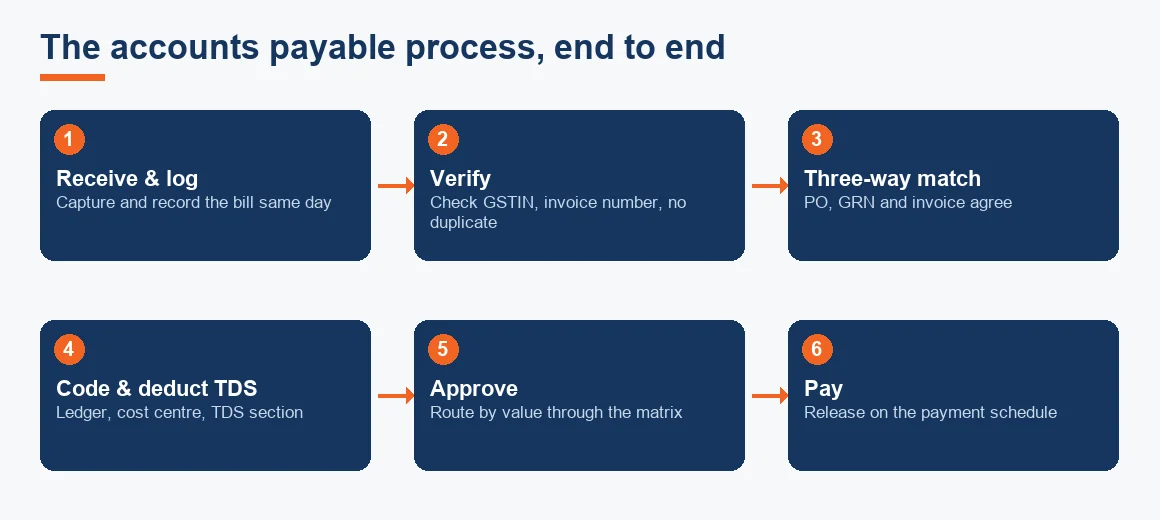
- Receive and log: capture the bill, scan it, and record it against the supplier in the ledger the same day it arrives.
- Verify: check the GSTIN, invoice number and date, and confirm the bill is not already in the system.
- Match: run the three-way match against the purchase order and goods receipt note.
- Code: post it to the correct expense ledger and cost centre.
- Deduct TDS: tag the applicable section and withhold the correct amount.
- Approve: route it through the approval matrix by value.
- Pay and reconcile: release the payment on the schedule and tie it back to the bank statement.
What is three-way matching in accounts payable?
Three-way matching is the control that stops you paying for goods you did not order or did not receive. It compares three documents before a bill is cleared: the purchase order (what you agreed to buy), the goods receipt note (what actually arrived), and the supplier invoice (what you are being asked to pay). When all three agree on quantity, rate and value, the bill passes. When they do not, it is held and queried.
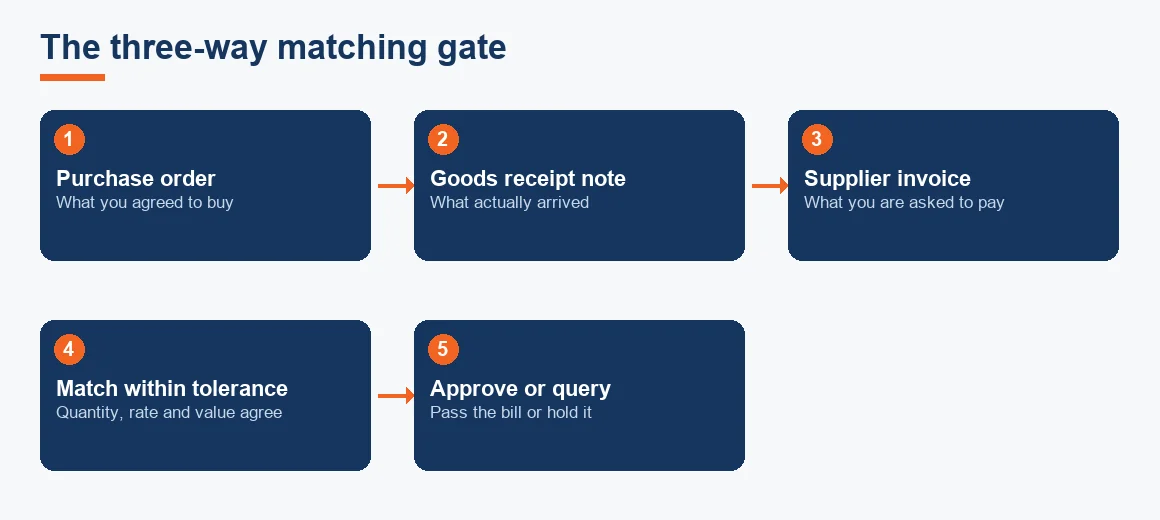
No two deliveries are ever penny-perfect, so the SOP should state a purchase order (PO) tolerance: a small band, often one or two per cent or a fixed rupee cap, within which minor differences pass automatically. Anything outside the band goes to a named person for a decision. Set the tolerance too tight and the team drowns in queries; set it too loose and overbilling slips through.
What is the invoice approval process, and how should the matrix be set?
The approval matrix is the part owners care about most, because it decides who can commit the company's money. It ties an approval level to a value band, so a small utility bill clears quickly while a large capital purchase needs a senior sign-off. The table below is a workable starting point; set your own bands to match your cash position and risk appetite.
| Invoice value (Exl GST) | Match required | Approver | Payment mode |
|---|---|---|---|
| Up to Rs 25,000 | Two-way (bill and PO) | AP executive | Scheduled batch |
| Rs 25,001 to Rs 2,00,000 | Three-way | Finance manager | Scheduled batch |
| Rs 2,00,001 to Rs 10,00,000 | Three-way | Finance head | Reviewed release |
| Above Rs 10,00,000 | Three-way plus contract check | Director / owner | Reviewed release |
Whatever the bands, the SOP must keep the approver separate from the person who books the bill and the person who releases the bank payment. That separation is the backbone of the whole control environment.
What internal controls should an accounts payable SOP include?
Good financial internal controls in payables are not exotic; they are a short list applied without exception. The most important is segregation of duties (SoD): no single person should be able to create a supplier, book a bill, approve it and release the payment. Beyond that, the SOP should build in a duplicate-invoice check on supplier plus invoice number, a vendor master that only a nominated person can amend, GSTR-2B matching before input tax credit is claimed, TDS section tagging at the point of booking, and a monthly review of any debit balance in the payables control account, which usually signals an advance, a duplicate payment or an unadjusted credit note.
These payables controls are one slice of a wider system. If you are setting them up across the finance function at the same time, our overview of why every growing business needs financial SOPs puts them in context, and the payment cycle links naturally into the month-end close SOP where the payables ledger is finally reconciled and reported.
How do you write an accounts payable SOP?
Writing the document follows the same discipline as any SOP, and our full guide on how to write an SOP for your accounting department covers the general method. For payables in particular, work in this order: map the process exactly as it runs today, not as you wish it ran; interview the person who currently handles the bills so nothing informal is lost; write each step as a plain instruction with the responsible role named; insert the control points and the approval matrix; then pilot it on a live batch and fix whatever trips up. Version the file, date it, and name an owner who reviews it at least once a year. If you would rather have the procedure drafted and embedded for you, that is the remit of SOP Drafting & Implementation.
Worked example: processing one supplier invoice
To see the SOP in action, take a manufacturer with turnover above Rs 10 crore in the previous year, so Section 194Q applies, whose cumulative purchases from this supplier have already crossed the Rs 50 lakh threshold for the financial year. A fresh bill arrives and is run through the procedure.
| Step | Detail | Amount (Rs) |
|---|---|---|
| Invoice base value | Matches PO and GRN within tolerance | 8,00,000 |
| Add: GST at 18% | Shown separately on the bill | 1,44,000 |
| Invoice total | Booked to the supplier ledger | 9,44,000 |
| Less: TDS under Section 194Q at 0.1% | 0.1% of base value (threshold already crossed) | 800 |
| Net payable to supplier | Released on the payment schedule | 9,43,200 |
The TDS is 0.1 per cent of the Rs 8,00,000 base value, which is Rs 800, deducted because the Rs 50 lakh limit for the year was already passed. The GST of Rs 1,44,000 is checked against Section 194Q TDS on goods rules and against GSTR-2B before the input tax credit is claimed. Figures are indicative and Exl GST where stated; confirm the current TDS position for your case.
Key terms
- Three-Way Matching: comparing the purchase order, goods receipt note and invoice before a bill is cleared.
- Purchase Order (PO) Tolerance: the small variance band within which a bill passes matching automatically.
- Segregation of Duties (SoD): splitting booking, approval and payment across different people.
- Section 43B(h) MSME Clock: the payment window that governs deductibility of dues to registered micro and small enterprises.
- GSTR-2B Input Tax Credit Matching: verifying a bill appears in the auto-drafted statement before claiming credit.
Two payables cycles that mirror each other are worth keeping in mind when you write the procedure: the outbound side sits with your receivables process, and if that too is being formalised, Accounts Receivable Outsourcing follows the same control logic. Where the payables volume outgrows the in-house team, Accounts Payable Outsourcing runs the documented process on your behalf. The statutory points above should always be checked against the source: GSTR-2B and input tax credit rules on the CBIC GST portal, and TDS provisions such as Section 194Q and Section 43B(h) on the Income Tax Department site.
Key takeaways
- An accounts payable SOP fixes the invoice-to-payment cycle so it runs the same way whoever is at the desk.
- The three-way match and a value-banded approval matrix are the two controls that carry most of the weight.
- For Indian teams the SOP must build in GSTIN and GSTR-2B checks, TDS tagging including Section 194Q, and the Section 43B(h) MSME clock.
- Segregation of duties, a duplicate-bill check and a monthly control-account reconciliation keep the process honest.
- Write the SOP as it actually runs, pilot it on a live batch, date it and give it an owner who reviews it yearly.
Decision guide