In this guide
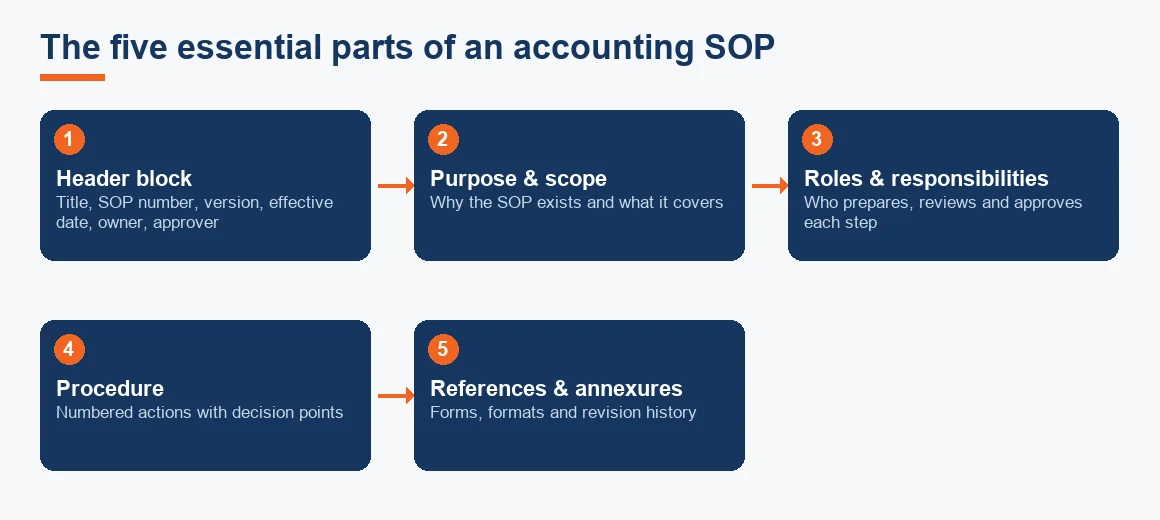
An accounting SOP format is built from five essential parts: a header block, a purpose and scope statement, a roles and responsibilities section, the numbered step-by-step procedure, and a closing block of references and annexures. Get those five in the right order and almost any finance process, from a supplier payment to a month-end close, becomes a document a new joiner can follow without asking twice. This guide sets out what each part holds, the working behind it, and the three format types you can choose between, with one worked example you can copy.
What are the five parts of an SOP?
At its core a standard operating procedure answers five questions in a fixed order: what is this document, why does it exist, who does the work, exactly how is it done, and what supports it. Each question maps to one part. Skip a part and the reader is left guessing, which is precisely how steps get missed.
1. Header block (document control)
The header carries the title, a unique SOP number, the version, the effective date, the process owner and the approver. It is the part auditors read first, because it tells them which version was in force during the period under review. A clean header also prevents the single most common failure: two people working from two different copies.
2. Purpose and scope
Purpose says why the SOP exists in one or two sentences. Scope draws the boundary: which entities, ledgers or transaction types it covers, and what it deliberately excludes. For an accounts payable SOP the scope might read "all domestic vendor invoices above Rs 10,000; excludes petty cash and inter-company recharges", which stops the procedure being stretched to jobs it was never written for.
3. Roles and responsibilities
This section names who prepares, who reviews and who approves each action. It is where segregation of duties is made visible: the person who enters a vendor bill must not be the person who releases its payment. Written plainly here, the split becomes enforceable rather than assumed.
4. The procedure
The procedure is the working heart of the document: numbered steps, in sequence, each starting with an action verb, with decision points called out. This is the only part a trained user re-reads before doing the task, so it must stay short and literal. Everything explanatory belongs elsewhere.
5. References and annexures
The final part links out to policies, regulations and related SOPs, and attaches the forms, templates, screenshots and the revision history. Keeping these here rather than inside the procedure is what lets the core steps stay on a single page.
What is the standard SOP format?
Before the five parts, it helps to see the broadest split. A standard SOP breaks into two blocks: a header block and a procedure block. The header block is control data; the procedure block is everything the reader acts on, and the five essential parts sit across these two. Forms, flowcharts and formats hang off the procedure block as annexures rather than cluttering the steps.
A standard format also fixes a numbering scheme so linked documents stay tidy. If your month-end close runs across several sub-processes, a scheme such as FIN-CLOSE-01, FIN-CLOSE-02 keeps them in one family. The same discipline supports a clean month-end close checklist sitting as an annexure to the parent SOP.
What are the three types of SOP format?
The five parts stay constant; what changes is how you write the procedure. There are three types of SOP format, and the right one depends on how the task actually behaves.
| Format type | Best for | Procedure style | Typical accounting use |
|---|---|---|---|
| Simple step | Short routine tasks, under ten actions | Plain numbered list | Daily bank feed categorisation |
| Hierarchical | Tasks with sub-steps and rules | Numbered steps with lettered sub-steps | Vendor payment approval |
| Flowchart | Processes with branching outcomes | Boxes and decision diamonds | Invoice exception handling |
Long finance SOPs rarely pick just one. The common pattern is hierarchical text for the main path with a single flowchart annexure for the exceptions, so the reader gets literal steps and a visual map of the branches without either format bloating the other.
How is an accounting SOP structured, step by step?
Structuring the document is itself a short procedure. Follow it in order and the five parts fall into place.
- Assign the control data. Give the SOP its number, set version 1.0, name the process owner and the approver, and leave the effective date until sign-off.
- Write purpose and scope. One line on why, then the boundary of what is in and out.
- Map the roles. List each actor and what they prepare, review or approve, building in financial internal controls such as a maker-checker split.
- Draft the procedure. Walk the process once as you write, numbering each action and marking every decision point.
- Attach references and annexures. Link the governing rules, then bolt on forms, formats and the revision history.
- Review, approve and set the date. Only now does the effective date go in and the version freeze.
If your books are behind before you can even document the process, that is a sequencing problem, not an SOP problem; a backlog and catch-up exercise comes first, then the SOP captures the clean recurring routine. Our fuller walkthrough on how to write an accounting SOP covers the drafting craft in more depth.
Worked example: structuring a vendor payment SOP
To see the format carry a real transaction, take a single domestic vendor invoice moving through an accounts payable SOP built on the five parts. The invoice is for contractor work of Rs 2,00,000 plus 18% GST, and the procedure applies TDS under Section 194C at 2% (payment to a company) on the value excluding GST, with three-way matching as the control gate.
| SOP part | What it holds for this invoice | Amount (Rs) |
|---|---|---|
| Header | AP-PAY-03, v1.2, effective 01 Apr 2026, owner: AP Lead | - |
| Scope | Domestic vendor invoice, base value | 2,00,000 |
| Procedure step 3: add GST 18% | Invoice total payable to vendor account | 2,36,000 |
| Procedure step 5: TDS 194C at 2% on base | Tax deducted at source | 4,000 |
| Procedure step 6: net bank payout | Total less TDS (2,36,000 minus 4,000) | 2,32,000 |
| Annexure | Three-way match sheet, TDS challan reference | - |
The numbers are indicative and the base value is Exl GST. The point is structural: the header fixed the version, the scope set the transaction type, the procedure did the arithmetic in numbered steps, and the annexure held the evidence. TDS here is deducted on the amount excluding GST because the tax component is shown separately on the invoice, in line with the Income Tax Department's position on tax deducted at source; where you deal in goods rather than works contracts, the relevant provision shifts to Section 194Q and your procedure step changes accordingly.
Version control and revision history
Version control is not optional polish; it is the part of the format an auditor actively tests, because they need the exact version that was in force during the period under review. Give every SOP a document number, a version that increments with each approved change, an effective date and a superseded date, all held in one controlled register. Only the register copy is authoritative; printed or emailed copies are marked "uncontrolled", and retired versions are archived, never deleted.
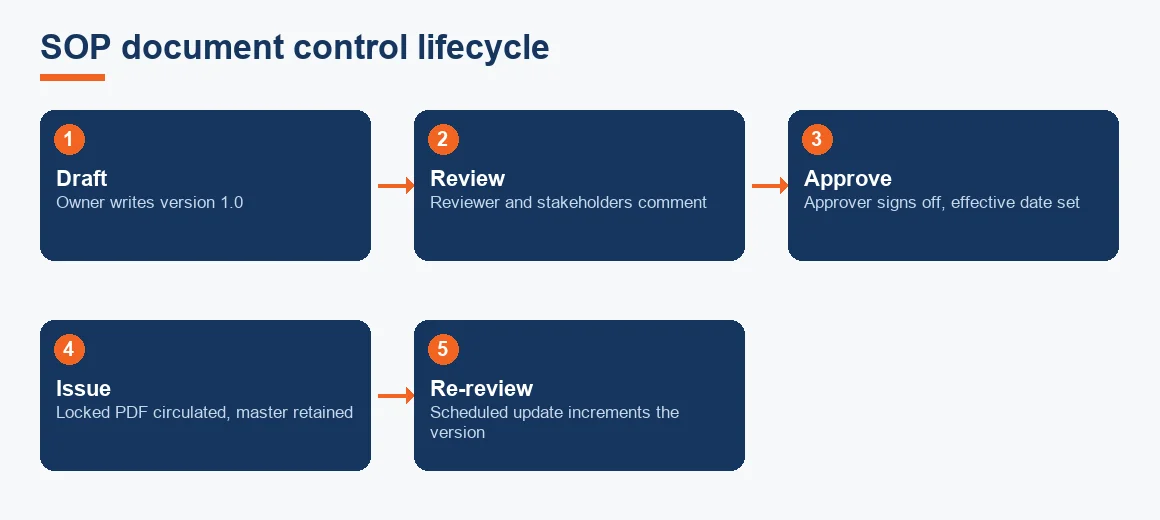
The same locked-PDF discipline that protects a payment SOP protects a receivables one: an accounts receivable collections procedure or an accounts payable template should circulate as a read-only PDF while the editable master stays with the owner. For process-heavy documents such as a fixed-asset SOP, the procedure can even point to a live utility like our depreciation calculator instead of restating Schedule II rates in the text.
When is the full five-part format worth it?
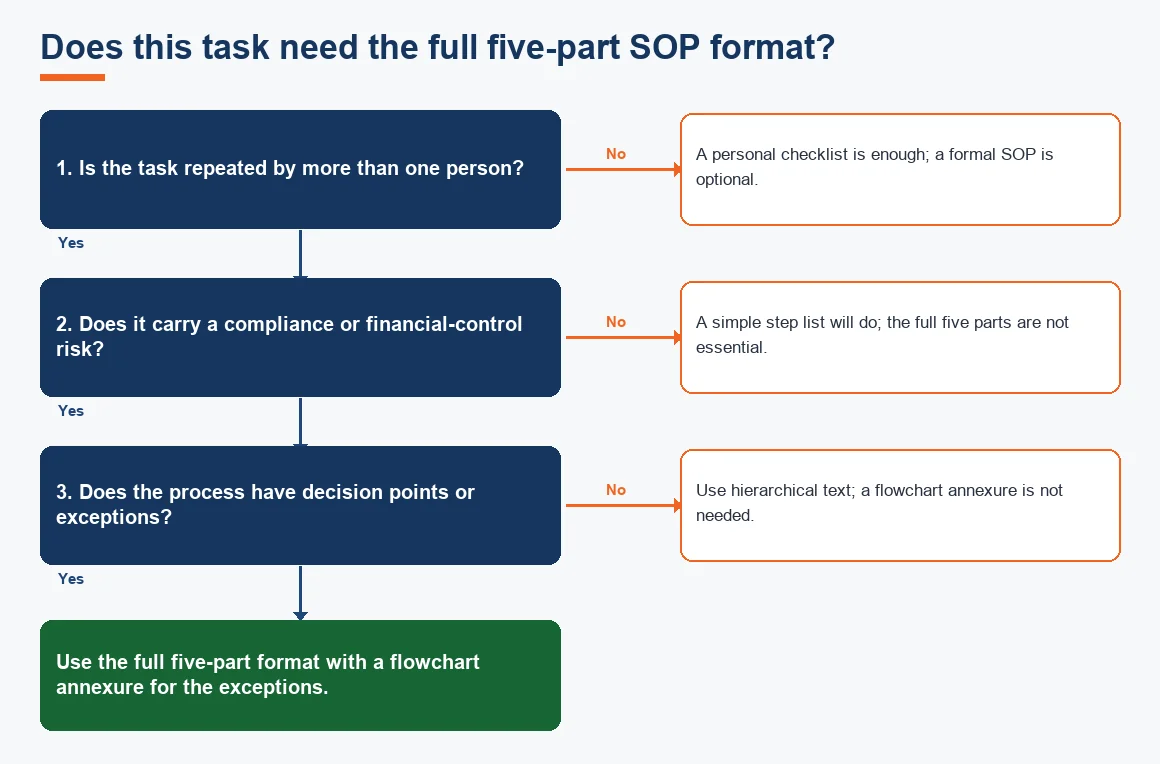
Not every task needs the complete structure. A one-person, low-risk checklist can stay a simple step list. The full five parts, with a flowchart annexure, earn their keep when a task is repeated by more than one person, carries a compliance or financial-control risk, and has genuine decision points. That is the case for most recurring finance routines, which is exactly why growing businesses need financial SOPs, and why the formatting choices above matter more as the team scales. When the writing and roll-out become a project in themselves, structured SOP drafting and implementation support turns a stack of drafts into a controlled, versioned library.
Key terms
- Standard Operating Procedure (SOP): a documented, repeatable set of steps for performing a routine task consistently.
- Financial Internal Controls: the checks built into a process to prevent and detect error or fraud.
- Segregation of Duties (SoD): splitting a task so no single person controls it end to end.
- Three-Way Matching: matching a purchase order, goods receipt and invoice before payment.
- Accounts Payable: money a business owes its suppliers for goods and services received.
Key takeaways
- Every accounting SOP holds the same five parts in order: header, purpose and scope, roles, procedure, references and annexures.
- The header block is control data; the procedure block is the work, and the five parts sit across these two.
- Pick simple step, hierarchical or flowchart to match how the task behaves, and combine hierarchical text with one flowchart for long procedures.
- Keep a single process to two to four pages and push forms, screenshots and rate charts into annexures.
- Version control (number, version, effective and superseded dates in one register) is what audit tests, so build it into the format from version 1.0.
For the underlying documentation and internal-control expectations that shape all of this, the ICAI guidance on internal controls and the statutory rate references at the CBIC GST portal are the authoritative sources to cite inside your annexures rather than paraphrasing in the procedure itself.
Decision guide