In this guide
To write an accounting SOP, set down the process exactly as it runs today, name a role for every step, add the approval limits and the voucher codes used, then test the draft against one real transaction before you finalise it. An SOP that describes the rule book rather than the actual working will read well and fail on the first busy day. Start with the working, correct it where it is wrong, and only then tidy the words. This guide covers the five parts of an accounting SOP, a step-by-step drafting method, a worked example and the statutory points an Indian finance team must build in. For a deeper view of why documented process matters as a business grows, see why every growing business needs financial SOPs.
What is an SOP in accounting?
An SOP, or standard operating procedure, is a written document that sets out how a specific accounting task is carried out from start to finish: who does what, in which system, in what order, with what checks and approvals. In accounting it is the difference between a task that survives a resignation and one that walks out of the door with the person who used to do it. A good SOP document names roles, not individuals, so it keeps working when the team changes.
An SOP is not a policy and it is not the glossary definition of a term. A policy states intent ("vendor payments require two approvals"); the SOP states the mechanics ("the executive raises the payment batch in the accounting software, the manager verifies it against the approval matrix, the finance head releases it in the bank portal"). Written well, the SOP is the practical backbone of your financial internal controls.
What are the five parts of an SOP?
Most accounting teams over-complicate this. A usable SOP has five working parts, and everything else is detail hung off them:
- Purpose and scope: what the SOP covers, what it does not, and which entity or unit it applies to.
- Roles and responsibilities: the process owner plus each role that touches the task, kept separate to preserve segregation of duties.
- The step-by-step activity table: the numbered sequence, the system used at each step, timelines and the ledger or voucher code.
- The approval matrix: monetary limits against each role, and what happens above each limit.
- Version control: version number, effective date, author, approver and a short history of changes.
If you want the structure treated in more depth, our companion piece on SOP format and the five essential parts unpacks each one. For the drafting itself, read on.
How to write an SOP step by step
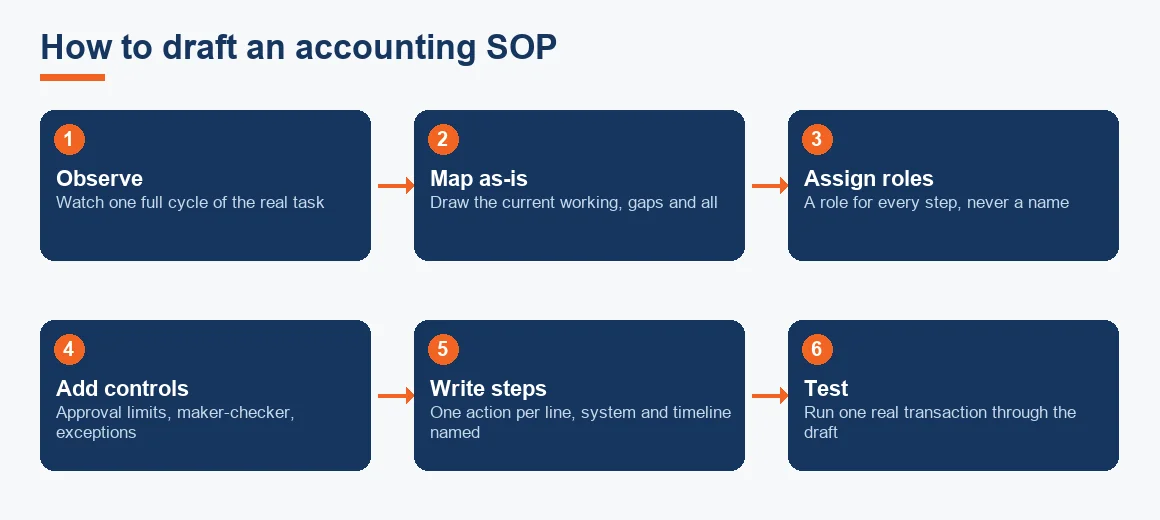
The first step of an SOP is not writing. It is watching. You document the process by observing it as it actually happens, then correcting it, then writing. Here is a practical order that works for Indian finance teams.
- Sit with the person who does the task. Note every click, approval and hand-off for one full cycle. This is how you document an accounting process honestly rather than from memory.
- Draw the process as-is. A rough flow of the current working, warts and all, tells you where the risks and the delays sit.
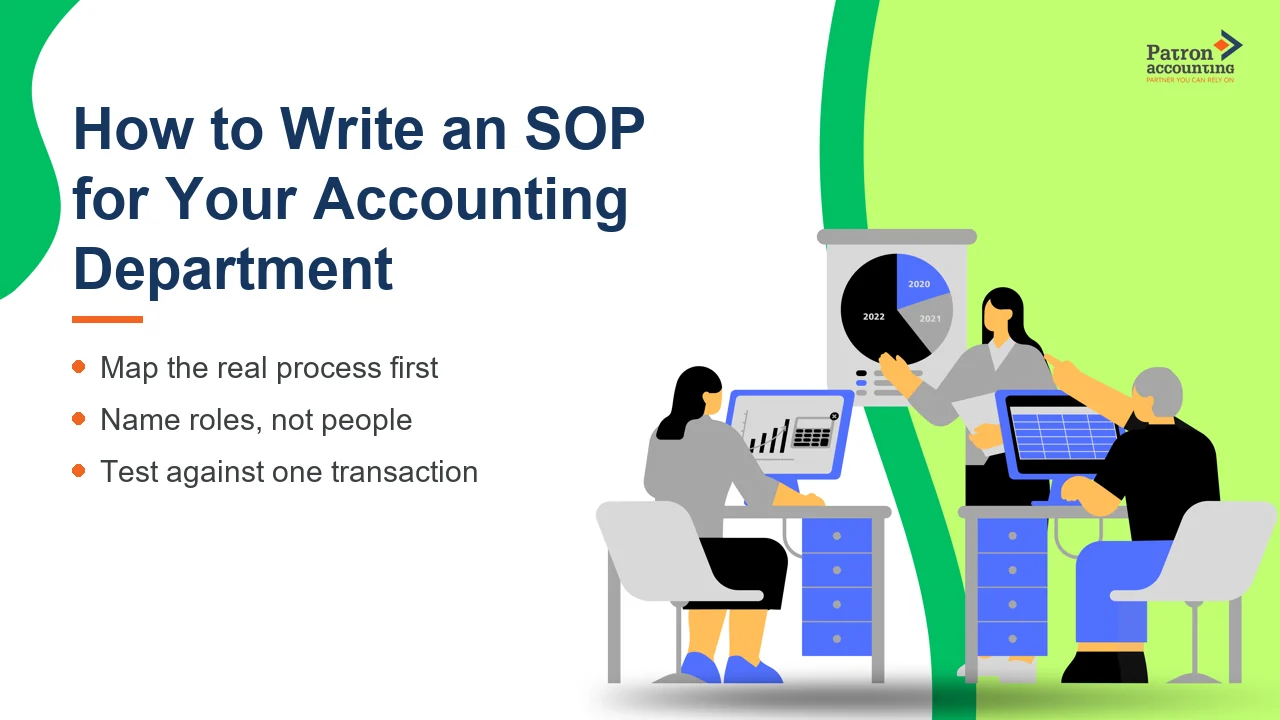
- Assign a role to every step. Never a name. "AP Executive", "Finance Manager", "Finance Head". The document must outlive any one employee.
- Add the controls. Insert the approval limits, the checks, the maker and checker split, and the exception route for anything that fails a check.
- Write the step table in plain language. One action per line, active voice, the system named, the timeline stated.
- Test the draft against one real transaction. Run a genuine invoice or receipt through the written steps. Every gap you hit is a line the SOP is missing.
- Get it approved and version it. The finance head signs it, you stamp version 1.0 with the effective date, and it goes live.
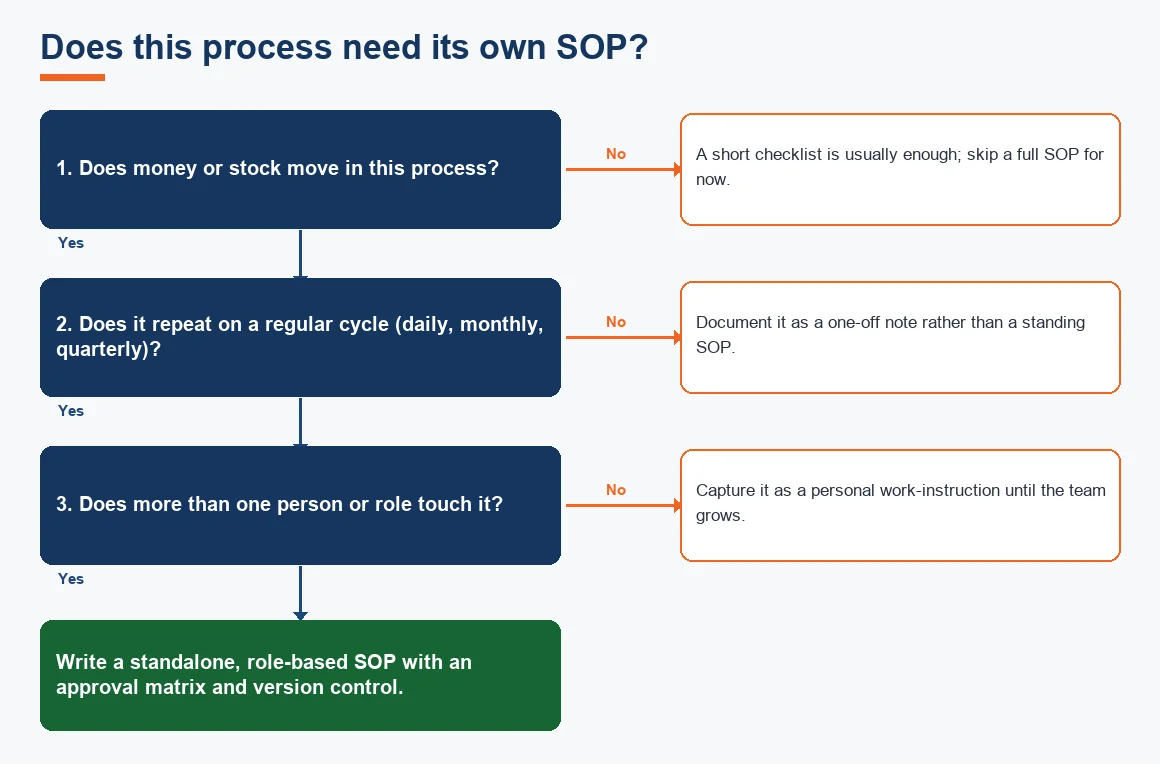
How do I start, and which processes need an SOP first?
Do not start with a master document of a hundred pages. Start with the one cycle where money moves and a mistake is expensive, write six to eight short SOPs over time, and link them. For a five-person finance team, short modular SOPs beat a single manual every time. The table below is a sensible priority order.
| Accounting process | Risk if left undocumented | Typical SOP owner | Priority |
|---|---|---|---|
| Purchase to payment | Duplicate or fraudulent payments, missed three-way matching | Accounts Payable | High |
| Sales to collection | Revenue slips, ageing receivables, GST mismatches | Accounts Receivable | High |
| Bank and cash | Unreconciled balances, cash leakage | Finance Manager | High |
| GST and TDS calendar | Late filing, interest and penalty | Compliance / Finance Head | High |
| Payroll | Wrong deductions, PF and PT errors | Payroll / HR-Finance | Medium |
| Month-end close | Delayed, unreliable reporting | Finance Manager | Medium |
| Fixed assets and inventory | Depreciation and valuation errors | Finance / Stores | Lower |
If your books are behind and you cannot write an SOP over a clean process, fix the backlog first with a backlog bookkeeping and catch-up exercise, then document the tidy version. The two payment-cycle SOPs above are treated in full in our accounts payable SOP template and checklist, and the close is covered in the month-end close SOP.
Worked example: a three-way match gate in a payments SOP
The most useful line in any accounts payable SOP is the tolerance rule: the point below which a small price difference is accepted and above which the invoice is queried. This is what an approval step looks like when you put numbers to it. Assume the SOP sets a 2% tolerance on the invoice base value and GST at 18%.
| Item | Purchase order | Vendor invoice | SOP check |
|---|---|---|---|
| Base value | ₹5,00,000 | ₹5,09,000 | Variance ₹9,000 |
| Variance % | , | , | 1.8% (within 2% limit) |
| GST @ 18% | ₹90,000 | ₹91,620 | Recompute on invoice base |
| Invoice total | ₹5,90,000 | ₹6,00,620 | Payable amount |
| Outcome | , | , | Auto-clears the executive for approval |
The arithmetic: variance of ₹9,000 on a ₹5,00,000 order is 1.8%, which sits inside the 2% tolerance, so the SOP lets the AP executive process it without escalation. Had the invoice base been ₹5,15,000, the 3% variance would breach tolerance and the SOP would route it to the finance manager with the purchase order and goods receipt attached. The SOP should also flag the annual TDS position: Section 194Q applies TDS at 0.1% on purchases from a single seller once they cross ₹50 lakh in the financial year, so the payment step must check the running total, not just the single bill. The rate and threshold are set by the Income Tax Department.
Building approvals and the audit trail into the SOP
Two statutory points belong in every Indian accounting SOP, and auditors now look for them. First, the approval matrix must be real and enforced, because where internal financial controls reporting applies, the board relies on it for the directors' responsibility statement under Section 134(5)(e) of the Companies Act, and the statutory auditor tests whether the SOP is actually followed, not merely whether it exists. Guidance on internal financial controls is published by the ICAI.
Second, the SOP must state that the accounting software's edit log stays switched on at all times. Rule 3(1) of the Companies (Accounts) Rules requires companies to use software with an audit trail that records every change and cannot be disabled, and the auditor reports on it separately under Rule 11(g) of the Companies (Audit and Auditors) Rules 2014. The requirement is set out by the Ministry of Corporate Affairs. Your GST and TDS steps should point at the return calendar on the GST portal so the dates in the SOP stay current.
Keeping the SOP alive: review and version control
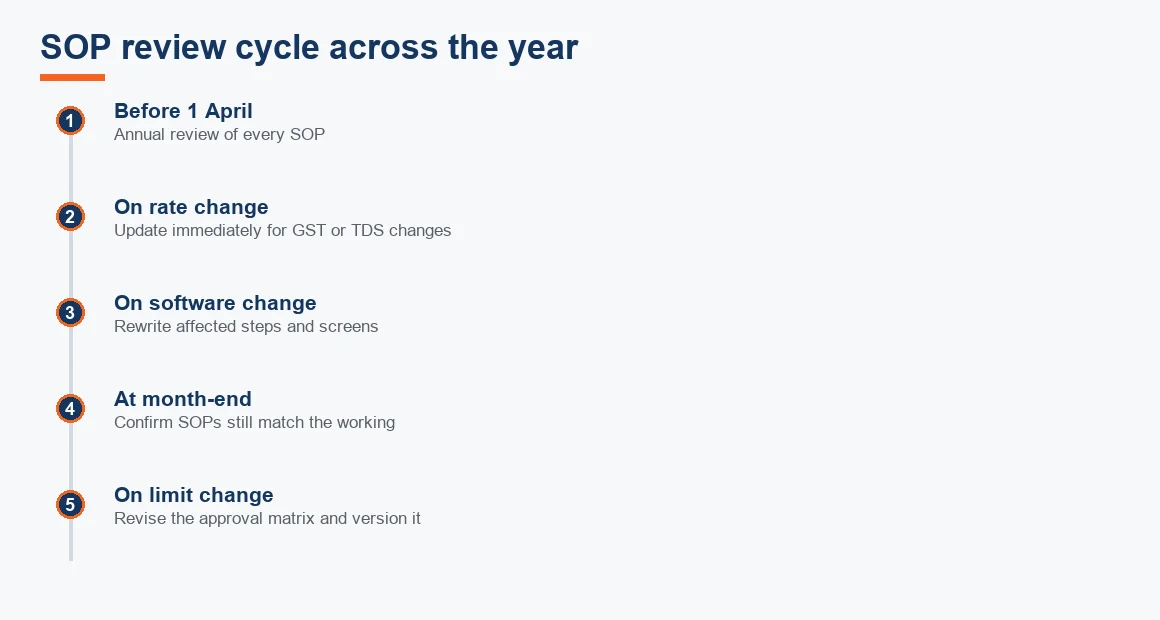
An SOP that is written once and filed is worse than no SOP, because it gives false comfort. Review each document once a year before 1 April, and immediately after any change of accounting software, GST or TDS rate, or approval matrix. Most teams find two or three revisions a year realistic. Keep the version number, the effective date and the approver on the front page, and never overwrite an old version silently. The month-end close is the natural moment to confirm the SOPs still match the working, using the same discipline as a month-end close checklist. Where an SOP touches the bank, tie it to a monthly bank reconciliation so the control is proven, not just described.
Key terms
- Standard Operating Procedure (SOP): a written, role-based description of how a specific task is done end to end.
- Financial Internal Controls: the checks that keep reported numbers reliable and assets protected.
- Segregation of Duties (SoD): splitting a task so no single person can both create and approve a transaction.
- Three-Way Matching: matching the purchase order, goods receipt and invoice before payment.
- Month-End Close Checklist: the standard list of tasks that close a period cleanly and on time.
When to get outside help
Writing the SOP is straightforward; running the process it describes, month after month, is the hard part. If your team is stretched, the honest options are to hand the underlying work to a documented external process, such as accounts payable outsourcing or accounts receivable outsourcing, or to have the SOPs drafted and embedded properly through a SOP drafting and implementation engagement. Either way, the same discipline applies to depreciation and asset SOPs too, where a depreciation calculator and an AS versus Ind AS comparison keep the numbers defensible.
Key takeaways
- Write the SOP from the process as it actually runs, then test it against one real transaction.
- Name roles, never people, so the document survives resignations.
- Keep SOPs short and modular, one per cycle, prioritising where money moves.
- State tolerances as percentages and put real monetary limits in the approval matrix.
- Build in the audit trail requirement and version every change with an effective date.
Decision guide