In this guide
If you run a product startup in Hinjewadi or Kharadi, ARR and MRR accounting is less about the ledger and more about keeping two very different views of your business honest at the same time. Annual Recurring Revenue (ARR) and Monthly Recurring Revenue (MRR) are the metrics your board and investors watch, but they are not accounting figures and never appear in the financial statements. This guide explains how a Pune SaaS company reconciles those growth metrics with statutory revenue under Ind AS 115 or AS 9, how deferred revenue behaves, and where GST and export rules bite. For the commercial engagement itself, our SaaS Accounting Services (IT & SaaS) page and the local SaaS Accounting Services (IT & SaaS) Pune page cover scope and pricing; this article stays on the how and why.
ARR and MRR: metrics, not ledger balances
MRR is the normalised monthly value of your active subscriptions, and ARR is simply MRR multiplied by twelve. They are management metrics used to measure momentum, so they are tracked in a billing system or a spreadsheet, not booked as journal entries. A common error we see in early-stage Hinjewadi companies is treating an ARR number as though it were sales in the profit and loss. It is not. ARR is measured net of churn: opening ARR plus new and expansion ARR, less contraction and churned ARR.
Because ARR blends in annual contracts that have only just been signed, it will almost always sit above the revenue your accounts actually recognise in the same period. That gap is normal and expected. The discipline is to reconcile the two: build an ARR bridge for the investors and a revenue recognition schedule for the statutory books, and make sure the underlying contract data feeding both is identical. A monthly contribution margin dashboard alongside a clean MRR figure is usually enough for a Series A conversation.
How Ind AS 115 recognises subscription revenue
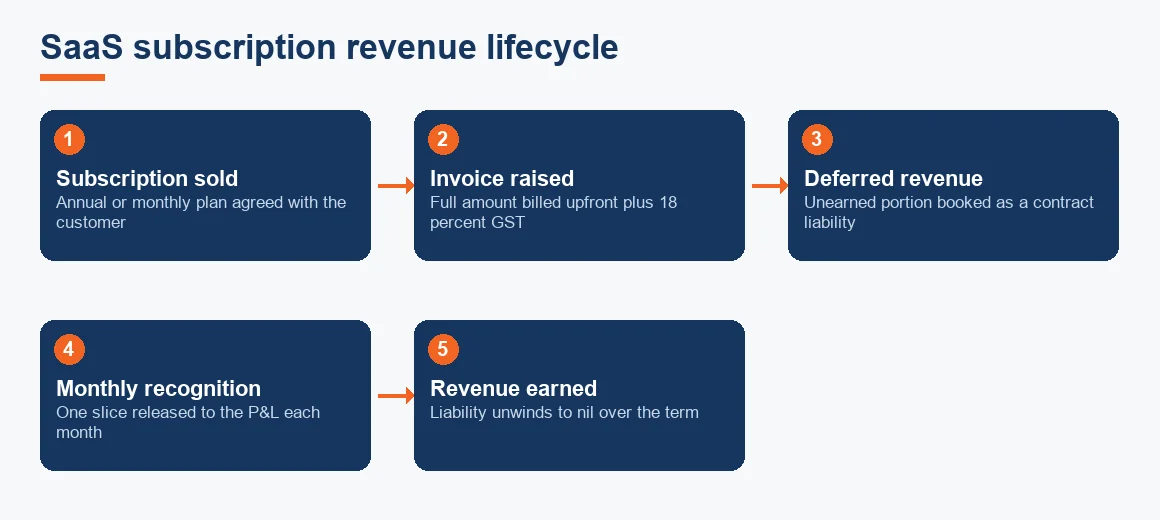
Ind AS 115 applies a five-step model: identify the contract, identify the performance obligations, determine the transaction price, allocate it to the obligations, and recognise revenue as each obligation is satisfied. For a straightforward SaaS subscription the performance obligation is providing access to the software over the term, so revenue is recognised evenly across the subscription period rather than when the invoice is raised. An annual plan billed upfront therefore turns into revenue one month at a time.
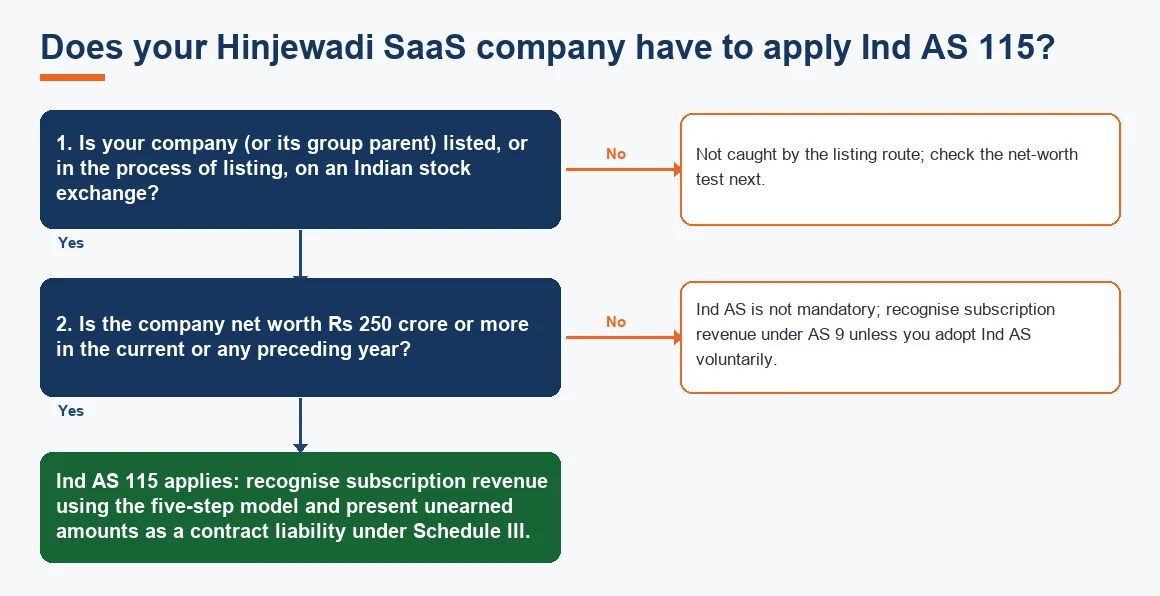
Whether you must apply Ind AS 115 at all depends on the applicability thresholds. Ind AS is mandatory for listed companies and for companies with net worth of Rs 250 crore or more; most Pune startups below that line follow AS 9 instead, which reaches broadly the same monthly recognition outcome for a simple subscription. If your topology is more complex (usage-based tiers, implementation fees, multi-year deals with discounts), the allocation step matters and it is worth confirming applicability first. Our Ind AS Applicability Checker walks through the net-worth and listing tests. For deeper treatment of the broader IT engagement model, see our IT & Software Company Accounting Services.
Deferred revenue and the contract liability
When you invoice an annual plan upfront, the money you have collected but not yet earned is a liability, not income. Under Ind AS 115 it is presented as a contract liability within other current liabilities, and Schedule III requires the current portion to be shown separately from any amount running beyond twelve months. As you deliver the service, the liability unwinds and revenue flows into the profit and loss. This is why a fast-growing SaaS company can look cash-rich and revenue-modest at the same time.
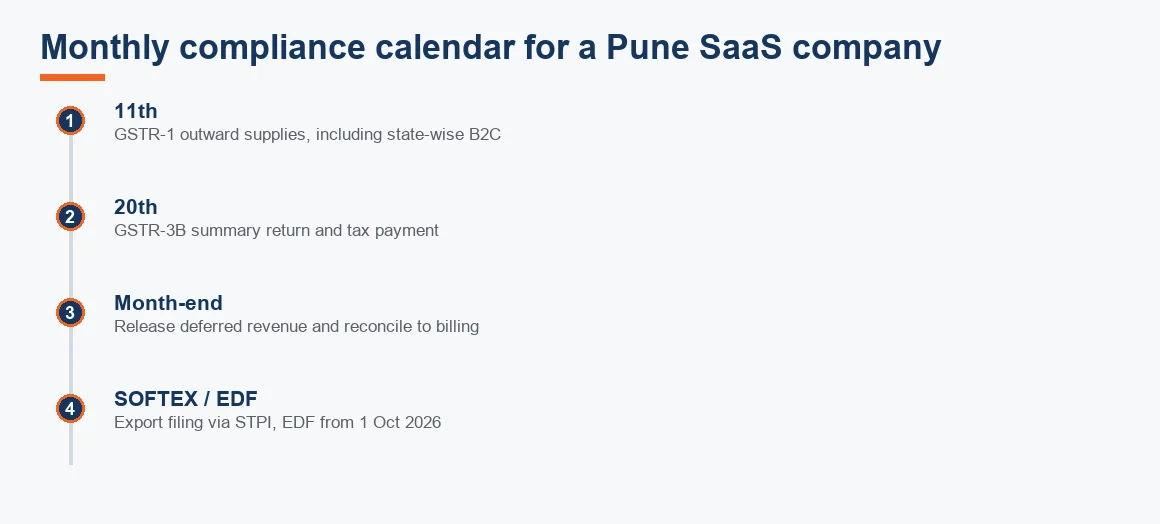
The mechanics are simple once the schedule is set up, and we work them through in the example below. The heavier lifting is discipline at month-end: releasing the right slice, handling mid-term upgrades and cancellations, and making sure the balance sheet figure ties back to the billing system. For the month-end rhythm around this, our monthly bookkeeping and MIS checklist for Pune businesses is a useful companion, and the underlying presentation follows the Schedule III balance sheet format.
Where customer acquisition costs sit
Incremental costs of obtaining a contract, mainly sales commissions that you would not have paid had the deal not closed, are capitalised under Ind AS 115 and amortised over the expected customer relationship, not just the initial contract term. There is a practical expedient: where the amortisation period would be one year or less, you may expense these costs as incurred. Salaries and general marketing spend that you would have incurred regardless of any single contract stay in the profit and loss as normal operating costs. Getting this line right matters for early SaaS margins, because expensing all commissions upfront understates the true unit economics your investors are underwriting.
GST on SaaS subscriptions from Pune
SaaS is a supply of service. When a Pune company sells a subscription to a GST-registered customer in Bengaluru, the place of supply is the recipient's location, so it is an inter-state supply and IGST at 18 percent applies. The Bengaluru customer claims that IGST as input tax credit, but only if your invoice carries the correct GSTIN and state code, because a wrong code keeps the credit out of their GSTR-2B. The statutory basis for place of supply sits in the IGST Act; the CBIC portal at cbic-gst.gov.in carries the current rules and rate notifications.
For sales to unregistered customers, inter-state B2C invoices must be reported invoice-wise and state-wise once the invoice value exceeds Rs 2.5 lakh, while smaller invoices go into the consolidated table. The GST Council has recommended cutting this limit to Rs 1 lakh, but that change is not yet notified, so the Rs 2.5 lakh threshold still applies; watch for the notification and check your billing export before you file. The official return specifications are on the GST portal at gst.gov.in.
Setting up SaaS books: a step-by-step
A clean set-up removes most month-end pain. The sequence we use for a new Hinjewadi or Kharadi SaaS client is:
- Map every plan in the billing system to a single ledger for subscription revenue and a matching deferred revenue ledger.
- Decide the recognition rule per plan (monthly straight-line for standard subscriptions; separate obligations for one-off implementation or onboarding fees).
- Configure GST correctly: 18 percent, place of supply by customer location, and separate handling for export invoices (see the local angle below).
- Set the commission capitalisation policy and the one-year expedient in writing, so treatment is consistent.
- Build the monthly close: release deferred revenue, reconcile the liability to the billing system, and refresh the ARR bridge from the same data.
If you are moving from a founder-run spreadsheet to a proper stack, our guidance on Startup Accounting Services India and the Pune-specific startup accounting page set out the wider compliance calendar a funded company carries.
AS 9 versus Ind AS 115 for a SaaS subscription
For a plain annual subscription the two frameworks land in a similar place, but the presentation and the edge cases differ. This summary helps a Pune founder judge which they are subject to and what changes if they cross the threshold.
| Point | AS 9 | Ind AS 115 |
|---|---|---|
| Applies to | Companies below the Ind AS net-worth threshold | Listed companies and net worth Rs 250 crore or more |
| Subscription revenue | Recognised over the service period | Recognised as the access obligation is satisfied (five-step model) |
| Unearned amount | Advance from customers / deferred revenue | Contract liability, split current and non-current under Schedule III |
| Sales commissions | Generally expensed as incurred | Capitalised and amortised, with a one-year expedient |
| Multi-element deals | Limited explicit guidance | Explicit allocation to each performance obligation |
Worked example: deferred revenue schedule
Take a Kharadi SaaS company that sells a Rs 24,00,000 annual plan (indicative and Exl GST) to a domestic customer, invoiced on 1 January and recognised evenly over twelve months. On the invoice date the whole amount is a contract liability; only Rs 2,00,000 becomes revenue each month. At 31 March, three months in, Rs 6,00,000 has been recognised and Rs 18,00,000 remains deferred. The journal on invoice is: debit trade receivable Rs 28,32,000, credit deferred revenue Rs 24,00,000, credit output IGST Rs 4,32,000. Each month, debit deferred revenue Rs 2,00,000 and credit subscription revenue Rs 2,00,000.
| Month | Revenue recognised (Rs) | Cumulative revenue (Rs) | Deferred revenue balance (Rs) |
|---|---|---|---|
| 1 Jan (invoice) | 0 | 0 | 24,00,000 |
| January | 2,00,000 | 2,00,000 | 22,00,000 |
| February | 2,00,000 | 4,00,000 | 20,00,000 |
| March | 2,00,000 | 6,00,000 | 18,00,000 |
| April to December | 18,00,000 | 24,00,000 | 0 |
The Rs 18,00,000 sitting at 31 March is the figure your auditor will trace to the balance sheet, and it must reconcile to the open contract in your billing system.
The Hinjewadi and Kharadi export angle
Much of Pune's SaaS revenue is exported, and that changes the compliance picture. A software export is a zero-rated supply under GST, so you can supply under a Letter of Undertaking without paying IGST, or pay and claim a refund. Export receipts also bring foreign-exchange documentation: at present, software exporters file SOFTEX through STPI, but under the revised FEMA export regulations that monthly SOFTEX route gives way to monthly EDF filing from 1 October 2026, with AD banks certifying on par with STPI. Building that change into your 2026 close now avoids a scramble. The RBI is the authority here, at rbi.org.in.
On direct tax, note that the Section 10AA SEZ deduction has a sunset: units that commenced operations on or after 1 April 2021 are not eligible, so a new Hinjewadi IT-park unit cannot assume the old holiday. Older STPI income-tax holidays under Sections 10A and 10B expired years ago, and STPI today is an export-monitoring and SOFTEX/EDF filing function rather than a tax break; the treatment of that software export revenue should be confirmed on the Income Tax portal at incometax.gov.in before you model any deduction. If your product also sells through app marketplaces, the treatment of platform deductions overlaps with our E-Commerce Accounting Services.
Choosing local help and benchmarking cost
SaaS books reward an accountant who understands recognition and export rules, not just data entry. If you are comparing options across Hinjewadi, Kharadi and Baner, our guide on how to choose an accountant in Pune and the 2026 cost of accounting and bookkeeping in Pune benchmarks set realistic expectations. Product companies with a hardware or device line should also read our note on costing and inventory accounting for Pune's Chakan-Pimpri makers, and general bookkeeping needs are covered by our accounting and bookkeeping services in Pune.
Key terms
- Ind AS 115 Revenue Recognition: the five-step standard that spreads subscription revenue over the service period.
- Deferred Revenue (Unearned Revenue): money invoiced but not yet earned, shown as a contract liability.
- Monthly Recurring Revenue (MRR): the normalised monthly subscription value used as a growth metric, not an accounting figure.
- STPI / SOFTEX Export Filing: the foreign-exchange documentation route for software exports, moving to monthly EDF from 1 October 2026.
Key takeaways
- ARR and MRR are board metrics; statutory revenue follows Ind AS 115 or AS 9 and will usually read lower in the same period.
- An upfront annual plan is a contract liability first and revenue later: release it monthly and tie the balance to your billing system.
- Inter-state B2B SaaS carries IGST at 18 percent; correct GSTIN and state code protect your customer's input credit.
- Inter-state B2C invoices above Rs 2.5 lakh need invoice-wise, state-wise GSTR-1 reporting; a proposed cut to Rs 1 lakh is not yet notified.
- Pune exporters should plan for the SOFTEX-to-EDF shift on 1 October 2026 and check Section 10AA eligibility before modelling any holiday.
Decision guide