In this guide
For a Mumbai software or SaaS company, three accounting questions come up again and again: how to book subscription revenue that is billed upfront, how to record the cost of employee stock options, and how a unit inside the SEEPZ special economic zone treats its export sales. This explainer walks through revenue recognition and ESOP accounting for Mumbai SaaS startups in plain terms, with the local SEEPZ angle folded in. It is an informational guide; if you want the work done for your books, the commercial SaaS Accounting Services (IT & SaaS) Mumbai page and the national SaaS Accounting Services (IT & SaaS) service page are the right starting points.
What SEEPZ SEZ status means for a Mumbai software unit
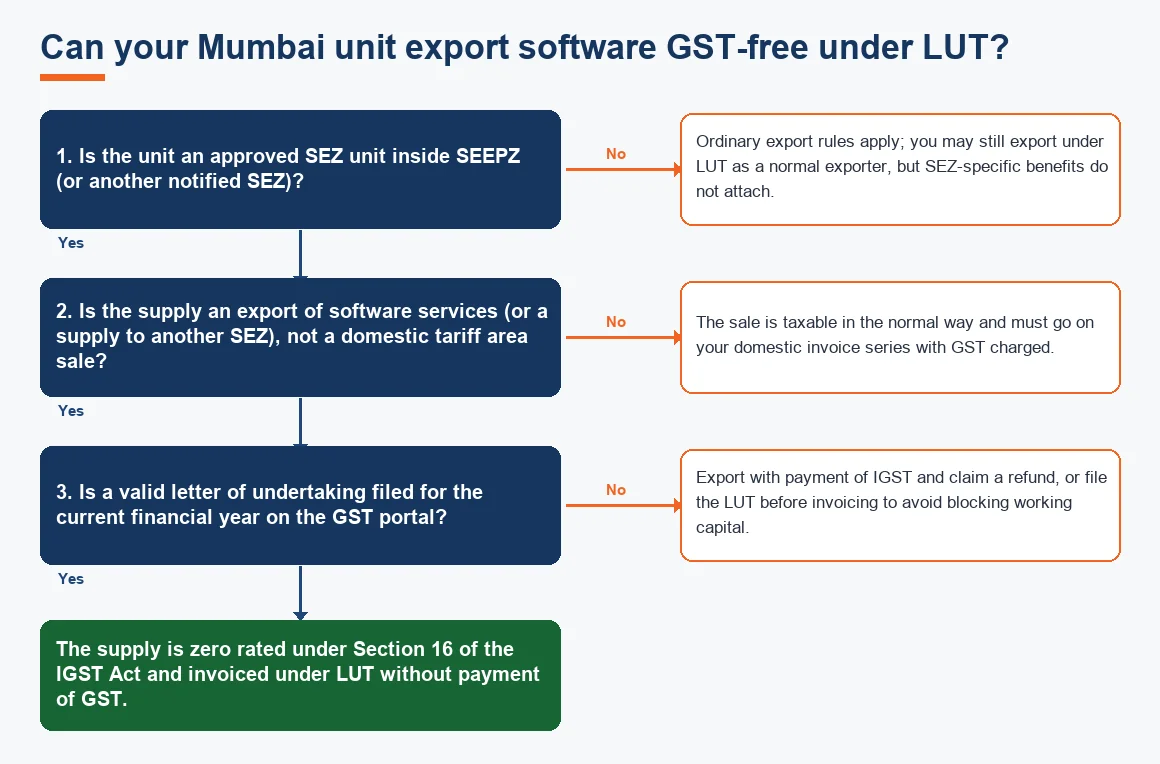
SEEPZ, the Santacruz Electronics Export Processing Zone in Andheri East, is a special economic zone notified under the SEZ Act 2005. It houses gems and jewellery units alongside IT and software companies. The accounting consequence is simple to state and easy to get wrong: a unit inside the zone is treated as being outside the customs territory of India for supply purposes. Sales of software services to and from the zone for export are zero rated, while any sale the same unit makes into the domestic tariff area (the rest of India) is taxable in the ordinary way.
That split is the heart of SEEPZ accounting. The books must keep zone output separate from domestic tariff area sales, ideally on distinct invoice series, so that the export turnover and the taxable turnover never blur into one figure at the year end. Getting this structure right early avoids painful reconciliation later, a point the Audit-Readiness & Book-Cleanup Checklist for Mumbai Businesses covers for any Mumbai company.
How SaaS subscription revenue is recognised under Ind AS 115
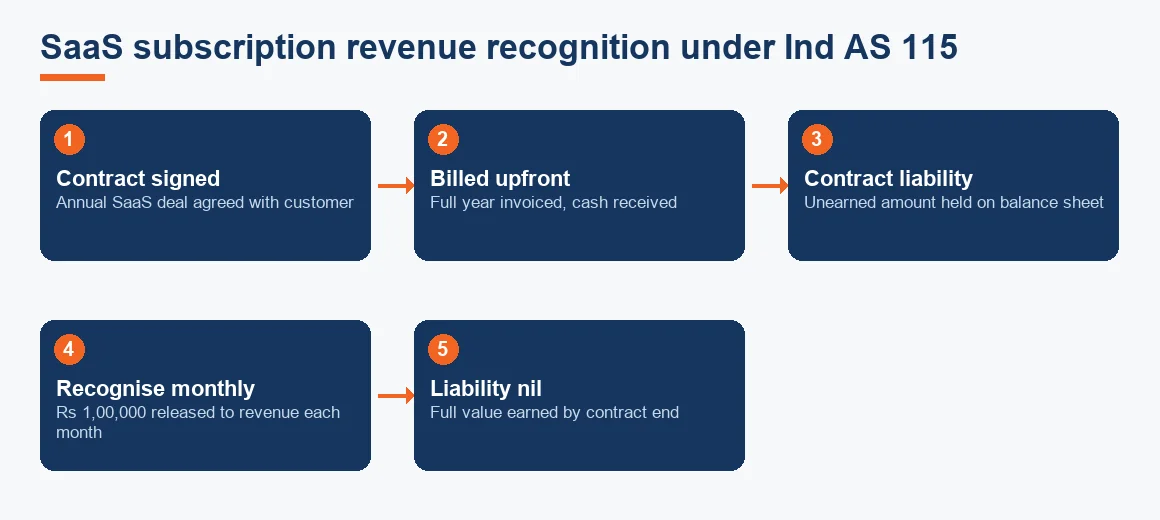
Subscription revenue is recognised evenly over the subscription period, because the customer consumes the benefit of continuous access as it is provided rather than at the moment of billing. Under Ind AS 115, an annual contract of Rs 12,00,000 billed upfront is recognised at Rs 1,00,000 a month, and the amount not yet earned sits on the balance sheet as a contract liability, commonly called deferred revenue.
One time setup or onboarding fees rarely qualify as a separate performance obligation, because the customer cannot benefit from setup on its own without the ongoing service. They are usually spread over the contract term as well, or over the expected customer life if that is longer. The same treatment underlies how you read monthly recurring revenue: recognised revenue, not cash collected, is the honest measure of a SaaS book.
ESOP accounting: the grant-date fair value charge
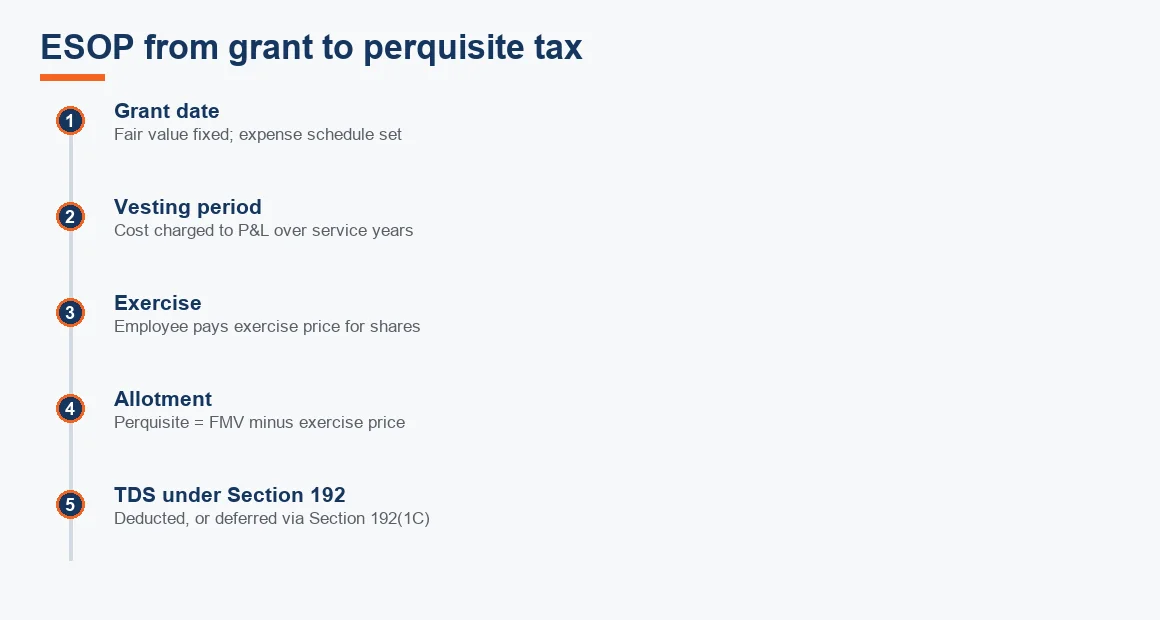
Employee stock options are an expense, even though no cash leaves the company. The charge equals the fair value of the option at the grant date, spread over the vesting period as an employee benefit expense, with a matching credit to a stock options outstanding account within equity. An option valued at Rs 300 vesting evenly over three years creates a charge of Rs 100 a year.
Which standard applies depends on your reporting framework. Companies on Ind AS apply Ind AS 102; companies still on the older Accounting Standards follow the ICAI Guidance Note on Employee Share-based Payments. Both push the cost through the profit and loss account over the service period rather than in one lump at grant. If your options vest in tranches rather than evenly, the cost follows a graded vesting pattern, front loading the expense. If you are unsure whether Ind AS applies to your company at all, the Ind AS Applicability Checker settles it against the turnover and net worth thresholds.
GST on software exported from a SEEPZ SEZ unit
No GST is charged on software services exported by an SEZ unit. Such a supply is zero rated under Section 16 of the IGST Act, and the unit exports under a letter of undertaking (LUT) without payment of tax, as set out by the Central Board of Indirect Taxes and Customs. The LUT is filed once a year on the GST portal and lets you invoice foreign customers, and DTA-to-SEZ suppliers invoice you, without blocking working capital in tax that would otherwise be claimed back as a refund.
Two housekeeping points matter. First, sales from the same unit into the domestic tariff area are taxable normally, which is why the invoice series for zone and domestic sales must stay separate. Second, export of software still carries filing obligations beyond GST: banking realisation and, until the STPI regime fully transitions, SOFTEX filing. For the income tax profit link, note the Section 10AA SEZ deduction that a qualifying unit may claim on export profits.
Key terms
- Ind AS 115 Revenue Recognition: the standard that spreads subscription income over the service period.
- Deferred Revenue: cash billed but not yet earned, held as a contract liability.
- Ind AS 102 Share-based Payment: the standard governing the ESOP expense charge.
- Software Export Revenue (Section 10AA SEZ): the income tax deduction on SEZ export profits.
Perquisite tax on ESOPs and the startup deferral
The company charge and the employee tax are two different events. Tax in the employee's hands arises on allotment of the shares, computed as the fair market value on the exercise date minus the exercise price, and the employer deducts it under Section 192 as salary perquisite. This is a well known cash flow problem: the employee owes tax on paper gains before selling a single share.
Relief exists for genuine startups. An employee of a DPIIT recognised eligible startup under Section 80-IAC gets a deferral under Section 192(1C): the TDS falls due within 14 days of the earliest of three dates, being 48 months from the end of the relevant assessment year, the date the shares are sold, or the date the employee leaves. The rule and the eligibility conditions are set out by the Income Tax Department. Many Mumbai SaaS teams qualify but never claim the deferral because payroll was not set up to flag it, so confirm your DPIIT recognition status before the first exercise window.
Worked example: annual SaaS contract recognised quarter by quarter
Take a Mumbai SaaS company that signs a one year contract for Rs 12,00,000 (indicative, Exl GST), billed in full on 1 April. Under Ind AS 115 the revenue is earned at Rs 1,00,000 a month, so the contract liability unwinds evenly across the year. The schedule below shows the position at each quarter end.
| Period | Revenue recognised (cumulative) | Contract liability (period end) |
|---|---|---|
| 1 April (billed) | Rs 0 | Rs 12,00,000 |
| Quarter 1 (Apr to Jun) | Rs 3,00,000 | Rs 9,00,000 |
| Quarter 2 (Jul to Sep) | Rs 6,00,000 | Rs 6,00,000 |
| Quarter 3 (Oct to Dec) | Rs 9,00,000 | Rs 3,00,000 |
| Quarter 4 (Jan to Mar) | Rs 12,00,000 | Rs 0 |
At each month end you pass one journal entry: debit the contract liability and credit subscription revenue with Rs 1,00,000. By 31 March the liability is fully released and the entire Rs 12,00,000 has hit the profit and loss account, matching the service actually delivered.
SEZ versus domestic tariff area treatment at a glance
The single biggest structural decision for a SEEPZ unit is keeping the two sales streams apart. This table summarises how each stream is treated, so the books, the GST returns and the income tax computation all agree.
| Feature | SEZ export supply (SEEPZ unit) | Domestic tariff area supply |
|---|---|---|
| GST treatment | Zero rated under Section 16, IGST Act | Taxable at the applicable rate |
| Documentation | Export under LUT, no tax paid | Standard tax invoice with GST |
| Invoice series | Separate export series | Separate domestic series |
| Income tax link | Section 10AA deduction may apply | Normal taxable profit |
| Currency | Usually foreign currency, realisation tracked | Indian rupees |
A month-end close for a Mumbai SaaS startup
A clean close each month is what keeps revenue recognition and ESOP accounting honest rather than a year end scramble. A workable sequence:
- Reconcile the bank, including any foreign currency receivable account, and confirm export realisations against invoices.
- Release the earned slice of every subscription contract from the contract liability to revenue.
- Post the monthly ESOP expense based on the grant-date fair value schedule.
- Split zone and domestic sales, and tie the GST output back to each ledger before filing.
- Review deferred revenue and unbilled balances so the balance sheet tells the true story.
Related Mumbai reading sits alongside this: the Cost of Outsourced Accounting in Mumbai: 2026 Price Benchmarks if you are budgeting the work, How to Choose an Accountant in Mumbai if you are hiring, and the Maharashtra Professional Tax & Shops Act guide for the payroll side that ESOP payouts touch. If your model is closer to a marketplace or storefront than pure subscriptions, E-Commerce Accounting Services covers that pattern, while broader technology bookkeeping lives under IT & Software Company Accounting Services and early stage funding accounting under Startup Accounting Services India. For the general Mumbai bookkeeping baseline, see Accounting & Bookkeeping Services in Mumbai.
Key takeaways
- A SEEPZ unit's software exports are zero rated under Section 16 of the IGST Act and go out under an LUT; domestic tariff area sales from the same unit are taxable and must run on a separate invoice series.
- Under Ind AS 115, subscription revenue is spread over the service period; upfront billing sits as a contract liability that unwinds month by month.
- ESOP cost is the grant-date fair value charged over the vesting period, under Ind AS 102 or the ICAI Guidance Note depending on your framework.
- Employee perquisite tax on ESOPs arises on allotment, but a DPIIT recognised eligible startup can defer the TDS under Section 192(1C).
- A disciplined monthly close keeps revenue, deferred income and the ESOP charge accurate all year.
Decision guide