In this guide
The functions of accounting are the separate jobs an accounting system performs on every business transaction: recording it, classifying it into accounts, summarising the accounts, analysing and interpreting what the numbers say, communicating that to the people who need it, keeping the business compliant with statute, and safeguarding its assets. Different textbooks group these into five or seven headings, but the workflow is one continuous chain. This article explains each function, shows which ones Indian law makes compulsory, and walks one transaction through the whole cycle. It is a concept explainer: if you want the commercial scope of the work, see our scope checklist on what an accounting service actually includes.
What are the functions of accounting?
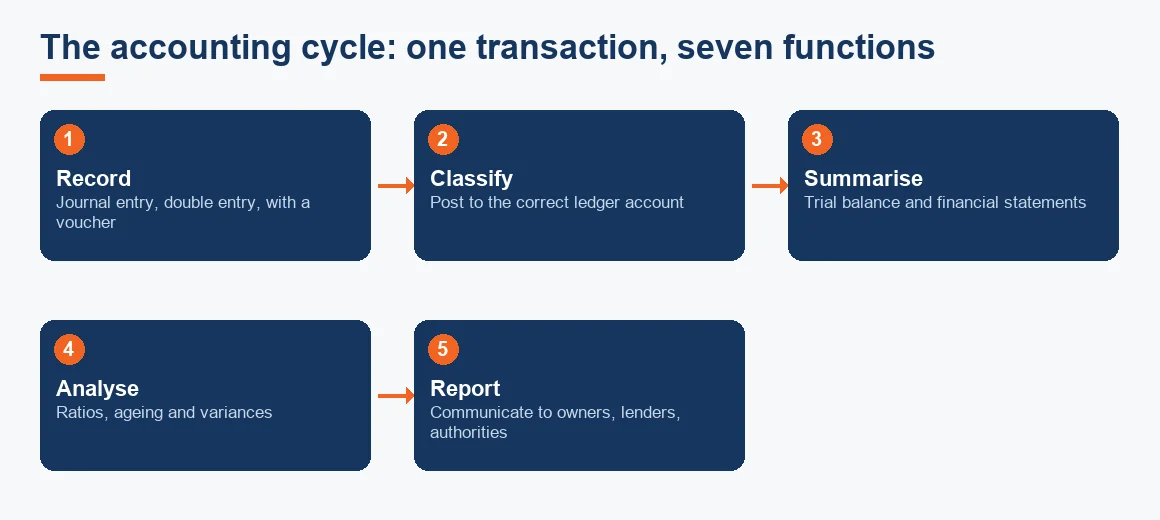
Accounting is often reduced to "keeping the books", but recording is only the first of several functions. The system exists to convert raw transactions into information that owners, lenders, tax authorities and the statutory auditor can rely on. Whether a syllabus lists five functions or seven, each one adds a layer of processing on top of the last. The seven functions we use below are recording, classifying, summarising, analysing, interpreting and communicating, plus the compliance and control work that Indian statute layers on top. If you want to see how these functions map onto the different specialisms (financial, cost, management and so on), our companion piece on the 12 branches of accounting covers that split.
What is the first function of accounting? Recording
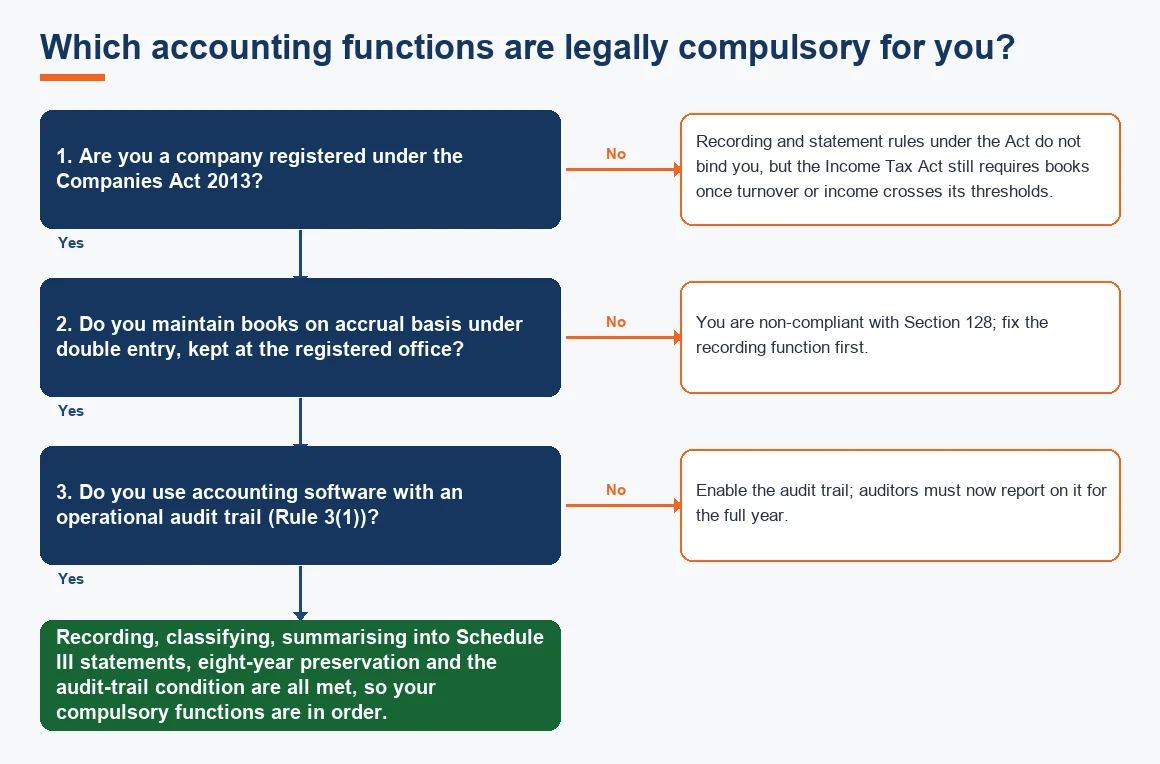
The first function is recording, also called bookkeeping. Every transaction is entered in the books of original entry as a journal entry, using double-entry bookkeeping so that each debit has an equal credit. Recording must be complete, dated and supported by a voucher: an invoice, a bank statement line, a payroll register. In India this function is not optional for a company. Section 128 of the Companies Act 2013 requires books of account to be kept on an accrual basis under the double-entry system, maintained at the registered office and preserved for eight financial years. From the software side, Rule 3(1) of the Companies (Accounts) Rules requires accounting software that carries an audit trail, so the recording function now has a technology condition attached to it.
Classifying and summarising: from ledger to trial balance
The second function, classifying, moves each journal entry into its proper account in the general ledger: sales, purchases, rent, a particular bank account, a particular debtor. This is where the chart of accounts does its work, sorting hundreds of scattered entries into a handful of meaningful heads.
The third function, summarising, totals those ledger accounts and pulls the balances into a trial balance, then into the financial statements: the balance sheet, the statement of profit and loss and the cash flow statement. For an Indian company this summarising output is not free-form. Section 129 requires the financial statements to follow the Schedule III format, prepared under Accounting Standards or Ind AS as notified by the Ministry of Corporate Affairs and the standards issued by the ICAI.
Analysing and interpreting the numbers
The fourth and fifth functions are where accounting stops describing the past and starts informing decisions. Analysing means breaking the summarised figures into ratios and trends: gross margin, working capital, days sales outstanding, the ageing of receivables. Interpreting means explaining what those movements mean for the business, for example that margin fell because a costlier supplier was used, not because prices dropped. This is the heart of management accounting, which is internal, has no prescribed format and is never filed with the MCA. That freedom is exactly why a monthly management information pack can follow whatever cost-centre structure the business needs, unlike the rigid statutory statements.
Reporting and communicating to external users
The sixth function is communicating: presenting the interpreted information to the people entitled to it. Different audiences need different reports. Owners and boards want the management pack. Lenders want the audited financials and key ratios. The Income Tax Department and the GST authorities want the figures in prescribed returns. The statutory auditor tests the trail that recording and summarising created before reporting under Section 143. This is the function that separates financial accounting (output for outsiders, governed by statute) from management accounting (output for insiders, governed by usefulness). If you are weighing up who should own this reporting layer, our note on CA vs ACCA vs CPA for a business is a useful read.
The compliance and control function: what the law makes compulsory
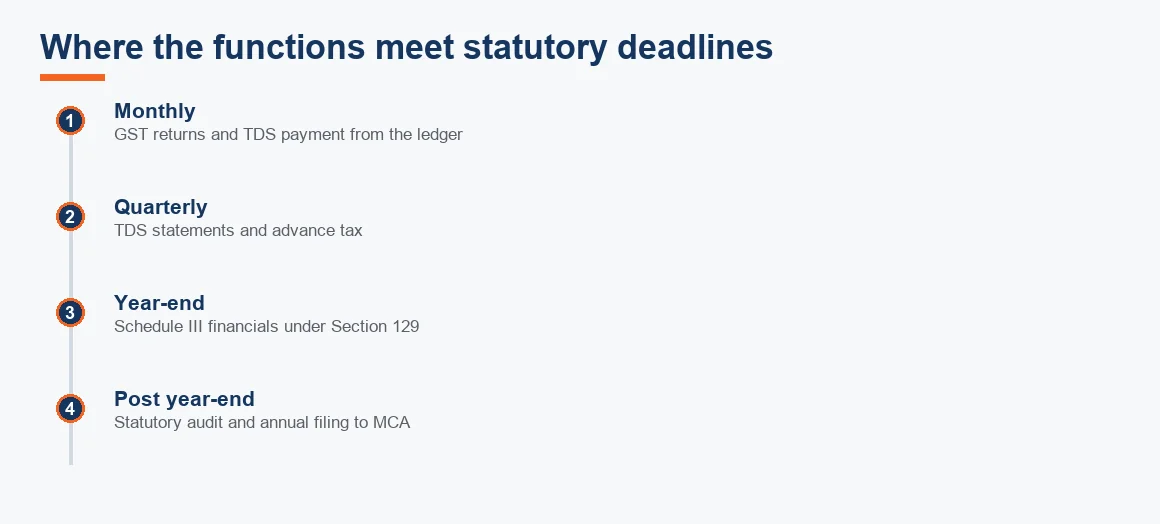
The seventh function bundles two duties that Indian statute makes non-negotiable: compliance and safeguarding assets. Compliance means the accounting system must feed accurate figures into the statutory calendar, GST returns, TDS statements, advance tax and the annual filing, on the deadlines set by law rather than by internal convenience. Safeguarding means internal controls, reconciliations and segregation of duties that protect assets and keep the records reliable. Reconciliation sits squarely inside this function: matching the books to the bank and to vendor statements, which is why it is usually paired with reconciliation and audit support. Three functions in particular are compulsory for a company, and the table below separates the legal duties from the good-practice ones.
The 7 functions of accounting at a glance
The table summarises each function, the output it produces, and whether Indian statute makes it compulsory for a company.
| Function | What it produces | Statutory position (company) |
|---|---|---|
| 1. Recording | Journal entries, day books | Compulsory: Section 128, accrual + double entry |
| 2. Classifying | Ledger accounts | Compulsory (part of books of account) |
| 3. Summarising | Trial balance, financial statements | Compulsory: Section 129, Schedule III |
| 4. Analysing | Ratios, ageing, variances | Good practice, not prescribed |
| 5. Interpreting | Management commentary, MIS | Good practice, no prescribed format |
| 6. Communicating | Reports, returns, audited accounts | Compulsory where a return or filing is due |
| 7. Compliance and control | Reconciliations, filings, internal controls | Compulsory for filings; controls expected |
Worked example: one sale through the accounting cycle
To see the functions connect, follow a single credit sale of goods worth Rs 1,00,000 (indicative, Exl GST at 18%) through recording, classifying and summarising. The journal entry captures the sale and the GST liability; the ledger classifies each leg; the trial balance proves the books still balance.
| Step / Account | Debit (Rs) | Credit (Rs) |
|---|---|---|
| Recording: Debtor A/c | 1,18,000 | - |
| Recording: Sales A/c | - | 1,00,000 |
| Recording: Output GST A/c | - | 18,000 |
| Summarising: Trial balance totals | 1,18,000 | 1,18,000 |
The debit of Rs 1,18,000 to the debtor equals the credit of Rs 1,00,000 to sales plus Rs 18,000 of output GST, so the trial balance stays equal. The recording function created the entry, classifying sent each leg to its ledger, and summarising rolled the balances up. Analysing this same figure later (is the debtor paying on time?) is the next function in the chain, and it draws on the very same data.
Is it 5 functions or 7? And the two main functions
The count depends on how finely you split the chain. A Class 11 syllabus often lists five functions (recording, classifying, summarising, analysing and interpreting, communicating) by folding compliance and control into the others. Seven-function lists pull compliance and safeguarding out as separate duties, which suits the Indian statutory environment better. The five basic functions of an accounting department are usually described operationally: accounts payable, accounts receivable, banking and reconciliation, payroll, and reporting. And the two main functions, stripped to the core, are financial accounting (producing statements for external users under Schedule III and the Income Tax Act) and management accounting (producing internal information for decisions). Everything else is a subdivision of those two. For how a firm prices this ongoing work, see our guide to what a CA charges for monthly accounting in India.
Where the functions live in your business
In a company with turnover near Rs 50 crore, the recording, classifying and reconciliation functions typically occupy four to six people, while analysis and reporting sit with a finance lead or an outsourced partner. Whether you keep this in-house or hand it to accounting and bookkeeping services in India depends on scale, but the functions themselves do not change. The full menu of what the system covers, across process, software and industry, is set out on the accounting and bookkeeping hub. Statutory rate and threshold checks along the way (for example depreciation or Ind AS applicability) can be run through our depreciation calculator and AS vs Ind AS comparison matrix.
Key terms
- Double-Entry Bookkeeping: the method where every transaction posts an equal debit and credit.
- Journal Entry: the first record of a transaction in the books of original entry.
- General Ledger: the master set of accounts into which entries are classified.
- Trial Balance: a list of ledger balances used to check that debits equal credits.
- Accrual Accounting: recognising income and expense when earned or incurred, as Section 128 requires.
Key takeaways
- The functions of accounting are one chain: record, classify, summarise, analyse, interpret, communicate, and stay compliant and controlled.
- The first function is always recording; the two main functions are financial accounting for outsiders and management accounting for insiders.
- For an Indian company, recording (Section 128), statement preparation (Section 129, Schedule III) and eight-year record preservation are legally compulsory.
- Bookkeeping covers only the first three functions. Analysis, reporting and compliance are what turn a ledger into decisions and filed returns.
Decision guide