
In this guide
An accounting service is a packaged set of tasks that keeps a business's financial records accurate, compliant and useful for decisions. In practice, what is included in accounting services falls into three tiers: recurring monthly bookkeeping (recording transactions, reconciling banks, scrutinising ledgers), periodic statutory filings (GST returns, TDS payments and returns, ROC forms) and annual work (financial statements and the income tax return). The trap most owners fall into is assuming all three sit inside one flat monthly fee. They usually do not, and the only reliable way to know what you are paying for is a written scope that names each deliverable. This guide sets out the full menu so you can read any proposal with a clear eye.
What is included in accounting services: the core scope
At its heart, an accounting service converts raw paperwork into a set of reliable numbers. The recurring core that almost every engagement includes covers voucher and invoice entry, bank and card reconciliation, ledger scrutiny to catch misposted entries, and a monthly or quarterly set of reports. The recording is built on double-entry bookkeeping, so every transaction hits two accounts and the general ledger stays self-balancing. At month-end the accountant draws a trial balance to confirm debits equal credits before any report is issued. For a fuller commercial menu of what a provider actually delivers, see our Accounting & Bookkeeping Services in India page, and for the process, software and industry breakdown see the Accounting & Bookkeeping HUB.
What are the types of accounting services?
Business owners searching for the 8 types of accounting are usually looking for the same practical list, described in slightly different ways. The common types of accounting services are:
- Financial accounting: recording transactions and producing the balance sheet, profit and loss and cash flow statements.
- Bookkeeping: the day-to-day recording layer that feeds everything else.
- Management (MIS) accounting: internal dashboards, margins and variance reports for decisions, covered by our MIS reporting services.
- Tax accounting: GST, TDS and income tax computation and returns.
- Cost accounting: product, project or job costing for manufacturers and service firms.
- Payroll accounting: salaries, PF, ESIC and professional tax.
- Statutory compliance: ROC filings and audit support.
- Forensic and advisory: investigations, due diligence and one-off reviews.
These map onto the wider discipline covered in our explainer on the 12 branches of accounting. Not every business needs all eight; a small trading firm may only take financial accounting, bookkeeping and tax, while a manufacturer will add cost and payroll accounting.
What are the 4 areas and 7 functions of accounting?
The 4 areas (sometimes called the 4 pillars) are usually given as recording, classifying, summarising and reporting or interpreting. The 7 functions of accounting extend this into recording, classifying, summarising, analysing, reporting, forecasting or budgeting, and ensuring compliance. Rather than repeat that framework here, we cover it in depth in the 7 functions of accounting and why each matters for compliance. The point for scoping is simple: a good accounting service should touch every one of these functions, not just the recording step. If a provider only enters vouchers and stops, you are buying bookkeeping, not accounting.
Accounting services vs bookkeeping services: the difference
Bookkeeping and accounting are often used interchangeably, but they are different layers. Bookkeeping is the mechanical recording of transactions into ledgers. Accounting sits on top and adds reconciliation, review, adjustment, reporting and interpretation. A bookkeeper tells you what happened; an accountant tells you what it means and what to do about it. In an Indian context the distinction also carries a compliance weight, because returns and statements filed under GST and the Income Tax Act must be prepared to a standard a bookkeeper alone is not expected to meet. The table below shows how the layers stack up.
| Task | Bookkeeping | Full accounting service |
|---|---|---|
| Voucher and invoice entry | Yes | Yes |
| Bank and card reconciliation | Basic | Yes, with review |
| Ledger scrutiny and adjustments | No | Yes |
| Financial statements | No | Yes |
| GST, TDS and ROC filings | No | Yes (often priced separately) |
| MIS and interpretation | No | Yes |
For where individual professionals fit in, our guide on CA vs ACCA vs CPA for business explains which qualification signs off which work.
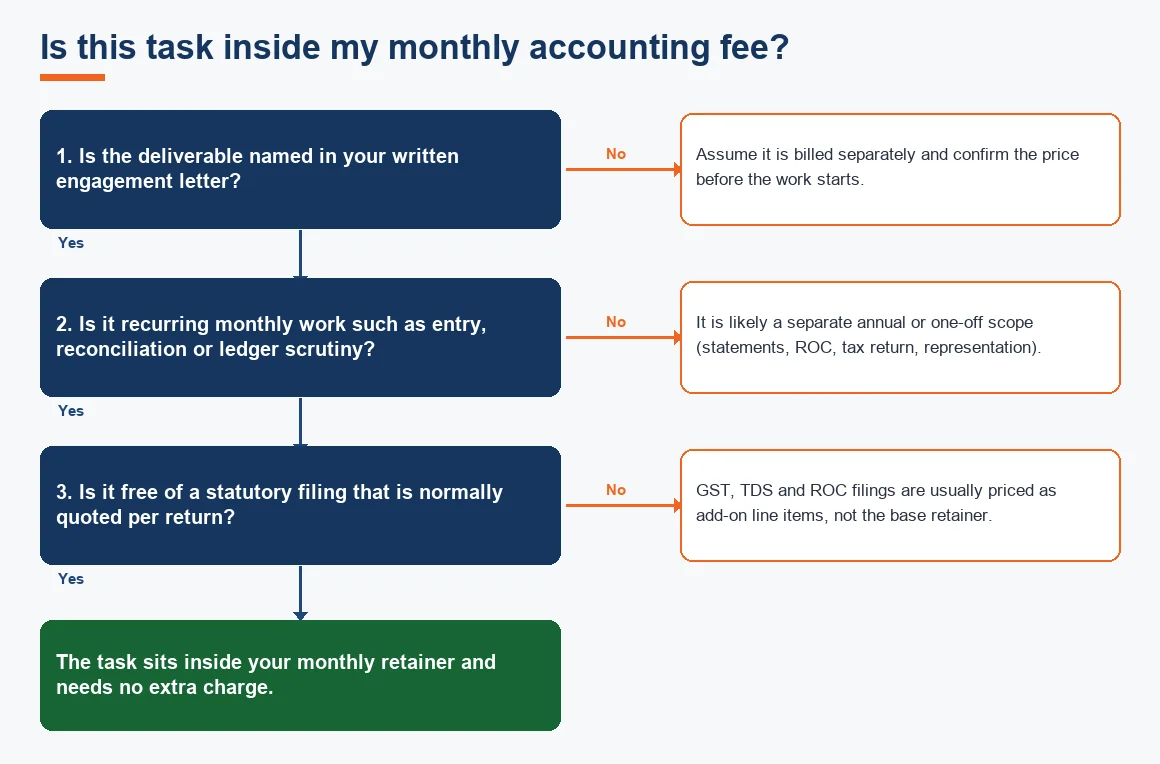
What sits inside a monthly retainer, and what is billed on top
This is the question that decides your real cost. A typical monthly retainer covers recurring recording and reconciliation. Statutory filings and annual work are frequently quoted separately because their effort is fixed by law and dates, not by transaction volume. The split below is the industry norm; your own engagement letter is the only authority for your specific case.
- Usually inside the monthly fee: voucher entry, bank reconciliation, ledger scrutiny, accounts payable and accounts receivable tracking, and a monthly report pack.
- Usually billed separately: GSTR-1 and GSTR-3B filing, TDS deposit and Form 26Q or 24Q returns, payroll processing, and month-end MIS if it is detailed.
- Usually a further annual scope: financial statements, ROC forms, the income tax return and audit support.
For a sense of market rates, see our breakdown of how much a CA charges for monthly accounting in India.
What a monthly accounting cycle actually looks like
Understanding the cycle tells you what you are paying for and why documents by the 5th matter. The recurring monthly flow runs like this:
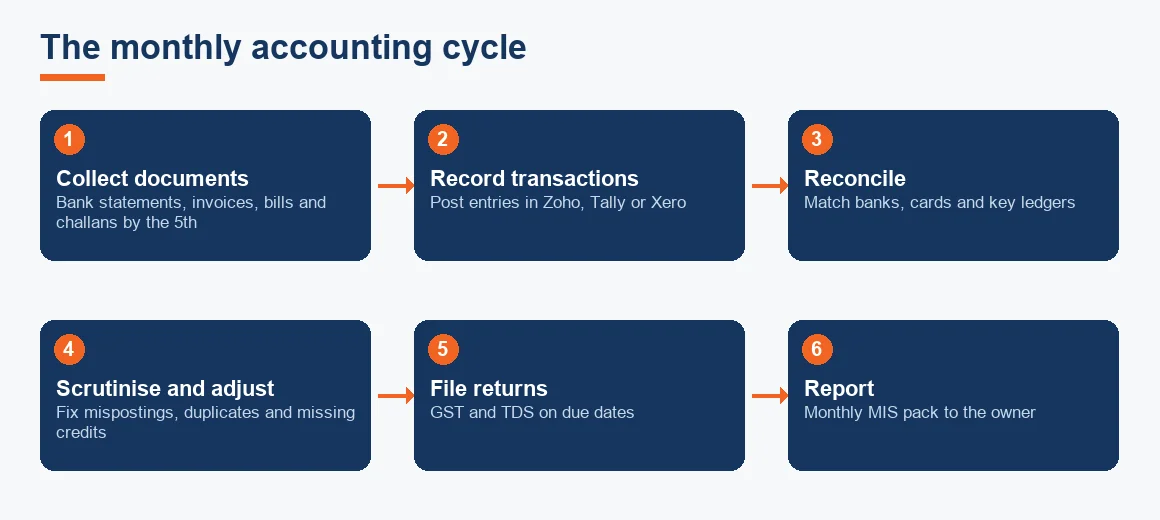
- Collect documents: you send bank statements, sales and purchase invoices, expense bills and challans, ideally by the 5th.
- Record transactions: the accountant posts entries in your software (Zoho, Tally, Xero or QuickBooks-alternative).
- Reconcile: banks, cards and key ledgers are matched so the books agree with real balances.
- Scrutinise and adjust: misposted entries, duplicate bills and missing credits are corrected.
- File statutory returns: GST and TDS are filed on their due dates.
- Report: a monthly pack goes to you, closing the loop against the month-end close checklist.
Because so much hangs on statutory dates, the compliance side of the same month looks like a calendar:

Worked example: reading a monthly quote line by line
Take a small private limited company on Zoho Books with around 120 transactions a month, GST registration, TDS on a few vendor payments and five employees on payroll. A typical proposal might read as a single number, but a properly scoped quote breaks it out. All figures below are indicative and Exl GST.
| Line item | Frequency | In base fee? | Indicative charge (Exl GST) |
|---|---|---|---|
| Bookkeeping and bank reconciliation (120 txns) | Monthly | Yes | INR 8000 |
| GSTR-1 and GSTR-3B filing | Monthly | No | INR 2500 |
| TDS deposit and quarterly return share | Monthly | No | INR 1500 |
| Payroll for 5 employees (PF, ESIC, PT) | Monthly | No | INR 2000 |
| MIS report pack | Monthly | Yes | INR 1000 |
| Total monthly (Exl GST) | INR 15000 | ||
The arithmetic (8000 + 2500 + 1500 + 2000 + 1000) settles at INR 15000 per month, of which only INR 9000 is genuinely the base retainer. Annual financial statements, ROC filings and the income tax return would be quoted on top, typically once a year. Reading the quote this way tells you exactly which lines are negotiable and which are fixed by compliance.
Accounting services vs audit services
One boundary is set by law, not by preference. Accounting services prepare the records and returns; audit services independently examine them and give an opinion. The same firm cannot do both for a company. Section 144 of the Companies Act, 2013 bars a statutory auditor from providing bookkeeping, accounting or internal audit services to its audit client, its holding company or its subsidiaries, as set out by the Ministry of Corporate Affairs. The practical difference between the two is covered in our glossary entry on statutory vs internal audit. So if your accounting firm also signs your statutory audit, that is a red flag worth questioning.
Do accounting services include GST, TDS and representation?
It depends on the engagement, and it should be in writing. GST return filing under the returns framework of the Central Board of Indirect Taxes and Customs and TDS compliance under the Income Tax Act are commonly scoped as separate line items rather than folded into the base fee. Representation is a further step again: a chartered accountant can appear as an authorised representative under section 288 of the Income Tax Act, and the framework is administered by the Income Tax Department. Because the effort of answering a notice depends entirely on the notice, representation is almost always billed outside the monthly accounting fee. When you scope an engagement, decide in advance which of these you want inside the retainer and which you are happy to pay for as they arise. Depreciation on fixed assets, for instance, can be estimated up front with our depreciation calculator so there are no year-end surprises.
Key terms
- Double-Entry Bookkeeping: the method where every transaction is recorded in at least two accounts, keeping the books balanced.
- General Ledger: the master record that holds every account and its running balance.
- Trial Balance: a month-end list proving total debits equal total credits before reports are drawn.
- Journal Entry: the individual dated record that posts a transaction to its two or more accounts.
How to read your engagement scope before you sign
Whatever a provider promises verbally, the engagement letter is what governs. Before signing, confirm five things: who signs the work and their ICAI membership number; whether GST, TDS and ROC filings are inside the fee or billed separately; which software the books are kept in and who owns the data; the turnaround for monthly reporting; and how errors and resulting penalties are handled. A scope with named deliverables and dates protects both sides and turns a vague relationship into a measurable one. If a line is not written down, assume it is not included and ask before the work begins.
Key takeaways
- Accounting services split into three tiers: monthly bookkeeping, separate statutory filings, and annual statements and returns.
- Bookkeeping is only the recording layer; full accounting adds reconciliation, review, reporting and compliance.
- GST, TDS, payroll and representation are commonly billed on top of the base retainer, so confirm each line in writing.
- A statutory auditor cannot keep your books under section 144 of the Companies Act.
- A written scope naming every deliverable, its frequency and its price is the single best protection against surprise bills.
Decision guide