
In this guide
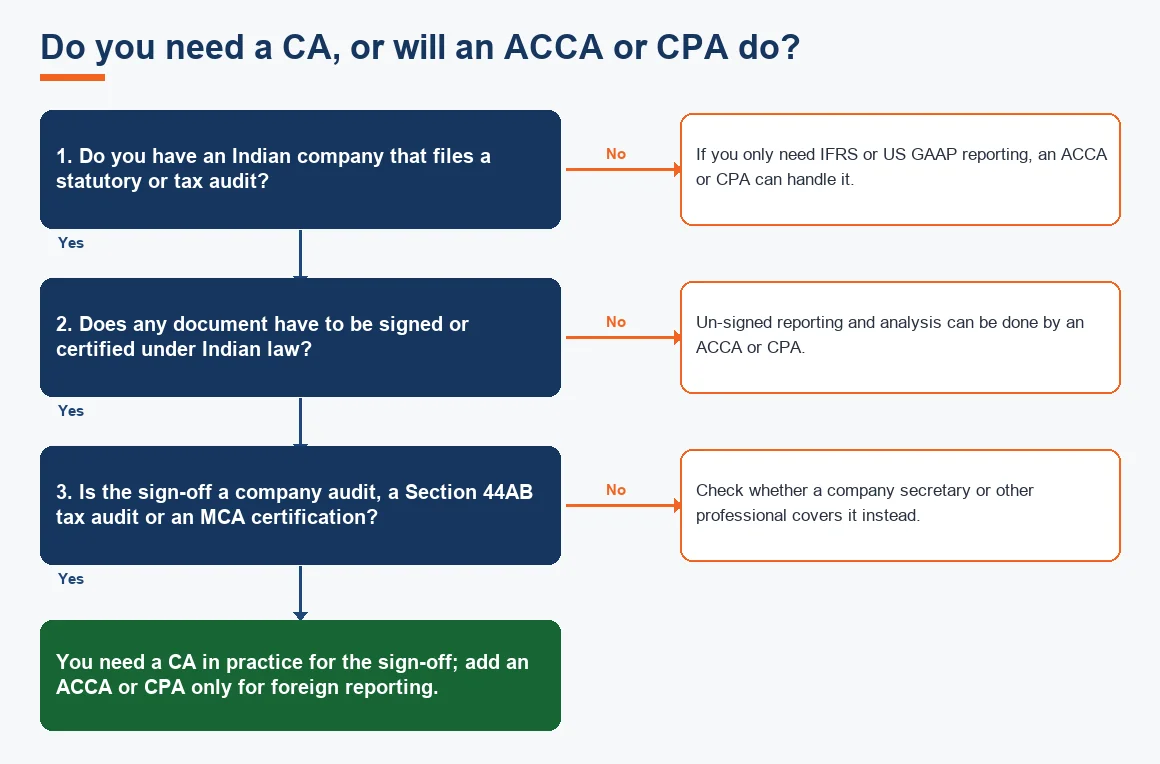
If you are comparing CA vs ACCA vs CPA for your business, the decision is simpler than the exam-difficulty debates suggest. A CA (Chartered Accountant, qualified by the Institute of Chartered Accountants of India) is the only one of the three who can legally sign a statutory audit, a tax audit or a certification filed with the government in India. ACCA (the UK based Association of Chartered Certified Accountants) and CPA (a United States licence) are strong finance qualifications, but neither carries signing rights here. So for most Indian business owners the real question is not which is best in the abstract, it is which qualification matches the work you actually need done.
CA, ACCA and CPA at a glance
All three are respected accounting credentials, but they are governed by different bodies and built for different legal systems. The table below sets out what matters most to a business owner: who awards the qualification, which country's law it is built around, and whether it can sign statutory documents in India.
| Qualification | Awarding body | Built around | Signing rights in India | Typical business role |
|---|---|---|---|---|
| CA (Chartered Accountant) | ICAI (India) | Companies Act, Income Tax Act, GST | Yes, with a certificate of practice | Statutory audit, tax audit, ROC and tax filings |
| ACCA | ACCA (United Kingdom) | IFRS, UK and global standards | No | IFRS reporting, group finance, consolidation |
| CPA | US state boards | US GAAP, Internal Revenue Code | No | US GAAP reporting, US tax, parent company accounts |
The pattern is clear once you read the last two columns together. A CA is a domestic statutory role. ACCA and CPA are reporting and advisory roles that become relevant the moment your business touches a foreign parent, a foreign subsidiary or an overseas investor. If you want the commercial view of what an outsourced finance function covers, our Accounting & Bookkeeping Services in India page and the wider Accounting & Bookkeeping HUB set out the scope; this article stays on the qualification comparison.
What only a CA can sign in India
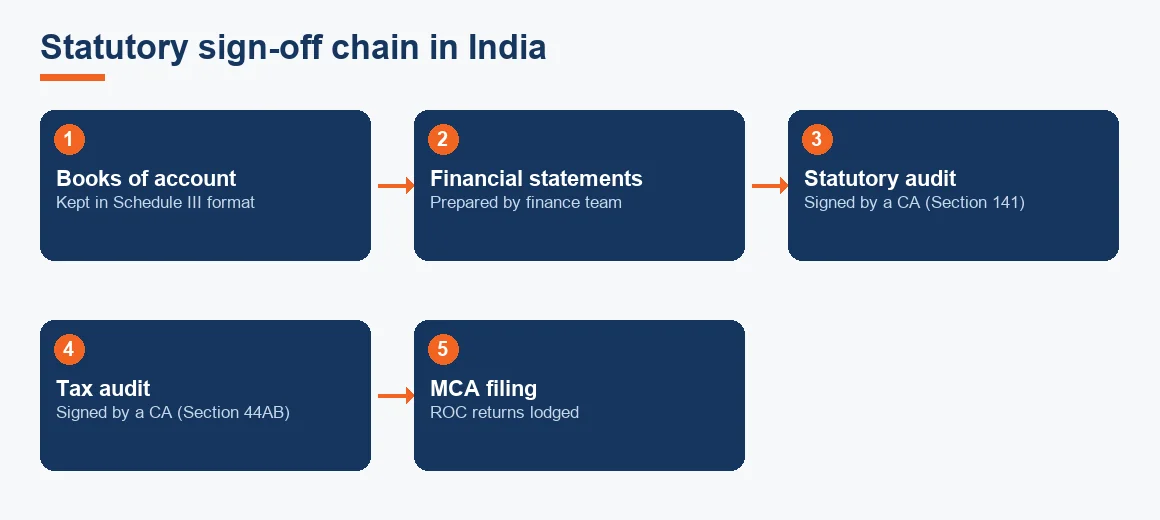
This is the load-bearing difference, so it is worth being precise. Under Section 141 of the Companies Act 2013, only a chartered accountant in practice (an ICAI member holding a valid certificate of practice) can be appointed as a company's statutory auditor. Under Section 44AB of the Income Tax Act, a tax audit report must be signed by a CA. Section 288 of the same Act governs who may appear as an authorised representative before the tax authorities, and again the certification roles sit with chartered accountants. You can read the statutory audit eligibility rules on the Ministry of Corporate Affairs site and the tax audit provisions on the Income Tax Department portal, and ICAI's own guidance is at icai.org.
An ACCA member or a US CPA can prepare the numbers, run the consolidation, design the controls and manage the close. What they cannot do is put their signature on the audit report, the tax audit report or an MCA certification, however deep their experience with IFRS or US GAAP. That restriction is about the licence, not about competence. For the difference between the audit that a CA signs and the internal review anyone can run, see statutory vs internal audit.
CA vs CPA: does a CPA have value in India, and can one practise here?
A US CPA has clear value in India, but a specific kind. If your company is a subsidiary of a US parent, or has US customers, investors or a Delaware holding entity, a CPA handles the US GAAP reporting, the federal and state tax position and the parent company consolidation. That is real, billable, necessary work. What a CPA cannot do is practise as a statutory auditor in India or sign a Section 44AB tax audit: those roles are reserved for ICAI members with a certificate of practice.
Can a CPA become a CA, or vice versa? ICAI has, over the years, entered mutual recognition arrangements with several overseas bodies, and the terms are revised periodically, so the honest answer is to check the current position on the ICAI website rather than rely on an old exemption count. In practice, a CPA who wants Indian signing rights sits the required ICAI route; a CA who wants US reporting recognition pursues the CPA credential. The two coexist happily in a group finance team.
ACCA vs CPA: which is harder, and which travels further?
ACCA and CPA are often compared because both are international rather than Indian. ACCA is a broad, IFRS-centred programme with a large syllabus and papers taken over an extended period; it is recognised across the UK, Europe, the Middle East and much of Asia. CPA is a US licence, examined in four sections, tightly focused on US GAAP and US tax. "Which is harder" depends on the candidate: CPA is narrower but demands US-specific depth and has state-level experience requirements, while ACCA covers more ground at a broader level. For a business owner the more useful question is which market you report into. IFRS-heavy or European exposure points to ACCA; US GAAP and US filings point to CPA.
CA vs ACCA: is a CA "bigger" than an ACCA?
Within India, a CA is the qualification with statutory authority, so for domestic compliance it is the one that counts. Globally, ACCA has wider name recognition across many countries because it is designed as a portable, IFRS-based credential. Neither is objectively "bigger"; they are optimised for different things. A CA is the right answer for signing Indian statutory documents. An ACCA is the right answer for a finance professional who may work across borders or in an IFRS reporting environment. Many Indian professionals hold both, using the CA for practice rights and the ACCA for international mobility.
Which is better for your business: CA, ACCA or CPA?
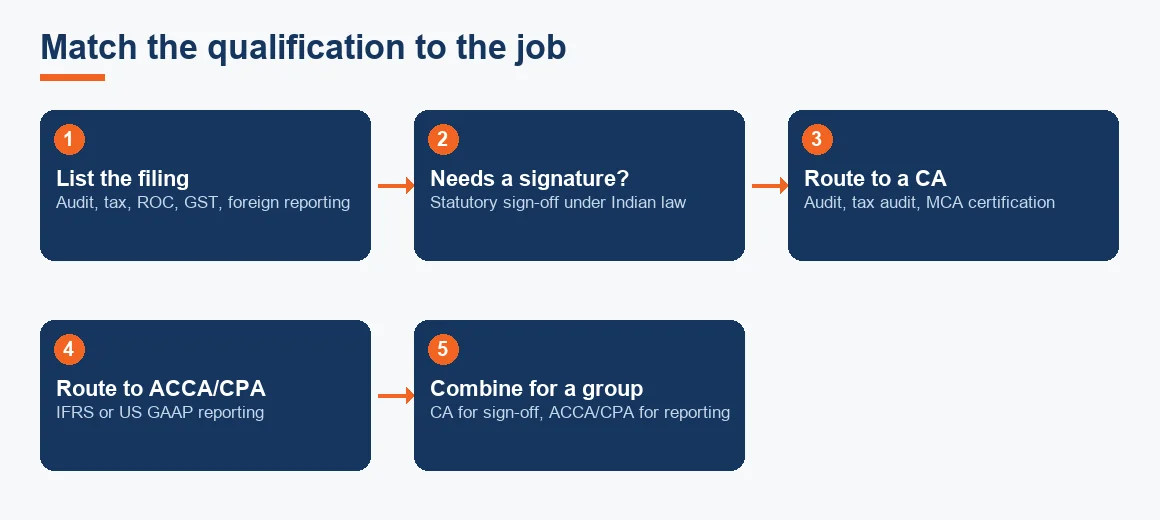
The honest answer is that "better" is set by your reporting obligations, not by exam difficulty. Work backwards from what has to be signed and filed. Here is a simple sequence for an owner deciding whom to engage.
- List the filings you owe. Statutory audit, tax audit, ROC returns, GST returns, TDS returns, and any foreign parent reporting.
- Separate the signed items. Anything that must be signed or certified under Indian law (audit report, tax audit, MCA certification) goes to a CA in practice.
- Identify foreign reporting. US GAAP for a US parent points to a CPA; IFRS or European reporting points to an ACCA.
- Decide in-house versus outsourced. Most SMEs outsource the CA statutory work and keep only what is needed in-house.
- Combine where a group needs both. A CA for Indian sign-off plus an ACCA or CPA for group reporting is a normal, efficient split.
If your foreign reporting hinges on how revenue is recognised or how the group consolidates, two concepts do most of the heavy lifting: Ind AS 115 revenue recognition and parent-subsidiary consolidation. To check which reporting framework even applies to you before you hire, the Ind AS Applicability Checker and the AS vs Ind AS Comparison Matrix are a quick first pass.
Worked example: sign-off and budget for a small Indian subsidiary
Consider a private limited company that is a subsidiary of a US parent, with turnover of ₹6 crore and mostly digital receipts and payments. It needs Indian statutory work signed by a CA and a US GAAP reporting pack for the parent. The table shows who signs each item and an indicative annual fee. Figures are indicative and Exl GST.
| Work item | Who can sign or perform | Indicative fee (Exl GST) |
|---|---|---|
| Statutory audit (Companies Act, Section 141) | CA in practice | ₹55,000 |
| Tax audit (Section 44AB) | CA in practice | ₹30,000 |
| ROC annual filings (MCA) | CA or CS | ₹20,000 |
| Monthly bookkeeping and GST/TDS returns | CA firm team | ₹1,80,000 |
| US GAAP reporting pack for parent | CPA or trained CA team | ₹90,000 |
| Indicative annual total | ₹3,75,000 |
Two things stand out. First, the three items that must be signed (statutory audit, tax audit, ROC) all sit with a CA; that is ₹1,05,000 of the total and it is non-negotiable. Second, the US GAAP pack is the only line where a CPA is genuinely additive, and even that can often be delivered by a CA team trained in US GAAP. Note that because cash receipts and payments here are within the digital threshold, this company would fall under the higher ₹10 crore tax-audit limit if it were purely domestic; it takes the audit anyway as a Companies Act requirement. For how a monthly retainer like the bookkeeping line is priced in the market, see how much a CA charges for monthly accounting in India.
Where each qualification fits a growing company
As a business scales from domestic-only to cross-border, the mix shifts. A local trading company needs a CA and little else. A company that starts exporting or takes foreign investment adds IFRS or US GAAP reporting, which is where an ACCA or CPA earns their keep. The core outputs stay the same in any framework, a balance sheet and a profit & loss statement, but the recognition and disclosure rules behind them differ. A funded startup with a Delaware parent will often run all three competencies at once: a CA for Indian sign-off, and CPA or ACCA input for investor and parent reporting. Understanding the underlying branches of accounting and the functions of accounting helps you see why the roles do not overlap. If you are still mapping what a full finance engagement covers, our checklist on what an accounting service actually includes and the financial statement preparation page fill in the scope.
Key terms
- Statutory vs Internal Audit: the statutory audit must be signed by a CA; an internal review can be run by anyone.
- Schedule III Balance Sheet: the prescribed Companies Act format for presenting Indian financial statements.
- Ind AS 115 Revenue Recognition: the standard that decides when and how much revenue is booked under Indian GAAP aligned with IFRS.
- Parent-Subsidiary Consolidation: combining a subsidiary's accounts into the parent's group reporting.
- Notes to Accounts: the disclosures attached to the statements that a foreign reviewer relies on.
Key takeaways
- Only a CA in practice can sign a statutory audit, a Section 44AB tax audit or an MCA certification in India.
- ACCA and CPA add value for IFRS and US GAAP reporting respectively, but neither can sign statutory documents in India.
- For a domestic company the answer is a CA; foreign reporting is what makes an ACCA or CPA worth adding.
- Decide by the filing you owe, not by which exam is reputedly harder.
- Groups commonly use a CA plus an ACCA or CPA together, which is efficient rather than duplicative.
Decision guide