In this guide
Most Indian businesses pay a chartered accountant between Rs 3,000 and Rs 20,000 a month for regular accounting, with the exact figure set by transaction volume and compliance scope rather than turnover on its own. A small trader with a handful of monthly invoices sits at the lower end, while a growing company running GST, TDS and payroll sits higher. This guide sets out the typical ranges, explains what actually moves the number, and shows the working with one costed example. It is a pricing-research explainer: if you want a fixed quote for your own books, that belongs on our Accounting & Bookkeeping Services in India page.
How much does a CA charge for monthly accounting in India?
There is no single answer, because ICAI publishes only a recommended minimum scale of fees and not a fixed rate card. What firms actually charge clusters into bands by business size and the volume of entries each month. The table below shows indicative monthly retainers seen across Indian practices in 2026. Treat every figure as indicative and Exl GST.
| Business profile | Approx. turnover | Monthly transactions | Indicative monthly fee (Exl GST) |
|---|---|---|---|
| Micro / sole proprietor | Under Rs 40 lakh | Up to 50 | Rs 3,000 to Rs 8,000 |
| Small growing company | Rs 40 lakh to Rs 2 crore | 50 to 300 | Rs 8,000 to Rs 20,000 |
| Established mid-size | Rs 2 crore to Rs 10 crore | 300 to 1,000 | Rs 20,000 to Rs 50,000 |
| Larger / multi-location | Above Rs 10 crore | 1,000 plus | Rs 50,000 upward |
These bands assume a clean monthly cycle, not a year-end reconstruction. If your books are behind, expect a separate one-off charge before the monthly retainer begins.
What drives the monthly fee
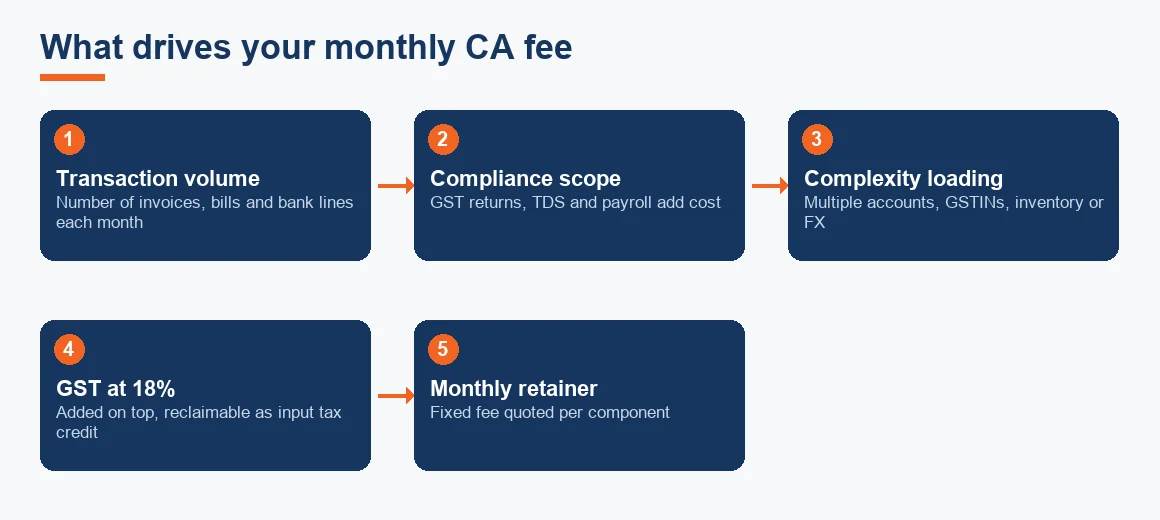
Two businesses with the same turnover can be quoted very differently. The fee is built from the work involved, not a percentage of sales. The main drivers are set out below.
Transaction volume
The single biggest lever is how many entries pass through the books each month: sales invoices, purchase bills, bank lines and journal postings. A firm with 500 monthly transactions simply takes more hours to record and reconcile than one with 40, whatever the rupee value. This is why a low-margin high-volume retailer often pays more than a high-margin consultancy on the same turnover.
Compliance scope
A quote that includes GST return filing, TDS working and payroll processing costs more than plain bookkeeping. Ask exactly what sits inside the retainer, because our checklist on what an accounting service actually includes shows how widely scope varies between firms. Each added compliance task carries its own deadline and its own liability if missed.
Complexity of the books
Multiple bank accounts, inventory, foreign currency, several GST registrations or a group structure all add loading. Reconciling three current accounts and matching input tax credit against GSTR-2B is more involved than a single-account cash business. The seven functions of accounting each add a slice of work, and firms price for the ones your business actually needs.
What is included in a monthly accounting retainer
A standard monthly cycle usually covers recording of all transactions, bank reconciliation, GST return preparation, TDS computation and a short management report. The lifecycle below shows how a typical month is worked.
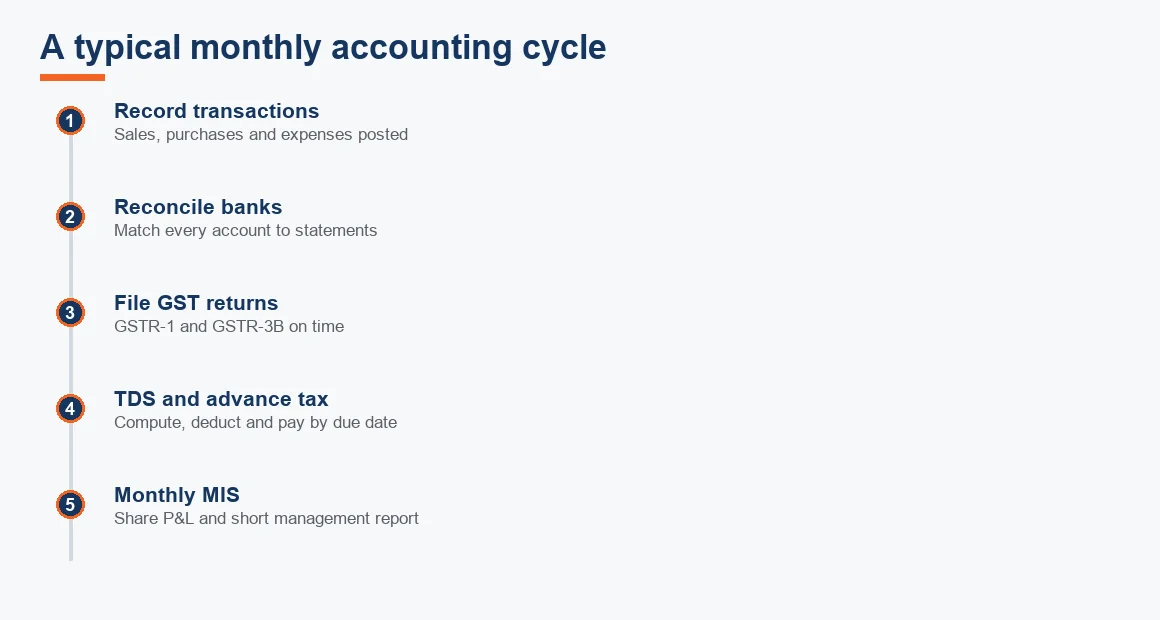
The compliance backbone matters here. Regular monthly work keeps GSTR-3B and TDS challans on time, which is the whole point of paying monthly rather than scrambling at year end. If you are still deciding whether a CA, ACCA or CPA suits your business, our note on choosing the right accountant covers the qualification differences.
CA charges for balance sheet and year-end statements
Preparation of the annual financial statements is normally a separate line from the monthly retainer. For a small private limited company, drawing up the balance sheet, profit and loss statement and notes in Schedule III format commonly costs Rs 8,000 to Rs 25,000, depending on how clean the monthly books are. Where a firm has kept your general ledger current all year, the year-end fee is lower because there is no reconstruction to do. Depreciation on fixed assets is one line the year-end close must get right, and a quick depreciation calculator helps you sense-check the figure before it hits the balance sheet. A separate statutory audit under the Companies Act, and a tax audit under section 44AB where applicable, are quoted on top of this.
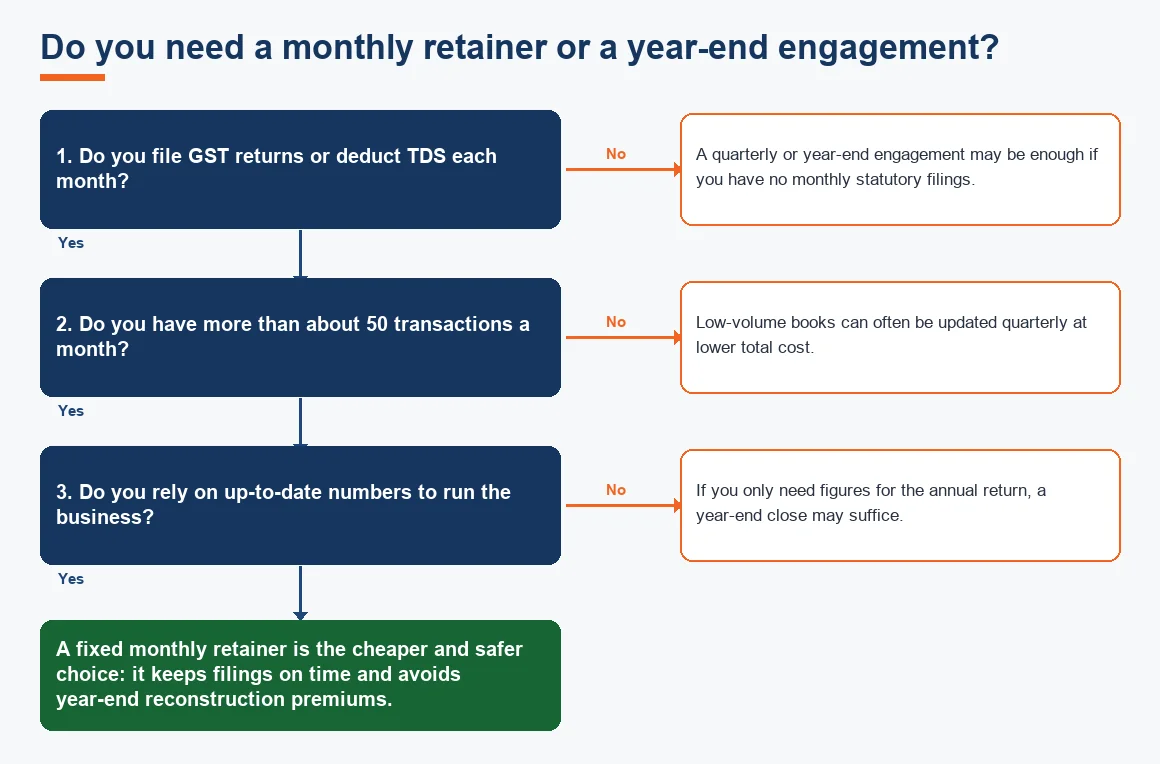
Is monthly bookkeeping cheaper than a year-end exercise?
In total cost, yes. A year-end catch-up prices the same twelve months of work at a premium because it is reconstruction under deadline pressure, and it often lands after due dates have passed. Spreading the work across the year through regular monthly recording typically costs 20 to 30 percent less over the full year. The bigger saving is avoided interest and late fees: delayed advance tax attracts interest at 1 percent a month under section 234B, and unpaid GST runs at 18 percent a year. Keeping a monthly close discipline removes both. The accounting and bookkeeping hub explains the process, software and industry variations in more depth.
Worked example: building up a monthly fee
Consider a services company with turnover of about Rs 1.2 crore and roughly 180 transactions a month, one GST registration and three bank accounts. A component-wise quote might look like this. Figures are indicative and Exl GST.
| Component | Basis | Monthly fee (Exl GST) |
|---|---|---|
| Bookkeeping | 180 transactions, incl. bank reconciliation | Rs 6,000 |
| Bank reconciliation loading | 3 current accounts | Rs 1,500 |
| GST returns | GSTR-1 and GSTR-3B, 1 GSTIN | Rs 2,000 |
| TDS working and challan | Monthly computation and payment | Rs 1,500 |
| Monthly MIS / P&L | One management report | Rs 1,500 |
| Subtotal | Rs 12,500 | |
| GST at 18 percent | On professional fee | Rs 2,250 |
| Invoice total | Rs 14,750 |
Because the client is GST-registered, the Rs 2,250 GST is claimed back as input tax credit, so the effective cost is the Rs 12,500 fee alone. That is why the headline number and the real cost differ for a registered business.
Do CA firms charge GST, and are the fees tax deductible?
A firm registered under GST adds 18 percent to accounting, bookkeeping and audit fees, in line with the rate schedule on the CBIC GST portal. A registered business client claims that as input tax credit, so the effective outflow is the fee itself. Where the firm is unregistered and below the Rs 20 lakh services threshold, no GST is added at all.
On deductibility, professional fees paid wholly for the business are an allowable expense under section 37 of the Income-tax Act, so they reduce your taxable profit. The Income Tax Department treats accounting and audit fees as normal business expenditure, provided they are genuinely incurred for the business and properly recorded in your books.
How to compare quotes before you commit
Pricing-research is only useful if you compare like with like. Work through these steps.
- List your monthly transaction count and every compliance task you need, so scope is defined before you ask.
- Request a component-wise quote from each firm, Exl GST, with the year-end close and any audit priced separately.
- Check what software and access is included, and who owns the data.
- Confirm turnaround dates for GST and TDS, and the penalty position if a deadline is missed.
- Compare the annual total, not just the monthly figure, since add-ons and year-end work often sit outside the retainer.
Startups with irregular volumes may want to read our view on accounting for startups before fixing a retainer, as burn rate and reporting needs shift quickly in the early months. To understand where each service sits, our overview of the branches of accounting is a useful map.
Key terms
- Bank Reconciliation: matching your books against the bank statement each month to catch missing or duplicated entries.
- General Ledger: the master record of every account, from which the trial balance and financial statements are drawn.
- Catch-Up Bookkeeping: reconstructing months of unrecorded transactions, usually priced at a premium over regular monthly work.
- Month-End Close Checklist: the routine of reconciliations and postings that finalises each month's books on time.
- Trial Balance: the list of ledger balances used to confirm the books are arithmetically in order before statements are prepared.
Key takeaways
- Expect roughly Rs 3,000 to Rs 20,000 a month for most small and growing Indian businesses, indicative and Exl GST.
- Transaction volume and compliance scope drive the fee more than turnover does.
- ICAI sets only a recommended minimum, so there is no fixed statutory rate.
- GST at 18 percent is added but reclaimable as input tax credit by a registered client.
- Monthly work costs less in total than a year-end catch-up and avoids interest under section 234B and GST.
- Year-end accounts and any audit are usually separate from the monthly retainer.
Decision guide