In this guide
The branches of accounting are the specialised streams within one discipline, each taking the same underlying transactions and reporting them for a different audience and purpose. Financial accounting produces statutory statements for outsiders, cost accounting works out what a unit of output costs, management accounting guides internal decisions, tax accounting computes liability under tax law, and auditing and forensic accounting provide assurance. Textbooks commonly list anywhere from three to twelve branches; the number changes only because some authors group or split the same work. This guide explains each branch, what it is for, and where Indian rules such as the Companies Act, the accounting standards and the Income Tax Act decide who must do what.
What are the branches of accounting?
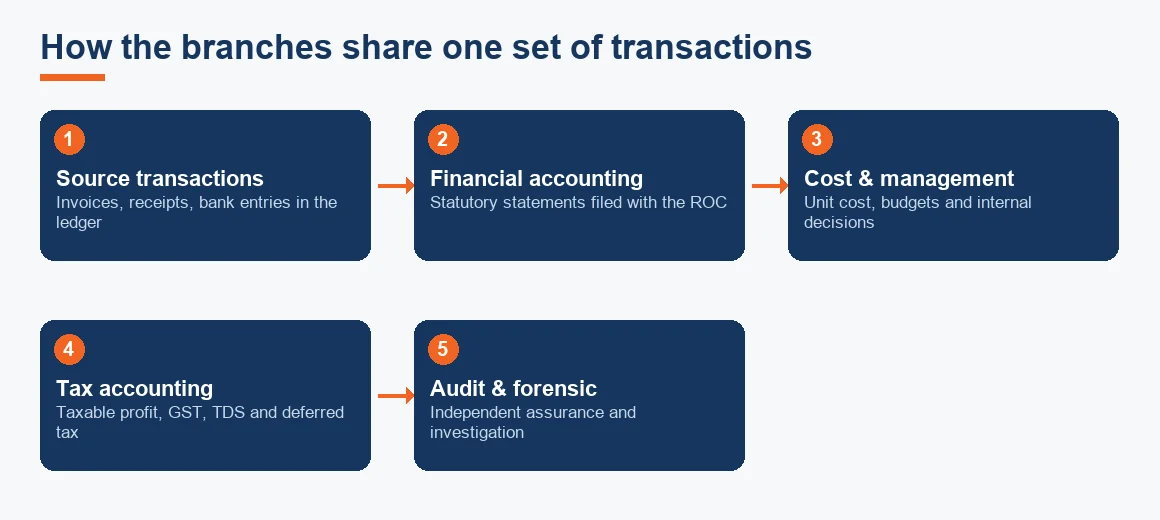
A branch of accounting is a field of practice defined by whom the information is for and which rulebook governs it. The plumbing underneath is shared: every branch relies on double-entry bookkeeping, the same ledgers and the same source documents. What differs is the output. Financial accounting answers to shareholders, lenders and the Registrar of Companies. Cost and management accounting answer to owners and managers. Tax accounting answers to the tax authorities. Auditing checks the work of the others. Because the raw data is common, one purchase invoice can appear in four branches at once, valued differently in each, which is exactly why the branches exist as separate disciplines rather than one.
If you want the wider view of what accountants actually do with this data day to day, our companion piece on the seven functions of accounting covers the recording, classifying and reporting steps that sit underneath every branch below.
The main branches of accounting and their scope
The short answer to "how many branches are there" is that there are a handful of core branches and several that most syllabuses bolt on to reach a longer count. The three branches everyone agrees on are financial, cost and management accounting; add tax and auditing and you have the five that matter to nearly every Indian business; the six, seven, eight and twelve lists simply keep adding the specialist fields shown lower in the table. Their scope, audience and governing rulebook are set out below.
| Branch | Main purpose | Primary audience | Indian rulebook |
|---|---|---|---|
| Financial accounting | Statutory statements of what happened | Shareholders, lenders, ROC | AS or Ind AS, Schedule III, Companies Act 2013 |
| Cost accounting | Cost per unit, product or process | Owners, pricing teams | Cost Records and Audit Rules 2014 |
| Management accounting | Budgets, forecasts, decision support | Internal management | No prescribed format |
| Tax accounting | Taxable profit and returns | Income Tax Dept, GST authorities | Income Tax Act 1961, CGST Act 2017 |
| Auditing | Independent assurance on accounts | Members, regulators | Standards on Auditing, ICAI |
| Forensic accounting | Investigate fraud and disputes | Courts, tribunals, boards | ICAI Forensic Standards |
| Government / fund accounting | Track funds against sanctions | Government, donors, trustees | Government rules, trust deeds |
| Fiduciary accounting | Account for assets held for others | Beneficiaries, executors | Trust and estate law |
| International accounting | Reporting across jurisdictions | Group parents, foreign investors | IFRS, Ind AS convergence |
| Social / ESG accounting | Non-financial and CSR reporting | Regulators, public | Section 135, BRSR |
Financial accounting: the statutory branch
Financial accounting is the branch most people picture when they hear the word. It records completed transactions and summarises them into the balance sheet, the statement of profit and loss and the cash flow statement, drawn up in the Schedule III format and, for companies, filed with the Registrar of Companies in Form AOC-4. It is historical, prescribed and annual. For companies it follows either Accounting Standards or Ind AS, and it uses accrual accounting rather than cash, so income and expense are recognised when earned or incurred, not when the money moves. The Ministry of Corporate Affairs publishes the notified standards and filing forms at mca.gov.in. If you are unsure what a full financial accounting engagement covers in practice, our scope checklist on what an accounting service actually includes lays it out.
Cost and management accounting: the internal branches
Cost accounting works out what a single unit, batch or process costs to produce, splitting spend into material, labour and overhead and absorbing it into output. It underpins pricing and margin decisions and draws on tools such as variance analysis and cost of goods sold tracking. Management accounting sits one level up: it takes cost and financial data and turns it into budgets, forecasts and the numbers behind a decision. It has no prescribed format and can be produced weekly, monthly or on demand, which is the opposite of financial accounting's fixed annual cycle.
Tax accounting: computing profit under tax law
Tax accounting computes liability under tax law rather than under the accounting standards, which is why its numbers rarely match the audited profit. Book depreciation is replaced by depreciation at the rates in the Income Tax Act, disallowances such as Section 40(a)(ia) are added back, and GST, TDS and deferred tax are all worked here. Because tax profit and book profit diverge, the difference is carried as deferred tax, which is where financial and tax accounting meet again. The Income Tax Department's portal at incometax.gov.in and the CBIC site at cbic-gst.gov.in are the authorities for the rates and forms this branch uses.
Auditing and forensic accounting: the assurance branches
Auditing does not prepare accounts; it independently checks them. A statutory audit gives an opinion on whether the financial statements show a true and fair view, following the Standards on Auditing issued by ICAI. Internal audit, by contrast, reviews controls and processes for management throughout the year. Forensic accounting is the investigative branch: it examines suspected fraud, misappropriation and misstatement and produces findings that can stand up in court or before a tribunal. In India it appears in bank fraud reviews, insolvency proceedings under the IBC and partnership disputes, and members follow the Forensic Accounting and Investigation Standards published by ICAI at icai.org.
Other branches you may meet
The longer lists add fields that matter to specific organisations. Government and fund-based accounting tracks money against sanctioned heads rather than profit, and is how trusts, NGOs and public bodies report. Fiduciary accounting covers assets one party holds for another, such as an executor managing an estate. International accounting handles reporting across jurisdictions, which for Indian groups usually means reconciling Ind AS with IFRS. Social or ESG accounting reports non-financial impact, now formalised for larger listed companies through BRSR. Some textbooks also count accounting information systems and human resource accounting, which is how a list reaches twelve.
What is branch accounting?
"Branch accounting" is a different term that is easy to confuse with the branches of accounting. Branch accounting is the practice of keeping a separate set of books for each branch office or location, so that head office can measure the profit of each unit and then consolidate them. It is a method within financial accounting, not a discipline of its own. A retailer with shops in three cities might run branch accounting to see each store's result, using a Schedule III balance sheet at group level. So the branches of accounting are the fields; branch accounting is one bookkeeping arrangement inside the financial branch.
How to work out which branch your business needs
Most small companies use three branches without naming them: financial accounting to file, tax accounting to pay, and light management accounting to run the business. You can place any accounting task with a short sequence.
- Ask who the output is for. Outsiders and the Registrar point to financial accounting; the tax office points to tax accounting; your own managers point to cost or management accounting.
- Ask which rulebook governs it. A prescribed format such as Schedule III or a tax form means a statutory branch; a free format means an internal one.
- Ask whether it is historical or forward looking. Reporting the past is financial or tax; planning the future is management accounting.
- Ask whether anyone must check it independently. If yes, auditing is engaged on top of the branch that prepared the numbers.
Key terms
- Accrual Accounting: recognising income and expense when earned or incurred, not when cash moves; the basis of financial accounting.
- Double-Entry Bookkeeping: the shared recording method under every branch, where each entry has an equal debit and credit.
- Variance Analysis: comparing actual cost against budget or standard, a core tool of cost and management accounting.
- Fund-Based Accounting: tracking money against sanctioned funds rather than profit, used in government and NGO accounting.
Worked example: one machine across four branches
The clearest way to see the branches working together is to follow a single transaction. A company buys a machine for Rs 10,00,000 (indicative, Exl GST) and treats it in Year 1 under four branches. Book depreciation uses the straight-line method over a ten-year life; tax depreciation uses the 15 per cent written-down-value block for plant and machinery. The gap between them is a timing difference that tax accounting carries as deferred tax, computed here at an indicative effective rate of 25.17 per cent.
| Branch | Treatment of the Rs 10,00,000 machine, Year 1 | Amount |
|---|---|---|
| Financial accounting | Capitalised; straight-line depreciation, ten-year life | Rs 1,00,000 |
| Cost accounting | Charged to factory overhead and absorbed into unit cost | Rs 1,00,000 |
| Tax accounting | Depreciation at 15% WDV under the Income Tax Act | Rs 1,50,000 |
| Management accounting | Annual cost weighed against extra output to judge the buy | Rs 1,00,000 |
| Deferred tax (book vs tax gap) | Difference Rs 50,000 taxed at 25.17% | Rs 12,585 |
One invoice, four figures, one reconciling item. The Rs 50,000 extra depreciation the tax branch claims this year reverses in later years, so the deferred tax liability of Rs 12,585 keeps the financial and tax branches consistent over the life of the asset. You can test the same numbers on our depreciation calculator and, for the timing difference, the deferred tax calculator.
Key takeaways
- The branches of accounting are streams of one discipline, separated by audience and rulebook, not by different underlying data.
- Financial and tax accounting are prescribed and backward looking; cost and management accounting are free-format and forward looking.
- The count of "branches" varies from three to twelve only because authors group the same specialist fields differently.
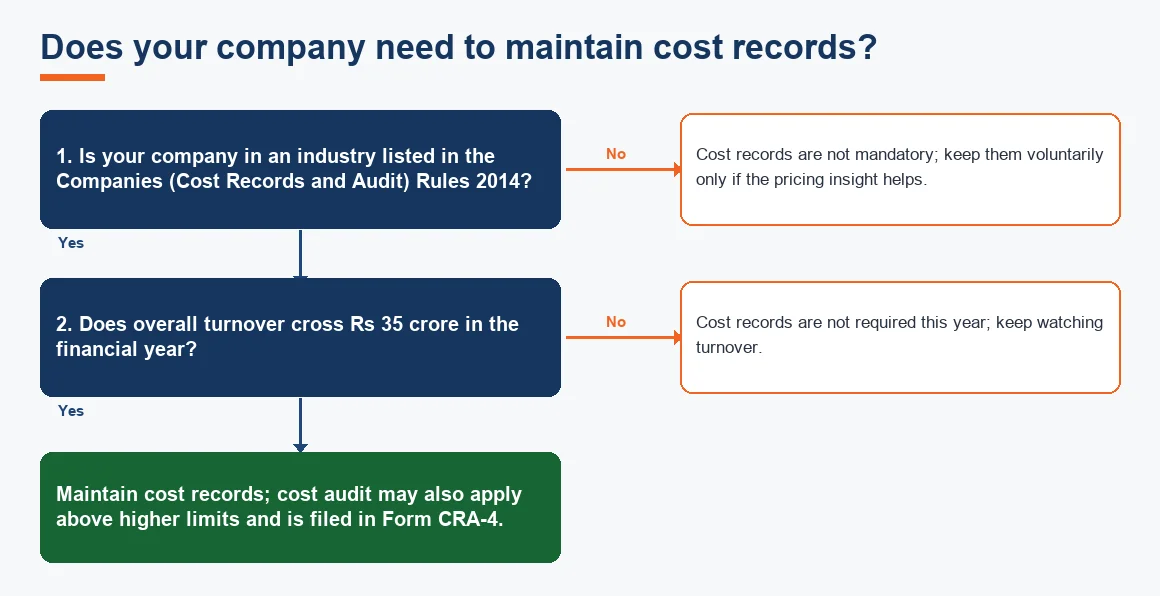
- Cost records are mandatory only for listed industries above Rs 35 crore turnover under the 2014 Rules.
- Branch accounting (books per branch office) is a method inside financial accounting, not a separate branch.
Choosing which branches to run, and who should run them, is a commercial decision rather than a definitional one. If you want that mapped to a real scope and fee, see our Accounting & Bookkeeping Services in India, browse the wider accounting and bookkeeping hub across process, software and industry, and read how much a CA charges for monthly accounting and whether you need a CA, ACCA or CPA before you decide who keeps your books.
Decision guide