
In this guide
The four types of financial statements are the balance sheet, the statement of profit and loss, the cash flow statement and the statement of changes in equity. Together they answer four different questions about a business: what it owns and owes, whether it made a profit, where its cash went, and how the owners' stake moved over the year. Under Indian law the notes to accounts are added as a mandatory fifth element, so the same set is often described as five statements. This guide explains what each one shows, where the notes fit, and how the four lock together.
What are financial statements?
Financial statements are the formal summary of a business's transactions for a financial year, prepared from the books once the year is closed. They start from a closed trial balance, run through closing journal entries for depreciation, provisions, accruals and tax, and end as a structured set that an owner, a lender, a tax officer or an auditor can read. In a company they are prepared on the accrual basis, meaning income and expenses are recognised when they arise, not when cash moves. For the mechanics of building the set in the right sequence, see our note on the correct order to prepare financial statements.
Section 2(40) of the Companies Act 2013 defines financial statements to include the balance sheet, the statement of profit and loss, the cash flow statement, the statement of changes in equity where applicable, and the notes. That definition is the reason the answer to "how many financial statements are there" is not a single number: the primary statements are four, and with the notes counted the set is five.
The four types of financial statements explained
Each statement has a distinct job. Three describe activity or position, and the fourth traces how equity changed. Here is what each one answers.
1. Balance sheet
The balance sheet is a snapshot at a single date, usually 31 March. It lists what the business owns (assets), what it owes (liabilities) and the owners' residual stake (equity), and the two sides must always balance. It tells you about solvency, debt and working capital. If you have never read one, our beginner's guide on how to read a balance sheet walks through it line by line.
2. Statement of profit and loss
The statement of profit and loss, still widely called the P&L or income statement, covers a period rather than a date. It sets revenue against expenses to arrive at net profit for the year. This is the statement most owners look at first, because it answers the plain question of whether the business made money.
3. Cash flow statement
The cash flow statement explains why the profit figure does not equal the change in the bank balance. It splits movements into operating, investing and financing activities, so a profitable company that is quietly running out of cash shows up here and nowhere else. AS 3 and Ind AS 7 permit the direct or the indirect method, and most Indian companies use the indirect method. We cover the choice in direct versus indirect method explained.
4. Statement of changes in equity
The statement of changes in equity reconciles opening equity to closing equity, showing profit retained, dividends paid, fresh capital raised and other movements. It is mandatory for companies applying Ind AS. Companies applying AS present the same information within the notes rather than as a separate face statement, which is one reason the count of "main" statements varies between three and four in general reading.
| Statement | What it answers | Period or point in time | Governing standard |
|---|---|---|---|
| Balance sheet | What the business owns and owes at year end | Point in time (31 March) | Schedule III, AS / Ind AS |
| Statement of profit and loss | Whether the business made a profit | Period (full year) | Schedule III, AS / Ind AS |
| Cash flow statement | Where the cash came from and went | Period (full year) | AS 3 / Ind AS 7 |
| Statement of changes in equity | How the owners' stake moved | Period (full year) | Ind AS (in notes under AS) |
Three, four or five? Where the notes to accounts fit
The confusion between "the big 3", four types and five basic financial statements comes down to two things: whether you count the statement of changes in equity, and whether you count the notes. The notes to accounts are not an optional appendix. Section 2(40) puts them inside the definition, and the auditor's opinion covers them exactly as it covers the primary statements. The notes carry the accounting policies, the Schedule III disclosures, contingent liabilities and related party transactions, which is often where the real story sits.
So the honest answer is: four primary statements, five elements once the notes are added. You will occasionally see "six components" quoted, which usually counts the notes and the accounting policies separately, or adds the auditor's report, but the statutory definition stops at five.
Elements of financial statements
"Elements of financial statements" is a different question from "types". Types are the statements; elements are the building blocks that populate them. There are five: assets, liabilities and equity sit on the balance sheet, while income (revenue) and expenses drive the profit and loss statement. Some frameworks describe four elements by grouping equity with the balance sheet items differently, but for a company in India the practical set is these five. Every rupee in the financial statements ultimately lands in one of them.
Key terms
- Balance sheet: a dated statement of assets, liabilities and equity that must balance.
- Profit and loss statement: revenue less expenses over a period, ending in net profit.
- Cash flow statement: cash movements split into operating, investing and financing activities.
- Equity: the owners' residual stake after liabilities are deducted from assets.
- Notes to accounts: accounting policies and disclosures that form part of the statements.
Which law prescribes the format of financial statements in India?
The format is not a matter of choice. Schedule III to the Companies Act 2013 fixes the layout of the balance sheet and the statement of profit and loss, the current and non-current split, and the sequence of the notes. Division I applies to companies following AS, Division II to companies following Ind AS and Division III to NBFCs. Rounding off to the nearest hundred, thousand, lakh or million is mandatory based on total income. The Ministry of Corporate Affairs publishes the schedule and its amendments at mca.gov.in, and the cash flow standards AS 3 and Ind AS 7 are issued by the Institute of Chartered Accountants of India at icai.org.
If you are deciding whether Ind AS applies to your company at all, our Ind AS Applicability Checker works through the turnover and net worth thresholds for you.
Do all companies prepare all four statements?
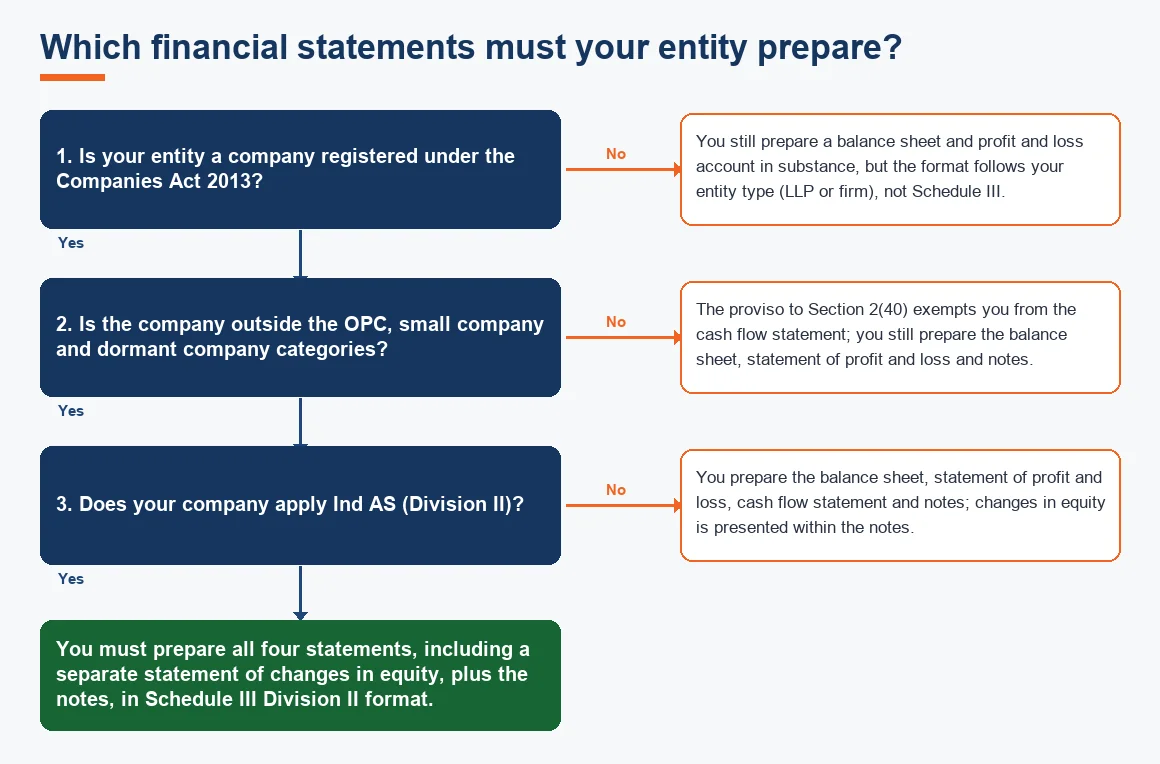
No. The proviso to Section 2(40) exempts one person companies, small companies and dormant companies from the cash flow statement. They still prepare the balance sheet, the statement of profit and loss and the notes. Businesses that are not companies at all, such as LLPs and proprietorships, are not governed by Schedule III, though lenders and the income tax return often expect a balance sheet and profit and loss account in substance. The step-by-step decision below sets out who prepares what.
- Confirm the entity type: company, LLP, firm or proprietorship.
- If it is a company, identify the framework: AS (Division I) or Ind AS (Division II), or NBFC rules (Division III).
- Check whether it is an OPC, small company or dormant company, which removes the cash flow statement requirement.
- Prepare the balance sheet and statement of profit and loss in the correct Division format.
- Add the cash flow statement and, under Ind AS, the statement of changes in equity.
- Complete the notes to accounts, then let the audit cover the full set.
How the four statements connect: a worked example
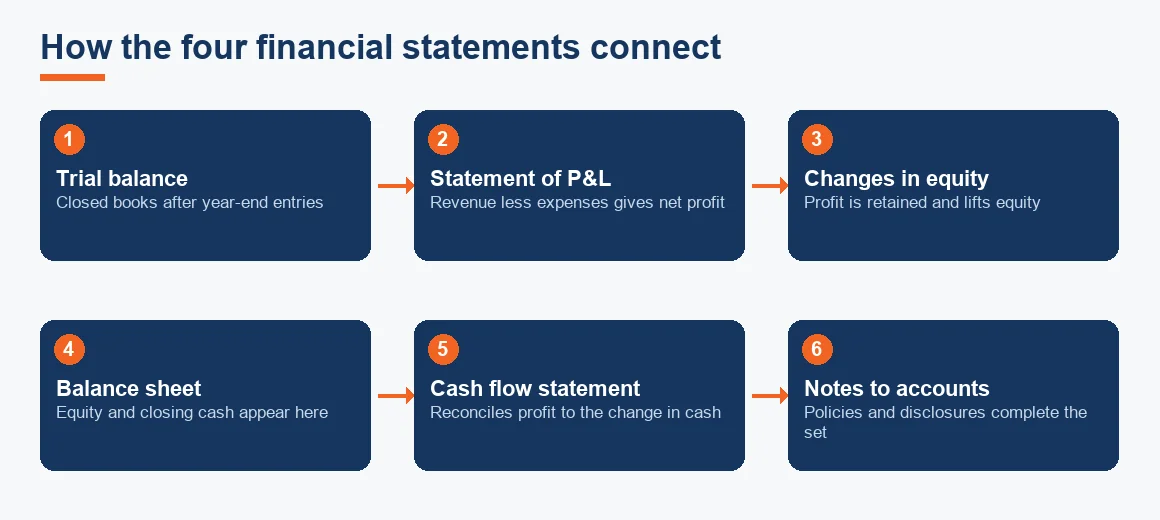
The statements are not four separate documents; they interlock. Profit from the P&L flows into equity, closing equity sits on the balance sheet, and the cash flow statement reconciles profit back to the change in cash. The worked figures below (indicative only) show that reconciliation using the indirect method, which is where the connection is easiest to see.
| Particulars | Amount (INR) |
|---|---|
| Profit after tax (from the statement of profit and loss) | 10,00,000 |
| Add: Depreciation (non-cash expense) | 2,00,000 |
| Less: Increase in trade receivables | (3,00,000) |
| Less: Increase in inventory | (1,00,000) |
| Add: Increase in trade payables | 1,50,000 |
| Net cash from operating activities | 9,50,000 |
| Less: Purchase of equipment (investing) | (4,00,000) |
| Less: Loan repayment (financing) | (2,00,000) |
| Net increase in cash | 3,50,000 |
| Add: Opening cash and bank balance | 5,00,000 |
| Closing cash (appears on the balance sheet) | 8,50,000 |
The profit of 10,00,000 came from the P&L, yet cash rose by only 3,50,000, because receivables and inventory absorbed cash while payables released some. The closing figure of 8,50,000 is the exact cash line on the balance sheet, and the retained 10,00,000 of profit lifts equity in the statement of changes in equity. That is the whole set proving itself.
How to read the four statements together
Reading them one at a time misses the point. Start with the auditor's report for any qualification, then the statement of profit and loss for the revenue and margin trend, then the balance sheet for debt and working capital, and finally the cash flow statement to confirm that profit is converting into cash. A rising profit alongside falling operating cash is a warning that receivables or inventory are building up, and only the two statements read together reveal it. Weak or delayed books make this impossible, which is where preparing the statements in the correct order and clean payables and receivables ledgers matter.
Key takeaways
- The four types of financial statements are the balance sheet, statement of profit and loss, cash flow statement and statement of changes in equity.
- Add the notes to accounts and the statutory set is five, per Section 2(40) of the Companies Act 2013.
- Schedule III fixes the format; AS 3 and Ind AS 7 govern the cash flow statement.
- OPCs, small companies and dormant companies are exempt from the cash flow statement.
- The statements interlock: profit feeds equity, equity sits on the balance sheet, and the cash flow statement explains the gap between profit and cash.
Getting a clean, Schedule III compliant set out of your books is a preparation exercise, not a reading one. If your ledgers are behind or your payables and receivables are not tied out, our financial statement preparation team can take it from trial balance to signed accounts, supported by backlog bookkeeping and catch-up, accounts payable outsourcing and accounts receivable outsourcing where the underlying books need work first. You can also test your depreciation charge with our depreciation calculator before it flows into the P&L and balance sheet.
Decision guide