
In this guide
Schedule III format is the presentation layout that the Companies Act 2013 requires every Indian company to follow when it prepares its financial statements. It fixes how the balance sheet, the statement of profit and loss and the accompanying notes are laid out, the order of line items, and the disclosures that must sit alongside the numbers. It does not change how you measure a transaction (that is the job of the Accounting Standards); it decides how the finished figures are shown to shareholders, lenders and the Registrar of Companies.
What is Schedule III of the Companies Act?
Schedule III is a schedule attached to the Companies Act 2013, notified by the Ministry of Corporate Affairs, that lays down the general instructions for preparing the balance sheet and the statement of profit and loss of a company. Before 2011 companies used the old Schedule VI, which permitted a horizontal balance sheet. Schedule III replaced it and made the vertical format the only permitted layout. The schedule is organised into divisions so that companies on different measurement frameworks each have a matching presentation format.
The structure it enforces is simple to picture: three statements feeding into one signed set of accounts. The flow below shows how the pieces fit together before they reach the notes to accounts.
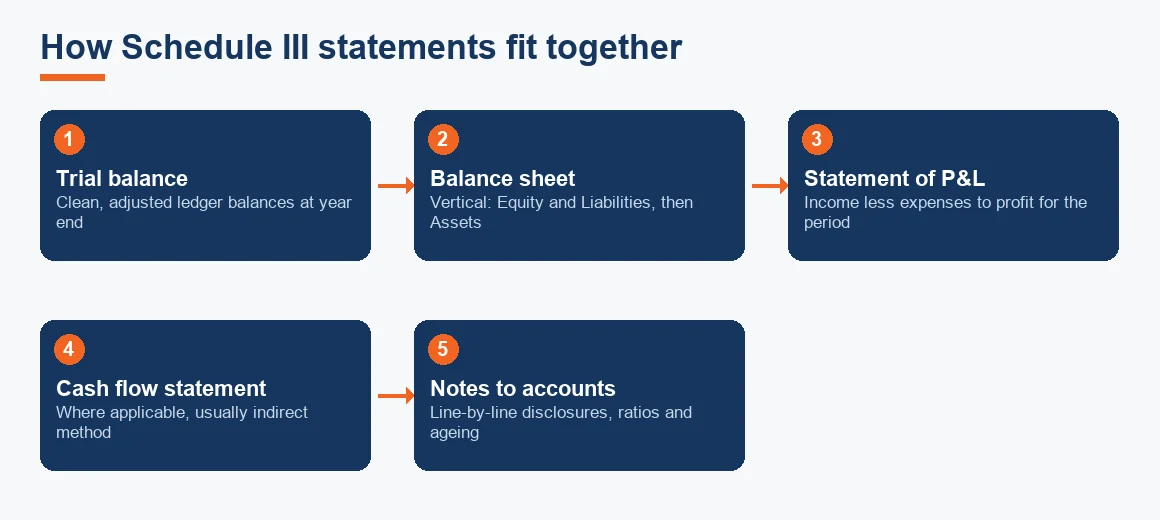
If you are still fixing which statement comes first, our guide on the correct order to prepare financial statements walks through the sequence, and the four types of financial statements post explains what each one is for.
Does Schedule III apply to all companies?
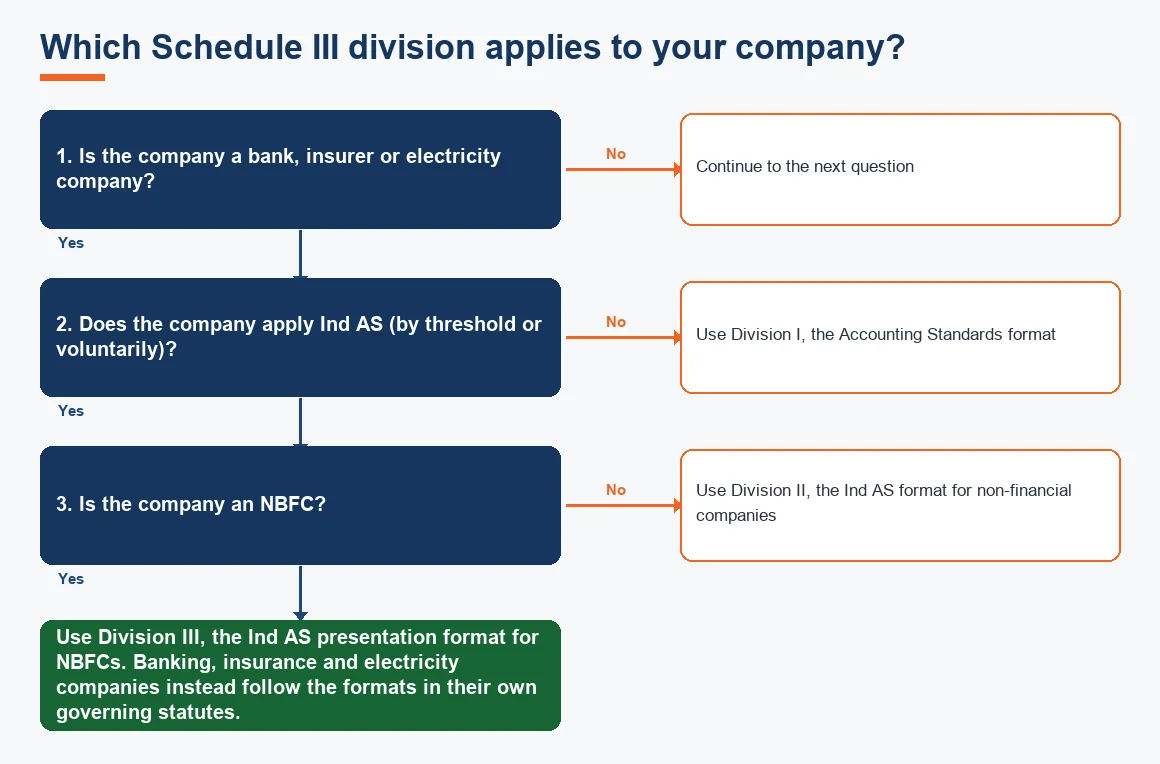
Schedule III applies to every company that prepares financial statements under the Companies Act 2013, but the exact format depends on which division you fall into. Three divisions run in parallel.
- Division I: companies that follow the Accounting Standards (AS) notified under the Companies (Accounting Standards) Rules.
- Division II: companies that follow the Indian Accounting Standards (Ind AS).
- Division III: Non-Banking Financial Companies (NBFCs) that apply Ind AS, which have their own liquidity-based presentation.
The important exceptions are banking companies, insurance companies and companies engaged in the generation or supply of electricity. These follow the formats prescribed by their own governing statutes (the Banking Regulation Act, the Insurance Act and the Electricity Act), and Schedule III applies only where those statutes are silent. You can confirm whether a company sits on AS or Ind AS with our Ind AS Applicability Checker, and compare the two frameworks side by side using the AS vs Ind AS comparison matrix.
What is the difference between Division I and Division II of Schedule III?
The two divisions share the same vertical shape but differ in terminology and depth. Division II, built for Ind AS, uses concepts that Division I does not, such as Other Comprehensive Income, financial assets and financial liabilities, and a statement of changes in equity as a separate primary statement. Division I keeps the older AS vocabulary and shows reserves and surplus rather than the Ind AS equity structure.
| Feature | Division I (AS) | Division II (Ind AS) |
|---|---|---|
| Framework | Accounting Standards | Indian Accounting Standards |
| Equity presentation | Shareholders' funds: share capital and reserves and surplus | Equity share capital and Other equity |
| Statement of changes in equity | Not a separate statement | Separate primary statement |
| Other Comprehensive Income | Not applicable | Presented within the statement of profit and loss |
| Financial instruments | Investments, loans, trade items shown by nature | Financial assets and financial liabilities classified per Ind AS 109 |
What is the vertical format of the Schedule III balance sheet?
The Schedule III balance sheet is presented vertically in two blocks that must be equal: Equity and Liabilities on top, Assets below. Within each block, items are grouped by whether they are non-current or current, which gives lenders a clear read on working capital. A simplified Division I skeleton looks like this:
- Equity and Liabilities: Shareholders' funds (share capital, reserves and surplus); Non-current liabilities (long-term borrowings, deferred tax liabilities, long-term provisions); Current liabilities (short-term borrowings, trade payables, other current liabilities, short-term provisions).
- Assets: Non-current assets (property, plant and equipment, intangible assets, non-current investments, deferred tax assets); Current assets (inventories, trade receivables, cash and cash equivalents, short-term loans and advances).
Every line item carries a note number that points to the detailed breakdown in the notes to accounts. For a plain-language walk-through of what these figures mean once assembled, our post on how to read a balance sheet is a useful companion, and the Schedule III balance sheet glossary entry gives the one-line definition.
How is the profit and loss statement prepared under Schedule III?
The statement of profit and loss is a single vertical statement with no horizontal or account form. It runs from income down to profit for the period in a fixed order: Revenue from operations, then Other income, giving Total income; then Expenses (cost of materials consumed, purchases of stock-in-trade, changes in inventories, employee benefits, finance costs, depreciation and amortisation, and other expenses). The result is profit before exceptional items and tax, then exceptional items are shown on their own line, giving profit before tax, followed by current and deferred tax, and finally profit for the period.
Two points trip people up. Exceptional items get a dedicated line before tax when their size, nature or incidence needs separate disclosure, such as a large impairment or a one-off litigation settlement. Extraordinary items, by contrast, were removed from Schedule III in 2016 and no longer exist as a category. The depreciation calculator helps you fix the depreciation and amortisation line in line with Schedule II useful lives.
What are the disclosure requirements under Schedule III?
Beyond the face of the two statements, Schedule III demands a long list of note disclosures, and this list grew sharply with the 2021 amendment. The headline additions apply to Division I and Division II non-financial companies and include:
- Ageing schedules for trade receivables, trade payables, capital work-in-progress and intangible assets under development, bucketed by period outstanding.
- Eleven financial ratios with the formula, the current and previous year figures, and an explanation for any variance above 25 per cent.
- Promoter shareholding, showing the change during the year.
- Disclosures on title deeds of immovable property not held in the company's name, loans to related parties, undisclosed income, crypto or virtual currency dealings, benami property proceedings, relationships with struck-off companies, and borrowings on the security of current assets reconciled with the quarterly returns filed with banks.
The eleven ratios are the current ratio, debt-equity ratio, debt service coverage ratio, return on equity, inventory turnover, trade receivables turnover, trade payables turnover, net capital turnover, net profit ratio, return on capital employed and return on investment. Getting the underlying ledgers clean before you compute these is exactly where a backlog bookkeeping catch-up earns its keep, and accurate receivables data drives the ageing buckets.
What are the recent amendments to Schedule III?
Schedule III has been revised several times, and three dates matter most. The timeline below sets them out.
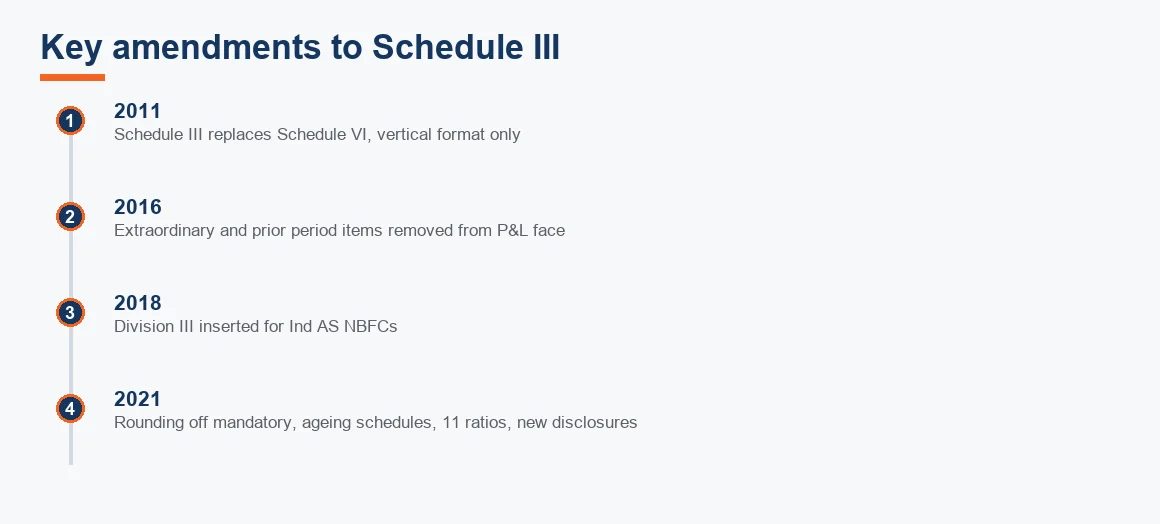
The 2016 change dropped extraordinary items and prior period items from the face of the statement of profit and loss. The 2018 revision inserted Division III for Ind AS NBFCs. The 2021 amendment, effective for financial years beginning on or after 1 April 2021, was the largest: it made rounding off mandatory, added the ageing schedules, the eleven ratios and the extensive new disclosures listed above. Because these are notified through the Companies (Accounts) framework, the Ministry of Corporate Affairs is the authority to check for the current text, and the ICAI guidance notes on Schedule III explain the practical application.
Worked example: applying mandatory rounding off
Rounding off became mandatory in 2021. A company with total income below Rs 100 crore rounds to the nearest hundreds, thousands, lakhs or millions; a company with total income of Rs 100 crore or more rounds to lakhs, millions or crores, and the same unit must run through every statement. Take a company with total income of Rs 245 crore, so it must round at least to the nearest lakh. The extract below shows selected balances rounded to Rs in lakhs (indicative figures).
| Balance sheet line (Division I) | As per ledger (Rs) | Rounded (Rs in lakhs) |
|---|---|---|
| Share capital | 5,00,00,000 | 500.00 |
| Reserves and surplus | 12,45,67,890 | 1,245.68 |
| Long-term borrowings | 8,90,12,345 | 890.12 |
| Trade payables | 3,74,55,110 | 374.55 |
| Property, plant and equipment | 18,20,33,900 | 1,820.34 |
| Trade receivables | 6,11,49,505 | 611.50 |
Each ledger figure is divided by 1,00,000 and shown to two decimals: 12,45,67,890 divided by 1,00,000 is 1,245.6789, which rounds to 1,245.68. The unit chosen, lakhs, must then be used consistently across the balance sheet, the statement of profit and loss and the notes.
Key terms
- Schedule III Balance Sheet: the mandatory vertical balance sheet layout for companies under the Companies Act 2013.
- Notes to Accounts: the supporting disclosures cross-referenced from each line of the financial statements.
- Current Assets: assets expected to be realised within twelve months or the operating cycle.
- Current Liabilities: obligations due for settlement within twelve months of the reporting date.
- Profit & Loss Statement: the vertical statement of income and expenses ending in profit for the period.
Key takeaways
- Schedule III fixes the presentation of company financial statements; it does not change measurement, which the Accounting Standards govern.
- Choose your division first: I for AS, II for Ind AS, III for Ind AS NBFCs, with banking, insurance and electricity companies on their own statutes.
- The balance sheet is vertical only, Equity and Liabilities above Assets, split into current and non-current.
- The 2021 amendment made rounding off mandatory and added ageing schedules, eleven ratios and a wide set of new disclosures.
- For an end-to-end managed close in this format, our Financial Statement Preparation service handles the assembly and the disclosures.
Schedule III looks intimidating because of the disclosure load, but the format itself is stable and logical once the division is settled. Pair it with a clean trial balance and a disciplined month-end routine, and the annual statements largely assemble themselves. If the cash flow presentation is the piece you are unsure about, our explainer on the direct versus indirect method covers that statement in detail.
Decision guide