In this guide
The difference between direct and indirect cash flow lies entirely in how the operating section is built, not in the answer it reaches. The direct method lists the actual cash received from customers and cash paid to suppliers, employees and tax authorities. The indirect method takes profit before tax straight from the books and works backwards, adding non-cash charges and adjusting for changes in receivables, payables and inventory. Both arrive at exactly the same net cash from operating activities. In India, AS 3 and Ind AS 7 allow either, but the indirect method is used by almost every company because it starts from a number the ledger already holds.
What is the difference between direct and indirect cash flow?
A cash flow statement splits the movement of cash into three activities: operating, investing and financing. The direct and indirect methods only change the presentation of the first of these, the operating section. Investing and financing flows, such as buying plant or raising a term loan, are shown gross under both approaches, so the debate is narrow.
The direct method answers a plain question: how much cash actually came in from trade and how much went out. The indirect method answers a reconciliation question: why does the profit reported in the profit and loss statement not equal the cash the business generated. A firm can report healthy profit yet see its bank balance fall, because sales are stuck in accounts receivable or cash is tied up in stock. The indirect method makes that gap visible line by line, which is one reason lenders and auditors are comfortable with it.
What is direct cash flow?
The direct method (sometimes called the direct method cash flow statement) reports operating cash as gross categories of receipts and payments. A typical layout shows cash collected from customers, then subtracts cash paid to suppliers, cash paid to employees, other operating payments and income tax paid. The residual is net cash from operations.
Its appeal is clarity: a reader sees the genuine cash cycle without wading through accruals. Its drawback in practice is data. Most Indian books are kept on accrual accounting, so the system records invoices and bills, not the cash split behind each one. To produce a direct method statement you either maintain a parallel cash analysis or reconstruct receipts and payments from the bank ledger, which is why so few companies bother. Ind AS 7 encourages the direct method precisely because that gross detail is useful, yet it stops short of mandating it.
How does an indirect cash flow work?
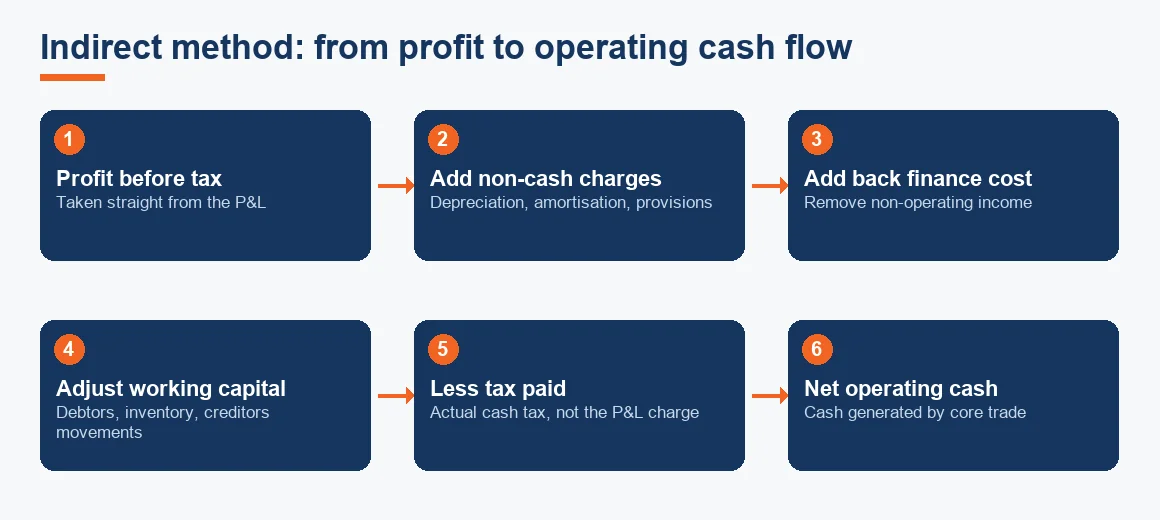
The indirect method begins with profit before tax and removes everything in that figure that did not move cash. The steps are consistent:
- Start with profit before tax from the P&L.
- Add back non-cash charges such as depreciation and amortisation, because they reduced profit but never left the bank.
- Add back finance cost and remove non-operating income, so the section reflects only trading and financing lines are shown separately.
- Adjust for working capital: subtract a rise in receivables or inventory, and add a rise in payables, because these movements consume or release cash.
- Subtract income tax actually paid during the year.
The result is net cash from operating activities. The logic is that every difference between profit and cash sits in either a non-cash charge or a change in a working capital balance, so reversing those differences converts one into the other. This is the method the glossary describes under cash flow statement (indirect method).
What are the two methods of cash flow?
The two methods are direct and indirect, and they apply only to the operating section. The table below summarises how they compare on the points that actually matter when you sit down to prepare the statement.
| Point of comparison | Direct method | Indirect method |
|---|---|---|
| Starting point | Gross cash receipts from customers | Profit before tax |
| What the reader sees | Actual cash in and cash out by category | Reconciliation of profit to cash |
| Data required | Cash analysis or reconstructed bank splits | Figures already in the ledger and balance sheet |
| Effort in India | High, rarely maintained | Low, standard practice |
| Standard preference | Encouraged by Ind AS 7 | Permitted by AS 3 and Ind AS 7 |
| Net operating cash figure | Identical | Identical |
What are the three types of cash flow statements?
A common point of confusion: there are not three types of cash flow statement, there are three sections within one statement. Every cash flow statement, direct or indirect, groups cash into operating, investing and financing activities.
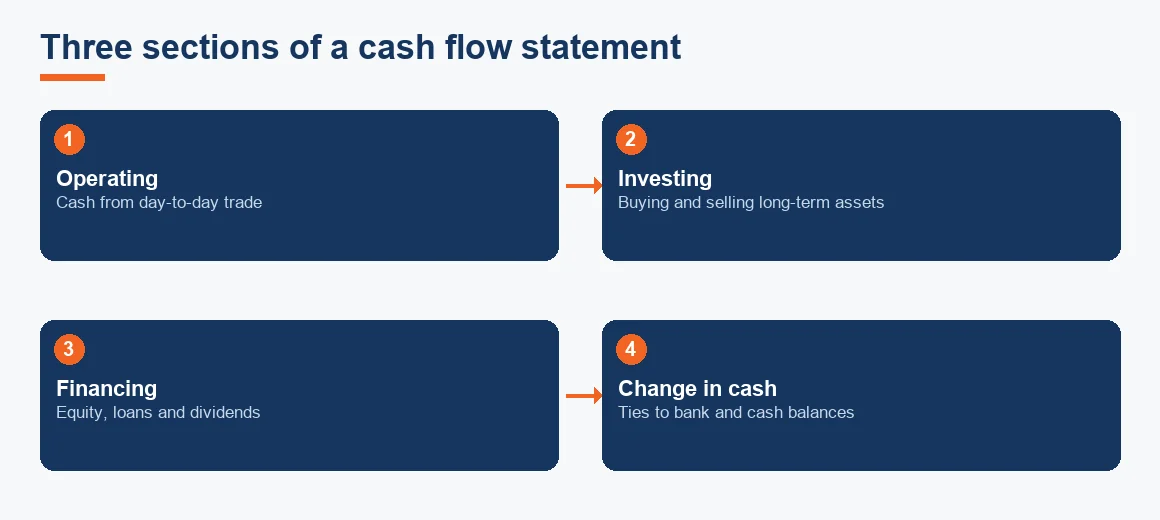
Operating activities cover the day-to-day trade. Investing activities cover the purchase and sale of long-term assets such as plant, property and investments. Financing activities cover equity raised, dividends paid, and loans taken or repaid. The three sections added together equal the change in cash and cash equivalents, which must reconcile to the movement in your bank and cash balances. If it does not tie, the statement is wrong, and a quick bank reconciliation is usually where the error is found. For the wider set of reports, see our guide on the four types of financial statements and the correct order to prepare them.
Worked example: indirect method operating cash flow
Assume a trading company with profit before tax of Rs 60 lakh. During the year it charged Rs 10 lakh of depreciation and Rs 4 lakh of finance cost, debtors rose by Rs 25 lakh, inventory rose by Rs 8 lakh, creditors rose by Rs 12 lakh, and it paid Rs 15 lakh of income tax. The indirect method builds operating cash as follows.
| Line item | Amount (Rs lakh) |
|---|---|
| Profit before tax | 60 |
| Add: Depreciation | 10 |
| Add: Finance cost | 4 |
| Operating profit before working capital changes | 74 |
| Less: Increase in debtors | (25) |
| Less: Increase in inventory | (8) |
| Add: Increase in creditors | 12 |
| Cash generated from operations | 53 |
| Less: Income tax paid | (15) |
| Net cash from operating activities | 38 |
The company reported Rs 60 lakh of profit before tax but generated only Rs 38 lakh of operating cash, and the reconciliation shows exactly why: Rs 33 lakh was absorbed by higher debtors and stock, partly offset by Rs 12 lakh of extra supplier credit. A direct method statement for the same firm would report cash received from customers and cash paid to suppliers and employees, land on the same Rs 38 lakh, but would not reveal the working capital story at a glance. Under-collecting debtors is a persistent drag, and disciplined accounts receivable outsourcing or tighter accounts payable outsourcing often does more for operating cash than a change in reporting format.
How to do an indirect cash flow, step by step
To prepare the operating section under the indirect method for an Indian entity:
- Pull profit before tax and the closing balance sheet, then place last year's balance sheet alongside it.
- Add back every non-cash charge in the P&L: depreciation, amortisation, provisions and impairment.
- Add back finance cost and strip out interest and dividend income, which belong in investing or financing.
- Compute the change in each working capital line (debtors, inventory, prepaid items, creditors, accruals) and apply the correct sign.
- Deduct income tax actually paid, taken from the tax ledger rather than the P&L charge.
- Build the investing and financing sections gross, then confirm the three totals equal the movement in cash and cash equivalents.
Accurate books are the real prerequisite. If prior months are incomplete, a backlog bookkeeping and catch-up exercise has to come first, because a cash flow statement can only be as reliable as the ledgers behind it. When the books are current, assembling the statement is a mechanical part of financial statement preparation.
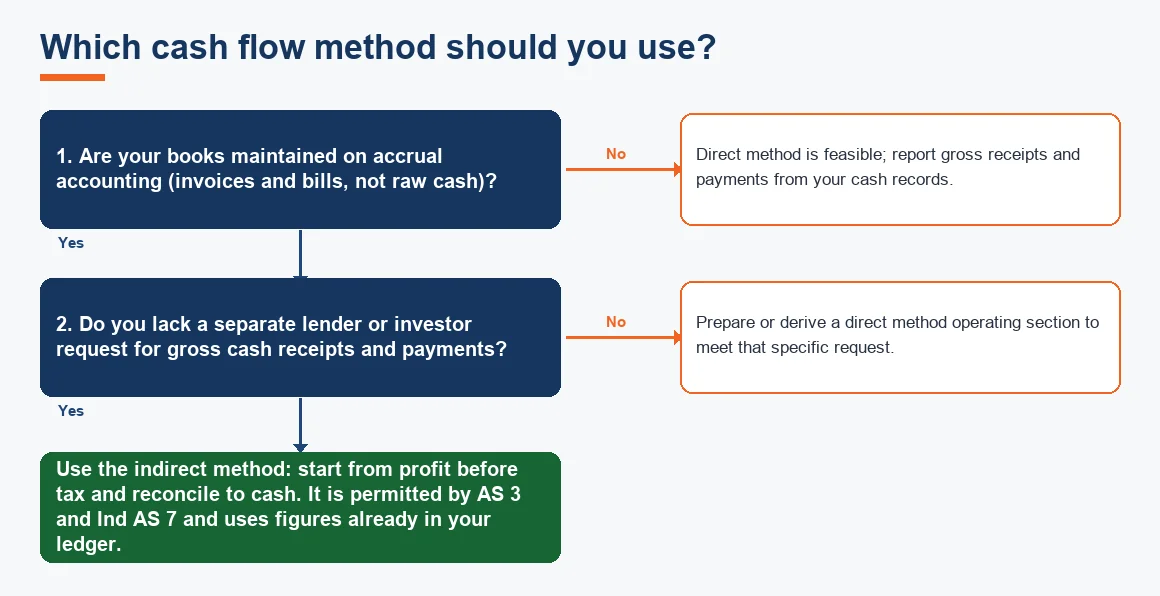
Which method should you use in India?
For statutory accounts, the indirect method is the pragmatic default. AS 3, notified under the Companies (Accounting Standards) Rules, and Ind AS 7 both explicitly permit either method for operating activities, so you are compliant with the indirect method even though Ind AS 7 expresses a preference for the direct method's gross detail. Because listed and larger companies present a cash flow statement as part of their audited results, and their books already produce profit before tax, the indirect method is the path of least resistance. You can confirm which framework applies to your entity with the Ind AS Applicability Checker, and if depreciation add-backs are involved, the depreciation calculator keeps that line consistent with Schedule II. Whether a cash flow statement is compulsory for a particular company depends on its size and class; the format follows Schedule III, which we cover in the Schedule III financial statement format guide, and reading it alongside the balance sheet gives the full picture.
Key terms
- Cash Flow Statement: the statement reporting cash moving through operating, investing and financing activities over a period.
- Cash Flow Statement (Indirect Method): the operating section built by adjusting profit before tax for non-cash items and working capital.
- Working Capital: current assets less current liabilities; its movement drives most of the profit-to-cash gap.
- Accrual Accounting: recognising income and expense when earned or incurred rather than when cash changes hands.
- Depreciation: the non-cash charge added back first under the indirect method.
Key takeaways
- Direct and indirect differ only in the operating section and reach the same net operating cash.
- The indirect method starts from profit before tax and reverses non-cash and working capital items.
- AS 3 and Ind AS 7 permit either method; the indirect method is standard in India because it uses figures already in the ledger.
- All three sections must tie to the change in bank and cash balances.
- A profit-to-cash gap almost always sits in receivables, inventory or payables.
The two methods are not a real choice for most Indian businesses so much as a matter of presentation. Get the books current and accurate, apply the indirect method consistently, and the statement will tell you honestly whether your trade, not your borrowing, is funding the company. The governing standards are set out by the Ministry of Corporate Affairs and the Institute of Chartered Accountants of India, which remain the authorities to consult on any AS 3 or Ind AS 7 question.
Decision guide