In this guide
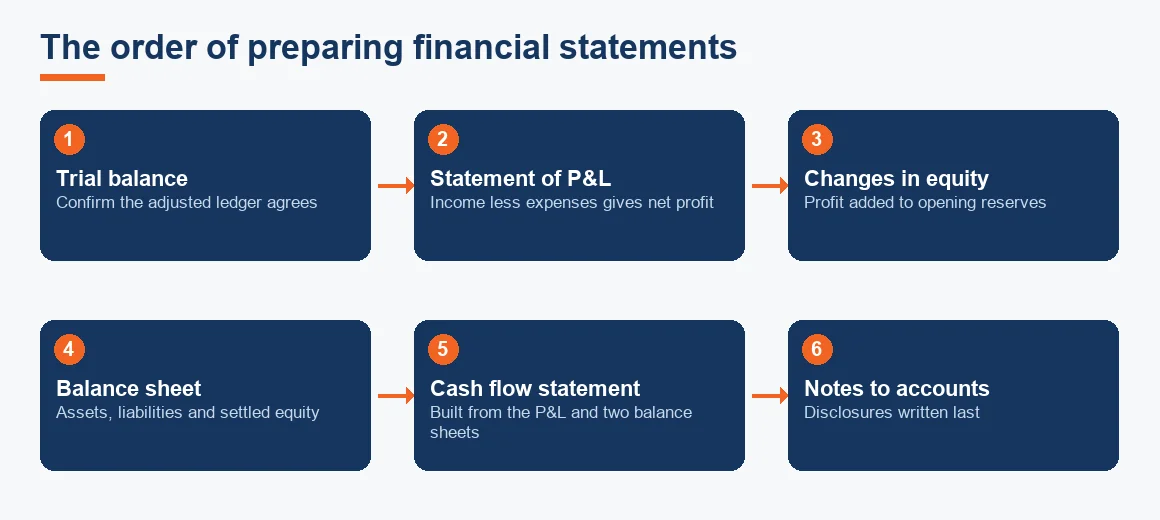
The correct order of financial statement preparation is fixed, not a matter of preference: you prepare the trial balance first, then the statement of profit and loss, then the statement of changes in equity where it applies, then the balance sheet, then the cash flow statement, and last of all the notes to accounts. Each statement supplies a figure the next one needs, so the sequence cannot be reshuffled without the numbers breaking. This explainer sets out why that order exists and what it means when you close a year in practice.
Which financial statement is prepared first?
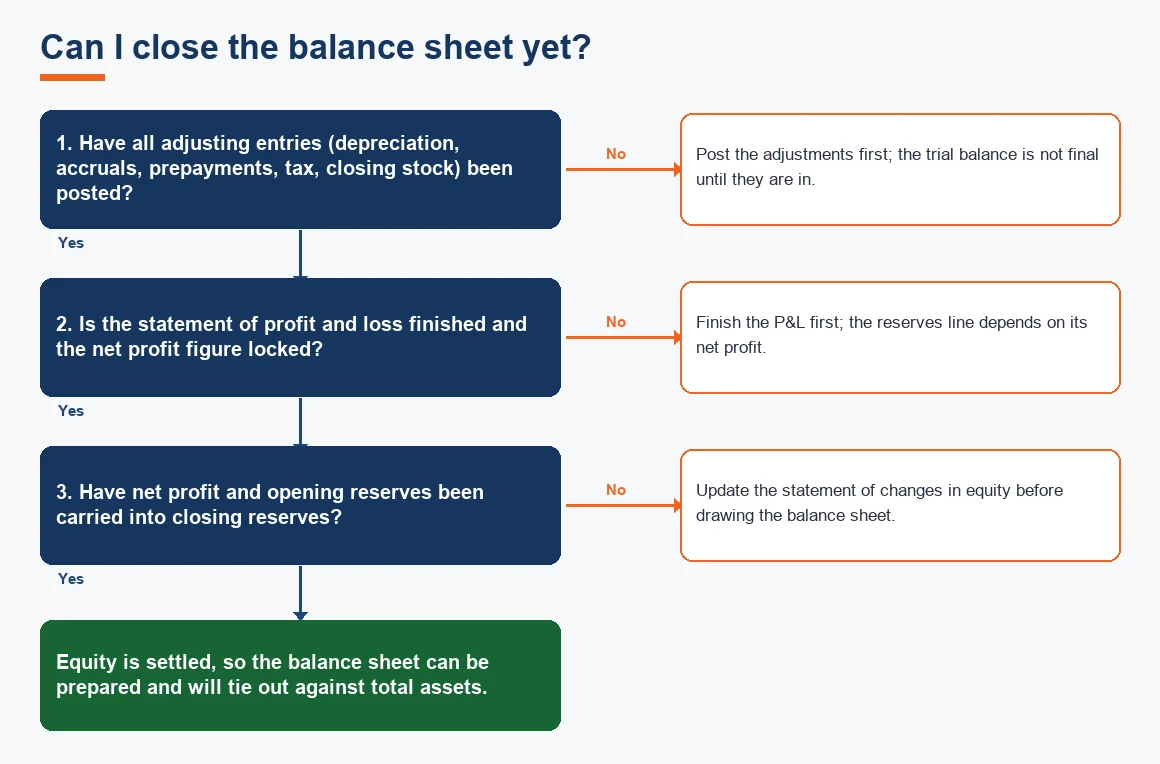
Strictly speaking the trial balance is prepared first, but the trial balance is a working schedule rather than one of the published statements. Among the statements a business actually issues, the statement of profit and loss (the income statement) is prepared first. It is prepared first for one plain reason: it produces the net profit figure, and that figure has to be carried into reserves before the balance sheet can be drawn. Prepare the balance sheet before the P&L is settled and the reserves line is a guess, so the statement will not tie out.
Under double-entry bookkeeping every transaction has already touched two accounts, so by year end the raw material for all the statements is sitting in the ledgers. The order is simply the route by which those balances are turned into a finished set of accounts.
The correct order of preparing financial statements
The chronological order of the financial statements follows the logic of dependency. Here is the full sequence with the reason each step sits where it does.
- Trial balance. The general ledger balances are listed as debits and credits to confirm the books agree before anything is drawn up.
- Statement of profit and loss. Income less expenses gives the net profit or loss for the year.
- Statement of changes in equity. The net profit is added to opening reserves; this statement applies to companies reporting under Ind AS.
- Balance sheet. Assets, liabilities and the now-settled equity figure are presented as at the year end.
- Cash flow statement. Prepared from the P&L and the movement between two balance sheets, so it needs both of the earlier statements finished.
- Notes to accounts. The explanatory notes are written last because they reference figures from every statement above.
This is why the honest answer to "what comes first, a balance sheet or an income statement?" is always the income statement. The related question of what the four types of financial statements are is covered separately; here the concern is only the order in which they are built.
What are the 9 steps in preparing financial statements?
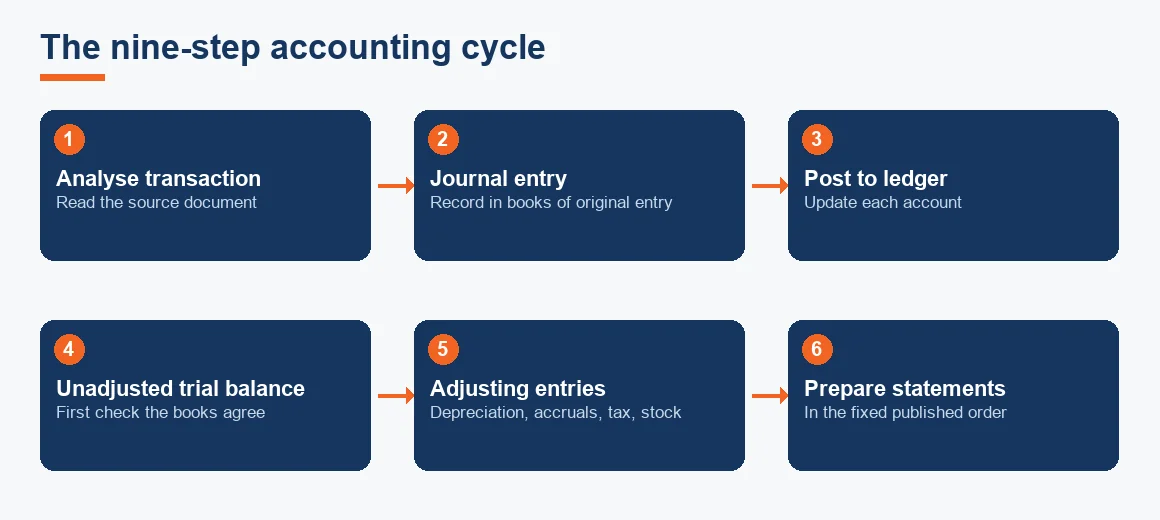
The published order above sits inside the wider accounting cycle. The nine steps that carry a business from a raw transaction to a signed set of accounts are:
- Identify and analyse the transaction from its source document.
- Record the journal entry in the books of original entry.
- Post the entries to the ledger accounts.
- Extract the unadjusted trial balance.
- Pass the adjusting entries: depreciation, accruals, prepayments, provision for tax and closing stock.
- Extract the adjusted trial balance.
- Prepare the financial statements in the order set out above.
- Pass the closing entries to zero out the income and expense accounts.
- Draw the post-closing trial balance to confirm only real accounts remain.
Steps one to six are ordinary bookkeeping; the order that matters for the statements themselves is entirely in step seven. If your books are months behind, this cycle is exactly what a backlog bookkeeping and catch-up exercise rebuilds before any statement can be trusted.
Why the P&L must close before the balance sheet
The dependency is arithmetic, not convention. The net profit calculated in the statement of profit and loss is transferred to reserves and surplus, which sits on the equity side of the balance sheet. Until that profit figure is locked, the equity total is unknown, and if equity is unknown the balance sheet cannot balance against total assets. This is also why the trial balance has to be finalised first: the balance sheet is drawn straight from closing trial balance figures after every adjustment has been posted.
Closing stock is the entry that catches people out, because it lands in two places at once. It reduces the cost of goods sold in the P&L (raising profit) and it appears as a current asset on the balance sheet. Change the stock value and both statements move together, which is a clean illustration of why they cannot be prepared independently.
A worked example: how profit flows into the balance sheet
The clearest way to see the order is to follow one profit figure from the P&L into equity. Take a small trading company with an adjusted trial balance already in hand. All figures are in rupees and illustrative.
| Line | Statement of profit and loss | Amount (INR) |
|---|---|---|
| Revenue from operations | Income | 50,00,000 |
| Cost of goods sold | Less | 30,00,000 |
| Operating expenses | Less | 8,00,000 |
| Depreciation | Less | 2,00,000 |
| Profit before tax | Subtotal | 10,00,000 |
| Provision for tax at 25% | Less | 2,50,000 |
| Net profit for the year | Result | 7,50,000 |
That net profit of 7,50,000 is not the end of the P&L's job; it is the start of the balance sheet's. It is added to opening reserves of 20,00,000, giving closing reserves of 27,50,000. With share capital of 10,00,000, total equity becomes 37,50,000. None of that equity figure could have been written down before the P&L was finished, which is the whole point of the sequence. The tax rate used is the 25% rate that applies to a domestic company with turnover up to Rs 400 crore that has not elected a concessional regime, and is indicative only; your effective rate depends on the regime you have elected. A company that opts into Section 115BAA is instead taxed at a lower 22% base rate (about 25.17% with surcharge and cess).
The statutory backing in India
The order is not just good practice, it sits on top of statutory requirements. Section 2(40) of the Companies Act lists five financial statements: the balance sheet, the statement of profit and loss, the cash flow statement, the statement of changes in equity where applicable, and the explanatory notes. One person companies, small companies, dormant companies and eligible start-ups are not required to prepare the cash flow statement.
Section 129 turns the whole exercise into a statutory duty to present a true and fair view in the format prescribed by Schedule III of the Companies Act. Once adopted at the annual general meeting, companies file the statements with the Ministry of Corporate Affairs in Form AOC-4. The measurement and presentation standards behind the numbers are issued by the ICAI, and the tax provision that appears in the P&L follows the rates notified by the Income Tax Department. Getting the sequence right is what lets a business meet all of these in one clean pass.
How the sequence compares at a glance
The table below summarises each statement, what it depends on and why it sits where it does in the order.
| Order | Statement | Depends on | Key output |
|---|---|---|---|
| 1 | Trial balance | Adjusted ledger balances | Confirms books agree |
| 2 | Statement of profit and loss | Adjusted trial balance | Net profit for the year |
| 3 | Statement of changes in equity | Net profit from step 2 | Closing reserves |
| 4 | Balance sheet | Closing reserves and assets | Position at year end |
| 5 | Cash flow statement | Steps 2 and 4 | Cash movement |
| 6 | Notes to accounts | All statements above | Disclosures |
Reading the finished output is a separate skill; if that is your next question, our guide on how to read a balance sheet and the piece on the direct versus indirect cash flow method pick up where this one ends.
Key terms
- Trial Balance: a list of all ledger balances as debits and credits, used to check the books agree before statements are drawn.
- Profit & Loss Statement: the statement of income and expenses that produces the net profit for the year.
- Balance Sheet: the statement of assets, liabilities and equity as at the year-end date.
- Closing Journal Entries: entries that zero out income and expense accounts and carry profit to reserves.
- Notes to Accounts: the explanatory disclosures prepared last, referencing every statement above.
When to hand the sequence over
For a business with clean books, running this order at year end is routine. It stops being routine when the ledgers are incomplete, when adjustments have been missed, or when a fast-growing company needs the accounts closed to a deadline. That is the point at which structured financial statement preparation or a broader accounting service earns its place, because the order is only as reliable as the trial balance it starts from. If you want to sanity-check the depreciation figure that feeds step five, our depreciation calculator and deferred tax calculator handle the arithmetic under Schedule II and Ind AS.
Key takeaways
- The order is trial balance, P&L, statement of changes in equity, balance sheet, cash flow statement, then notes.
- The statement of profit and loss is always prepared before the balance sheet, because its net profit feeds equity.
- Finalise the trial balance only after every adjustment (depreciation, accruals, prepayments, tax, closing stock) is posted.
- Closing stock affects both the P&L and the balance sheet, so the two cannot be prepared independently.
- Section 2(40) lists five statements; Section 129 requires a true and fair view in the Schedule III format.
Decision guide