
In this guide
The four methods of costing are job costing, batch costing, process costing and contract costing. They are not competing theories: each is a way of gathering cost against a chosen unit, and a business picks the one that mirrors how it actually produces. A jobbing engineer that builds one machine to order needs a different unit of measurement from a cement plant that runs a continuous kiln, so the two use different methods even though both are following the same underlying cost accounting logic. This article explains the four methods, shows where techniques such as standard costing and activity based costing sit, and sets out what Indian law requires. For a costing system built and run for your business, that sits with our Inventory Accounting & Costing team rather than with this explainer.
What are the 4 methods of costing?
All four methods answer the same question, what did our output cost, but they differ in what they treat as the cost unit. Choosing the unit correctly is the whole game, because every material issue, labour hour and overhead recovery is then collected against it.
- Job costing collects cost against a single, identifiable job or order.
- Batch costing collects cost against a batch of identical units, then divides to get a cost per unit.
- Process costing collects cost against a process or stage over a period, and averages it over the units passing through.
- Contract costing collects cost against one large, long-running contract, usually executed at a site away from the factory.
People sometimes ask what the two methods of costing are, expecting a shorter list. The honest answer is that costing splits broadly into specific order costing (job, batch and contract, where output is made to a distinct order) and continuous operation costing (process and its variants, where output flows without a distinct order). The four named methods are simply the practical members of those two families.
What is the job costing method?
Job costing treats each order as its own cost centre. You open a job card, book the direct and indirect factory overheads, direct materials and direct labour to that card, absorb a share of production overhead, and the total on the card is what the job cost. It suits work that is made to a customer specification and does not repeat identically: printing, tool rooms, custom fabrication, interior fit-outs and repair work. The strength of job costing is precision on a single order; the discipline it demands is accurate time and material booking, because a job that is under-booked looks more profitable than it is. Where jobs stay open across a month end, the unfinished value sits as work-in-progress and must be carried correctly into the accounts.
What is batch costing?
Batch costing is job costing applied to a group. Instead of costing one unit, you cost a whole batch as if it were a single job, then divide the batch cost by the number of good units to get a cost per unit. It fits production that runs in identical lots: a pharmaceutical company making 10,000 strips of one formulation, a garment unit cutting a run of one style and size, or a bakery baking a tray of the same product. The natural question batch costing answers is the economic batch quantity, the run size at which set-up cost per unit and holding cost per unit are jointly lowest. A bill of materials underpins the whole calculation, because the material cost of the batch is only as reliable as the recipe behind it.
What is process costing?
Process costing is used where output is continuous and one unit is indistinguishable from the next: cement, sugar, paint, chemicals, refining and bulk food. You cannot point to a single job, so you collect the cost of each process for a period and spread it over the equivalent units produced, making an allowance for partly finished work. Two features make process costing distinctive. First, output of one process becomes the input of the next, so cost accumulates stage by stage. Second, normal loss (evaporation, trimming, unavoidable wastage) is absorbed by the good units, while abnormal loss is separated out and investigated. Because everything is averaged, process costing is less about pricing one order and more about controlling yield and loss across a run, which is why loss percentages and variance analysis matter so much in a process environment.
What is contract costing?
Contract costing is job costing scaled up for large, long-duration work carried out at a site: civil construction, infrastructure, shipbuilding and turnkey projects. Each contract is a cost unit, most cost is direct to that contract, and profit has to be recognised sensibly before the contract finishes. That is where the percentage of completion method comes in, taking a prudent share of the estimated profit as the work progresses rather than waiting for handover. Retention money, plant on site and materials at site all need careful treatment, so contract costing carries more balance-sheet complexity than the other three methods.
Which costing method is best?
There is no best method in the abstract; there is only the method that matches your production flow. Force process costing onto a jobbing workshop and every order looks like the average, hiding the loss-makers. Force job costing onto a continuous plant and you spend effort tracking units that are genuinely identical. Use the table below to map how you produce to the method that fits.
| Method | Cost unit | Best when production is | Typical Indian industries |
|---|---|---|---|
| Job costing | The individual job or order | One-off, made to a customer specification | Printing, tool rooms, custom fabrication, interiors |
| Batch costing | A batch of identical units | Repeated in identical lots | Pharma, garments, bakery, components |
| Process costing | A process or stage per period | Continuous and standardised | Cement, sugar, paint, chemicals, refining |
| Contract costing | The individual contract | Large, long-duration, site based | Construction, infrastructure, shipbuilding |
Standard, ABC and the other terms people search for
Several popular searches, the standard costing method, the ABC costing method, the direct costing method, are really about techniques applied on top of the four methods.
Standard costing method
Standard costing sets a predetermined cost for material, labour and overhead, then measures the gap between standard and actual as variances. It is a control technique: it tells you where reality drifted from plan and by how much. The output feeds a standard cost variance review that separates price effects from usage effects.
ABC (activity based costing) method
Activity based costing traces overhead through cost pools to the activities that drive it, number of set-ups, purchase orders, inspections, rather than spreading overhead on a single volume rate such as machine hours. It gives a fairer picture where a low-volume product consumes a lot of support activity. It is a management tool and is not required for statutory accounts. Our explainer on ABC analysis in inventory management covers the related stock-prioritisation idea in one place, so we will not repeat it here.
Marginal and direct costing
Marginal costing (often loosely called direct costing) charges only variable cost to the product and writes fixed overhead off in the period, which is useful for pricing and break-even decisions. Absorption costing loads a share of fixed overhead into every unit and is what AS 2 requires for the financial statements. The two give different closing stock values, so the decision view and the statutory view are deliberately kept separate.
Costing method and the value that lands in stock
The costing method decides how you gather cost; the inventory valuation formula decides how that cost flows out as goods are sold. The two are linked but distinct. AS 2 permits FIFO and weighted average for interchangeable items and requires specific identification for items that are not ordinarily interchangeable; LIFO is not permitted in India. Whichever formula you pick must be applied consistently and disclosed. Our comparison of FIFO, LIFO and weighted average and the FIFO versus weighted average cost gloss set out the mechanics, and whether you run a perpetual or periodic inventory system decides how often that flow is recalculated. The figure that finally reaches the profit and loss account as cost of goods sold depends on all three choices working together.
Does Indian law require a particular costing method?
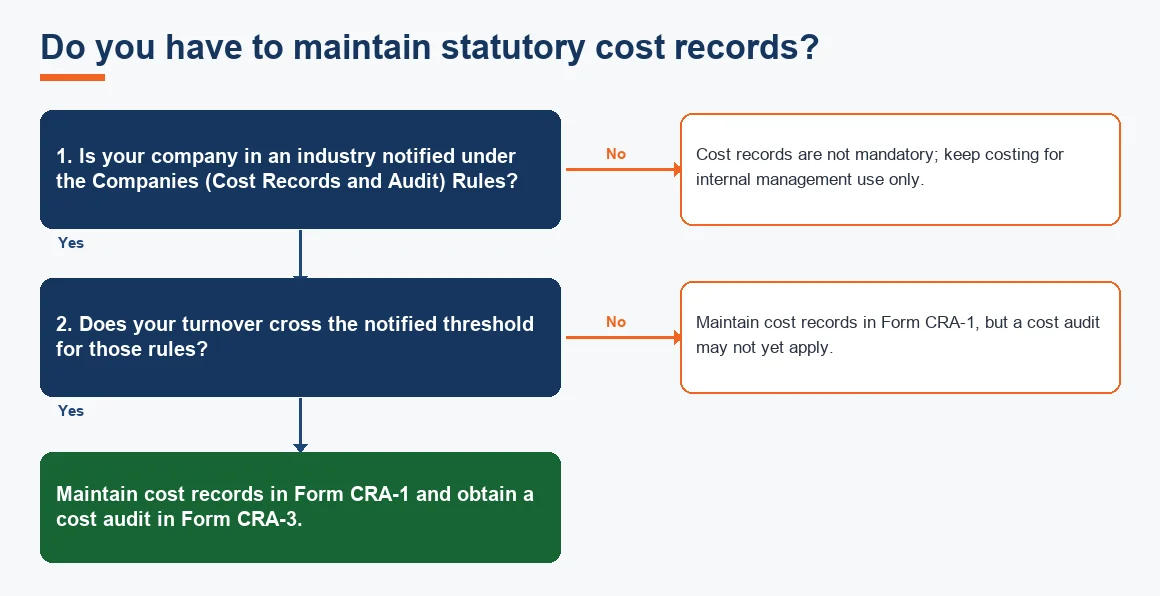
No single method is prescribed. What the law does require, for specified industries, is that cost records are kept. Section 148 of the Companies Act, read with the Companies (Cost Records and Audit) Rules, requires notified companies to maintain cost records in Form CRA-1, which lists the cost headings to be captured, and a cost audit in Form CRA-3 applies once notified turnover thresholds are crossed. The rules and forms are published by the Ministry of Corporate Affairs. Within that framework you still choose job, batch, process or contract costing to suit your production, and you value the resulting inventory under AS 2 issued by the ICAI. In other words, the law fixes the record-keeping and the valuation floor; it leaves the method to the nature of your operations.
Worked example: a job cost sheet
To make job costing concrete, here is a cost sheet for a single fabrication order (Job No. J-418). Overhead is absorbed at a predetermined rate of Rs 150 per direct labour hour, administration and selling overhead is recovered at 10 percent of works cost, and the firm targets a 20 percent margin on cost. All figures are indicative and Exl GST.
| Cost element | Basis | Amount (Rs) |
|---|---|---|
| Direct materials | Issued to job | 1,20,000 |
| Direct labour | 200 hours @ Rs 250 | 50,000 |
| Direct expenses | Hired tooling | 10,000 |
| Prime cost | Sum of the above | 1,80,000 |
| Production overhead | 200 hours @ Rs 150 | 30,000 |
| Works cost | Prime cost + production overhead | 2,10,000 |
| Admin, selling & distribution | 10% of works cost | 21,000 |
| Total cost | Works cost + admin, S&D | 2,31,000 |
| Profit margin | 20% of total cost | 46,200 |
| Quoted price | Total cost + margin | 2,77,200 |
The same skeleton, materials plus labour plus expenses to prime cost, then overhead to works cost, then a margin, is what you would use for a batch (dividing the total by good units) or a contract (recognising profit by stage). A shared depreciation calculator helps here, because plant depreciation is a large part of the production overhead you absorb per hour.
Key terms
- Cost of Goods Sold: the cost of the units actually sold in a period, the figure your costing method ultimately feeds.
- Work-in-Progress (WIP) Valuation: the value of jobs or processes unfinished at period end, carried into the accounts.
- Bill of Materials (BOM) Costing: the priced recipe that sets the material cost of a unit or batch.
- Direct vs Indirect Factory Overheads: the split that decides what is booked straight to a job and what is absorbed.
- Standard Cost Variance: the gap between predetermined and actual cost, split into price and usage effects.
Key takeaways
- The four methods of costing are job, batch, process and contract; each is defined by the cost unit it uses.
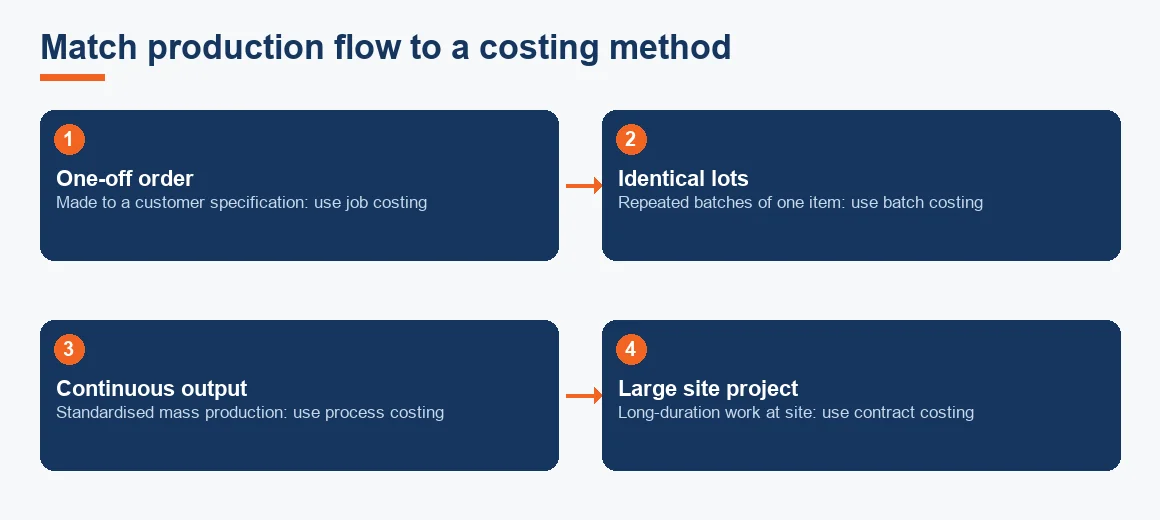
- Match the method to the production flow, not the other way round: one-off orders to job, identical lots to batch, continuous output to process, long site projects to contract.
- Standard costing, marginal costing and ABC are techniques applied on top of a method, not additional methods.
- Indian law prescribes no single method but requires notified industries to keep cost records in Form CRA-1 and values the resulting stock under AS 2.
- Costing decisions only work on clean books, so fix any bookkeeping backlog before trusting the numbers.
Decision guide