In this guide
The difference between a perpetual vs periodic inventory system comes down to when stock records move. A perpetual system updates quantity and cost of goods sold on every single receipt and issue, so the book balance is live. A periodic system leaves the records untouched during the period and works out cost of goods sold only after a full physical count at the end. Both are legitimate under Indian accounting standards, but they suit very different businesses, and one of them is now closer to a compliance expectation than a choice.
What is a perpetual inventory system?
A perpetual inventory system keeps a continuous, running record of every item. The moment a strip of medicine is billed at a pharmacy or a carton leaves a warehouse, the software reduces stock, recognises cost of goods sold and updates gross margin. There is no waiting. If you open your books at 3 pm on a Tuesday, the closing stock figure on screen is meant to be correct as of that instant.
This is the default behaviour of item-wise accounting in TallyPrime, Zoho Books, Odoo and most enterprise resource planning systems. Each sale posts two effects at once: it records revenue, and it moves the cost of the item sold out of the inventory account and into cost of goods sold. That second posting is what makes the system perpetual. For a deeper look at how the underlying two-sided posting works, see our note on double-entry bookkeeping.
What is a periodic inventory system?
A periodic inventory system records purchases as they happen but does not touch the cost of goods sold or the stock account when a sale is made. The revenue is booked, yet the cost side stays frozen. At the end of the month, quarter or year, someone physically counts what is left, values it, and only then is cost of goods sold worked out by a simple formula:
Opening stock + Purchases during the period − Closing stock (counted) = Cost of goods sold.
The system is cheap and simple because it needs no item-level tracking through the period. The price you pay is blindness: between two counts you genuinely do not know your true stock or your true margin. A shortage caused by theft, breakage or a wrong issue only surfaces when the count happens, by which time the trail has gone cold.
Difference between perpetual and periodic inventory
The two systems answer the same question, closing stock and cost of goods sold, but at different moments and with different discipline. The table below sets the practical differences side by side.
| Feature | Perpetual system | Periodic system |
|---|---|---|
| When records update | Continuously, on every receipt and issue | Only at period end, after a physical count |
| Cost of goods sold | Known at any moment | Computed by formula after counting |
| Stock visibility | Real-time book balance | Unknown between counts |
| Shrinkage detection | Book vs physical gap is visible | Buried inside cost of goods sold |
| Software needed | Yes, item-wise accounting | Not essential |
| Effort and discipline | High: every issue must be entered | Low during period, spike at count |
| Best suited to | High-value or fast-moving stock | Small, low-value inventories |
Notice that shrinkage line. In a perpetual system the difference between the book figure and the counted figure is a measurable number, which you can then treat as an inventory shrinkage provision. In a periodic system that same loss simply inflates cost of goods sold and no one ever isolates it.
How a perpetual inventory system works step by step
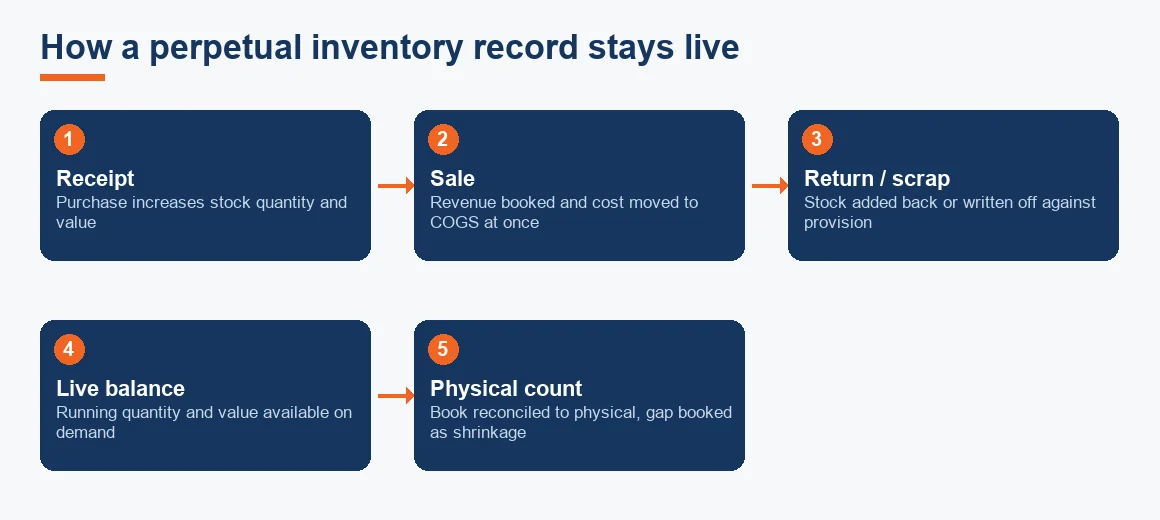
The mechanics are the same in any item-wise package. The point is that the cost posting is automatic and paired with the sale.
- Receipt: a purchase or goods-received note increases the item quantity and the inventory value in the general ledger.
- Sale: the invoice books revenue and, at the same instant, moves the item's cost from inventory to cost of goods sold.
- Return or scrap: a sales return adds stock back; damaged or expired goods are written off against a provision.
- Live balance: the running quantity and value are available on demand, feeding reorder levels and margin reports.
- Physical verification: a periodic count reconciles book to physical, and the gap is booked as shrinkage.
What is the journal entry for perpetual inventory?
This is where the two systems visibly diverge. Under a perpetual system a sale needs two journal entries, one for the money and one for the cost. Under a periodic system only the revenue entry is passed during the period; the cost of goods sold is a single adjusting entry at the end.
Assume a trader sells goods for ₹50,000 (indicative, Exl GST) that cost ₹32,000. The perpetual entries are:
- Entry 1 (record the sale)
- Debit Accounts Receivable ₹50,000; Credit Sales ₹50,000.
- Entry 2 (record the cost)
- Debit Cost of Goods Sold ₹32,000; Credit Inventory ₹32,000.
Under a periodic system, only Entry 1 is passed at the point of sale. Entry 2 never appears item by item; instead, the whole period's cost of goods sold is derived at the count. If journal entry mechanics are new to you, the glossary explains the debit and credit logic.
Worked example: a perpetual stock card and its entries
The clearest way to see a perpetual system is a stock ledger card that moves with every transaction. Below is a card for a single product over one month, valued on first-in-first-out, with the closing balance flowing straight into the books.
| Date | Transaction | In (units) | Out (units) | Rate (₹) | Balance (units) | Stock value (₹) |
|---|---|---|---|---|---|---|
| 01 Jul | Opening | - | - | 200 | 100 | 20,000 |
| 06 Jul | Purchase | 150 | - | 220 | 250 | 53,000 |
| 14 Jul | Sale | - | 120 | - | 130 | 28,600 |
| 22 Jul | Purchase | 100 | - | 240 | 230 | 52,600 |
| 28 Jul | Sale | - | 90 | - | 140 | 32,800 |
On the 14 July sale, first-in-first-out issues 100 units at ₹200 and 20 units at ₹220, a cost of ₹24,400, so the cost of goods sold entry is Debit Cost of Goods Sold ₹24,400 and Credit Inventory ₹24,400. The card shows a live closing value of ₹32,800 at month end, which a physical count of 140 units should confirm. Any gap between 140 book units and the counted units is your shrinkage. For the valuation choice behind these numbers, compare methods in FIFO vs LIFO vs Weighted Average; note that AS 2 and Ind AS 2 do not permit LIFO in India at all.
Do most companies use periodic or perpetual inventory?
In modern practice, perpetual has become the norm for any business of scale, simply because the accounting software does it automatically. Supermarkets with barcode scanning, e-commerce fulfilment centres, pharmacies and manufacturers all run perpetual systems by default. Periodic survives in small operations, a corner stationery shop or a low-value spares store, where the cost and effort of item-wise tracking outweigh the benefit of real-time figures.
There is also a compliance push. Rule 56(2) of the CGST Rules requires every registered person dealing in goods to keep a true and correct account of stock, showing opening balance, receipts, supplies, goods lost, stolen, destroyed or written off, free samples and closing balance. In practice that means item-wise records, which is a perpetual system in all but name. You can read the rule on the CBIC GST portal. Composition dealers are exempt from this requirement.
Why choose perpetual over periodic (and the disadvantages)
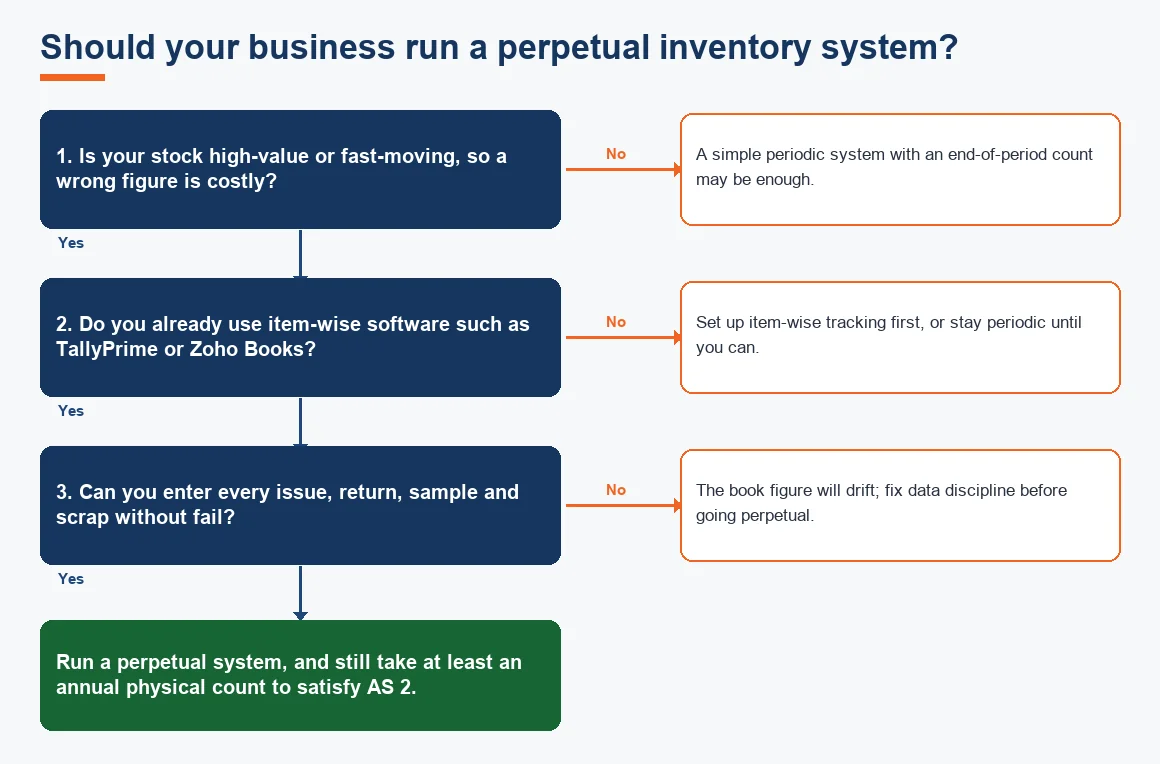
A company chooses perpetual over periodic when it needs to see stock and margin at any moment, wants reorder levels to trigger automatically, and cannot afford to discover a shortage only at year end. The purpose of perpetual inventory is control: it makes losses visible within days, supports ABC analysis of which items deserve the tightest watch, and lets management act on live data rather than a stale snapshot.
The disadvantages are real, though. A perpetual system demands discipline: every issue, return, sample and scrap must be entered, or the book figure becomes fiction. It costs more to set up and run, needs trained staff, and can breed false confidence if the physical count is skipped. A periodic system, by contrast, is cheap and simple but leaves you flying blind between counts and cannot isolate shrinkage. The costing angle for both is covered in the four methods of costing.
Key terms
- Cost of Goods Sold: the direct cost of the items actually sold in a period.
- Inventory Shrinkage Provision: the accounting entry for the gap between book stock and physical stock.
- Work-in-Progress (WIP) Valuation: valuing partly finished goods still on the production line.
- Retail Inventory Method: estimating stock value from selling prices and a cost-to-retail ratio.
- General Ledger: the master record where inventory and cost accounts are held.
Choosing and running the right system
The decision is rarely about accounting theory; it is about the value of your stock, the speed it moves and how much a wrong number would cost you. High-value or fast-moving inventory almost always justifies perpetual. A small, slow, low-value store may reasonably stay periodic. Whichever you run, a physical count remains non-negotiable, because valuation under AS 2 rests on the counted figure. The Institute of Chartered Accountants of India publishes the standard on the ICAI website. To pressure-test how AS 2 and Ind AS 2 apply to you, our AS vs Ind AS comparison matrix is a useful starting point. Clean stock accounting also depends on the surrounding cycle, so it links naturally to accounts payable on the purchase side and accounts receivable on the sales side.
Key takeaways
- Perpetual updates stock and cost of goods sold continuously; periodic waits for a physical count at period end.
- Perpetual makes shrinkage visible as a measurable gap; periodic buries the same loss inside cost of goods sold.
- A perpetual sale needs two journal entries (revenue and cost); a periodic sale books only revenue during the period.
- Rule 56(2) of the CGST Rules pushes most GST dealers towards item-wise, perpetual-style records; composition dealers are exempt.
- Every system still needs a physical count, because AS 2 values closing stock on the verified physical figure.
If you want the mechanics set up correctly, from valuation method to stock reconciliation, our Inventory Accounting and Costing services can put the right system in place for your business.
Decision guide