In this guide
The choice between FIFO and LIFO for inventory decides which purchase costs land in cost of goods sold and which stay on the balance sheet as closing stock. In India the decision is narrower than the textbooks suggest: LIFO cannot be used at all. Accounting Standard (AS) 2 and Ind AS 2 permit only first in first out (FIFO) and weighted average cost, so for an Indian preparer the real contest is FIFO versus weighted average, with LIFO relevant only as a comparison you will meet in United States GAAP. This article sets out each method, shows the working with real numbers, and explains the effect on reported margin.
FIFO vs LIFO inventory: what each assumption means
These are cost flow assumptions, not descriptions of how goods physically move. FIFO assumes the earliest units purchased are the first ones issued to cost of goods sold, which leaves the most recent purchase costs sitting in closing stock. LIFO assumes the reverse: the newest units are issued first, so the oldest, usually cheaper, costs remain in closing stock. Weighted average ignores the order entirely and pools cost, charging every issue at a blended rate. The physical goods can move in any order regardless of which assumption you apply for valuation.
Because the three methods split the same total cost differently, they produce different profit and different closing stock from identical purchases and sales. That is the whole reason the choice matters. For a fuller treatment of how cost pools are built before a method is even applied, see the four methods of costing every business should know.
Is LIFO allowed in India, and why is LIFO banned?
No. Both AS 2 (paragraph on cost formulas) and Ind AS 2 allow only FIFO and weighted average cost. The Institute of Chartered Accountants of India removed LIFO because it can distort the balance sheet: in a long inflationary run, closing stock stays valued at outdated low costs that no longer reflect replacement value. The same objection led the international standard, IAS 2, to prohibit LIFO, so FIFO is fully allowed under IFRS while LIFO is not. LIFO persists only in the United States, where it is retained mainly for the tax deferral it produces when prices rise.
For income tax, Section 145A of the Income Tax Act requires inventory to be valued by the method regularly employed and to be inclusive of taxes and duties actually paid to bring the goods to their present location and condition. Read that alongside the guidance on the Income Tax Department portal: the Act does not name FIFO or weighted average, but because the books must follow AS 2, LIFO is excluded in practice.
FIFO and LIFO examples, and how to calculate FIFO and LIFO
The calculation is a running ledger. You list purchases with their rates, then when stock is issued you peel units off the stack in the order the method dictates.
Step by step
- Record each purchase lot separately with its quantity and rate.
- When a sale occurs, decide which lot to release: the oldest lot under FIFO, the newest under LIFO, or the blended pool under weighted average.
- Multiply units issued by the applicable rate to get cost of goods sold for that issue.
- Carry the unissued lots forward as closing stock.
- Repeat for the next transaction, recomputing the weighted average rate each time a fresh purchase changes the pool.
A worked set of numbers follows in the next section so you can see FIFO, LIFO and weighted average side by side on the same data. If you are reconstructing several months of stock movements from scratch before you can even apply a method, that is a backlog bookkeeping and catch-up exercise first.
How to calculate weighted average cost of inventory
Weighted average cost divides the total cost of goods available for sale by the total units available for sale. Take 100 units bought at Rs 50 followed by 150 units at Rs 60: total cost of Rs 14,000 across 250 units gives a weighted average of Rs 56 per unit. Every issue is charged at Rs 56 until the next purchase shifts the average. In a perpetual system the average is recomputed on each purchase (moving average); in a periodic system it is computed once at period end. Which system you run changes the timing of the recalculation, a point covered in perpetual vs periodic inventory systems.
Worked example: FIFO vs LIFO vs weighted average on the same data
Assume two purchases and one sale of 180 units. Prices are rising, which is where the methods diverge most. All figures are illustrative and in rupees.
| Method | Cost of goods sold (180 units) | Closing stock (70 units) | Gross profit effect |
|---|---|---|---|
| FIFO | (100 x 50) + (80 x 60) = 9,800 | 70 x 60 = 4,200 | Highest profit |
| Weighted average (Rs 56) | 180 x 56 = 10,080 | 70 x 56 = 3,920 | Middle |
| LIFO (US GAAP only, not permitted in India) | (150 x 60) + (30 x 50) = 10,500 | 70 x 50 = 3,500 | Lowest profit |
Purchases were 100 units at Rs 50 (Rs 5,000) and 150 units at Rs 60 (Rs 9,000), a total of 250 units for Rs 14,000. Because prices rose, FIFO pushes the oldest cheap costs into cost of goods sold and reports the most profit, while LIFO does the opposite. The Rs 700 gap in reported cost of goods sold between FIFO and LIFO flows straight to the profit line, which is exactly why the LIFO route is closed in India: it would let firms understate profit in inflation. Note the closing stock also differs, and that inventory value carries into your balance sheet and next period's opening stock.
FIFO vs weighted average: which is better?
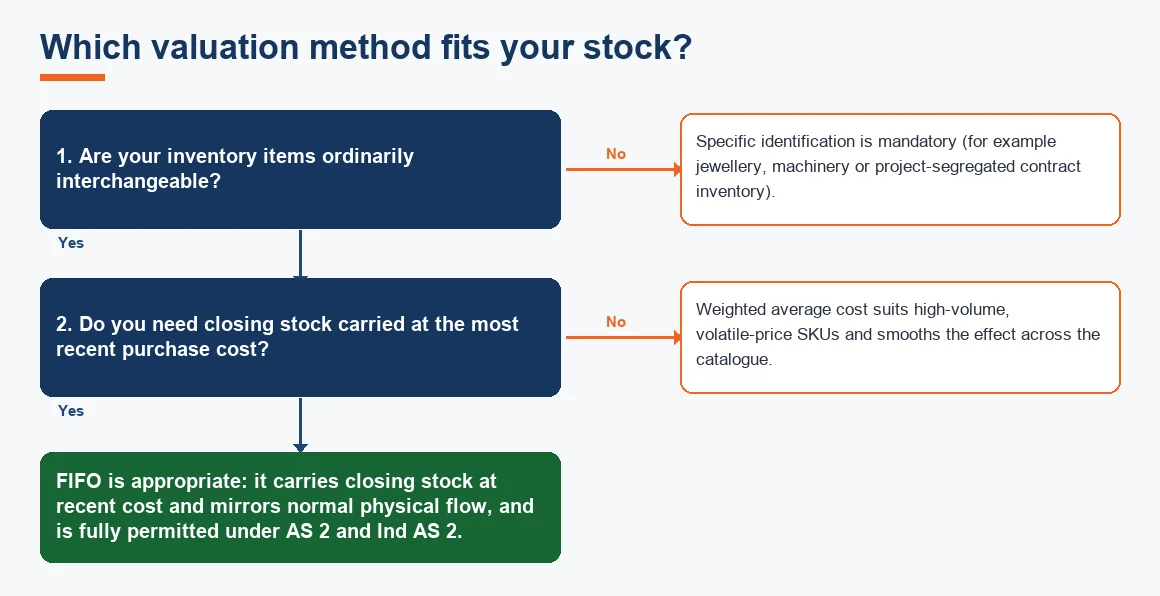
Both are permitted, so the deciding factor is which mirrors the actual physical flow and reporting need, not tax gaming. FIFO suits perishable or fast moving stock (pharmacy, food, FMCG) where the oldest units genuinely go out first, and in a rising market it carries closing stock at recent cost, keeping the balance sheet current. Weighted average smooths sharp price swings and is operationally simpler across large catalogues, which is why manufacturers and distributors with thousands of components lean towards it. For a formal side by side, our glossary entry on FIFO vs weighted average cost lays out the trade-offs, and the interactive AS vs Ind AS comparison matrix confirms neither treatment differs between the two frameworks.
Whichever you pick, the landed cost that feeds the rate matters as much as the flow assumption. Freight, insurance and non-creditable duties belong in cost under AS 2, a landing cost adjustment that both FIFO and weighted average rely on being correct.
Specific identification and the four inventory valuation methods
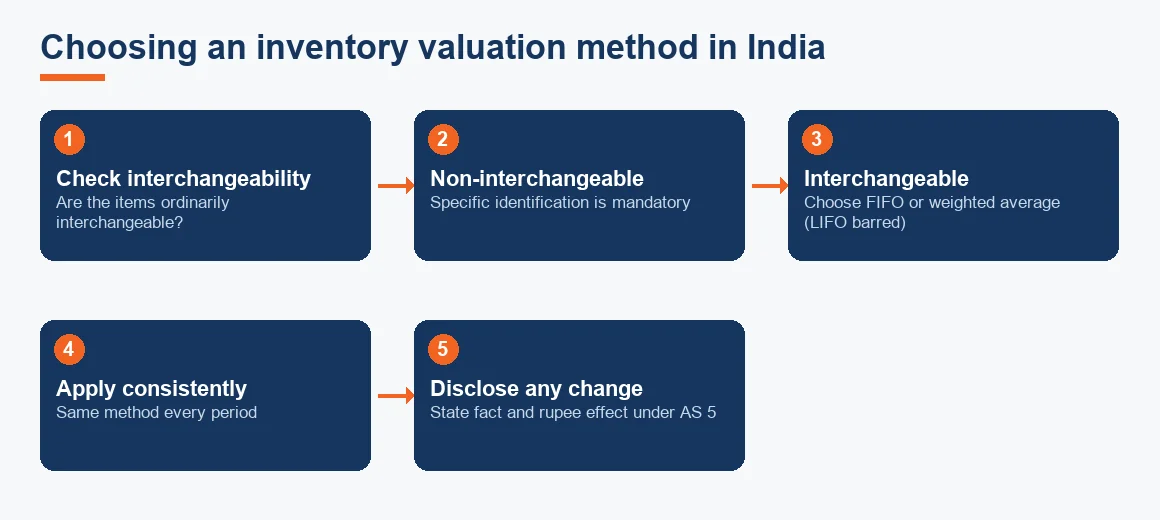
Textbooks list four methods: FIFO, LIFO, weighted average and specific identification. India allows three, since LIFO is barred. Specific identification is not optional where items are not ordinarily interchangeable or are segregated for a particular project. Jewellery, bespoke machinery, real estate units and contract inventory must each be costed at their own actual purchase cost, not a pooled rate. This overlaps with work-in-progress valuation on long jobs, and with bill of materials costing in assembly. Getting the right method onto the right item class is a core part of an inventory accounting and costing engagement, and it interacts with how purchases and returns are captured through accounts payable and how sales returns adjust stock through accounts receivable.
Changing the method once adopted
Consistency is the rule. AS 1 and AS 5 treat a switch, say from FIFO to weighted average, as a change in accounting policy, allowed only when it gives a more appropriate presentation or a standard or statute requires it. You must disclose the fact of the change and its rupee effect in that year's financial statements. Frequent switching to manage profit invites the assessing officer to reject the books under Section 145 of the Income Tax Act. Where you are cleaning up inconsistent historical treatment, map it through your inventory voucher mapping before restating. Analysts should also remember the method flows into cost of goods sold and therefore gross profit, so any change breaks year-on-year comparability unless restated.
Key terms
- FIFO vs Weighted Average Cost: the two cost flow formulas AS 2 permits, differing in how issues are priced.
- Cost of Goods Sold: the cost of inventory issued or sold in the period, driven by the valuation method chosen.
- Work-in-Progress (WIP) Valuation: valuing partly completed goods, often requiring specific identification on long jobs.
- Landing Cost Adjustment: adding freight, insurance and non-creditable duty into unit cost before a flow method is applied.
Key takeaways
- LIFO is not permitted in India; choose between FIFO and weighted average cost only.
- In rising prices FIFO reports the lowest cost of goods sold and highest gross profit; weighted average sits in between.
- Weighted average = total cost of goods available divided by total units, recomputed on each purchase.
- Specific identification is mandatory for non-interchangeable or project-segregated items.
- Apply the method consistently; disclose any change and its rupee effect under AS 5.
For a quick read on which framework applies to your entity before you finalise a policy, the Ind AS applicability checker is a useful first step, and the wider stock discipline of ranking items by value is covered in ABC analysis in inventory management.
Decision guide