
In this guide
Accounting and GST for Pune EdTech startups turns on one habit: treat an upfront fee as money you still owe teaching for, not as income earned the moment it reaches the bank. A Hinjewadi platform selling a six month cohort, a Kharadi tutoring app billing a yearly subscription and a Baner coaching institute collecting annual fees in June all face the same discipline. Recognise the fee across the period it covers, charge GST correctly on what is taxable, and keep the student wise register tying back to the ledger. This is a local explainer for founders and finance staff; when you want the work done for you, the commercial route sits with our Accounting Services for Schools & Colleges Pune page.
Why EdTech revenue recognition works differently
A traditional Pune institute collects annual fees and delivers a fixed academic calendar. An EdTech company sells access, cohorts, mentorship and content updates that stretch across months or years. The accounting question is the same in both cases: for how long are you obliged to deliver? Under accrual accounting the answer sets the split between income earned and income still owed. Get it wrong and your profit looks inflated in the month of collection and thin in every month after, which misleads founders, lenders and investors alike.
This is a matching exercise, not a cash exercise. The cash may all arrive in April, but the teaching, support and platform access are consumed over the cohort. Sibling explainers cover the software mechanics of this for SaaS billing in our SaaS Accounting Services (IT & SaaS) note, so this blog stays on the education and Pune angle.
How is fee income recognised when fees are collected in advance?
Recognise the fee over the academic period or cohort it covers, not when the money arrives. Fees for a whole year received in June are credited to a fees received in advance account and released to income month by month, so the 31 March accounts carry only the earned portion. The unearned balance sits under current liabilities and must reconcile to the student wise fee register.
For a Pune EdTech running rolling cohorts, keep one deferred revenue ledger per cohort. When a learner joins a six month programme, the fee is spread across those six months. If a cohort straddles the year end, the split falls naturally out of the schedule: months before 31 March are income, months after are a liability carried into the next year.
GST on an online course sold by a Pune EdTech company
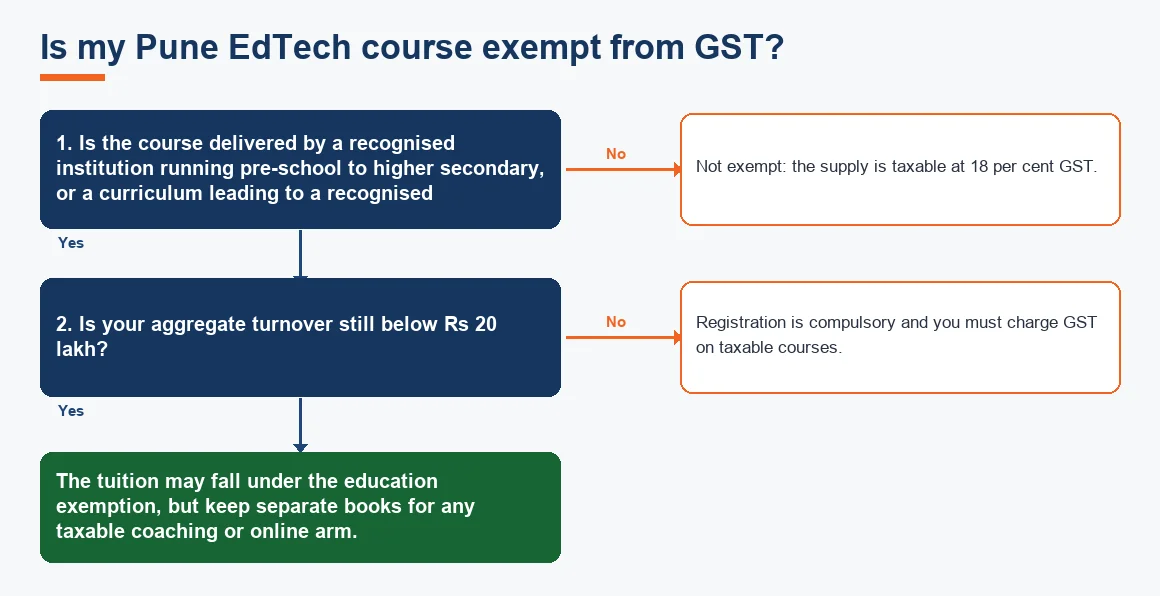
Online courses sold by a private EdTech company are taxable at 18 per cent GST. The education exemption under the GST notifications covers only institutions running pre-school to higher secondary education, or a curriculum leading to a recognised qualification. A self-paced skilling course or a paid subscription does not qualify, so output tax applies. Registration becomes compulsory once aggregate turnover crosses Rs 20 lakh, and you should track that threshold monthly rather than discover it at year end. The exemption wording sits in the GST rate notifications published by the CBIC, and turnover based registration is governed by the GST portal rules.
Two practical points for Pune founders. First, sales to overseas learners can qualify as export of services where the recipient is outside India and payment arrives in convertible foreign currency, which can be zero rated with the right documentation. Second, bundle carefully: if you sell a taxable course together with a book or a certificate, decide whether it is a composite or mixed supply before you set the invoice, because the two are taxed differently.
Cohort, subscription and lifetime access: matching revenue to the service period
The pricing model decides the recognition pattern. A fixed cohort is spread over the cohort length. A monthly or annual subscription is recognised across the subscription term, which is where Monthly Recurring Revenue (MRR) reporting comes from. Lifetime access is the hard one: estimate a service period, commonly two to three years, document how you reached the estimate, and release the fee over that period. Recognising the entire amount on sale is difficult to defend while content updates, support and platform access continue.
| Pricing model | Recognise over | Where the unearned part sits | Watch for |
|---|---|---|---|
| Fixed cohort (for example 6 months) | The cohort length | Fees received in advance (current liability) | Cohorts that straddle 31 March |
| Monthly or annual subscription | The subscription term | Deferred revenue, split current and non-current | Refunds and mid-term cancellations |
| Lifetime access | An estimated service period (2 to 3 years) | Deferred revenue, reviewed yearly | Documenting and revising the estimate |
Under Ind AS 115 Revenue Recognition the lifetime estimate is reviewed each year and revised prospectively, and the working must reconcile to the deferred revenue ledger. If Ind AS applies to your company at all is itself a threshold question; our Ind AS Applicability Checker walks through it.
Worked example: deferring a cohort fee across the year end
Take a Pune EdTech that sells a six month analytics cohort for Rs 60,000 (indicative, Exl GST). A learner pays in full in January for a cohort running January to June. GST at 18 per cent, Rs 10,800, is payable in the month of the advance. Revenue of Rs 60,000 is recognised at Rs 10,000 a month. By 31 March, three months are earned and three months remain a liability carried into the next financial year.
| Month | Fee recognised (Rs) | Cumulative income (Rs) | Deferred balance at month end (Rs) |
|---|---|---|---|
| January | 10,000 | 10,000 | 50,000 |
| February | 10,000 | 20,000 | 40,000 |
| March | 10,000 | 30,000 | 30,000 |
| 31 March close | - | 30,000 to P&L | 30,000 as current liability |
| April to June | 30,000 | 60,000 | Nil |
So the 31 March accounts show Rs 30,000 of course fee income and Rs 30,000 sitting under fees received in advance, while the Rs 10,800 GST was already discharged in January. Front-loading the whole Rs 60,000 into January would overstate this year's profit by Rs 30,000 and understate next year's by the same amount.
Step by step: the month-end revenue recognition close
A tidy monthly routine keeps the deferral honest and the year end painless. The flow below is what a Pune EdTech finance function repeats every month.
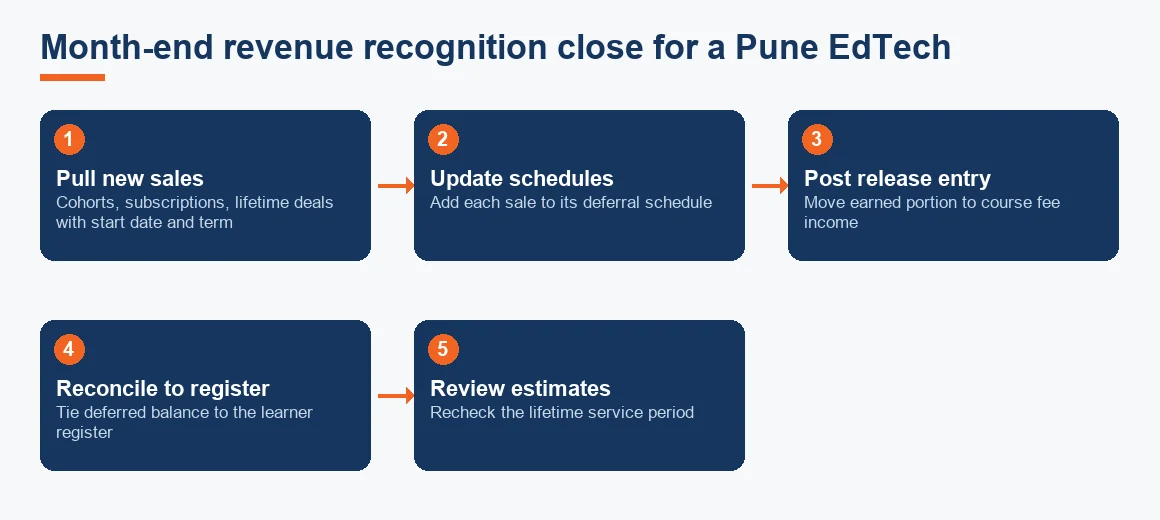
- Pull new sales: list every cohort, subscription and lifetime sale booked in the month, with start date and term.
- Update the schedules: add each new sale to its deferral schedule and confirm the term is correct.
- Post the release entry: move the month's earned portion from fees received in advance to course fee income.
- Reconcile to the register: tie the deferred revenue balance back to the student wise or learner wise register.
- Review estimates: for lifetime access, check whether the service period estimate still holds.
If catching up several months at once feels familiar, that is the signal to systematise. A monthly discipline is cheaper than an annual scramble, a point our Monthly Bookkeeping & MIS Checklist for Pune Businesses makes for any local firm.
Scholarships, concessions and exempt income of an institute
Record the gross fee as income and the concession as a separate scholarships and concessions line, so the fee register ties back to the accounts. Netting the two hides the value given away and distorts fee per student reporting. A scholarship funded by an outside donor or a government scheme is a restricted receipt, recorded and released as it is applied, which is where fund-based accounting earns its place in a trust run institute.
Hostel accommodation and transport supplied by an educational institution to its own students and staff are exempt from GST, while the same services sold to outsiders are taxable. For income tax, the surplus of a charitable institute stays within its exemption only where the activity is incidental to education and separate books are maintained. The Section 11 and Section 10(23C) framework, including the requirement to apply a large share of income to the object, is set out by the Income Tax Department. Where a trust runs both a recognised school and a taxable coaching arm, keep the two sets of books strictly apart.
The Pune angle: clusters, mixed models and what to reconcile
Pune's education base is unusually mixed: recognised colleges, coaching institutes across Baner and Kothrud, and a fast growing EdTech and skilling scene around Hinjewadi and Kharadi that often shares talent with the city's IT and SaaS firms. Many local founders run a hybrid: a recognised programme alongside a paid online product. That mix is exactly where GST positions and revenue recognition diverge inside one group, so the reconciliation between the fee register, the deferred revenue ledger and the GST returns is the control that matters most.
Startups in this space also carry the usual young-company questions on burn, runway and founder ledgers, which we keep in the Startup Accounting Services India and, for the software side, the IT & Software Company Accounting Services notes rather than repeating them here. If you are still choosing who keeps the books, our guide on how to choose an accountant in Pune (Hinjewadi, Kharadi, Baner) and the local cost of accounting and bookkeeping in Pune benchmarks are the practical starting points. For non-education Pune sectors, the same deferral logic reappears in different clothes, for instance in our costing note for Chakan-Pimpri auto-component makers, and general city bookkeeping lives on the Accounting & Bookkeeping Services Pune and SaaS Accounting Services Pune pages.
Key terms
- Deferred Revenue: fees collected but not yet earned, carried as a liability until delivered.
- Ind AS 115 Revenue Recognition: the standard that spreads revenue over the period a service is delivered.
- Monthly Recurring Revenue (MRR): normalised monthly subscription income used to read EdTech growth.
- Section 10(23C) Exemption Rules: the income tax exemption route for recognised educational institutions.
- 85% Income Application Rule: the share of income a charitable institute must apply to its objects to keep its exemption.
Key takeaways
- Upfront fees are a liability first: recognise them across the cohort, subscription or estimated service period.
- Private online courses carry 18 per cent GST; registration is due once turnover crosses Rs 20 lakh.
- Hostel and transport are exempt for an institution's own students, taxable for outsiders.
- Record scholarships gross with the concession on its own line so the register still ties out.
- For a hybrid Pune group, keep the recognised institution and the taxable EdTech arm in separate books.
None of this is a services pitch. It is the informational backbone; if you would rather hand the deferral schedules, GST positions and month-end close to a team, the commercial work sits on our Accounting Services for Schools & Colleges hub and its Pune page.
Decision guide