
In this guide
Multi-state GST reconciliation for Mumbai e-commerce sellers is the monthly job of matching each marketplace settlement report back to the outward supply you declare in GSTR-3B, split by the state your buyer sits in. Because you register in Maharashtra (state code 27) but ship orders to customers across India, a single settlement file mixes intra-state sales that carry CGST and SGST with inter-state sales that carry IGST. This explainer walks through how a Mumbai seller keeps that split clean, where the numbers commonly drift, and how to tie the settlement, the TCS credit and the return together. If you want the commercial engagement rather than the how-to, that sits with our E-Commerce Accounting Services Mumbai page.
What multi-state GST actually means for a Mumbai seller
Registration is state-specific. Your GSTIN is issued in Maharashtra, so Maharashtra is your home state and the place from which your supply is treated as originating when you dispatch from a Mumbai or Bhiwandi warehouse. The complication is that your buyers are everywhere. The GST treatment of each order turns on the place of supply, which for goods is the location where movement ends, meaning the delivery address. A parcel to Andheri is intra-state; a parcel to Bengaluru is inter-state; the same product, the same price, a different tax head.
Reconciliation is the discipline that keeps this from becoming guesswork. Every marketplace, whether Amazon, Flipkart or your own Shopify store settled through a payment gateway, hands you a settlement report. That report is stated in money received, net of the fees the platform kept. Your GST return, by contrast, is stated in taxable supply, gross of those fees. Bridging the two is the heart of the exercise, and it is why we treat marketplace settlement reconciliation as a named monthly control rather than an afterthought.
The Maharashtra state code (27) and when a sale turns inter-state
Every Mumbai GSTIN begins with 27, the GST state code for Maharashtra, which matches the census code and forms the first two digits of the fifteen-character number. Read the destination the same way. If the delivery is inside Maharashtra, you charge CGST plus SGST. If it leaves the state, you charge IGST at the combined rate. Nothing about the product changes; only the place of supply does.
The table below summarises the two paths for a single sale so you can see exactly what shifts.
| Attribute | Intra-state sale (buyer in Maharashtra) | Inter-state sale (buyer in another state) |
|---|---|---|
| Place of supply | Within state code 27 | Outside state code 27 |
| Tax heads charged | CGST + SGST | IGST |
| TCS split by marketplace (0.5%) | 0.25% CGST + 0.25% SGST | 0.5% IGST |
| GSTR-1 B2C reporting | Consolidated in state summary | Invoice-wise if value above Rs 2.5 lakh, else state-wise summary |
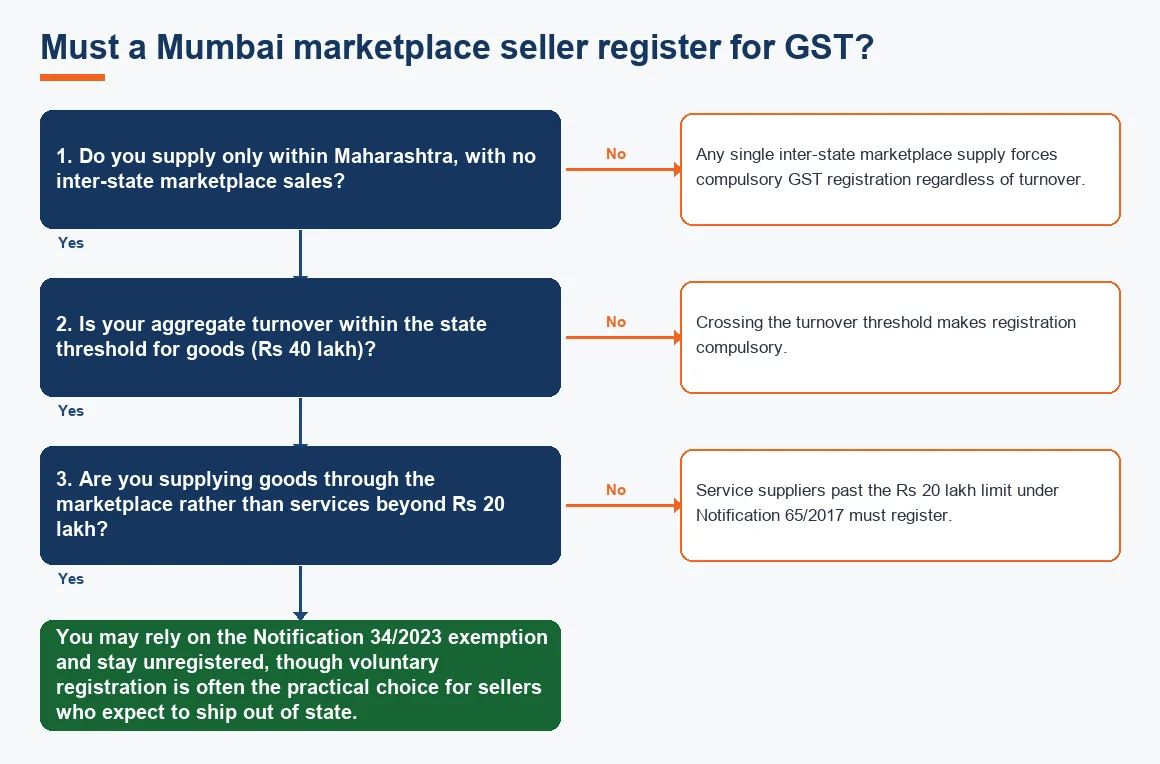
| Registration effect | May qualify for the Notification 34/2023 exemption | Forces compulsory registration |
Do you need GST registration for every marketplace sale?
Not always. Notification 34/2023-Central Tax exempts suppliers of goods through a marketplace from compulsory registration where turnover stays within the state threshold and every supply is intra-state. The moment you make one inter-state supply through a marketplace, that relief falls away and registration becomes compulsory regardless of turnover. Service suppliers using an e-commerce operator have a separate relief up to Rs 20 lakh under Notification 65/2017-Central Tax. You can confirm the current text of both notifications on the CBIC GST portal.
In practice most Mumbai sellers who list nationally register anyway, because the first out-of-state order would otherwise trigger a scramble. If you are still deciding whether to register or how your books should be set up from day one, that is a conversation for our parent E-Commerce Accounting Services team, or for the general accounting and bookkeeping services in Mumbai if your books extend well beyond marketplace sales, rather than something to resolve mid-month. If you are weighing whether to bring this in-house or outsource it, our guides on how to choose an accountant in Mumbai and the cost of outsourced accounting in Mumbai set out what to look for.
How marketplace TCS under section 52 works
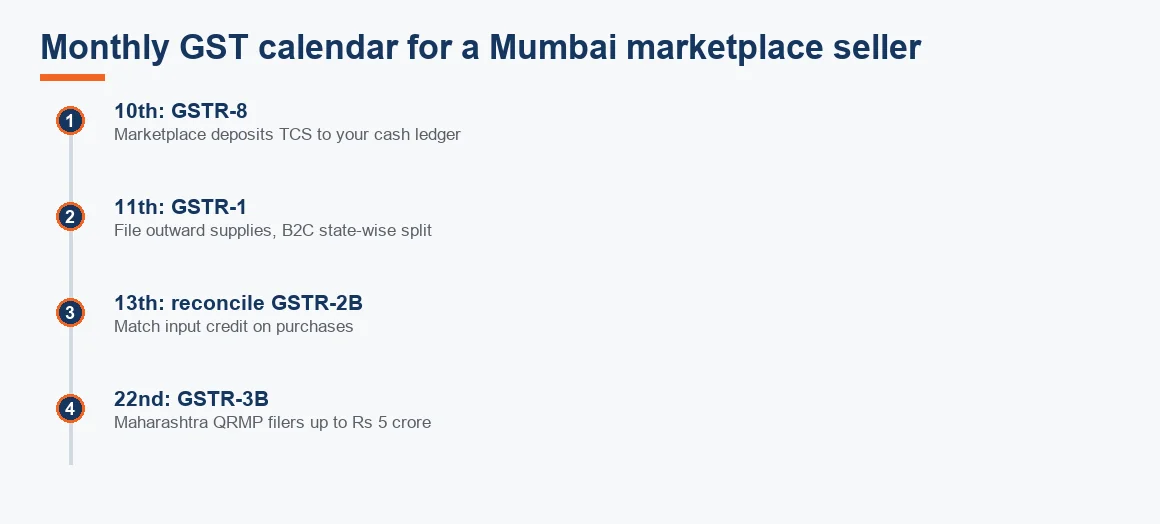
Marketplaces collect tax at source under section 52 of the CGST Act at 0.5 percent of net taxable supplies, made up of 0.25 percent CGST plus 0.25 percent SGST on intra-state sales, or 0.5 percent IGST on inter-state sales. Net taxable supplies here means gross sales less returns and cancellations, which is why a heavy-returns month reduces the TCS collected. The operator files GSTR-8 by the 10th of the following month, and the credit then appears in your electronic cash ledger, where you can set it against your output liability. You can view the deposited TCS in your ledger on the GST portal and should tie it to the marketplace's GSTR-8 figure every month. This mechanism is explained further under Section 52 TCS under GST.
The frequent slip is treating TCS as a cost. It is not an expense; it is your own tax paid in advance and sitting in the cash ledger. If you write it off to the profit and loss account you overstate expenses and understate your GST asset.
Reconciling a marketplace settlement report to GSTR-3B, step by step
The settlement report starts from what was sold and ends at what was paid into your bank. Your GSTR-3B starts from taxable supply. To connect them, work through the deductions the marketplace applied.
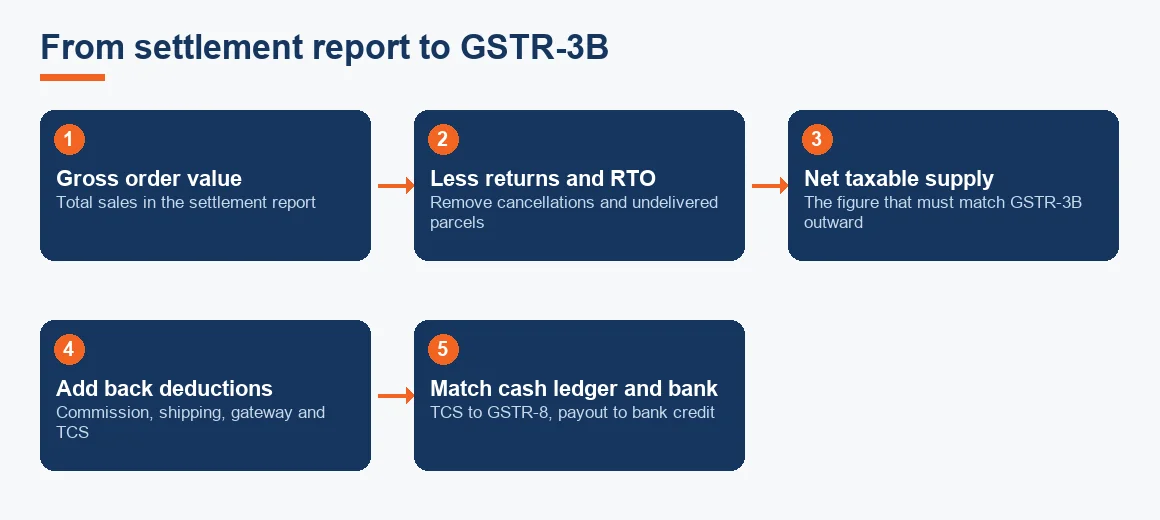
- Start from gross order value in the settlement report for the period.
- Remove cancellations and returns, including return to origin parcels that never reached the buyer, to reach net taxable supply.
- Add back the deductions the marketplace kept: commission, shipping recovered, payment gateway charges and the TCS withheld. These reduced your payout but do not reduce your taxable supply.
- Match net taxable supply to the outward supply reported in GSTR-3B, and match the TCS to the credit in your cash ledger.
- Investigate the residual. A small timing gap between the settlement cut-off and the tax period is normal; a large gap usually means missed returns or a mis-tagged place of supply.
Keeping a running bank reconciliation alongside the settlement match closes the loop, because the net payout figure from the settlement should equal the credit that lands in your current account. For the broader clean-up rhythm this fits inside, our audit-readiness and book-cleanup checklist for Mumbai businesses sets out the monthly cadence.
Reporting inter-state B2C sales state-wise in GSTR-1
Inter-state supplies to unregistered persons must be reported invoice-wise once the invoice value exceeds Rs 2.5 lakh. Below that limit, such supplies are consolidated state-wise in the summary table of GSTR-1. For a Mumbai seller shipping nationally, the practical fix is to tag the place of supply at invoice level in your billing software so the state split is produced automatically rather than assembled by hand at filing time. Reconciling input credit is the mirror exercise, covered by GSTR-2B input tax credit matching on the purchase side.
Worked example: settlement reconciliation for a Mumbai seller
Assume a Mumbai apparel seller on one marketplace for the month. The figures below are indicative and Exl GST on the sale value; the point is the bridge from taxable supply down to the net bank credit, and the TCS tie-out. TCS is 0.5 percent of net taxable supply, so 0.5% of Rs 8,80,000 equals Rs 4,400.
| Line | Amount (Rs) |
|---|---|
| Gross order value | 10,00,000 |
| Less: returns and cancellations | (1,20,000) |
| Net taxable supply (matches GSTR-3B outward) | 8,80,000 |
| Less: marketplace commission (incl GST at 18%) | (1,55,760) |
| Less: shipping recovered by marketplace | (47,200) |
| Less: payment gateway charges | (8,800) |
| Less: TCS withheld u/s 52 at 0.5% | (4,400) |
| Net amount credited to bank | 6,63,840 |
Two figures must tie out each month. The Rs 8,80,000 net taxable supply must equal the outward supply in GSTR-3B, and the Rs 4,400 TCS must equal the credit shown in your electronic cash ledger after the marketplace files GSTR-8. The Rs 6,63,840 net credit must equal the deposit in your bank statement. If any of the three fails to match, the reconciliation is not complete, whatever the profit and loss account appears to show.
The Mumbai e-commerce compliance calendar
The month has a fixed rhythm, and missing the sequence is what turns a small variance into a notice. Maharashtra taxpayers up to Rs 5 crore turnover file GSTR-3B by the 22nd under QRMP, after the marketplace has filed GSTR-8 on the 10th.
Sellers whose accounting extends into SaaS or software billing alongside physical goods will find related treatment in our SaaS Accounting Services (IT and SaaS) and IT and Software Company Accounting Services pages, while early-stage brands should look at Startup Accounting Services India. Maharashtra employers also carry a separate payroll-linked filing set out in our note on Maharashtra professional tax and Shops Act compliance.
Key terms
- Marketplace Settlement Reconciliation: matching a platform's payout report back to declared taxable supply and the bank credit.
- Section 52 TCS under GST: the 0.5 percent tax marketplaces collect on net taxable supplies and deposit to your cash ledger.
- Return to Origin (RTO) Provisions: accounting for parcels dispatched but returned undelivered, which reduce net taxable supply.
- GSTR-2B Input Tax Credit Matching: reconciling eligible input credit on purchases against the auto-drafted GSTR-2B.
- Bank Reconciliation: tying the net settlement payout to the actual deposit in your current account.
Key takeaways
- Tax follows the buyer's delivery state: intra-Maharashtra sales carry CGST and SGST, out-of-state sales carry IGST.
- Reconcile from taxable supply, not from the net payout; add back commission, shipping, gateway fees and TCS.
- Marketplace TCS is a cash-ledger asset to be matched to GSTR-8, never a selling expense.
- One inter-state marketplace supply removes the Notification 34/2023 registration exemption entirely.
- Three figures must tie every month: net taxable supply to GSTR-3B, TCS to the cash ledger, and net payout to the bank.
Decision guide