In this guide
Section 194-O TCS accounting for a Gurugram D2C brand comes down to one discipline: recording the gross value of every online order as revenue and then treating each platform deduction, whether it is income-tax TDS under Section 194-O, GST TCS under Section 52, marketplace commission or shipping, as its own line in the books. Get that separation right and the settlement report reconciles cleanly to the bank and the two tax-credit ledgers. This explainer walks a direct-to-consumer founder in Gurugram through how those deductions work, where they sit in the ledger and what the NCR location changes. For the commercial engagement itself, see our E-Commerce Accounting Services and the local E-Commerce Accounting Services Gurugram page.
What Section 194-O means for a Gurugram D2C brand
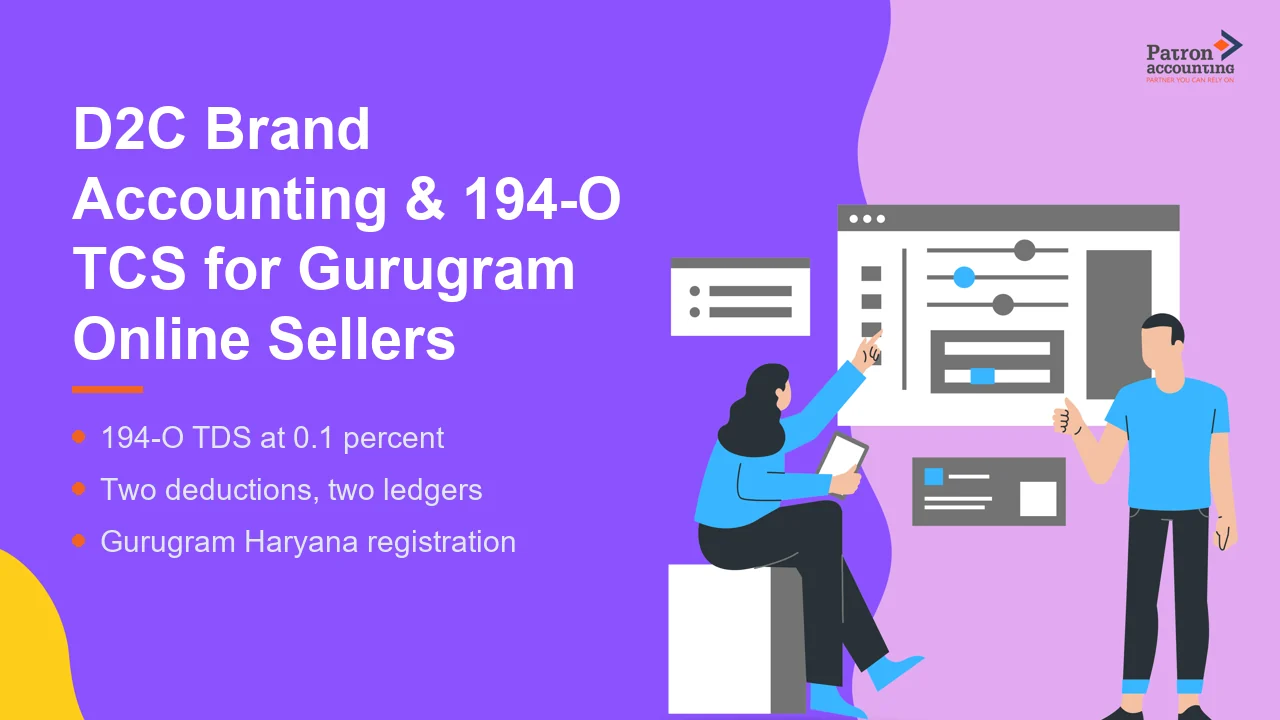
Section 194-O of the Income-tax Act requires an e-commerce operator (a marketplace such as Amazon, Flipkart, Myntra or a payment aggregator facilitating sales) to deduct TDS at 0.1 percent of the gross amount of sales made through its platform, at the time of credit or payment, whichever is earlier. The deduction is on gross value, before the operator nets off its own commission, so a Rs 1,00,000 sales day carries a Rs 100 deduction even though far less reaches your bank. Individual and HUF sellers who hold a valid PAN and whose gross sales through the platform stay at or below Rs 5 lakh in the financial year are exempt. Miss the PAN linkage and the rate jumps to 5 percent under Section 206AA, which on a growing D2C brand is a large, avoidable leak. The deducted amount shows up in your Form 26AS and AIS and is claimed against your income-tax liability at year end, so it must sit in a TDS receivable ledger, never be written off as a cost. The provision and its threshold are set out by the Income Tax Department.
194-O TDS versus GST TCS: two deductions, two ledgers
Founders routinely confuse the two collections a marketplace makes, because both are a small percentage skimmed at source. They are not the same tax and they do not share a ledger. Section 194-O is an income-tax deduction; Section 52 GST TCS is a goods-and-services-tax collection. The operator files them in different returns, and you reclaim them in different places, so mixing them corrupts both your income-tax and your GST reconciliations.
| Aspect | Section 194-O TDS | Section 52 GST TCS |
|---|---|---|
| Statute | Income-tax Act | CGST Act |
| Rate | 0.1 percent of gross sales (5 percent without PAN) | 0.5 percent of net taxable supplies (0.25 CGST + 0.25 SGST intra-state, 0.5 IGST inter-state) |
| Threshold | Exempt for individual or HUF with PAN and gross sales up to Rs 5 lakh | No threshold |
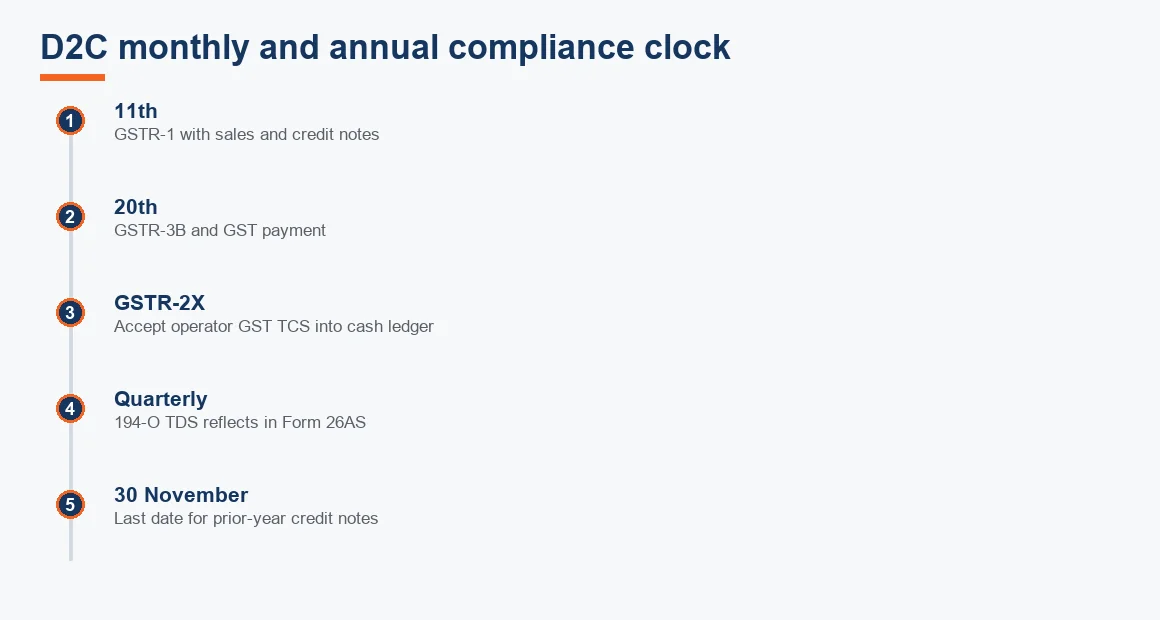
| Operator files in | Quarterly TDS return (Form 26Q) | Monthly GSTR-8 |
| Where you see it | Form 26AS / AIS | Auto-populated in electronic cash ledger via GSTR-2X |
| How you reclaim it | Adjust against income-tax liability | Utilise from cash ledger against GST output |
Both deductions belong in separate current-asset ledgers. The GST TCS credit flows to your electronic cash ledger once the operator files GSTR-8, and you should tie it out monthly against your GSTR-2B input tax credit matching routine so nothing is stranded. The Section 52 collection mechanism is explained on the CBIC GST portal.
How to record a marketplace and gateway settlement in your books
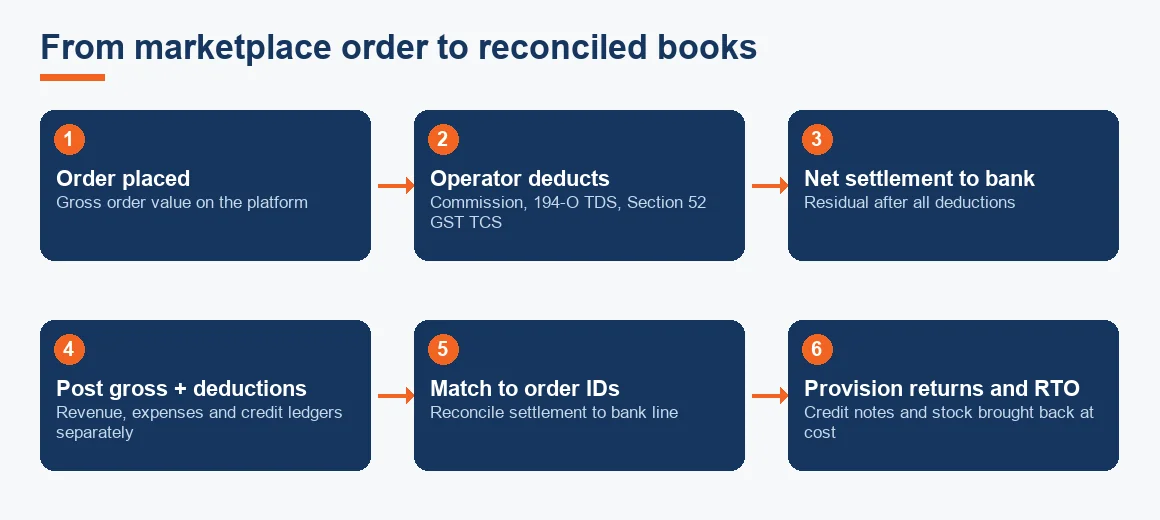
The settlement report is the single source of truth for D2C revenue. Work it in a fixed order so every rupee is accounted for.
- Post the gross order value of the settlement batch to sales revenue, exclusive of GST, with the GST liability booked separately.
- Book marketplace commission and its 18 percent GST as an expense and an input-credit line, not as a reduction of revenue.
- Book forward and reverse shipping, fulfilment and packaging as logistics expense, with GST as input credit.
- Carry the Section 194-O TDS to a TDS receivable ledger and the Section 52 GST TCS to the GST TCS credit ledger.
- The residual figure is the net bank credit; match it to the actual bank line and to the underlying order identifiers.
- Park any unmatched amount in a bank clearing account and clear it before month-end, and track cash-on-delivery remittances separately because they reach the bank several days after dispatch.
This is the core of marketplace settlement reconciliation, and it is where most D2C books go wrong. For the deeper mechanics of settlement-driven accounting across order volumes, our E-Commerce Accounting Services page covers the full engagement.
Returns, RTO and credit notes in D2C books
Returns and return-to-origin (RTO) shipments are the defining cost of the D2C model, and they must flow through the books deliberately. Raise a credit note against the original tax invoice for a returned order and report it in GSTR-1, which reverses the output GST provided the credit note is declared by 30 November following the end of the financial year, the time limit fixed on the GST portal. Bring the returned stock back into inventory at cost, charge both the forward and the reverse shipping to logistics expense, and write off any units damaged in transit as a separate loss rather than back into stock. High RTO categories such as apparel and footwear justify a standing return-to-origin provision so a spike in returns does not distort a single month's margin. We keep the returns mechanics itself in that glossary entry; this blog stays on how it sits in a Gurugram brand's books.
Does a Gurugram D2C brand need GST registration in other states?
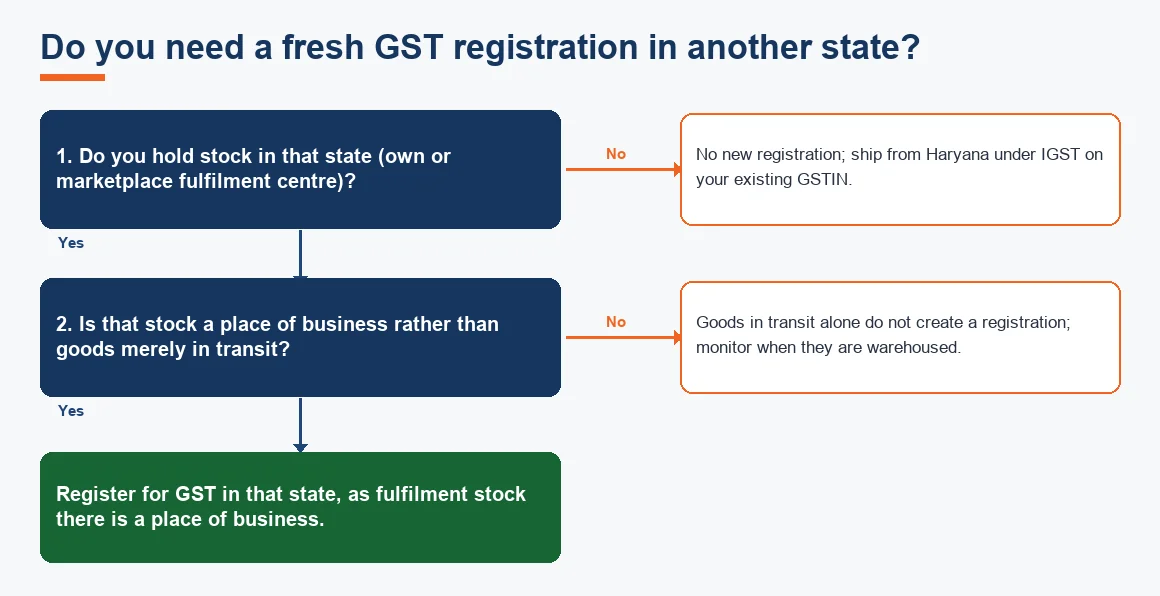
Registration follows where you hold a place of business, and for a D2C brand that turns on where your stock sits. A Gurugram brand selling and shipping from its own Haryana warehouse to customers across India needs only its Haryana GST registration, and those inter-state sales are charged as IGST. The moment you place inventory in a marketplace fulfilment centre in another state, for example an Amazon warehouse in Karnataka or a Flipkart hub in Telangana, you create a place of business there and a fresh registration requirement in that state. This is the single compliance trap that catches Gurugram brands scaling into national fulfilment, and it needs a clean NCR inter-state GST reconciliation once you operate across more than one state code.
Worked example: reconciling one marketplace settlement
Take a single settlement batch of Rs 1,00,000 in gross order value at a 15 percent marketplace commission, with shipping and fulfilment of Rs 6,000. The figures below are indicative and exclusive of GST on the sale itself. This shows why the net bank credit is never your revenue.
| Line item | Amount (Rs) |
|---|---|
| Gross order value (revenue booked) | 1,00,000 |
| Less: marketplace commission (15%) | (15,000) |
| Less: GST on commission (18%, input credit) | (2,700) |
| Less: shipping and fulfilment | (6,000) |
| Less: GST on shipping (18%, input credit) | (1,080) |
| Less: Section 194-O TDS (0.1%) | (100) |
| Less: Section 52 GST TCS (0.5%) | (500) |
| Net credited to bank | 74,620 |
Revenue in the books is Rs 1,00,000, not the Rs 74,620 that reaches the bank. The Rs 100 TDS sits in your TDS receivable ledger to be claimed against income tax; the Rs 500 GST TCS sits in the GST TCS credit ledger to be utilised against output GST; the commission and shipping GST of Rs 3,780 is input credit. Book it any other way and your turnover, margin and tax credits all read wrong.
The Gurugram angle: Haryana registration, no professional tax, NCR logistics
Two things make the Gurugram setup lighter than a Maharashtra or Karnataka equivalent. First, Haryana levies no professional tax, so your D2C payroll stack drops one monthly deduction and one return entirely; the payroll and Shops Act side is covered in our note on Haryana compliance for employers. Second, Gurugram's position in the NCR means a warehouse in Manesar or Udyog Vihar can serve Delhi, Noida and Faridabad customers across three different state codes, so IGST versus CGST-SGST classification has to be driven off the ship-to state, not off where your office sits. If you are still choosing a partner, our guides on choosing an accountant in Gurugram and the cost of outsourced accounting and virtual CFO in Gurugram set the expectations, and the virtual CFO checklist for Gurugram startups maps the wider finance-ops picture. For local bookkeeping beyond the D2C niche, see Accounting and Bookkeeping Services in Gurugram.
The same settlement discipline underpins adjacent models, so if your brand also sells a subscription or software layer, our SaaS Accounting Services and IT and Software Company Accounting Services pages carry the recurring-revenue treatment, and early-stage founders should read Startup Accounting Services India. Warehouse racking, packing equipment and fit-out are capitalised and depreciated; our Depreciation Calculator handles the Schedule II working.
Key terms
- Marketplace Settlement Reconciliation: matching a platform's settlement report to booked orders, deductions and the bank.
- Section 52 TCS under GST: the 0.5 percent GST an operator collects on net taxable supplies and reports in GSTR-8.
- Return to Origin (RTO) Provisions: a standing provision for orders that come back undelivered, common in apparel and footwear.
- GSTR-2B Input Tax Credit Matching: tying your claimed input credit to the auto-drafted GSTR-2B each month.
- Bank Clearing Account: a holding ledger for settlement amounts that have not yet matched to the bank line.
Key takeaways
- Book gross order value as revenue; the net bank credit is never your sales figure.
- Section 194-O TDS (0.1 percent, income tax) and Section 52 GST TCS (0.5 percent) are separate ledgers with separate reclaim routes.
- Keep your PAN linked in every seller panel or the 194-O rate rises to 5 percent under Section 206AA.
- A Haryana warehouse shipping nationwide needs only the Haryana registration and charges IGST; marketplace stock in another state triggers registration there.
- Raise return credit notes against the original invoice and declare them by 30 November following the financial year to reverse output GST.
- Haryana has no professional tax, which keeps the Gurugram payroll stack lighter.
Decision guide