
In this guide
Accounting for e-commerce returns means reversing the part of a sale that did not stick, so your books show only the revenue you actually kept. A customer return is handled with a credit note that takes back both the revenue and the GST you charged. A return to origin (RTO), where the parcel never reaches the buyer, is different again: no sale was ever completed, so nothing should have been recognised as revenue to begin with. Getting the two apart, and issuing credit notes correctly, is what keeps reported sales honest and your GST filings clean. This guide sets out the treatment, the journal entries and the one deadline that trips most sellers up. For the full commercial engagement, see our E-Commerce Accounting Services.
What is the accounting treatment for e-commerce returns?
The accounting treatment for a return is to reverse the sale to the extent goods come back. You do not delete the original invoice; you record a separate entry that reduces revenue and reverses the associated output GST. In double-entry terms the return sits on the opposite side to the sale. Because a sale was credited to revenue, a return is debited to a contra-revenue account usually called Sales Returns (or Sales Returns and Allowances). At period end that account is netted against gross sales so the profit and loss shows net revenue, which is the figure that matters for both tax and management reporting.
This is why returns are never booked as an expense. An expense would understate revenue and overstate costs at the same time, distorting your gross margin. Instead, a return is a reversal of income. If you are unsure how contra accounts flow through the ledgers, our note on double-entry bookkeeping explains the mechanics, and the general ledger is where the Sales Returns balance accumulates.
What are the types of returns in e-commerce?
Not every parcel that comes back is the same event, and mixing them up is the single most common error in marketplace books. There are three broad types.
Customer return
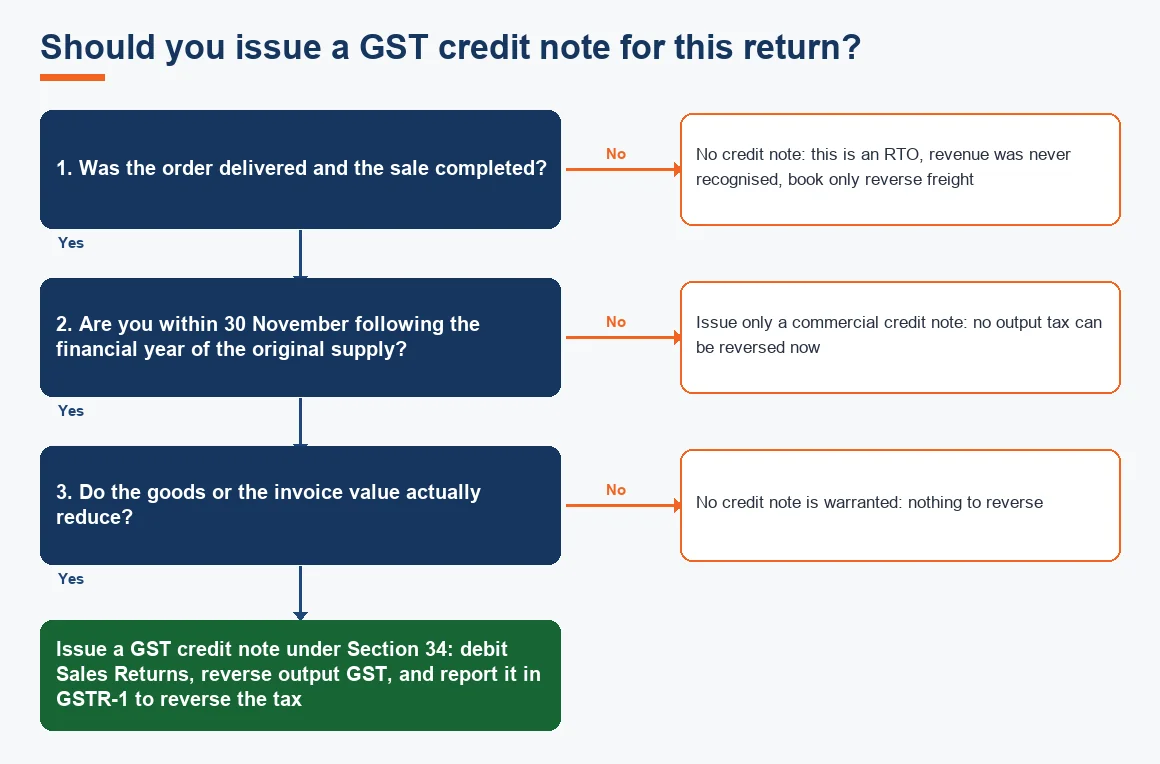
The order was delivered, the customer accepted it, and then sent it back within the return window. A sale was completed, so it must be reversed with a credit note that also reverses GST. This is the classic sales return.
Return to origin (RTO)
The shipment never reached the customer, most often on cash-on-delivery orders that were refused or undeliverable, and it comes back to your warehouse. No sale was completed, so revenue should never have been recognised. The stock simply returns to inventory. What you do carry is the forward and reverse freight, which belongs in delivery expenses, not in Sales Returns.
Exchange or replacement
The customer swaps a size or a defective unit. Depending on how the platform books it, this may be a return plus a fresh sale, or a straight replacement with no revenue movement. Read the settlement report rather than assuming.
The distinction between RTO and a customer return is set out plainly in the glossary entry on Return to Origin (RTO) Provisions.
Is a sales return a debit or credit?
A sales return is a debit. The original sale credited revenue, so reversing it debits the contra-revenue account (Sales Returns). Sales Returns therefore carries a debit balance, which is unusual for an income-side account and is exactly why it sits as a contra account against gross sales rather than as revenue in its own right. A purchase return works the other way: you originally debited purchases or inventory, so a purchase return is credited to a Purchase Returns account and reduces your cost of purchases.
Put simply, on the sales side a return is a debit that pulls revenue back down; on the purchase side a return is a credit that pulls cost back down. If you keep the two straight, the trial balance stays clean. A quick refresher on the journal entry structure and the trial balance helps here.
Credit notes under GST: Section 34 and the 30 November rule
A credit note is the GST document that formalises a return or a reduction in invoice value. Under Section 34 of the CGST Act, the supplier may issue a credit note where goods are returned or the taxable value or tax charged was more than it should have been. The law does not compel a seller to issue one, but marketplace contracts almost always make it compulsory for returns and RTO adjustments, and where the buyer has already claimed input tax credit the credit note is what forces that credit to be reversed.
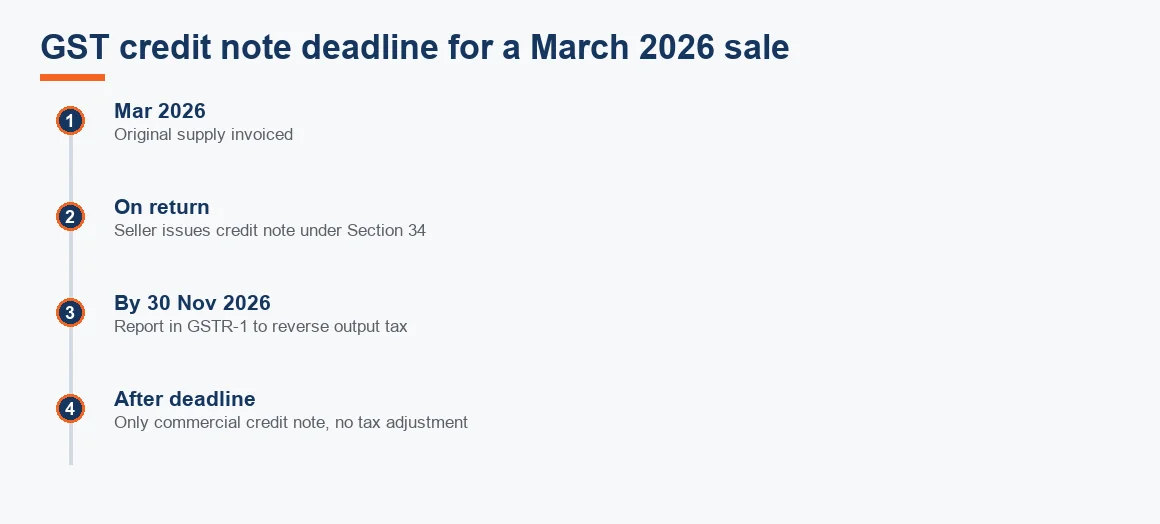
The deadline is the part sellers miss. A GST credit note that carries a tax adjustment must be reported in GSTR-1 by 30 November following the end of the financial year of the original supply, or the date of filing the annual return, whichever is earlier. A sale made in March 2026 must have its credit note in GSTR-1 by 30 November 2026. After that you can still issue a commercial credit note to settle the account, but it cannot reduce your output tax. The rule is set out in Section 34 of the CGST Act on the CBIC GST portal, and credit notes are furnished through your return on the GST portal.
Two points that catch marketplace sellers: only the seller issues the credit note (a buyer raises a debit note for their own records, but it does not reduce your liability), and the credit note must be linked to the settlement so the tax reversal actually reaches your GSTR-1. TCS collected by the operator under Section 52 also adjusts on returns, which we cover in TCS Under Section 52 for E-Commerce Sellers, and the wider registration position is in Is GST Registration Mandatory to Sell on Amazon or Flipkart.
How to record an e-commerce return: step by step
The mechanics are the same across Amazon, Flipkart and your own store; only the settlement report format changes.
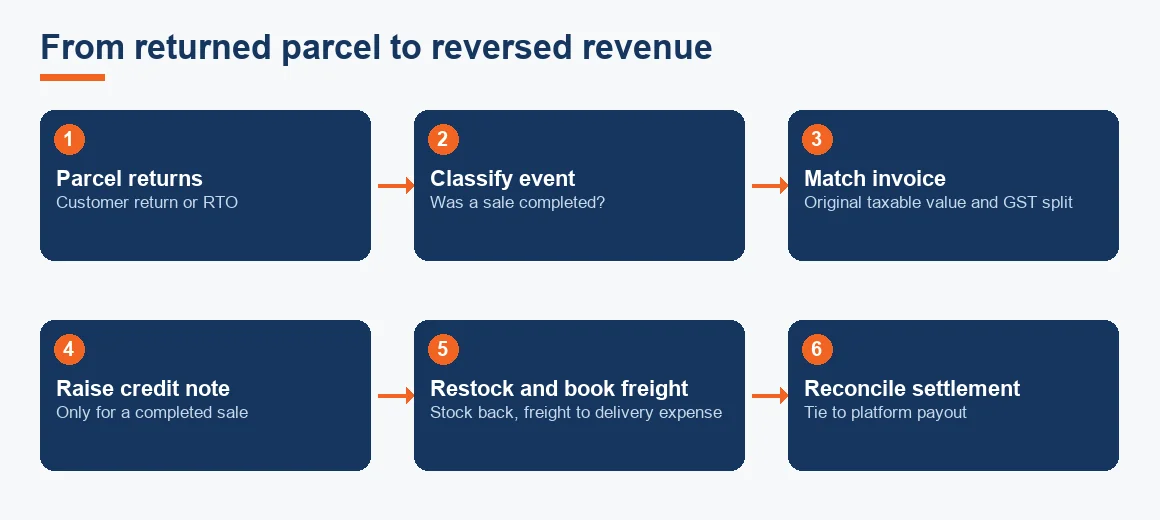
- Identify the event. Was the order delivered and then returned (customer return), or did it never arrive (RTO)? This decides whether revenue is reversed at all.
- Match to the original invoice. Pull the original sale so you reverse the exact taxable value and the exact CGST/SGST or IGST split.
- Raise the credit note (customer return only). Debit Sales Returns for the taxable value, debit the output tax ledgers, and credit the customer or marketplace receivable.
- Return stock to inventory. For saleable returns, add the unit back to stock at cost. For RTO, the stock never left in accounting terms, so only the freight is booked.
- Book the reverse freight. Forward and reverse shipping on an RTO goes to delivery expenses, not to Sales Returns.
- Reconcile against settlement. Tie every credit note and every fee reversal back to the platform payout so your books and the settlement agree.
That last step is where errors surface. Our guide on how to reconcile Amazon and Flipkart settlement reports walks through the matching, and the marketplace settlement reconciliation entry defines the process.
Customer return vs RTO vs exchange: a quick comparison
The table below summarises how each event hits your books.
| Aspect | Customer return | RTO (return to origin) | Exchange / replacement |
|---|---|---|---|
| Was a sale completed? | Yes, delivered then returned | No, never delivered | Yes, original sale stands |
| Revenue treatment | Reverse via Sales Returns | No reversal (revenue not recognised) | Usually no net change |
| GST credit note | Required, reverses output tax | Not applicable | Only if value changes |
| Stock | Back to inventory at cost | Back to inventory at cost | Swap units, cost neutral |
| Freight | Delivery expense | Delivery expense (forward + reverse) | Delivery expense |
Worked example: booking a returned order with GST
Take a delivered order of Rs 1,180 (indicative, Exl GST shown separately): a taxable value of Rs 1,000 plus 18% GST of Rs 180, split as CGST Rs 90 and SGST Rs 90 for an intra-state sale. The customer returns it within the window, so you issue a credit note reversing the whole sale. The credit note entry is below.
| Ledger | Debit (Rs) | Credit (Rs) |
|---|---|---|
| Sales Returns | 1,000 | - |
| Output CGST | 90 | - |
| Output SGST | 90 | - |
| Customer / Marketplace receivable | - | 1,180 |
| Total | 1,180 | 1,180 |
The entry reverses the Rs 1,000 revenue and the Rs 180 tax you originally charged, and clears the Rs 1,180 the customer no longer owes. Separately, if you paid Rs 60 forward and Rs 60 reverse courier on this parcel, that Rs 120 is debited to Delivery Expenses, not to Sales Returns, because freight is a cost you incurred whether or not the goods came back. Report the credit note in the GSTR-1 for the period so the Rs 180 output tax actually reverses on the portal.
Key terms
- Journal Entry: the paired debit and credit that records a single transaction such as a credit note.
- Return to Origin (RTO) Provisions: an undelivered shipment returned to the seller, where no sale was completed.
- Marketplace Settlement Reconciliation: matching platform payouts, fees and returns back to your own books.
- Section 52 TCS under GST: the tax the operator collects on your net sales, which also adjusts when orders are returned.
Where returns accounting sits in the bigger picture
Returns are one moving part in a marketplace ledger that also carries TCS, TDS under Section 194-O and monthly settlement reconciliations. The 0.1% operator TDS is explained in our Section 194-O TDS guide. Sellers who also run inventory-heavy operations should read across to Inventory Accounting and Costing, since a high return rate distorts stock valuation. For revenue-recognition-heavy models the same discipline applies in SaaS Accounting Services, IT and Software Company Accounting and, for younger businesses, Startup Accounting Services. If you want to sanity-check which reporting standard governs your revenue recognition, the AS vs Ind AS comparison matrix is a useful reference. General bookkeeping support sits under Accounting Services. Whether a return reverses revenue or leaves cost of goods sold untouched depends entirely on whether a sale was completed.
Key takeaways
- A customer return reverses a completed sale: debit Sales Returns, reverse the output GST, credit the receivable.
- RTO is not a sale, so no revenue was recognised and no credit note is due; only reverse freight is booked.
- The seller, never the buyer, issues the GST credit note under Section 34 of the CGST Act.
- Report tax-adjusting credit notes in GSTR-1 by 30 November following the year of supply, or lose the tax reversal.
- Reconcile every credit note against the marketplace settlement so your books and GSTR-1 agree.
Decision guide