In this guide
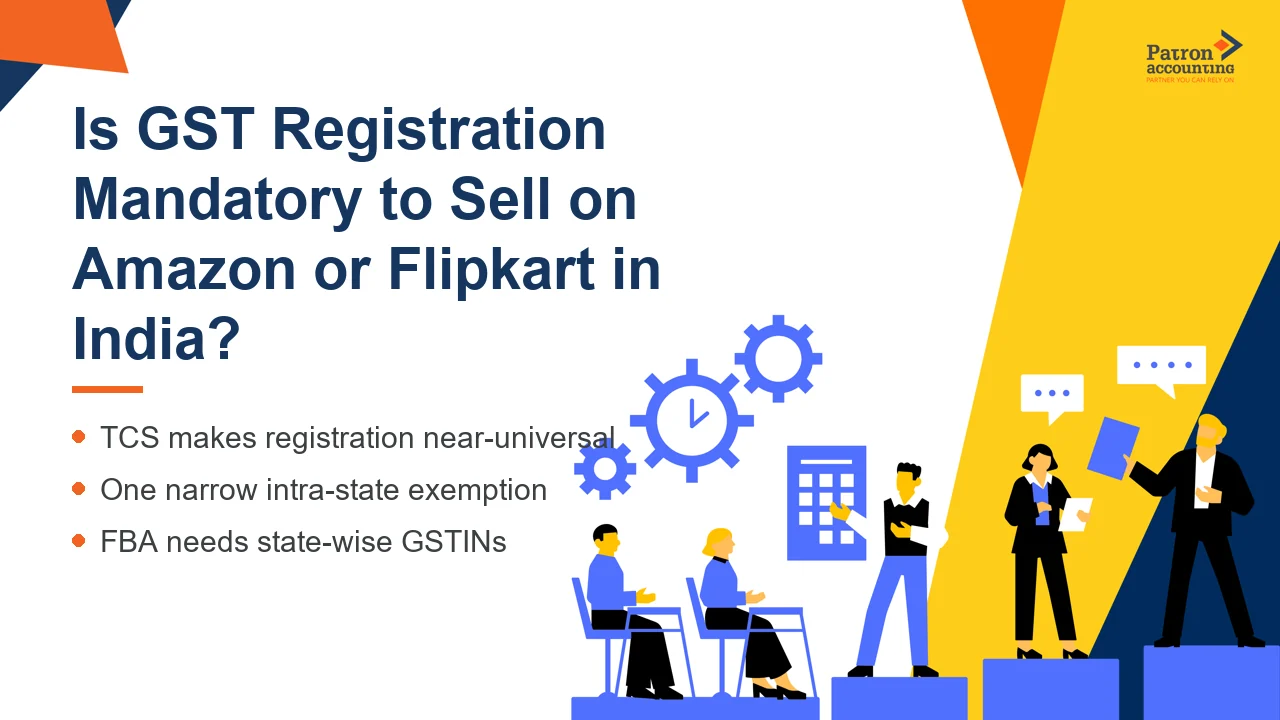
For the overwhelming majority of sellers, GST registration is mandatory to sell on Amazon or Flipkart in India. Because these marketplaces are e-commerce operators that collect tax at source (TCS) under section 52 of the CGST Act, the person supplying through them is required to register under section 24(ix) regardless of turnover. There is one narrow exemption for small intra-state goods sellers, which we set out below with the working, but as a rule you should expect to need a GSTIN before you can list a single product.
Is GST registration mandatory for Amazon sellers?
The starting point is section 24 of the CGST Act, which lists categories of person who must register compulsorily, irrespective of the ordinary turnover thresholds. Clause (ix) covers "persons who supply goods or services or both through an e-commerce operator who is required to collect tax at source under section 52". Amazon and Flipkart both collect TCS, so their sellers fall squarely inside that clause. In plain terms, the usual comfort of "my turnover is small, so I do not need GST" does not apply once you sell through a marketplace, unless you fit the single exemption described next.
This is why the marketplace onboarding screen asks for a GSTIN early on, and why you cannot activate most categories without one. If you are weighing up whether to sell online at all, this is a compliance cost to plan for from day one, and it usually sits alongside a wider bookkeeping setup covered by our E-Commerce Accounting Services.
The one exemption: Notification 34/2023 for intra-state goods sellers
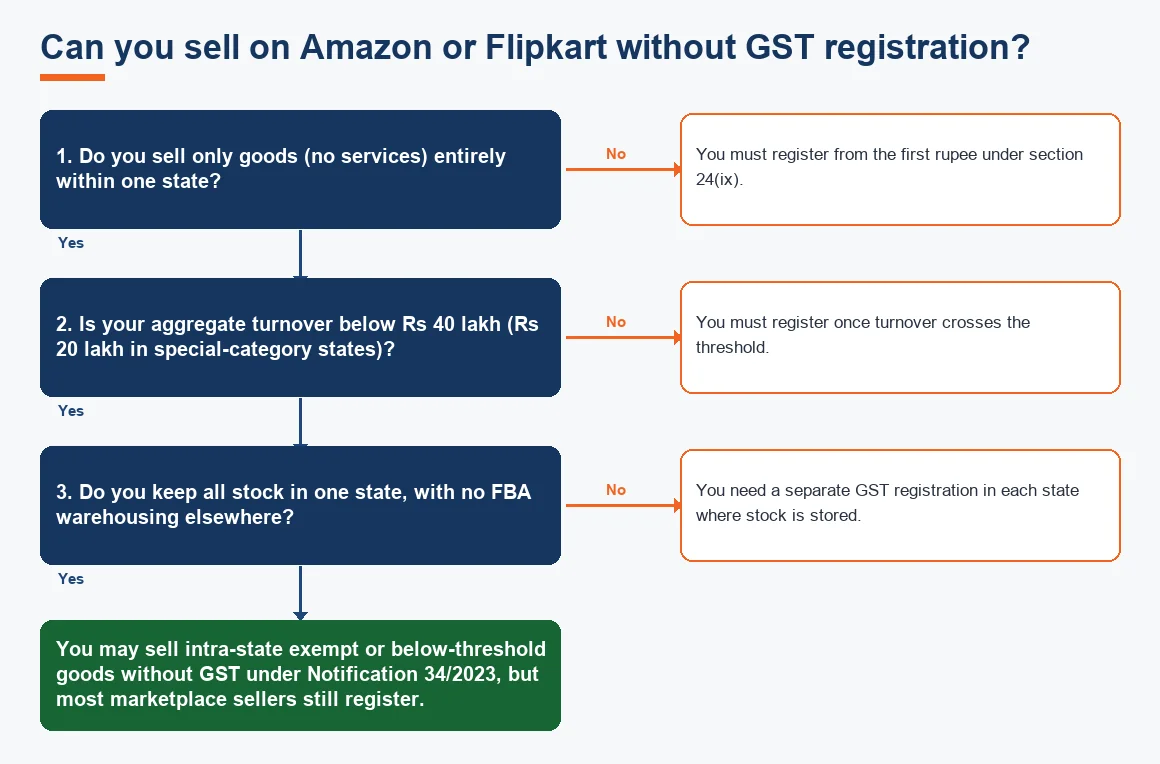
With effect from 1 October 2023, Notification 34/2023-Central Tax gave limited relief. A person supplying goods (not services) through an e-commerce operator does not have to register under section 24(ix) if all of the following hold: aggregate turnover is below the registration threshold (Rs 40 lakh for goods in most states, Rs 20 lakh in special-category states); supplies are made only within a single state or union territory (no inter-state supply); and the person is not required to register on any other ground. The seller must still declare a PAN and the enrolment number on the portal.
So the honest answer to "how much can I sell without GST" is: you can trade below the threshold only if you are an intra-state goods seller who ticks every box above. Cross a state line, add a service, or store stock elsewhere, and the exemption falls away. You can read the exact conditions on the CBIC-GST portal.
When you must register from the first rupee
Two groups have no threshold at all on a marketplace. Inter-state goods sellers, meaning anyone who ships to a buyer in another state, must register from the first sale. Service providers on a marketplace are, in practice, in a similar position: while a limited exemption exists for very small service suppliers, marketplaces generally require a GSTIN before you can list, so you should plan to register. If you sell software, subscriptions or professional services through a platform, this overlaps with the compliance covered by our SaaS Accounting Services (IT & SaaS) and IT & Software Company Accounting Services.
What can you sell on Amazon without GST?
The question usually comes from hobby and handmade sellers. A few product lines are exempt from GST altogether (certain unbranded food items, for example), and Amazon does permit a small number of GST-exempt categories to be listed without a GSTIN. But this is a category question, not a turnover question: if your product is taxable, the section 24(ix) rule applies. Handmade taxable goods (candles, jewellery, decor) are not exempt simply because they are handmade, so a maker selling taxable items across states will still need to register. Check the current exempt-category list inside Seller Central before assuming your item qualifies.
Which GST registration does an Amazon seller need, and how to get it
An Amazon or Flipkart seller needs a regular GST registration (not the composition scheme, which is barred for e-commerce suppliers). The process runs on the GST portal and is broadly the same across states.
- Gather PAN, Aadhaar, a business address proof, bank details and a photograph.
- File Form GST REG-01, Part A (PAN, mobile, email) to get a Temporary Reference Number.
- Complete Part B with business details, place(s) of business and the goods or services (HSN/SAC) you will supply.
- Complete Aadhaar authentication, or await physical verification if you skip it.
- Receive the GSTIN, usually within a week where Aadhaar is authenticated.
Enter that GSTIN in Seller Central against the correct state, and repeat the exercise for any additional state where you will hold stock.
TCS under section 52: what marketplaces collect and how you claim it
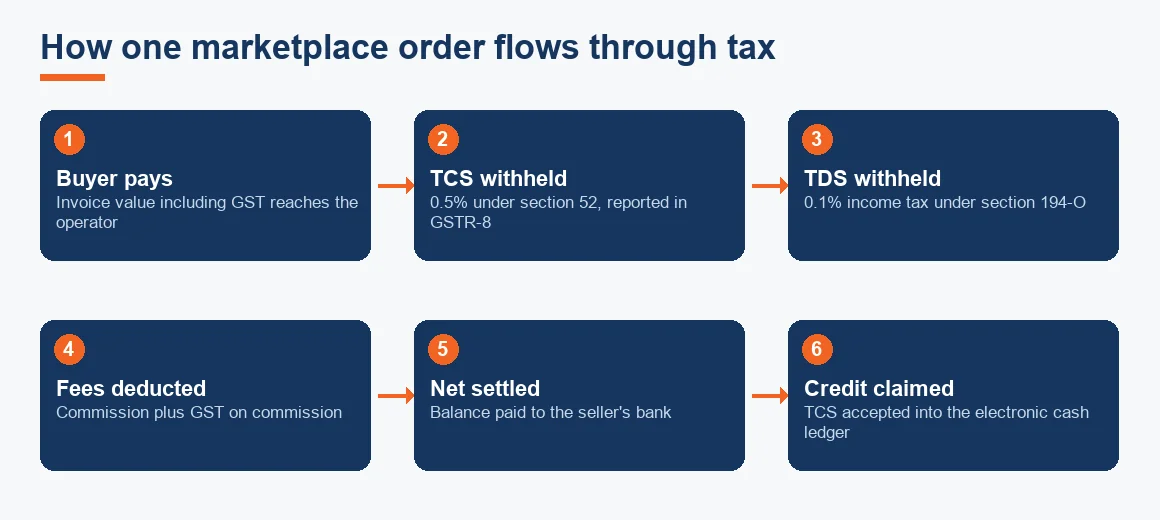
Every marketplace withholds tax at source on your taxable sales. Under section 52, the operator collects TCS of 0.5 per cent of the net value of taxable supplies, being 0.25 per cent CGST plus 0.25 per cent SGST on intra-state sales, or 0.5 per cent IGST on inter-state sales. The rate was halved from 1 per cent with effect from 10 July 2024. The operator reports the collection in Form GSTR-8 each month. That figure then auto-populates your TCS and TDS credit received statement on the portal; once you accept it, the credit lands in your electronic cash ledger and can be used to pay output tax or claimed as a refund. The mechanics are explained further in our note on TCS under section 52 for e-commerce sellers.
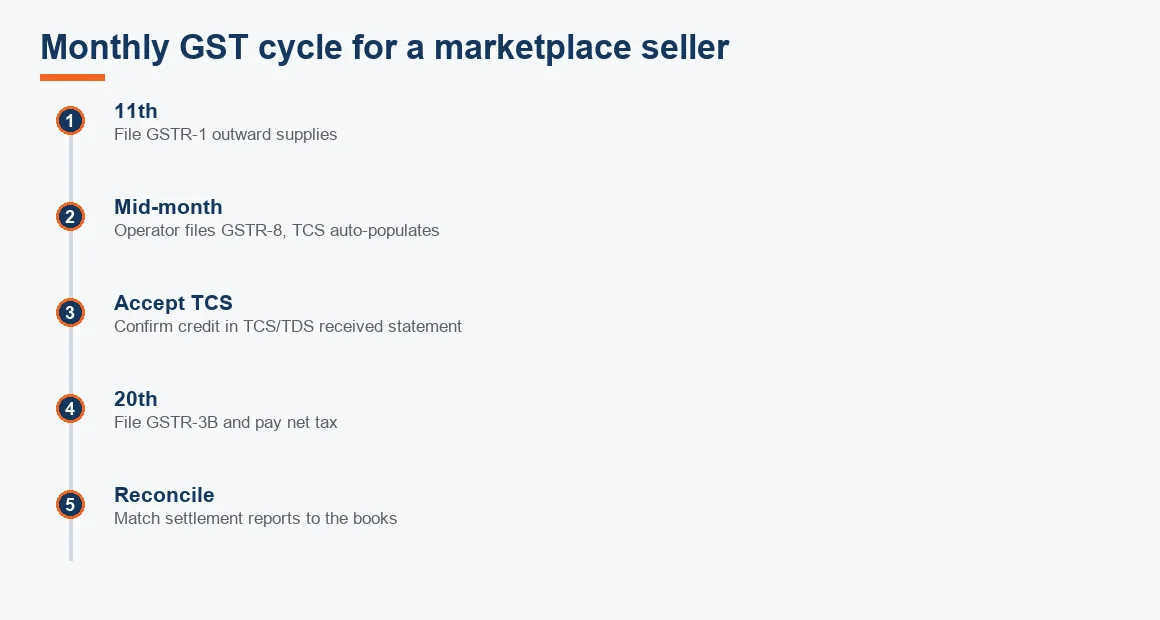
The discipline that matters is monthly matching: the TCS shown in GSTR-8 should agree with your marketplace settlement reports, which is a task we cover in reconciling Amazon and Flipkart settlement reports with your books. Where returns and RTO complicate the value, see accounting for returns, RTO and credit notes.
Separate GST registration in every state where stock is stored
If you use Amazon FBA or Flipkart's warehousing, your goods sit in the operator's fulfilment centres. Under GST, a place where you store goods for supply is a place of business, so each such state becomes a state where you are carrying on business. The consequence is direct: you need a GST registration in every state where your stock is held, with the warehouse declared as an additional place of business. Sales despatched from that state are billed under that state's GSTIN and reported in that state's returns. This is the single biggest surprise for new FBA sellers, who often plan for one registration and end up needing five or six.
Section 194-O income-tax TDS is separate from GST
Do not confuse the two deductions. Alongside GST TCS, the e-commerce operator also deducts income tax under section 194-O at 0.1 per cent of the gross amount of your sales, reduced from 1 per cent with effect from 1 October 2024. Individual and HUF sellers with gross sales up to Rs 5 lakh in the year who have furnished PAN are exempt from this deduction. It is a distinct tax, reflected in your Form 26AS and adjustable against your income-tax liability, and it is close cousin to section 194Q TDS on goods in the buyer-side world. Our seller's guide to section 194-O works through the detail; the Income Tax Department's rules sit on the income tax portal.
| Seller situation | Turnover threshold? | GST registration required? |
|---|---|---|
| Intra-state goods, below threshold, stock in one state | Applies (Rs 40 lakh / Rs 20 lakh) | Not required (Notification 34/2023) |
| Inter-state goods seller | None | Required from the first sale |
| Service provider on a marketplace | Limited | Usually required to list |
| FBA seller storing stock in multiple states | None | Required in each such state |
| Any seller above Rs 40 lakh (goods) / Rs 20 lakh | Crossed | Required |
Worked example: TCS, TDS and net settlement on one order
Take an intra-state sale of a taxable product listed at Rs 1,000 (indicative, Exl GST) attracting 18 per cent GST, on which the marketplace charges a 15 per cent commission. The figures below show what reaches your bank and what you owe. All amounts follow current rates.
| Line | Basis | Amount (Rs) |
|---|---|---|
| Taxable value of product | List price | 1,000.00 |
| GST on product @18% | Output tax | 180.00 |
| Invoice value collected from buyer | 1,000 + 180 | 1,180.00 |
| Less: GST TCS @0.5% (section 52) | 0.5% of 1,000 | (5.00) |
| Less: Income-tax TDS @0.1% (section 194-O) | 0.1% of 1,180 | (1.18) |
| Less: Marketplace commission incl 18% GST | 150 + 27 | (177.00) |
| Net settlement to seller | Balance | 996.82 |
The Rs 5 TCS and the Rs 1.18 TDS are not costs; they are advances. The Rs 5 credits your electronic cash ledger and reduces the GST you actually pay, and the Rs 1.18 is set against your income-tax bill. The Rs 27 GST on commission is input tax credit you can claim if you match it in GSTR-2B. Your net margin analysis should therefore start from the Rs 1,000 taxable value and your cost of goods sold, not from the Rs 996.82 that hits the bank.
Key terms
- Section 52 TCS under GST: the 0.5 per cent tax collected at source by a marketplace on your taxable sales.
- Marketplace Settlement Reconciliation: matching the net payout from Amazon or Flipkart to sales, fees and taxes in your books.
- GSTR-2B Input Tax Credit Matching: confirming that GST on commission and fees is eligible ITC before you claim it.
- Return to Origin (RTO) Provisions: accounting for undelivered orders returned to the seller and their tax reversal.
How this fits a wider seller setup
Registration is only the entry ticket. Once you hold GSTINs, the monthly rhythm of GSTR-1, GSTR-3B, accepting TCS credit and reconciling settlements begins, and it grows heavier with each additional state. If you are building an online business from scratch, it is worth phasing the compliance alongside your funding and cash planning, which is where our Startup Accounting Services India and the parent E-Commerce Accounting Services come in. This article stays on the informational question; the choice of who runs your filings belongs on those service pages.
Key takeaways
- Assume GST registration is mandatory to sell on Amazon or Flipkart; the section 24(ix) TCS rule catches almost everyone.
- The only exemption is for intra-state goods sellers below threshold with stock in one state, under Notification 34/2023.
- Inter-state sales and most services trigger registration from the first rupee.
- FBA and marketplace warehousing require a separate GST registration in every state where stock is stored.
- GST TCS at 0.5 per cent and income-tax TDS at 0.1 per cent are two different deductions; both are advances, not costs.
Decision guide