In this guide
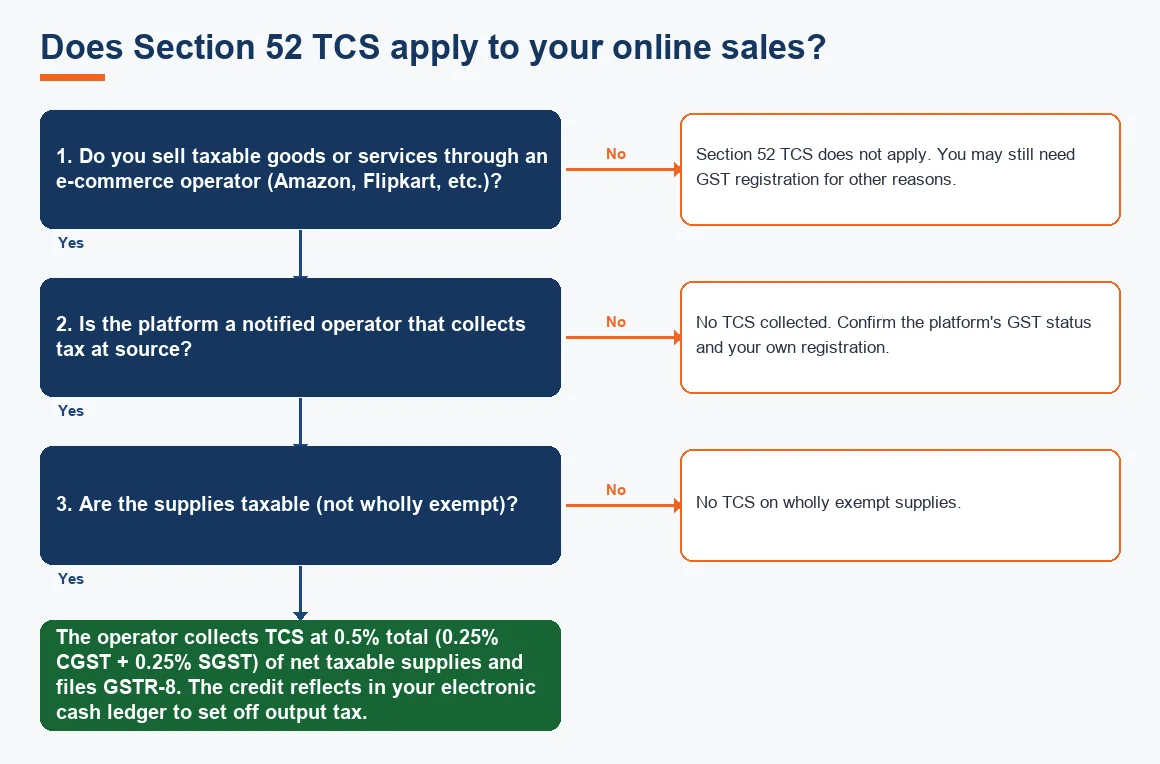
If you sell on Amazon, Flipkart, Meesho, or any other online marketplace, you will have seen a line in your settlement report labelled TCS. This is tax collected at source under Section 52 of the CGST Act, and TCS on e-commerce sales under Section 52 works differently from a normal expense: the operator withholds 0.5 percent of the net taxable value of your sales, deposits it with the government against your GSTIN, and you recover it in full through your GST return. This article explains the rate, the base it applies to, who collects it, and the exact steps to claim it back, without straying into how commission is charged or how much income tax you owe.
What is Section 52 of the CGST Act?
Section 52 is the provision that makes an electronic commerce operator responsible for collecting a small percentage of tax on the taxable supplies that other sellers make through its platform. The logic is simple. When thousands of small sellers transact through one marketplace, the tax department wants a paper trail and a partial collection at the point of settlement, so it puts the duty on the operator rather than chasing every seller. The operator is not paying your tax for you; it is collecting a slice on account and reporting each supplier's figures to the government. You still charge GST at the normal rate on the item, file your own returns, and pay the balance yourself.
Because the operator reports supplier-wise data, the amount it collects is matched to your GSTIN and made visible to you. If you also run a services business that sells online, note that a separate income-tax provision, covered in our guide to Section 194-O TDS on e-commerce operators, can apply alongside this one; the two are distinct and both can appear on a single settlement statement.
Key terms
- Section 52 TCS under GST: the GST rule requiring a marketplace to collect 0.5 percent of a seller's net taxable supplies.
- GSTR-2B: the auto-drafted statement where marketplace-collected TCS surfaces for you to accept.
- Marketplace Settlement Reconciliation: tying each payout from the platform back to invoices, fees, and TCS in your books.
- Return to Origin (RTO): undelivered or returned orders that reduce the net value on which TCS is charged.
What is the TCS rate under Section 52?
The rate is 0.5 percent of the net taxable value of supplies. For a supply within your own state that splits into 0.25 percent CGST and 0.25 percent SGST; for an inter-state supply it is a single 0.5 percent IGST. This is the reduced rate that came into effect on 10 July 2024, halving the earlier 1 percent charge, per the notification issued by the CBIC. Any settlement report or blog still quoting 1 percent is out of date. The rate does not depend on the GST rate of the product itself; a 5 percent item and an 18 percent item both attract the same 0.5 percent TCS on their net value.
On which amount is TCS applicable?
TCS is charged on the net taxable value of supplies, not on gross sales and not on the commission the platform charges you. Net value means the aggregate value of taxable supplies of goods or services made through the operator during the month, reduced by supplies returned to the sellers during the same month. In plain terms, sales less returns. The GST component of the invoice is excluded, and the operator's own commission is a separate transaction that carries its own 18 percent GST and has nothing to do with the TCS base.
Returns matter a great deal here. Because RTO and customer returns are netted off in the month they occur, a high-return category will show a smaller TCS figure than its gross sales suggest. Getting this netting right in your books is part of a clean marketplace settlement reconciliation, and we cover the mechanics in detail in reconciling Amazon and Flipkart settlement reports with your books and in the companion piece on accounting for returns, RTO, and credit notes.
A worked example
The table below shows how the operator arrives at the TCS it deducts for a seller making supplies within one state in a given month.
| Line | Amount (INR) |
|---|---|
| Gross taxable value of supplies | 5,00,000 |
| Less: value of goods returned in the month | 50,000 |
| Net taxable value of supplies | 4,50,000 |
| TCS at 0.5 percent (0.25% CGST + 0.25% SGST) | 2,250 |
| Amount credited to your electronic cash ledger | 2,250 |
The 2,250 is not a cost. It sits in your cash ledger and pays down the GST you owe on the same sales, so your actual outflow at return time is reduced by that amount.
Who is liable to collect TCS in GST?
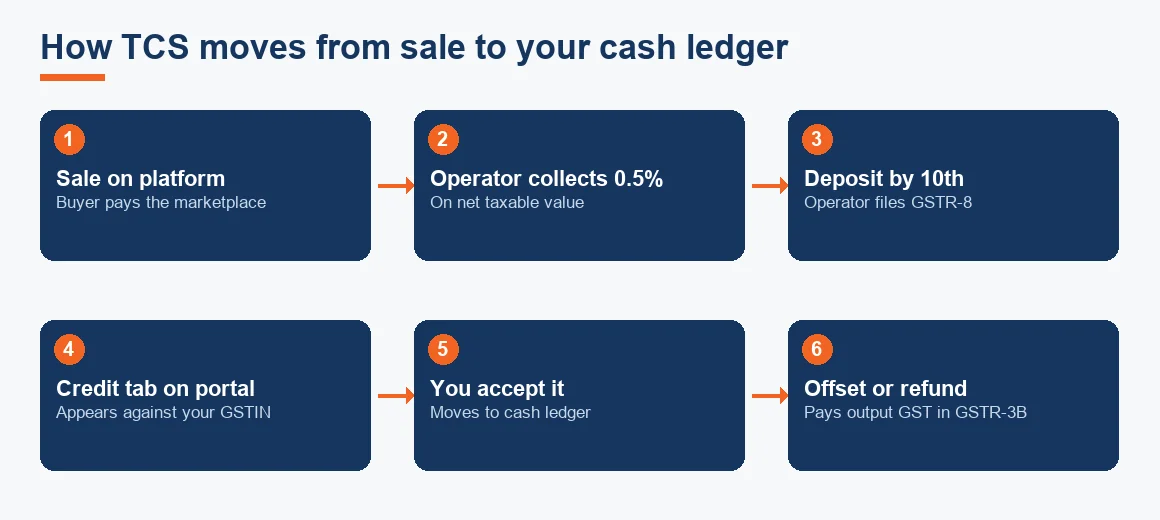
The duty to collect falls on the electronic commerce operator, meaning the marketplace that owns or manages the platform and controls the collection of consideration. You, the seller, never collect Section 52 TCS; you are the person from whom it is collected. The operator must register for TCS in every state where its suppliers are located, deposit what it collects by the 10th of the following month, and file its monthly statement in Form GSTR-8. It must also furnish an annual statement in addition to the monthly filings.
There is an important carve-out. A supplier who sells its own goods on its own website is generally not caught by Section 52, because it is not making supplies through another operator. The provision targets the aggregator model, where a platform hosts many independent sellers.
Which return reports TCS, and by when?
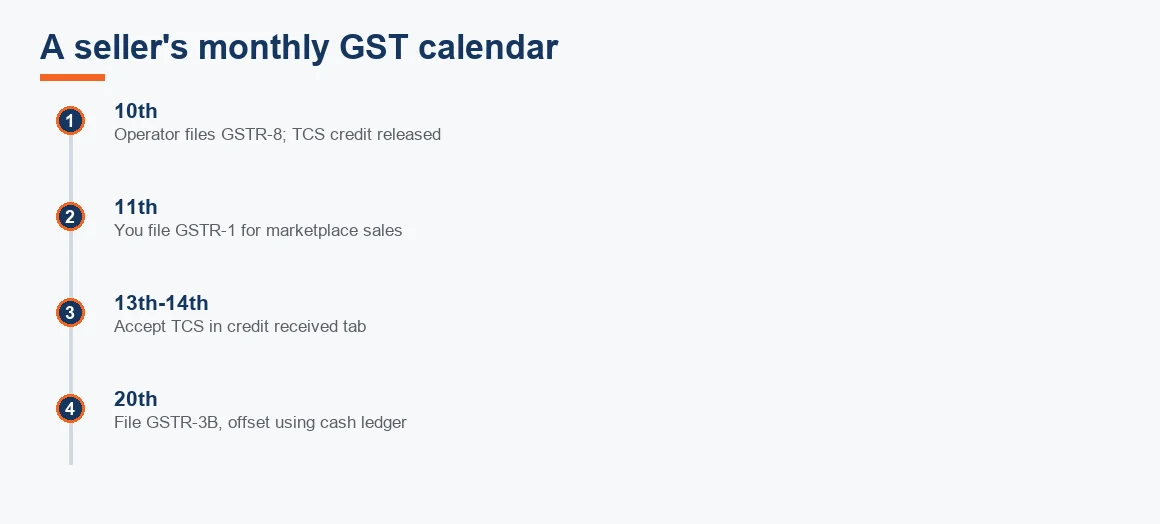
Two separate return trails run in parallel, and it helps to keep them clear. The operator reports what it collected; you report your own sales and reclaim the collection. The operator files Form GSTR-8 by the 10th of the following month, depositing the tax by the same date, as set out on the GST portal. Late deposit by the operator carries interest at 18 percent a year, and, crucially for you, the supplier cannot take the credit until the operator's return is filed.
On your side, you file GSTR-1 reporting your marketplace sales like any other supply, then GSTR-3B for the tax payable. The timeline below shows how a normal month lines up.
How to claim TCS back through your GSTR-2B
This is the step most sellers get wrong, usually by never accepting the credit at all. Once the operator files GSTR-8, the TCS it collected appears in the TCS and TDS credit received tab on the GST portal. You open that tab, accept the entries, and the amount moves into your electronic cash ledger. From there it behaves like cash you have deposited: it pays your output GST when you file GSTR-3B, or, if it keeps building up because your output tax is low, you can claim it as a refund.
- Wait for the operator to file GSTR-8 for the month; the credit will not appear before then.
- Log in to the GST portal and open the TCS and TDS credit received statement.
- Check the figures against your settlement reports, then accept the entries.
- The accepted amount lands in your electronic cash ledger.
- Use it to offset output tax in GSTR-3B, or apply for a refund if it accumulates.
Sellers who buy stock from large suppliers should not confuse this with Section 194Q TDS on goods purchases, which is an income-tax deduction on your purchases and has nothing to do with your marketplace collections. Keeping the two ledgers separate in your books avoids a painful year-end clean-up.
Worked example: TCS on a single marketplace order
Numbers make Section 52 concrete, so here is one intra-state order broken down line by line. The figures are indicative and the item price is shown Exl GST, tracing a single sale from the buyer's payment through to the TCS credit that reaches your electronic cash ledger.
| Line | Amount (INR) |
|---|---|
| Taxable value of the order (indicative, Exl GST) | 2,000 |
| Add: GST on the item at 18 percent | 360 |
| Invoice value paid by the buyer | 2,360 |
| Less: TCS collected by the operator at 0.5 percent (0.25% CGST + 0.25% SGST) | 10 |
| Amount settled to the seller (before platform commission) | 2,350 |
| TCS credited to your electronic cash ledger | 10 |
The operator withholds just 10 rupees, computed on the taxable value and not on the GST, and that same 10 rupees returns to you as credit once it files GSTR-8, so the order carries no extra tax cost. In your books the clean treatment is a simple journal entry that records the TCS as a receivable rather than an expense, the debit side of the double-entry being a tax asset you will recover in full. Tie each order back to its payout during your marketplace settlement reconciliation so no credit is ever left stranded on the portal.
Is GST registration compulsory to sell on a marketplace?
Not in every case any more. Under Notification 34/2023, a supplier of goods making only intra-state supplies through an operator is exempt from compulsory registration, provided aggregate turnover stays below the threshold and the person obtains a PAN and an enrolment number on the portal. Anyone making inter-state supplies through a marketplace, or supplying services above the threshold, must still register. We walk through the full decision in whether GST registration is mandatory to sell on Amazon or Flipkart, so treat this as the short version: small local-only sellers may now stay unregistered, but the moment you ship across a state border the exemption falls away.
Who needs to worry about Section 52 TCS?
If any part of your revenue flows through a third-party platform, this applies to you. That includes product sellers on the big horizontal marketplaces, brands running on niche or vertical platforms, and increasingly early-stage startups testing demand through an aggregator before building their own site. Businesses that sell software or subscriptions through an app store or reseller face the same collection mechanics on the goods-and-services value, which is why our SaaS accounting and IT and software company accounting clients raise it as often as pure retailers do. If reconciling these collections every month is eating your evenings, our e-commerce accounting services take the settlement-to-ledger work off your desk.
Key takeaways
- TCS under Section 52 is 0.5 percent (0.25% CGST + 0.25% SGST, or 0.5% IGST) on the net taxable value of your marketplace sales, reduced from 1 percent on 10 July 2024.
- It is charged on sales less returns, not on gross sales and not on the platform's commission.
- The marketplace collects and deposits it and files GSTR-8 by the 10th; you cannot claim the credit until it does.
- Accept the credit in the TCS and TDS credit received tab so it moves into your electronic cash ledger to pay output tax or be refunded.
- Never book TCS as an expense; it is your own tax held on account.
- Small intra-state-only sellers may be exempt from registration under Notification 34/2023, but inter-state sellers must register.
Decision guide