In this guide
Section 194-O of the Income Tax Act requires an e-commerce operator to deduct tax at 0.1% on the gross amount of sales it credits to a seller who lists on its platform. The operator (Amazon, Flipkart, Meesho, Nykaa and the like) does the deducting, the online seller bears it, and the amount shows up in the seller's Form 26AS as a prepaid tax that can be set off against the year's income tax. This guide explains the rate, the Rs 5 lakh threshold, who actually pays, and how to carry the figure correctly into your return.
What is TDS under Section 194-O?
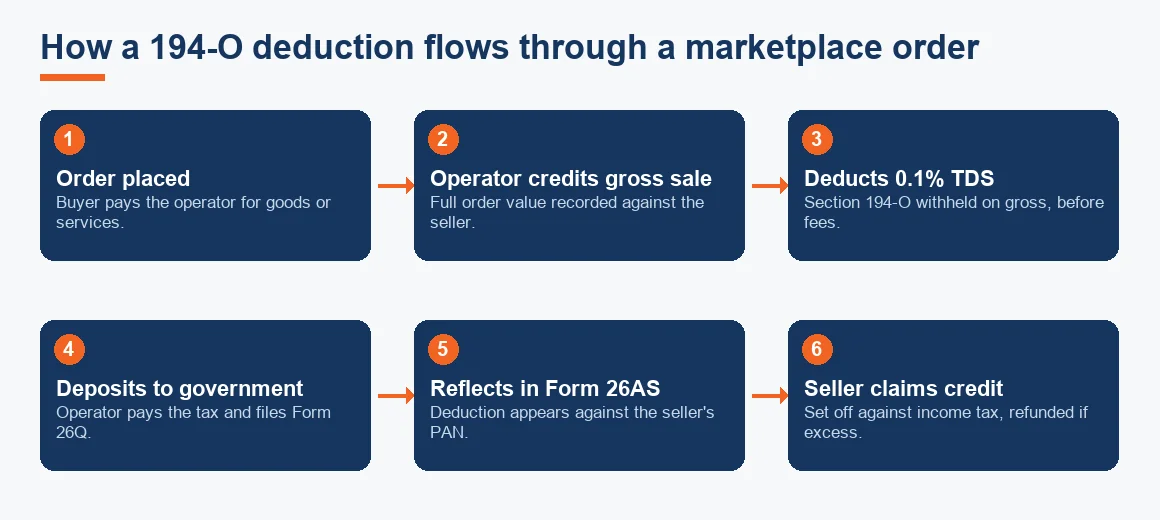
Introduced by the Finance Act 2020 and effective from 1 October 2020, Section 194-O brought online marketplace sales into the TDS net. The logic is simple: a large share of small sellers were invisible to the tax system, so the law placed the reporting duty on the operator, which sees every rupee that passes through its platform. When an operator facilitates the sale of goods or services and credits the sale value to the participant seller, it must deduct income tax at source on that gross value. The deduction happens at the earlier of the credit to the seller's account or the payment, whichever is first.
Importantly, the tax is calculated on the gross sale consideration, meaning the full order value before the operator subtracts its commission, logistics, storage and payment gateway charges. So even though only the net amount reaches your bank, the 0.1% bites on the larger gross figure. This single point causes most of the turnover mismatches sellers see later. The rule sits alongside GST TCS under Section 52, and both can apply to the very same order, a point we return to below.
What is the 194-O TDS rate and the Rs 5 lakh limit?
The headline rate is 0.1% of the gross amount of sales. It was originally 1%, but a Budget-era rate reduction brought it down, and 0.1% is the figure that applies today. Do not confuse this with the 2% and 5% rates that circulate online; those belong to other sections (194H commission, 194J services and 206AA no-PAN cases).
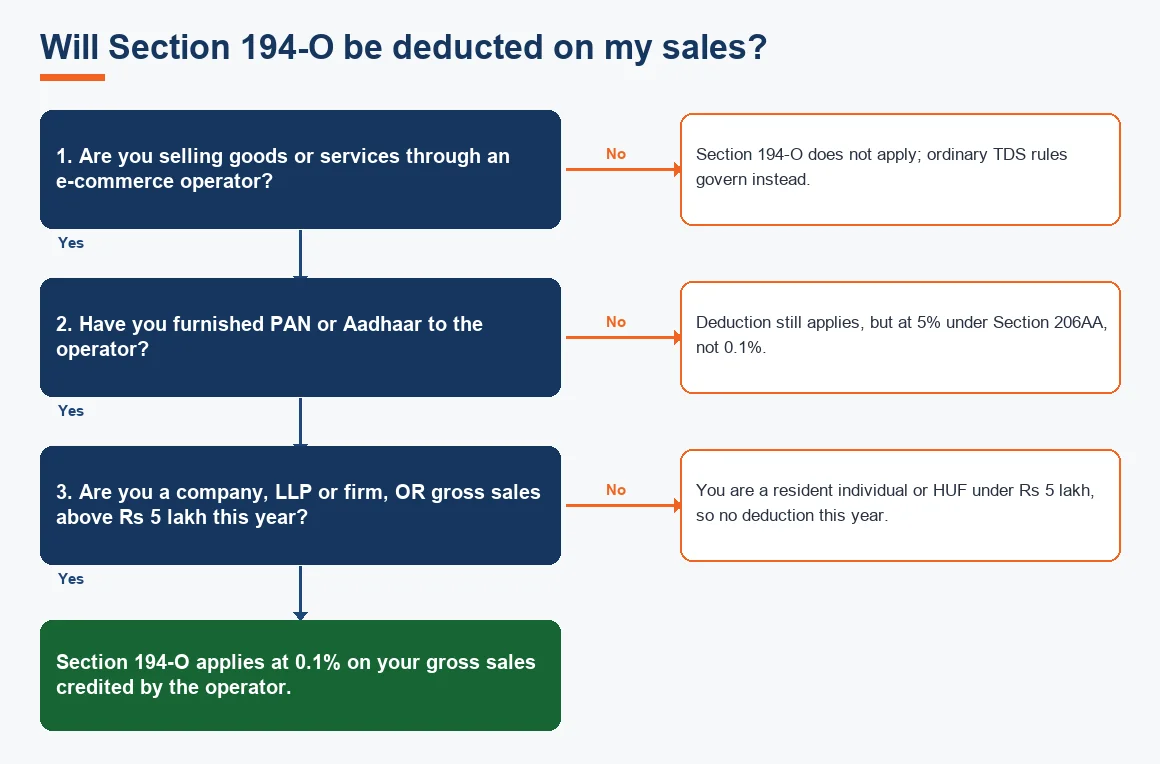
The 194-O limit is a narrow exemption. No tax is deducted where the seller is a resident individual or Hindu undivided family (HUF) and the gross sales and services routed through the operator during the financial year do not exceed Rs 5 lakh, and PAN or Aadhaar has been furnished. Cross Rs 5 lakh and deduction applies on the whole amount, not just the excess. Every other seller (a company, LLP or partnership firm) gets no threshold at all and faces deduction from the first transaction. If you sell across several industry verticals, the same logic applies whether you run an IT and software business or a consumer-goods store; the entity type, not the product, decides the threshold.
Who pays the TDS, the buyer or the seller?
Neither the buyer nor the seller physically deducts anything. The e-commerce operator deducts and deposits the tax, and the seller effectively bears it because it is withheld from the sale proceeds the operator would otherwise settle. The buyer paying for goods online is outside the mechanism entirely. For the seller it is not a cost, it is a prepaid tax: you get full credit for it against your income tax liability, in the same way salaried employees get credit for TDS on salary. If your final tax works out lower than the tax already deducted across the year, the balance comes back as a refund when you file.
194-O TDS versus GST TCS under Section 52
The most common confusion is between two collections that hit the same marketplace order from two different laws. Section 194-O is an income tax deduction; Section 52 of the CGST Act is a GST collection. They differ on rate, base, where the credit lands and how they are reported. If TCS under GST is new to you, our explainer on how the Section 52 collection works covers it end to end; the table below only draws the contrast.
| Feature | Section 194-O (Income Tax TDS) | Section 52 (GST TCS) |
|---|---|---|
| Law | Income Tax Act, 1961 | CGST Act, 2017 |
| Rate | 0.1% of gross sales | 0.5% of net taxable supplies |
| Base | Gross sale value, before fees | Net taxable value, after returns |
| Credit lands in | Form 26AS / AIS (income tax) | Electronic cash ledger (GST) |
| Operator reports in | Form 26Q TDS return | GSTR-8 |
| Set off against | Income tax liability | GST output liability |
Both can apply to a single order, so a seller usually reconciles two separate deductions from one settlement report. Getting the reconciliation right is why matching settlement reports to your books matters so much for online sellers.
A worked example: 194-O on a quarter of marketplace sales
Take a seller (a private limited company, so no Rs 5 lakh threshold) that routes Rs 5,00,000 of gross sales through one marketplace in a quarter. The operator charges 18% commission plus GST on the commission, and GST TCS applies on the net taxable value. The figures below show how 194-O sits inside the wider settlement. All amounts are illustrative.
| Line | Basis | Amount (Rs) |
|---|---|---|
| Gross sales credited | Full order value | 5,00,000 |
| Section 194-O TDS | 0.1% of 5,00,000 | 500 |
| GST TCS (Section 52) | 0.5% of net taxable, say 4,80,000 | 2,400 |
| Marketplace commission | 18% of 5,00,000 | 90,000 |
| GST on commission | 18% of 90,000 | 16,200 |
| Net settled to bank | Gross less all above | 3,90,900 |
Only Rs 3,90,900 reaches the bank, yet your books must record Rs 5,00,000 of turnover, claim the Rs 500 as TDS credit and the Rs 2,400 in the GST cash ledger, and book the commission and GST on commission as expenses with input credit where eligible. Had PAN not been furnished, the 194-O deduction alone would have been 5% of Rs 5,00,000, that is Rs 25,000, instead of Rs 500.
Where to show 194-O income in your ITR
Report the gross sale value the operator credited as your business turnover in the profit and loss account, not the net figure settled to your bank. Claim the tax deducted in the TDS schedule of the return, using the entries visible in Form 26AS and the Annual Information Statement (AIS). Marketplace commission, logistics, storage and payment gateway charges are claimed separately as business expenses, so your reported profit is not distorted. The single most important check before filing is that your declared turnover reconciles with the gross credited in 26AS; a gap here is a routine notice trigger. You can verify your 26AS and AIS directly on the Income Tax Department portal.
What happens when PAN is not furnished?
If the seller has not furnished PAN or Aadhaar to the operator, Section 206AA overrides the 0.1% rate. For 194-O the higher rate is 5%, a specific relief compared with the standard 20% no-PAN rate that applies to most other TDS sections. On our Rs 5,00,000 example that is the difference between Rs 500 and Rs 25,000 held back, a serious working-capital hit for a small seller. The fix is basic housekeeping: keep your PAN correctly mapped in every marketplace seller account, and confirm the operator has validated it. This is the same discipline that keeps your GST registration details clean across platforms.
Step by step: reconciling 194-O with your books
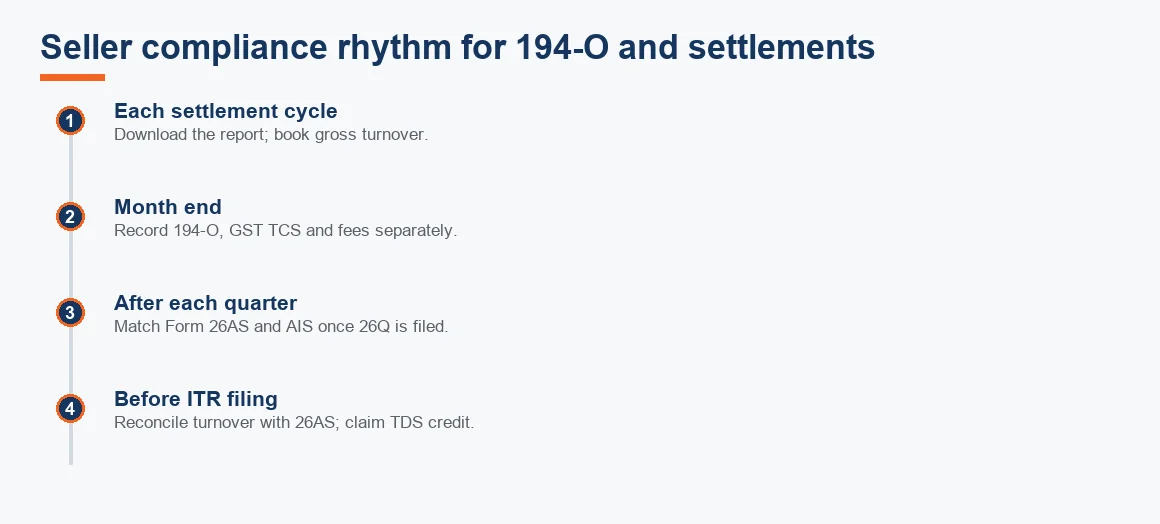
Because the deduction is on gross and the receipt is net, a monthly reconciliation is the only reliable way to keep turnover, TDS and GST aligned. Work through it in this order.
- Download the settlement report from each marketplace for the period, showing gross sales, commissions, 194-O TDS and GST TCS line by line.
- Book gross turnover in your accounting software, matching the operator's gross credited value, not the net payout.
- Record each deduction separately: 194-O to a TDS receivable ledger, GST TCS to the electronic cash ledger tracking account, commissions and fees to expenses.
- Match to Form 26AS and AIS after each quarter, once the operator files Form 26Q, and flag any figure that does not tie out.
- Track returns and RTO so that credit notes reduce turnover correctly; how you account for returns, RTO and credit notes feeds straight into these numbers.
Sellers listing across several categories, or running a funded startup or a SaaS business with digital services on marketplaces, will benefit from a fixed month-end routine here rather than a year-end scramble. A simple deferred-tax working, aided by a deferred tax calculator, also helps where timing differences arise between book turnover and the tax view.
Key terms
- Section 52 TCS under GST: the GST collection at 0.5% on net taxable marketplace supplies, reported by the operator in GSTR-8.
- Section 194Q TDS on Goods: a separate buyer-side TDS on purchase of goods, often confused with 194-O.
- Marketplace Settlement Reconciliation: matching an operator's settlement report to your books so gross, fees and deductions all tie out.
- Return to Origin (RTO) Provisions: accounting for orders that fail delivery and come back, reversing turnover and deductions.
- GSTR-2B Input Tax Credit Matching: reconciling input credit, including GST on marketplace commission, against the auto-drafted 2B.
How this fits into your e-commerce books
Section 194-O is a small deduction with an outsized effect on reporting, because it forces the gross-versus-net discipline that online sellers most often get wrong. Handled properly it is simply a prepaid tax you recover; handled loosely it produces turnover mismatches, refund delays and notices. If you would rather hand the monthly reconciliation, TDS tracking and return-linked reporting to a specialist, our E-Commerce Accounting Services team manages exactly this for marketplace sellers, keeping your accounts receivable and settlement books clean across platforms. The statutory text itself is available on the Income Tax Department site, and GST-side rules on the CBIC portal.
Key takeaways
- 194-O deducts 0.1% on gross marketplace sales, taken by the operator and borne by the seller as a prepaid income tax.
- The Rs 5 lakh exemption is only for resident individuals and HUFs with PAN or Aadhaar on file; companies, LLPs and firms are deducted from the first rupee.
- No PAN means 5% under Section 206AA, not 20%.
- It is a separate law from GST TCS under Section 52; both can hit the same order and are reported in different returns.
- Always book gross turnover, claim the TDS in Form 26AS, and reconcile monthly to avoid notices.
Decision guide