In this guide
A year-end closing checklist is the ordered list of reconciliations, adjusting entries, provisions and schedules that an Indian business completes after 31 March, before the books for the financial year are locked and handed to an auditor. It exists so that nothing is missed: the closing process turns a running set of ledgers into a trial balance that ties to bank statements, GST returns, Form 26AS and physical stock, and that already carries the depreciation, accruals and tax provision the year actually needs. This guide walks through what goes on that checklist, in the sequence a chartered accountant would follow.
What is year-end closing in accounting?
Year-end closing is the process of finalising the accounts for a completed financial year so that the profit and loss account and balance sheet present a true and fair view. In India the year runs from 1 April to 31 March for every business, fixed by Section 3 of the Income Tax Act and Section 2(41) of the Companies Act, so 31 March 2026 closes the year assessed in 2026-27. Closing is more than printing reports. It means agreeing every control account to an external source, posting the adjustments that accrual accounting demands, and then passing closing journal entries that move revenue and expense balances into the profit and loss account and carry the net result to reserves. The related idea of pulling all of this into a signed set of statements is covered in our explainer on what is finalisation of accounts.
What is included in a year-end closing checklist?
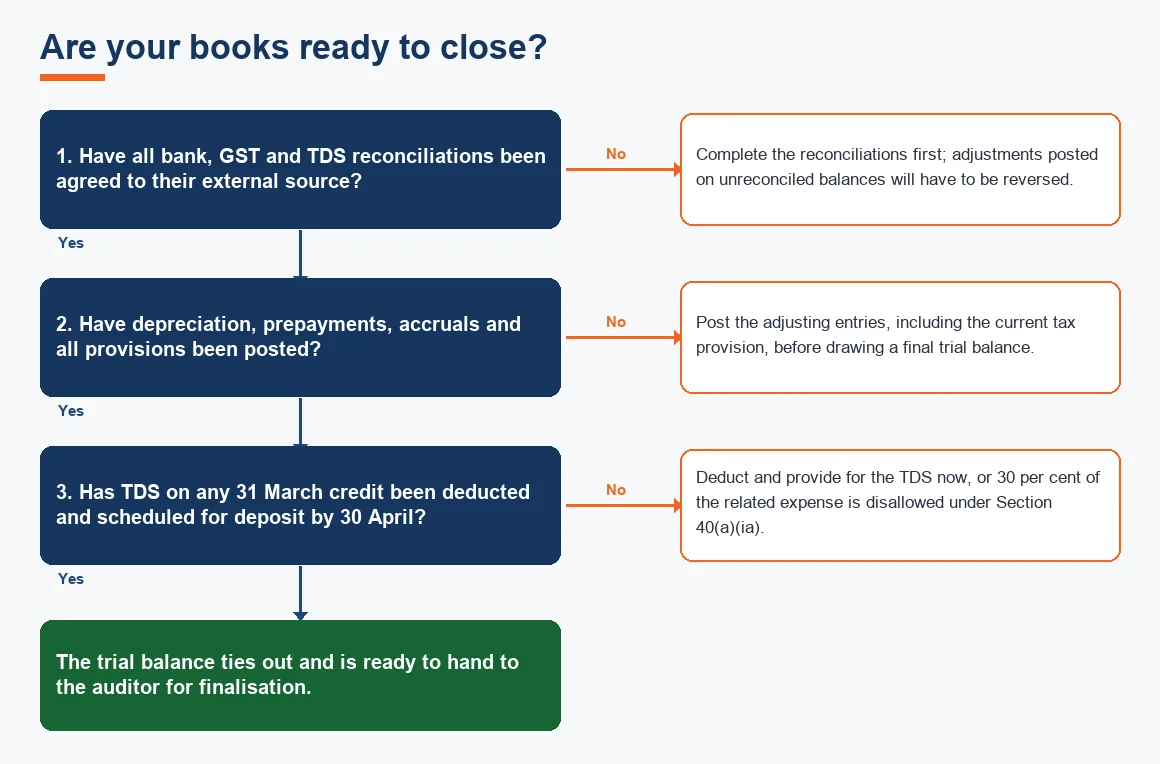
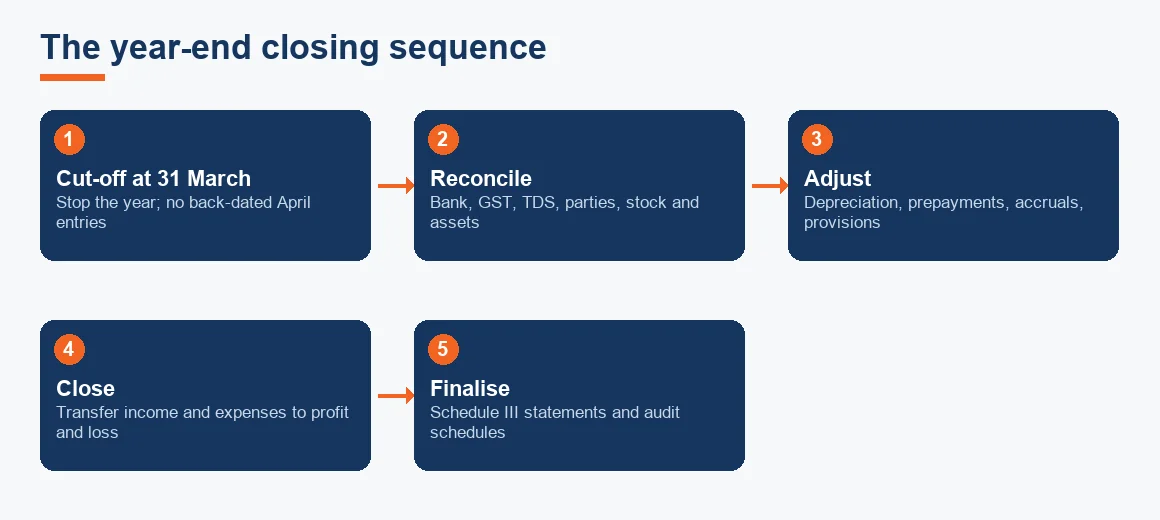
A working checklist has four blocks that run in order. Rushing to adjustments before the reconciliations agree is the most common reason a close has to be reopened.
- Reconciliations: bank accounts, input tax credit, output tax, TDS, vendor and customer balances, stock and fixed assets.
- Adjusting entries: depreciation for the full year, prepayments, accrued income and expenses, and provisions.
- Closing entries: transferring income and expense ledgers to the profit and loss account and the balance to reserves.
- Schedules and confirmations: the supporting files an auditor asks for, from the fixed asset register to balance confirmations.
Each block feeds the next, which is why a clean general ledger and an agreed opening trial balance matter before you start.
Which reconciliations have to be finished first?
Reconciliation is where most of the work sits, and it must be complete before a single adjustment is posted. The core set is the same for almost every business.
- Bank: every account agreed to its 31 March statement, with cheques issued but not cleared and deposits in transit listed out. If you have fallen behind here, our note on adjusting entries before finalising accounts shows how timing differences are handled.
- GST: input tax credit in the books matched to GSTR-2B, and output tax agreed to GSTR-1 and GSTR-3B. Reconcile the full year, not just March, so that the annual return in GSTR-9 does not throw up surprises.
- TDS: tax deducted and, separately, tax credit available, both tied to Form 26AS and the Annual Information Statement on the income tax portal.
- Parties: vendor and customer balances confirmed against statements, with disputes flagged. This is also where you apply the Section 43B(h) MSME payment test, since amounts owed to a registered micro or small enterprise beyond the agreed period are disallowed if unpaid at year end.
- Stock and assets: physical stock counted and agreed to the ledger, and fixed assets verified against the asset register.
What is the end-of-year adjustment, and how do you prepare closing entries?
Once the balances agree, you post the entries that accrual accounting requires but the year did not capture on its own. An end-of-year adjustment is any entry that shifts income or expense into the correct period regardless of when cash moved. The usual list:
- Depreciation for the full year on every asset, recomputed on additions and disposals. The depreciation calculator handles both the Schedule II and Income Tax Act bases.
- Prepayments such as insurance and annual software licences, spread over the months they cover.
- Accrued income and expenses, including March electricity, telephone and professional bills received in April.
- Provisions for audit fees, unpaid salaries, bonus at the statutory minimum of 8.33 per cent under the Payment of Bonus Act, gratuity and leave encashment on actuarial valuation where applicable, and expected credit loss where relevant.
- Current tax, after adjusting advance tax paid and TDS credited, with deferred tax computed separately using the deferred tax calculator.
After these, you pass the closing entries themselves: each revenue and expense ledger is cleared to the profit and loss account, and the resulting profit or loss is carried to reserves. The mechanics of that final step are set out in our guide to closing entries in accounting, and once profit is struck you can read it correctly using EBITDA, PBIT and PBT.
What do accountants need for end-of-year accounts?
An auditor works from schedules, not from the ledger alone. Having these ready before the audit begins is what separates a two-week close from a two-month one.
Key terms
- Closing Journal Entries: the year-end entries that clear income and expense accounts to the profit and loss account.
- Trial Balance: the list of all ledger balances that must tie out before finalisation.
- Accrued Liabilities: expenses incurred but not yet billed, provided for at year end.
- Prepaid Expense Amortization: spreading a prepayment across the periods it actually covers.
- Depreciation: the systematic write-down of fixed assets recomputed for the full year.
Which accounts are closed at year end?
Two kinds of account behave differently at the close. Understanding the split answers the common question of what actually gets closed.
| Account type | Examples | What happens at year end |
|---|---|---|
| Nominal (temporary) | Sales, purchases, salaries, rent, interest, all income and expenses | Balance transferred to the profit and loss account, then reset to nil for the new year |
| Real and personal (permanent) | Fixed assets, stock, debtors, creditors, bank, capital, reserves, loans | Closing balance carried forward as the opening balance of the next year |
Only the temporary accounts are truly closed. The permanent accounts carry forward, which is why an agreed closing balance sheet becomes next year's opening trial balance without a break.
How to prepare for the financial year end: a step-by-step close
The same eight steps apply whether you run a small trading firm or a private limited company.
- Cut off transactions at 31 March: no April invoices dated back into March.
- Complete all reconciliations and clear suspense and clearing accounts to nil.
- Verify and value closing stock, and confirm the fixed asset register.
- Post depreciation, prepayments and accruals.
- Create provisions, including the current tax provision.
- Deduct and deposit any TDS on year-end credits.
- Pass closing entries and draw a final trial balance.
- Prepare the Schedule III balance sheet, profit and loss account and notes, and assemble the audit schedules.
Which statutory due dates follow the year end?
Closing the books is the start of a compliance calendar, not the end of one. For a private limited company the year ended 31 March 2026 carries these deadlines in the assessment year 2026-27.
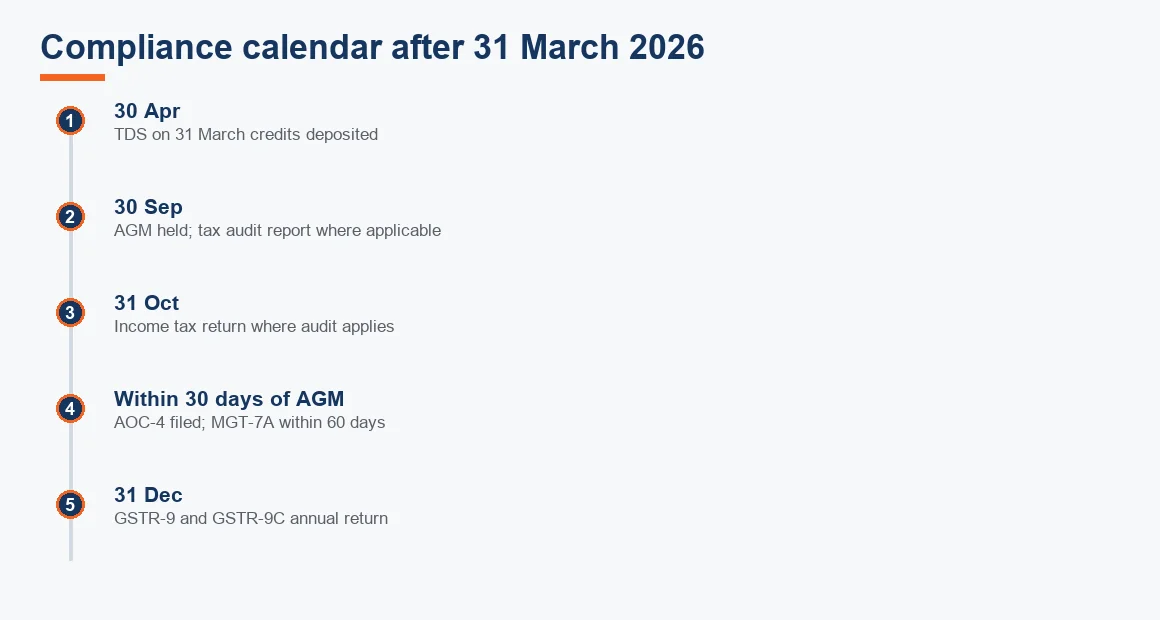
The annual general meeting is held by 30 September, AOC-4 is filed within 30 days of it and MGT-7A within 60 days. Where a tax audit under Section 44AB applies, the report is due by 30 September and the return by 31 October; otherwise the return is due by 31 July. The GST annual return in GSTR-9 and GSTR-9C is due by 31 December. Advance tax paid and TDS credited during the year should already reconcile to the AIS on the income tax portal before the return is filed.
Worked example: computing the year-end current tax provision
A domestic company with turnover under 400 crore (so the 25 per cent rate applies) needs to book its tax provision at year end. The figures below are illustrative.
| Line | Amount (INR) |
|---|---|
| Profit before tax per books | 40,00,000 |
| Add: disallowed expenses (donations, late TDS items) | 2,00,000 |
| Taxable income | 42,00,000 |
| Income tax at 25 per cent | 10,50,000 |
| Add: health and education cess at 4 per cent | 42,000 |
| Total tax liability | 10,92,000 |
| Less: advance tax paid | (8,00,000) |
| Less: TDS credit per Form 26AS | (1,20,000) |
| Provision for tax to book on 31 March | 1,72,000 |
The 1,72,000 is credited to a provision for tax account and settled as self-assessment tax before the return is filed. Surcharge is nil here because taxable income is below one crore. A business handing this off should send commercial work to a Year-End Closing & Finalisation service rather than attempt an audit-ready close under time pressure; where the delay is a bookkeeping backlog, Backlog Bookkeeping / Catch-Up comes first, and open party ledgers are cleaned up through Accounts Payable Outsourcing and Accounts Receivable Outsourcing.
Key takeaways
- Run the checklist in order: reconcile, then adjust, then close, then schedule.
- The Indian year always ends 31 March; every deadline that follows is anchored to that date.
- A 31 March provision for audit fees, commission or contractor bills attracts TDS, payable by 30 April.
- Only temporary accounts are closed to the profit and loss account; permanent accounts carry forward.
- Compute current tax after advance tax and TDS credit, and reconcile the credit to Form 26AS and the AIS.
Decision guide