In this guide
Adjusting entries are the journal entries you pass at the end of a reporting period, after the trial balance is ready but before the final accounts are drawn up, so that income and expenses land in the period they actually relate to rather than the period the cash moved. This guide sets out the rule, the main types, the order in which to pass them and a worked example, written for Indian business owners closing their books for the year ended 31 March.
What are adjustment entries in final accounts?
An adjustment entry corrects the trial balance for transactions that the routine day-to-day entries have not yet captured. The cash book records money in and money out, but a March electricity bill received in April, or an annual insurance premium that covers part of next year, is not fully reflected by cash movements alone. Adjustment entries bridge that gap. They are passed in the journal proper on the last day of the period and posted to the ledger, so the trial balance you finally work from shows the true position. If you are still catching up on months of unposted vouchers, sort that first through Backlog Bookkeeping / Catch-Up before you attempt any adjustments, because you cannot adjust a ledger that is incomplete.
Why are adjusting entries necessary for preparing final accounts?
Indian companies must keep books on the accrual basis and the double entry system. Section 128 of the Companies Act, 2013 makes this a statutory requirement, so omitting adjustments does not merely understate profit, it makes the accounts non-compliant. The accrual basis says income is recognised when earned and expense when incurred, regardless of when cash changes hands, which is the whole point of accrual accounting. Skipping adjustments distorts the profit figure that feeds the tax computation, so the error carries straight into your return. You can read the statutory text on the Ministry of Corporate Affairs portal. For the wider closing routine that surrounds this step, see What Is Finalisation of Accounts? The Steps Explained.
What are the three rules of adjusting entries?
Three simple rules keep adjusting entries honest, and they hold whether you post in Tally, Zoho Books or a spreadsheet.
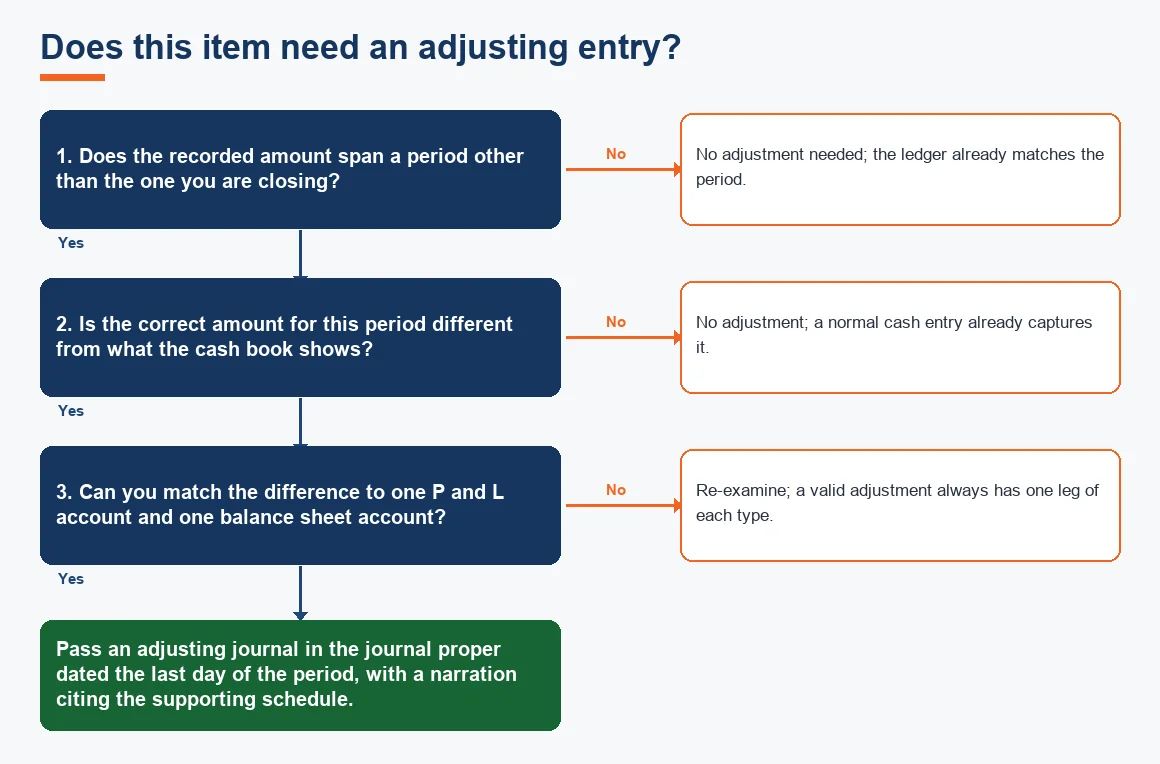
- One P and L account, one balance sheet account. Every adjusting entry touches exactly one item that belongs in the profit and loss account and one that belongs in the balance sheet. It never adjusts two revenue accounts or two asset accounts at once.
- No cash moves. Adjusting entries pass through the general ledger via the journal proper, never the cash book, because the cash for these items either has not arrived or already left in an earlier period.
- Match to the period, not the invoice date. The test is which period the benefit or obligation belongs to, not when the paperwork happens to be dated.
What are the 4 types, 5 adjustment entries and beyond?
Textbooks usually start with four types built around timing: accruals and prepayments on the expense side, and accrued and unearned income on the revenue side. In practice most Indian firms work with five, adding depreciation, and then a sixth and seventh for the provision for doubtful debts and closing stock. The table below groups them by what they correct.
| Adjustment | What it corrects | Debit | Credit |
|---|---|---|---|
| Accrued expense | Expense incurred, not yet billed or paid | Expense (P and L) | Outstanding liability (BS) |
| Accrued income | Income earned, not yet received or invoiced | Accrued income (BS) | Income (P and L) |
| Prepaid expense | Payment made for a future period | Prepaid asset (BS) | Expense (P and L) |
| Income received in advance | Cash received before the service is delivered | Income (P and L) | Unearned income (BS) |
| Depreciation | Wear on fixed assets over their useful life | Depreciation (P and L) | Accumulated depreciation (BS) |
| Provision for doubtful debts | Debtors unlikely to pay | Provision expense (P and L) | Provision (BS) |
| Closing stock | Unsold inventory under a periodic system | Closing stock (BS) | Trading account (P and L) |
Notice that each row obeys the first rule: one profit and loss leg and one balance sheet leg. Depreciation and the doubtful-debts provision are estimates rather than transactions, which is why they need a documented basis. The depreciation charge in particular should follow the useful lives in Schedule II of the Companies Act.
What is the journal entry for adjusting entries, and which accounts require one?
Any account where the recorded amount does not yet match the period is a candidate. The common ones are rent, electricity, salaries, professional fees, interest, insurance, subscriptions, commission income and fixed assets. As a quick test, ask whether the ledger balance would look different if you split it strictly by the 31 March cut-off. If yes, it needs an adjustment. Accrued items create an accrued liability; prepaid items create a prepaid asset that you later release through prepaid expense amortization. Where accruals sit on the purchase and vendor side, tidy them alongside Accounts Payable Outsourcing; where they sit on the customer side, alongside Accounts Receivable Outsourcing.
How to prepare final accounts with adjustments, step by step
The order matters, because a late accrual can force you to re-open a ledger the auditor has already tested.
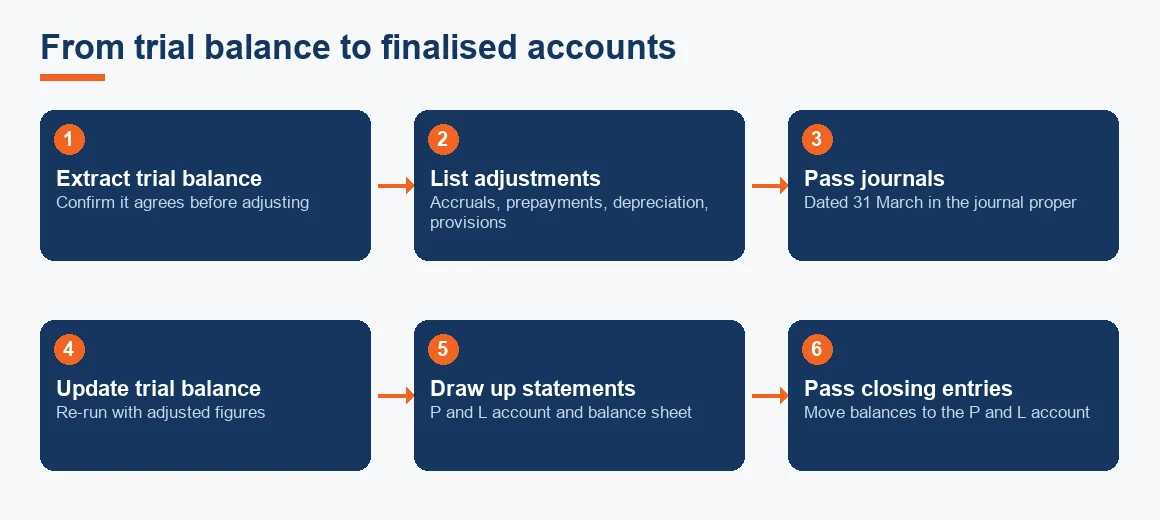
- Extract the trial balance. Confirm it agrees before touching anything, so any later imbalance is clearly your adjustment, not a pre-existing error.
- List the adjustments. Build a schedule of every accrual, prepayment, depreciation line and provision, each with a supporting document reference.
- Pass the journals. Post each entry in the journal proper dated 31 March, following the debit and credit legs in the table above.
- Update the trial balance. Re-run it so the adjusted figures flow into the statements.
- Draw up the statements. Prepare the profit and loss account and the balance sheet from the adjusted balances.
- Pass closing entries. Move the revenue and expense balances to the profit and loss account, a separate step covered in Closing Entries in Accounting: How and Why.
For a fuller list of what to reconcile before you reach step two, work through the Year-End Closing Checklist for Indian Businesses. Businesses that would rather hand the whole close over can route it through Year-End Closing & Finalisation.
Worked example: four adjustments at 31 March
Assume a small services company with a trial balance already agreed. It has four adjustments to pass before finalisation. The figures below are illustrative and each entry follows the one-P-and-L, one-balance-sheet rule.
| Adjustment and basis | Account debited | Account credited | Amount (INR) |
|---|---|---|---|
| March electricity bill received 8 April | Electricity expense | Outstanding expenses | 18,000 |
| Insurance ₹48,000 paid 1 Oct for 12 months; 6 months prepaid | Prepaid insurance | Insurance expense | 24,000 |
| Depreciation on equipment (₹5,00,000 over useful life, straight line) | Depreciation | Accumulated depreciation | 75,000 |
| Provision at 2% on debtors of ₹8,00,000 | Provision for doubtful debts | Provision for doubtful debts (BS) | 16,000 |
The net effect on the profit and loss account is a reduction in profit of ₹85,000, being ₹18,000 plus ₹75,000 plus ₹16,000 as charges, less ₹24,000 released back from insurance. The balance sheet gains a prepaid asset of ₹24,000 and an outstanding liability of ₹18,000, while accumulated depreciation and the debtors provision rise by ₹75,000 and ₹16,000 respectively. Only after these post does the profit figure that feeds your tax computation become reliable.
Which adjusting entries are reversed next year?
Accrual entries are reversed on 1 April so the real invoice or receipt can be booked in full without double counting. That covers accrued expenses, accrued income and income received in advance. Depreciation, the provision for doubtful debts and closing stock are never reversed, because they carry forward as accumulated balances. A reversal journal must carry the same narration and audit trail as the original entry it undoes. Guidance on the accounting standards that govern these estimates is published by the Institute of Chartered Accountants of India.
A note on MSME dues
When you accrue expenses to suppliers registered as micro or small enterprises, keep an eye on the Section 43B(h) MSME Clock. Amounts unpaid beyond the agreed period, capped at 45 days, are disallowed for tax until actually paid, so the way you accrue and disclose these dues affects the year-end computation, not just presentation. Once the profit line settles, reading it correctly through metrics such as EBITDA, PBIT and PBT is the natural next step.
Key terms
- Accrual Accounting: recognising income and expense in the period they relate to, not when cash moves.
- Journal Entry: the debit-and-credit record passed in the journal proper for each adjustment.
- Trial Balance: the list of ledger balances you adjust before drawing up the statements.
- Depreciation: the systematic charge for the wear on fixed assets over their useful life.
- Double-Entry Bookkeeping: the system requiring each entry to have equal debit and credit legs.
Two calculators help with the estimate-based adjustments: the Depreciation Calculator for Schedule II charges and the Deferred Tax Calculator for the book-versus-tax difference that depreciation creates.
Key takeaways
- Pass adjusting entries after the trial balance but before the final accounts, on the last day of the period.
- Each entry touches one profit and loss account and one balance sheet account, and never the cash book.
- The core five are accrued expenses, accrued income, prepaid expenses, income received in advance and depreciation, with provisions and closing stock often added.
- Reverse only the timing accruals on 1 April; leave depreciation, provisions and closing stock to carry forward.
- Section 128 makes the accrual basis mandatory, so skipping adjustments makes the accounts non-compliant and misstates tax.
Decision guide