In this guide
Finalisation of accounts is the year-end process of converting a closed, reconciled trial balance into a signed set of statutory financial statements. In practice it means taking the ledger balances at 31 March, layering in the year-end adjustments (depreciation, provisions, prepaid and accrued items, stock valuation and tax), and then presenting the result as a balance sheet, profit and loss account and notes in the Schedule III format of the Companies Act, 2013. A closed ledger is only the starting point; the finalised accounts are the finished, board-approved and audited output.
What does finalisation of accounts mean?
Finalisation is the bridge between day-to-day bookkeeping and the annual accounts your directors sign and your auditor reports on. Through the year your team records vouchers under double-entry bookkeeping, posts them to the general ledger, and periodically extracts a trial balance. That trial balance proves the debits equal the credits, but it is not yet a true and fair view of the year. Finalisation closes that gap. It recognises costs and incomes that belong to the year but were never invoiced, values assets and stock correctly, computes the tax charge, and reclassifies every balance into the presentation the law prescribes.
The word "final" matters because, once adopted, these accounts become the record filed with the Registrar of Companies and the base for your income tax return. Changing them afterwards is possible but tightly controlled, which is why the discipline of getting the adjustments right the first time is central to the exercise. If your books are behind, that reconciliation work sits upstream: our note on a year-end closing checklist for Indian businesses walks through the sequence, and heavy back-work is better handled as Backlog Bookkeeping / Catch-Up before finalisation begins.
What are the steps for finalisation of accounts?
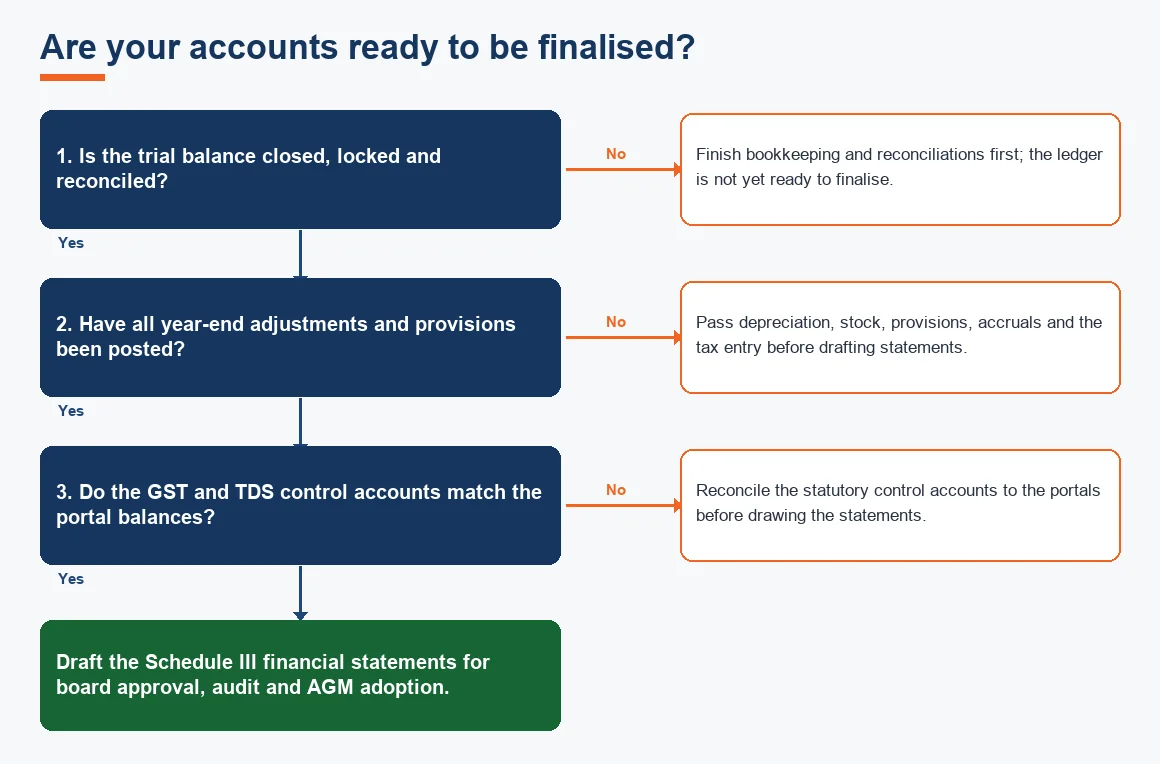
Finalisation follows a repeatable order. Skipping a step tends to surface later as a mismatch the auditor queries, so most Indian finance teams work through the sequence below.
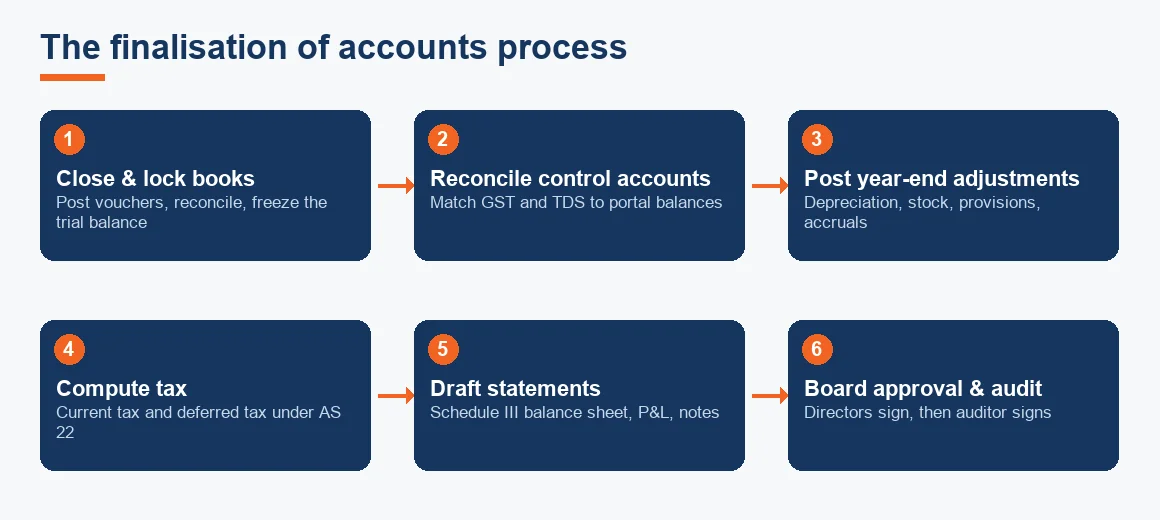
- Close and lock the books. Post every pending voucher, run bank and control-account reconciliations, and freeze the period so the trial balance cannot shift under you.
- Reconcile statutory control accounts. Match GST payable and input credit to the portal, and TDS payable to the challans and returns, before anything flows into the statements.
- Pass year-end adjustment entries. Depreciation, closing stock, provisions, prepaid and accrued items and interest accruals are all recognised here. Our guide to adjusting entries before finalising accounts covers each one.
- Compute current and deferred tax. Work out the tax charge and the deferred tax movement under AS 22, then book the provision.
- Draft the financial statements. Prepare the Schedule III balance sheet, the profit and loss statement, the cash flow statement and the notes to accounts.
- Board approval and audit. The board approves the statements, the directors sign, and only then does the auditor sign the audit report.
- Adopt and file. The accounts are adopted at the annual general meeting and filed with the Registrar of Companies.
The pure ledger-side of steps one and four is what accountants call closing; if that idea is new, closing entries in accounting explains how nominal accounts are zeroed into the profit and loss account each year.
Closing the books versus finalisation of accounts
These two terms are used loosely, but they are not the same thing. Closing the books means posting every voucher and locking the period so the trial balance is fixed. Finalisation takes that locked trial balance and does the accounting judgement work on top: adjustments, provisions, tax and Schedule III presentation. A closed ledger is an input to finalisation, never the finished output. Treating a locked trial balance as "done" is the single most common reason a set of accounts fails audit review.
What are the three types of final accounts?
Traditionally, the final accounts of a business are three statements prepared in sequence. Under the Companies Act, a company merges the first two into a single profit and loss statement and adds a cash flow statement and notes, but the underlying logic is unchanged.
| Final account | What it shows | Key output |
|---|---|---|
| Trading account | Direct trading result: sales less cost of goods sold, including opening and closing stock | Gross profit |
| Profit and loss account | Gross profit less indirect expenses, plus other income, after depreciation, provisions and tax | Net profit for the year |
| Balance sheet | Assets, liabilities and equity as at the year-end date | Financial position at 31 March |
If you want to understand the profit lines that sit between gross profit and the bottom line, our explainer on EBITDA, PBIT and PBT reads the year-end profit statement layer by layer.
What are the stages of preparing final accounts?
Within the adjustment step, a standard set of entries recurs at almost every Indian year-end. Depreciation is charged on fixed assets over their useful lives under Schedule II of the Companies Act, and our depreciation calculator handles the Schedule II and AS 10 workings. Closing stock is valued at the lower of cost and net realisable value under AS 2. A provision for doubtful debts is raised against the receivables ledger, and accrued expenses (audit fees, electricity, interest) and prepaid expenses (insurance, subscriptions) are recognised so each cost lands in the correct year.
Two entries carry the most tax weight. Current tax is the charge on the year's taxable profit, and deferred tax under AS 22 captures the timing differences between book and tax depreciation and other items; the deferred tax calculator works out the asset or liability. Gratuity and leave encashment are provided for on an actuarial basis. Only once these are posted does the profit shown in the accounts reflect the true result for the year. Where these adjustments touch payables or receivables ledgers, Accounts Payable Outsourcing and Accounts Receivable Outsourcing keep those sub-ledgers clean enough to close quickly.
Worked example: from trial balance to net profit
The schedule below shows how a provisional profit on a locked trial balance becomes the final profit after tax once year-end adjustments are posted. Figures are illustrative and rounded; the tax rate used is 25.168 per cent, the effective rate for a domestic company under Section 115BAA (22 per cent plus 10 per cent surcharge plus 4 per cent cess).
| Line | Adjustment | Amount (INR) |
|---|---|---|
| Provisional profit per trial balance | Draft, before year-end entries | 50,00,000 |
| Less: Depreciation (Schedule II) | Not yet charged | (6,00,000) |
| Less: Provision for doubtful debts | Against aged receivables | (1,50,000) |
| Add: Prepaid insurance | Expense belonging to next year | 40,000 |
| Less: Accrued audit fee | Cost of this year, not yet billed | (60,000) |
| Less: Interest accrued on loan | Cost of this year, not yet due | (90,000) |
| Profit before tax | After all adjustments | 41,40,000 |
| Less: Current tax at 25.168% | 41,40,000 x 25.168% | (10,41,955) |
| Net profit after tax | Carried to reserves | 30,98,045 |
The draft profit of 50,00,000 fell to a net profit of 30,98,045 once the accounts recognised costs the trial balance had not yet captured. That gap is exactly why a locked trial balance is not the same as finalised accounts, and why the tax charge should be computed on the adjusted figure and never on the draft.
Who signs the accounts, and by when?
Once the statements are drafted, the board approves them under Section 134 of the Companies Act and at least two directors sign, one being the managing director where one is appointed, along with the chief executive officer, chief financial officer and company secretary where those posts exist. The auditor signs the audit report only after that, carrying the same or a later date. The statutory calendar for a private limited company with a 31 March year end then runs as follows.
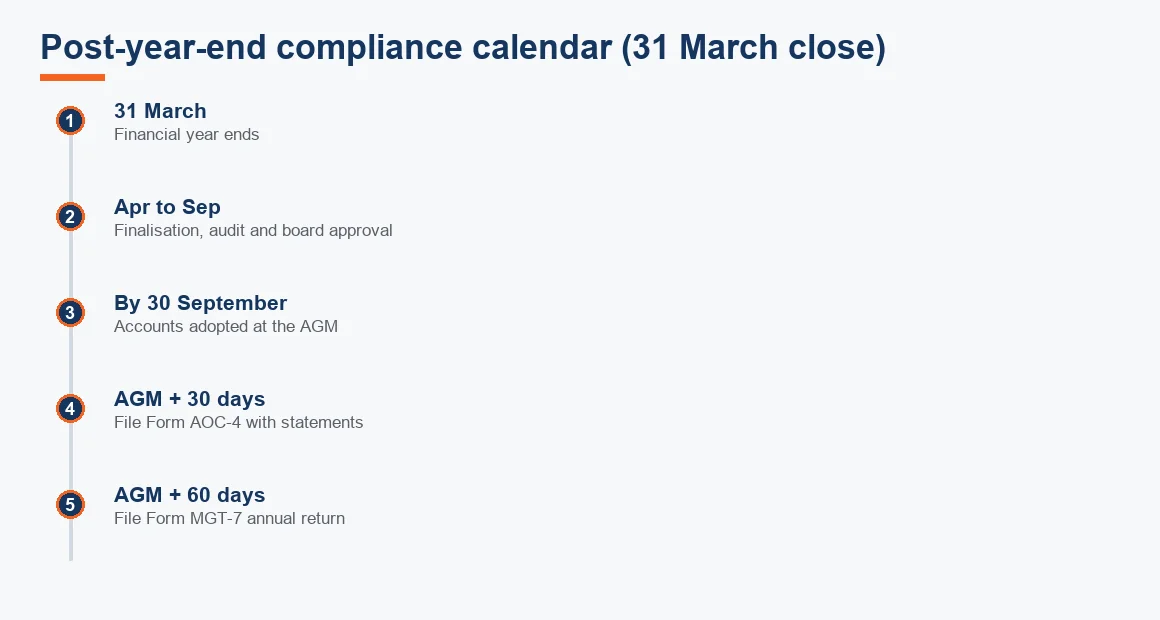
The accounts must be adopted at an annual general meeting within six months of the year end, so by 30 September. Form AOC-4 with the financial statements follows within 30 days of that meeting, and Form MGT-7 within 60 days. A one person company files AOC-4 within 180 days of the year end and need not hold an annual general meeting. These dates are set by the Ministry of Corporate Affairs; the current forms and timelines are published on the MCA portal. Missing them attracts a per-day additional fee, so the audit and adoption timeline is usually planned backwards from 30 September. Where directors want a single provider to own the year-end close, audit readiness and filing, that is the remit of Year-End Closing & Finalisation.
What if an error is found after the accounts are filed?
Mistakes surface, and the law provides routes to fix them rather than leaving a wrong record on file. Section 131 of the Companies Act allows a voluntary revision of the financial statements or the board's report for any of the three preceding financial years, but only with National Company Law Tribunal approval and only once for a given year. On the tax side, a revised return under Section 139(5) can be filed up to 31 December of the assessment year, and the process runs through the Income Tax Department portal. Smaller items that do not distort the view are usually taken through the current year as prior period items and disclosed in the notes rather than reopening a signed set of accounts.
Key terms
- Trial Balance: a list of all ledger balances proving debits equal credits; the starting point for finalisation.
- Schedule III Balance Sheet: the prescribed Companies Act format for presenting a company's assets, liabilities and equity.
- Notes to Accounts: the disclosures and accounting-policy explanations that accompany the primary statements.
- Closing Journal Entries: entries that transfer nominal account balances into the profit and loss account at year end.
- Prior-Period Adjustments: corrections of prior-year errors recognised and disclosed in the current period.
Key takeaways
- Finalisation converts a locked trial balance into signed, audited, Schedule III statements; closing the books is only the first input.
- Work the steps in order: close and reconcile, adjust, compute tax, draft statements, obtain board approval and audit, then adopt and file.
- The recurring year-end adjustments are depreciation, stock valuation, provisions, prepaid and accrued items, and current and deferred tax.
- A private limited company adopts accounts by 30 September, files AOC-4 within 30 days of the AGM and MGT-7 within 60 days.
- Post-filing errors are fixed through Section 131 revision, a Section 139(5) revised return, or prior period items, depending on materiality.
Decision guide