In this guide
To pass closing entries in accounting, you transfer the closing balance of every income and expense ledger into the profit and loss account through a journal, so that each of those ledgers ends the year at nil and the resulting profit or loss moves to capital or reserves. In India these entries are dated 31 March, and they are recorded only after the adjustment entries for depreciation, accruals and provisions are in place. This guide explains how to pass a closing entry, the four types, the correct order, and how software handles the work. If you want the wider month-by-month picture rather than the journal mechanics, our guide to the finalisation of accounts sets out the full sequence.
Why do we prepare closing entries?
The purpose of closing entries is to reset the nominal accounts to zero so that the next year starts clean, and to move the year's profit or loss to where it belongs on the balance sheet. Income and expense ledgers measure performance for one period only. If a sales figure of one year were carried into the next, the following year's profit would be overstated. Closing entries draw a line under the period.
They also create the link between the profit and loss statement and the balance sheet. When the net profit is transferred to capital (in a proprietorship or partnership) or to reserves and surplus (in a company), the two statements tie together. This is the same double-entry logic that runs through the books all year, applied one last time at the year end. For a refresher on how debits and credits balance, see double-entry bookkeeping.
What are the four types of closing entries?
Textbooks describe four closing entries, built around an intermediate account variously called the income summary, the trading and profit and loss account, or simply the profit and loss account. In Indian practice the profit and loss account plays this role. The four are:
- Close the revenue accounts. Debit each income ledger (sales, interest received, other income) and credit the profit and loss account.
- Close the expense accounts. Debit the profit and loss account and credit each expense ledger (purchases, salaries, rent, depreciation and the rest).
- Close the profit and loss balance. Transfer the net profit to the capital account, or to reserves and surplus in a company. A loss is transferred the other way.
- Close drawings or dividends. Debit the capital account and credit the drawings account (or, in a company, transfer the declared dividend out of reserves).
If someone asks what the two closing entries are, they usually mean the first pair: closing all revenues in one entry and all expenses in another. The four-way split simply carries the logic through to capital.
What are the four steps in the closing process?
The steps in closing entries follow the same order as the four types above, and it helps to see them as a flow rather than isolated journals.
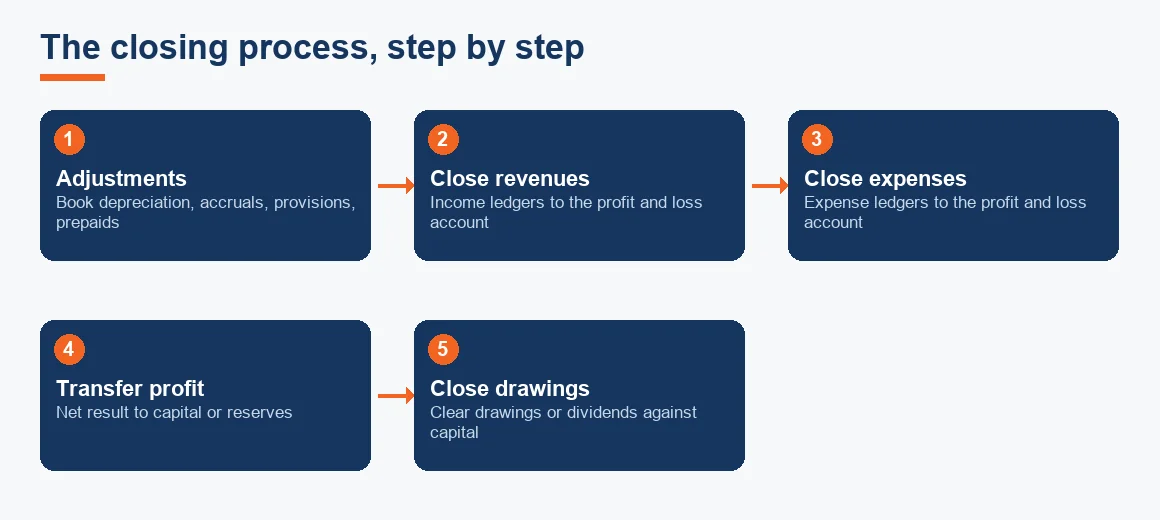
- Finish the adjustments first. Book depreciation, outstanding expenses, prepaid amounts, accrued income and any provisions. Our note on adjusting entries before finalisation covers this stage in detail.
- Close revenues to the profit and loss account. Every income ledger goes to nil.
- Close expenses to the profit and loss account. Every expense ledger goes to nil, and the profit and loss account now shows the net figure.
- Transfer the net result and close drawings. Move the profit or loss to capital or reserves, then clear drawings against capital.
Each entry is a journal entry in the journal proper, then posted to the general ledger. They never sit in a day book such as the sales register, because no external transaction has occurred.
What is the correct order for closing accounts?
The order matters because each step depends on the one before it. Revenues are closed first, then expenses, so that the profit and loss account holds a single net balance. Only then can that balance be transferred to capital, and drawings are cleared last. Reversing the order, for example transferring to capital before expenses are closed, produces a half-finished profit and loss account and a capital figure that does not agree with the balance sheet.
Opening entry and closing entry: what is the difference?
An opening entry and a closing entry sit at opposite ends of the year and do opposite jobs. The closing entry, on 31 March, clears the nominal accounts into the profit and loss account. The opening entry, on 1 April, brings forward the asset, liability and capital balances so the new books start where the old ones stopped. The opening entry must agree rupee for rupee with the previous closing balance sheet.
| Feature | Closing entry | Opening entry |
|---|---|---|
| Date | 31 March | 1 April |
| Accounts affected | Nominal only (incomes, expenses) | Real and personal (assets, liabilities, capital) |
| Purpose | Reset ledgers to nil, find profit | Carry balances into the new year |
| Balance left behind | Nil in every nominal ledger | Same balances as last year's balance sheet |
| Recorded in | Journal proper | Journal proper |
Note that the profit and loss balance itself moves to reserves and surplus, so retained earnings changes at the year end but is never reduced to zero. That is the one nominal-account-adjacent figure that lives on.
Worked example: closing entries for a small trading firm
Take Sunrise Traders, a proprietorship with the year ended 31 March 2026. After all adjustments, the trial balance shows sales of INR 40,00,000, other income of INR 60,000, and expenses of purchases INR 24,00,000, salaries INR 6,00,000, rent INR 3,00,000, depreciation INR 1,40,000 and other expenses INR 2,20,000. The three closing journals run as follows.
| Step | Journal entry | Debit (INR) | Credit (INR) |
|---|---|---|---|
| 1. Close revenue | Sales A/c Dr; Other Income A/c Dr; To Profit & Loss A/c | 40,60,000 | 40,60,000 |
| 2. Close expenses | Profit & Loss A/c Dr; To Purchases, Salaries, Rent, Depreciation, Other Expenses | 36,60,000 | 36,60,000 |
| 3. Transfer net profit | Profit & Loss A/c Dr; To Capital A/c | 4,00,000 | 4,00,000 |
Total income of INR 40,60,000 less total expenses of INR 36,60,000 gives a net profit of INR 4,00,000, which is added to the proprietor's capital. After these three journals, every income and expense ledger reads nil, and the profit has landed on the balance sheet. The depreciation figure of INR 1,40,000 would itself have come from an earlier adjustment; if you want to check a Schedule II working, our depreciation calculator handles the arithmetic. Reading the resulting profit line correctly is its own skill, which our note on EBITDA, PBIT and PBT unpacks.
Does accounting software pass closing entries automatically?
Largely, yes. Tally Prime, Zoho Books and Odoo compute the profit and loss balance and carry it to reserves the moment you open a new financial year, so the nominal accounts need no manual closing journal. What software will not do for you is the judgement work: depreciation, provisions, prepaid expenses and accruals still need a human to book them before the year is shut. Under Rule 3(1) of the Companies (Accounts) Rules, 2014, notified by the Ministry of Corporate Affairs, the audit trail must stay switched on for those journals, so do not disable it to tidy the ledger.
If your books are months behind and the nominal accounts are a mess before you even reach the closing stage, that is a backlog bookkeeping and catch-up problem, not a closing-entry problem. Clean data first. The same applies where accounts payable and accounts receivable ledgers carry stale open items that distort the expense and income totals you are about to close.
Where closing entries sit in the year-end picture
Closing entries are one link in a chain. They come after the trial balance and adjustments, and before the financial statements are signed off. Getting the mechanics right is straightforward once the data is clean; the harder part is the discipline around it, which is why many businesses treat the whole sequence as a single managed exercise. A structured year-end closing checklist keeps the order intact, and where the year end is genuinely complex, a year-end closing and finalisation engagement takes the journals, the adjustments and the statement build off your plate entirely.
Whichever route you take, the accounting standards that govern the figures being closed are set by the Institute of Chartered Accountants of India, and the 31 March cut-off itself follows the financial year defined for tax purposes by the Income Tax Department.
Key terms
- Closing Journal Entries: the year-end journals that zero the nominal ledgers into the profit and loss account.
- Journal Entry: a dated debit-and-credit record posted to the ledger.
- Trial Balance: the list of all ledger balances that must agree before closing begins.
- General Ledger: the master book to which closing entries are posted.
- Double-Entry Bookkeeping: the equal-and-opposite debit and credit rule that closing entries follow.
Key takeaways
- Closing entries transfer income and expense balances to the profit and loss account on 31 March, leaving those ledgers at nil.
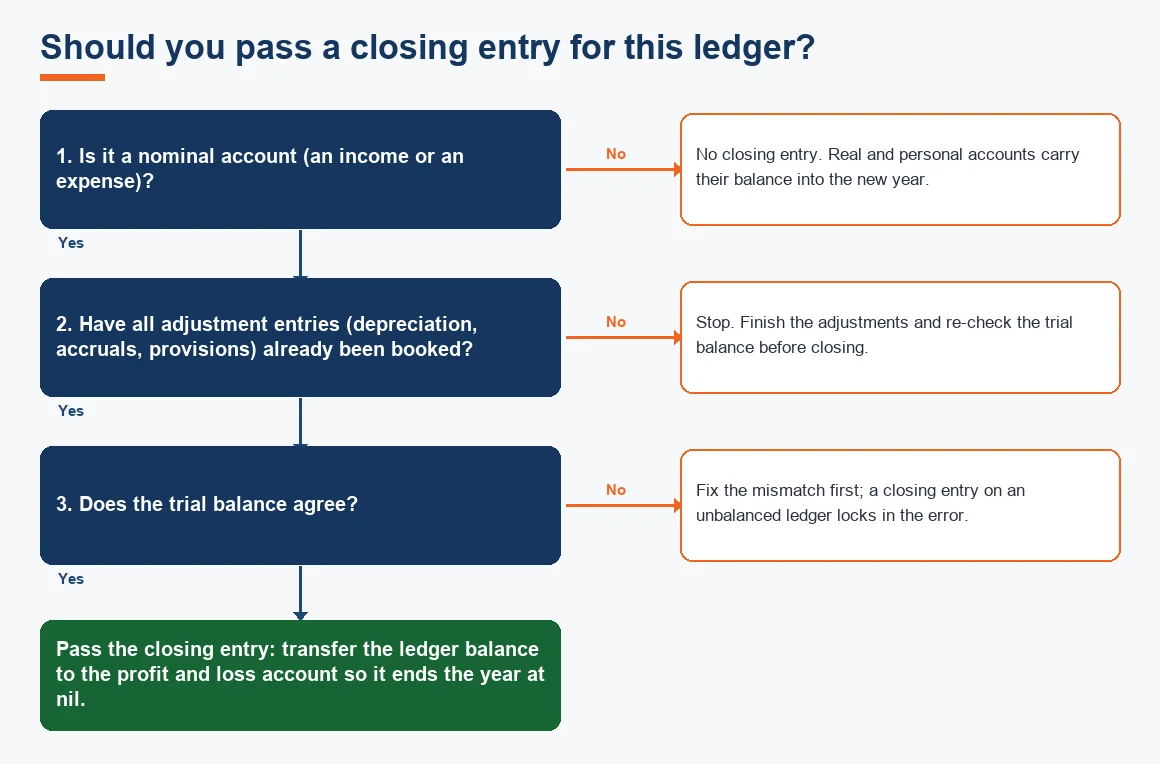
- Only nominal accounts close; real and personal accounts carry their balances forward through the opening entry on 1 April.
- The correct order is revenues, then expenses, then the net result to capital or reserves, then drawings or dividends.
- Always finish adjustments and confirm the trial balance before passing any closing journal.
- Software carries profit to reserves automatically, but adjustment journals and the audit trail still need human attention.
Decision guide