In this guide
Most Indian startups should bring in an accountant the moment they incorporate, not the day the books turn into a mess. The practical rule is simple: accounting software records what happened, but a chartered accountant is needed for anything that carries a statutory deadline or a judgement call. For a private limited company that trigger arrives on day one, because the first auditor must be appointed within 30 days of incorporation. For a sole proprietor it can wait until volume, GST or a funding round forces the issue. This guide sets out the volume and funding thresholds at which a CA stops being optional, and where software on its own is genuinely enough.
When does a startup need an accountant?
There is no single revenue figure that flips the switch, but three triggers do the work in practice: your legal structure, your monthly transaction volume, and whether you are raising money. A private limited company is regulated from incorporation, so it needs a CA immediately for the statutory audit and Registrar of Companies (ROC) filings. A sole proprietor or a small LLP can lean on software for longer. Across structures, once you cross roughly 50 to 75 vouchers a month, or you register for GST, the volume of returns and reconciliations quickly outgrows a founder doing books at midnight.
For the detail of what actually has to be in place in the first twelve months, see our companion guide on what accounting a startup actually needs in year one. This article stays on the narrower question of timing: at what point the work is worth paying for.
Accountant vs accounting software: what each one can and cannot do
The debate is usually framed as accountant versus accounting software, but they are not substitutes. Modern tools like Zoho Books or Xero are excellent at capturing data, running bank feeds and generating a double-entry set of books. What they cannot do is take responsibility for a position under the Companies Act or the Income-tax Act, sign an audit, or tell you whether a payout is a dividend or salary. The table below separates the two cleanly.
| Task | Accounting software alone | Chartered accountant |
|---|---|---|
| Recording invoices and expenses | Yes, this is its core strength | Not needed for data entry |
| Bank feeds and reconciliation | Automated, needs a human to review exceptions | Reviews and signs off month-end |
| GST and TDS returns | Prepares drafts, cannot judge classification | Confirms rates, files and defends |
| Statutory audit and ROC forms | No | Mandatory for a company |
| Tax planning and structuring | No | Yes, the core value |
| Funding diligence and MIS | Exports raw reports | Builds investor-ready books |
Signs you need an accountant
If you are asking whether you have reached that point, the following signs usually mean the answer is yes. Any one of them on its own is a nudge; two or more together mean you are already overdue.
- You are spending more than a few hours a week on data entry instead of the business.
- You have registered for GST and are filing GSTR-1 and GSTR-3B yourself.
- You have started deducting TDS on rent, professional fees or contractor payments.
- Your monthly vouchers have crossed roughly 75 and reconciliations are slipping.
- An investor, bank or buyer has asked for financial statements you cannot quickly produce.
- You are unsure whether you are on cash or accrual accounting, or your books mix the two.
What an accountant does for a startup
For a small business the value of an accountant is not the typing, it is everything that sits around it. A good outsourced CA keeps the ledgers reconciled, files GST and TDS on time, prepares the statutory financials, runs the audit, and flags the tax reliefs you would otherwise miss, such as the Section 80-IAC tax holiday for DPIIT-recognised startups. Once you are funded, the same books become the raw material investors examine, which is a discipline covered in our note on due-diligence-ready books. For sector-specific needs, SaaS founders often want revenue recognition handled properly through SaaS accounting support, product and services firms lean on IT and software company accounting, and marketplace sellers need the settlement and TCS work that sits inside e-commerce accounting.
Do small businesses need an accountant, or can they survive without one?
A business can survive for a while without an accountant, but it cannot survive without accounting. Those are different things. If you are a solo consultant billing a handful of clients, no GST, no employees, then software plus your own effort plus a CA once a year for the income-tax return is a defensible setup. The moment you incorporate, register for GST, take on staff or raise capital, the compliance calendar becomes non-negotiable and the cost of getting it wrong (interest, penalties, a rejected diligence) dwarfs the fee. The honest test is whether a missed deadline would cost you more than the accountant would.
Software, outsourced or in-house: a step-by-step way to decide
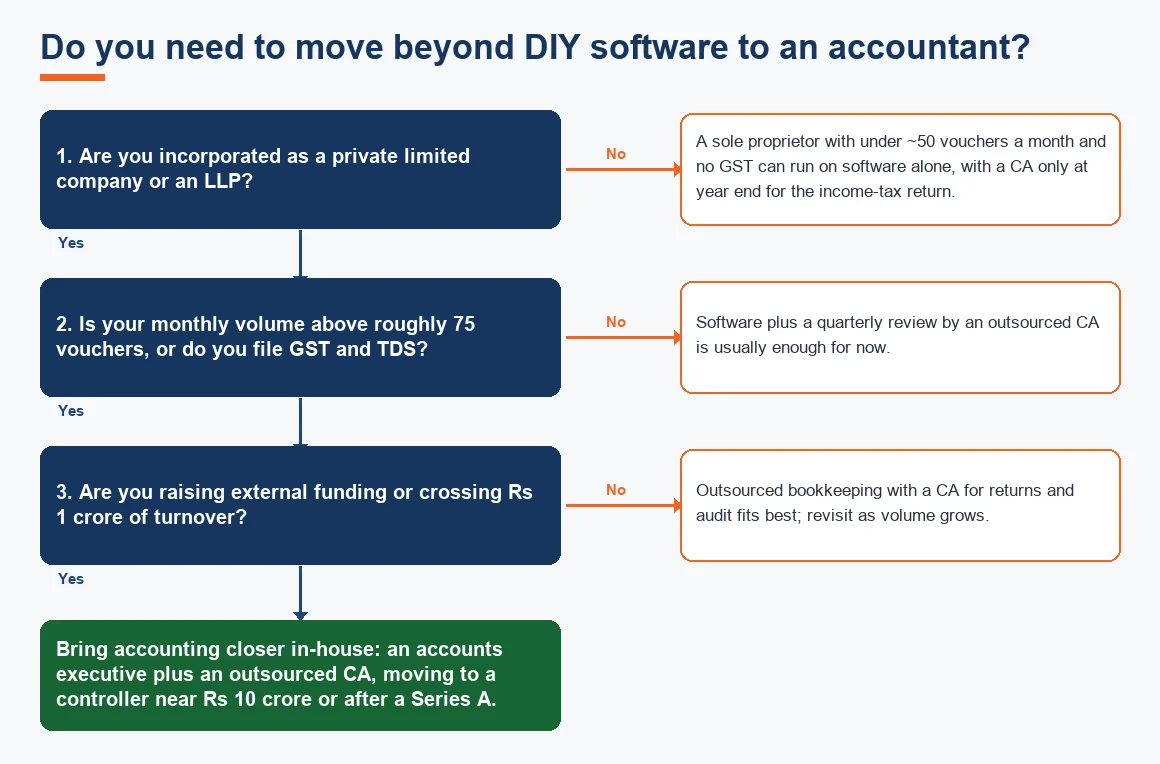
Work through these steps in order. Each one narrows the choice, so you stop at the first model that fits.
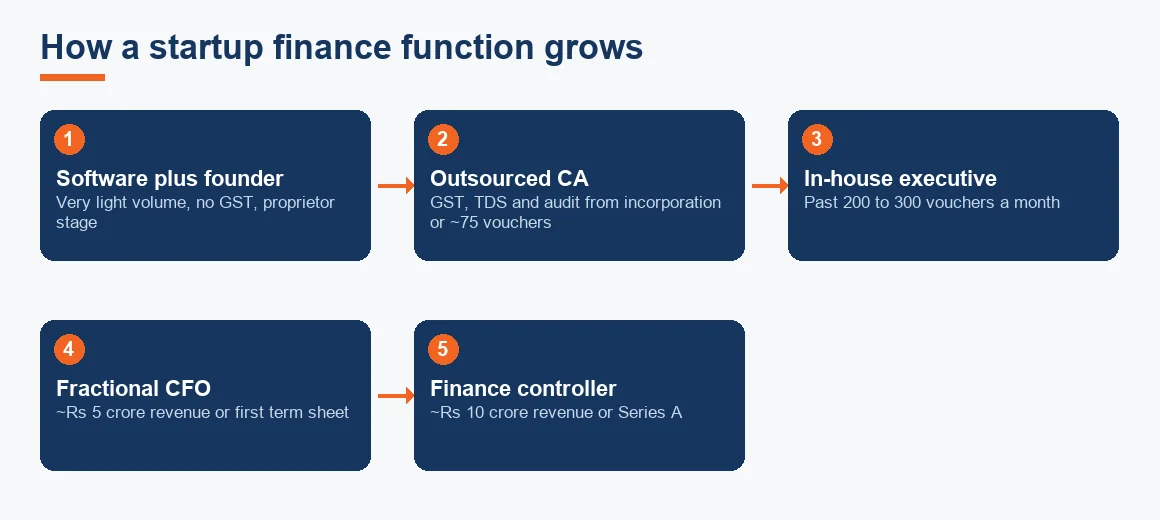
- Check your structure. A private limited company needs a CA from day one for audit and ROC. An LLP needs an audit only if turnover exceeds Rs 40 lakh or contribution exceeds Rs 25 lakh. A proprietor has the most freedom.
- Count your monthly vouchers. Under about 75 and simple, software plus a quarterly CA review is enough. Between 75 and 250, outsource the bookkeeping and compliance.
- Test the volume for in-house. Past roughly 200 to 300 vouchers a month, a salaried accounts executive plus an outsourced CA for returns and audit usually costs less per transaction than outsourcing everything.
- Add the funding lens. If you are raising an institutional round or crossing Rs 5 crore of revenue, layer in a fractional CFO for the model, MIS and cap table.
- Plan the controller. Near Rs 10 crore of revenue or after a Series A, a full-time finance controller becomes worthwhile.
Worked example: which model is cheapest at 250 vouchers a month?
Assume an early-stage private limited company processing about 250 vouchers a month, GST-registered, deducting TDS, and needing a statutory audit. The comparison below sets software-only (founder does the work) against fully outsourced and against an in-house accounts executive. All fees are indicative and Exl GST.
| Model | Monthly cost (indicative, Exl GST) | Annual cost | What it does not cover |
|---|---|---|---|
| Software only, founder runs it | Rs 2,000 (subscription) | Rs 24,000 | No sign-off, no audit, heavy founder time, high error risk |
| Outsourced CA (books plus compliance) | Rs 20,000 | Rs 2,40,000 | Scales with volume; good up to ~250 vouchers |
| In-house executive plus CA for audit | Rs 42,000 (Rs 35,000 salary plus Rs 2,000 software plus Rs 5,000 CA) | Rs 5,04,000 | Fixed cost regardless of a light month; adds leave and attrition risk |
At 250 vouchers the outsourced model is the clear winner: it is a tenth of software-only in real terms once you price the founder's time, and less than half the in-house cost while still bringing GST, TDS and audit expertise one junior hire cannot. The in-house line only overtakes outsourcing when volume roughly doubles, because the salary is the same whether the workload is light or heavy. Software-only looks cheapest on paper but carries the highest hidden cost in penalties and lost founder hours.
Do I need an accountant if I already have Xero?
Having Xero, Zoho Books or Odoo does not remove the need for an accountant; it changes what you pay the accountant to do. The tool automates bank reconciliation and produces the ledgers, so the CA spends less time on data and more on review, returns and tax. If anything, good software makes an accountant cheaper and faster because the raw material is clean. It is the founders on spreadsheets who pay the most, because someone has to rebuild the books before any real work begins. Keep an eye on your cash runway and, if you are watching burn closely, our guide on reading burn rate and runway from your MIS pairs well with a monthly close.
What to look for when getting an accountant
When you decide it is time, judge a firm on fit rather than the lowest quote. Ask whether they work with companies at your stage and in your sector, whether they file GST, TDS and ROC in-house rather than sub-contracting, how they handle a funding diligence, and what their month-end close and reporting cadence looks like. A firm that hands you a reconciled set of books by the tenth of each month is worth more than one that is cheaper but always three months behind. If a fixed-fee, stage-appropriate arrangement suits you, our startup accounting services for India is built for exactly this decision. For the compliance-heavy items you can also sanity-check figures yourself with tools such as the depreciation calculator and the deferred tax calculator before your review call.
Key terms
- Accrual Accounting: recording income and expenses when earned or incurred, not when cash moves, which is what companies must use.
- Cash Accounting: recording only when money is received or paid, simpler but allowed only in limited cases.
- Bank Reconciliation: matching your ledger against the bank statement so both agree at period end.
- Monthly Burn Rate: the net cash a startup consumes each month, the number runway is built from.
Key takeaways
- Structure decides the earliest trigger: a private limited company needs a CA from incorporation, a proprietor can wait.
- Volume decides the model: software for very light use, outsourcing up to ~250 vouchers, in-house beyond that.
- Funding decides the seniority: a fractional CFO from about Rs 5 crore or the first term sheet, a controller near Rs 10 crore or Series A.
- Software and an accountant are partners, not substitutes; the tool records, the CA judges and signs.
- Every private limited company faces a statutory audit and ROC filings from year one, whatever its revenue.
The regulatory anchors behind this article are worth reading first-hand: company incorporation and ROC forms such as INC-20A, AOC-4 and MGT-7 are governed by the Ministry of Corporate Affairs, tax audit thresholds under Section 44AB sit with the Income Tax Department, and GST return timelines are published by the GST portal. When in doubt on a statutory point, these are the sources of truth, not the software help pages.
Decision guide