In this guide
A financial due diligence checklist for a startup is the ordered set of records an investor's diligence team opens to test whether your reported numbers are real before it releases funds. It normally covers the last three completed financial years plus the current year to date, or the period since incorporation if the company is younger, and it sits alongside monthly MIS, the GST and TDS return history, bank statements, the cap table and board minutes. This guide explains what the team checks, what it most often finds wrong, and how to get your books ready so a round closes on the numbers you agreed rather than a discounted version of them. If you want a firm to manage the year-round books that make diligence painless, that sits with our Startup Accounting Services India team, not with this article.
What is a financial due diligence checklist for a startup?
Think of the checklist as the running order of a review, not a single form. The team works from the top of your financial statements downward, and for each line it asks two questions: is the number supported by a source document, and would it survive if the transaction were unwound. A startup checklist typically groups into revenue and quality of earnings, working capital and cash, statutory compliance, related party transactions, and the cap table. The output is not a pass or fail mark. It is a quantified list of adjustments and risks that the investor carries into the term sheet.
The distinction that trips up first-time founders is that diligence is evidence-led. Saying revenue was ₹4 crore is not enough; the team wants the invoices, the delivery proof, the bank credits and the matching GST returns to agree. Where they do not agree, the gap becomes a finding. Our note on what accounting a startup actually needs in year one covers the habits that keep those four records in step from day one.
What financial documents do investors check before funding?
The document request, often called the data room list, is fairly standard across Indian rounds. Expect to supply:
- Audited financial statements for three completed financial years, plus the current year to date.
- Monthly management information (MIS): profit and loss, balance sheet and a cash flow view.
- The complete GST return history (GSTR-1, GSTR-3B and the annual return) and the TDS return history (Form 26Q, 24Q and Form 26AS).
- Bank statements for every account, with reconciliations to the books.
- The cap table, share allotment records and board and shareholder minutes.
- Major customer and vendor contracts, the rent agreement and any loan or grant sanction letters.
- Payroll registers, ESOP grant records and the employee headcount trend.
A company incorporated in 2024 would supply FY 2024-25, FY 2025-26 and the months since. If you run a subscription or software model, the request extends into deferred revenue schedules and cohort data, which our SaaS Accounting Services (IT & SaaS) and IT & Software Company Accounting Services pages describe in more depth. Marketplace sellers should be ready with settlement reconciliations, which we cover under E-Commerce Accounting Services.
What is included in startup financial due diligence?
Financial due diligence tests the numbers rather than the paperwork around them. The core workstreams are:
Quality of earnings
The team rebuilds your EBITDA by stripping out one-off items, non-cash entries and anything that will not recur after the round. Grant income, a single large project, or founder expenses booked as revenue offsets all get normalised out. The normalised figure, not the reported one, usually drives the multiple.
Working capital and cash burn
Diligence sets a normal level of working capital and checks whether recent months were flattered by delaying vendor payments or pulling in receipts early. Alongside this sits your monthly burn and runway, the same numbers founders should already track from their MIS, as explained in burn rate and runway: how founders should read their MIS.
Statutory and unrecorded liabilities
GST, TDS and ROC positions are checked for gaps that create contingent liabilities: input tax credit claimed but not appearing in GSTR-2B, TDS deducted but not deposited, or annual filings missed. These become indemnities in the agreement.
Related party transactions
Loans to or from founders, rent paid to a director's property, and transactions with sister companies are isolated and tested for arm's length pricing and proper disclosure.
How do investors review a startup's books?
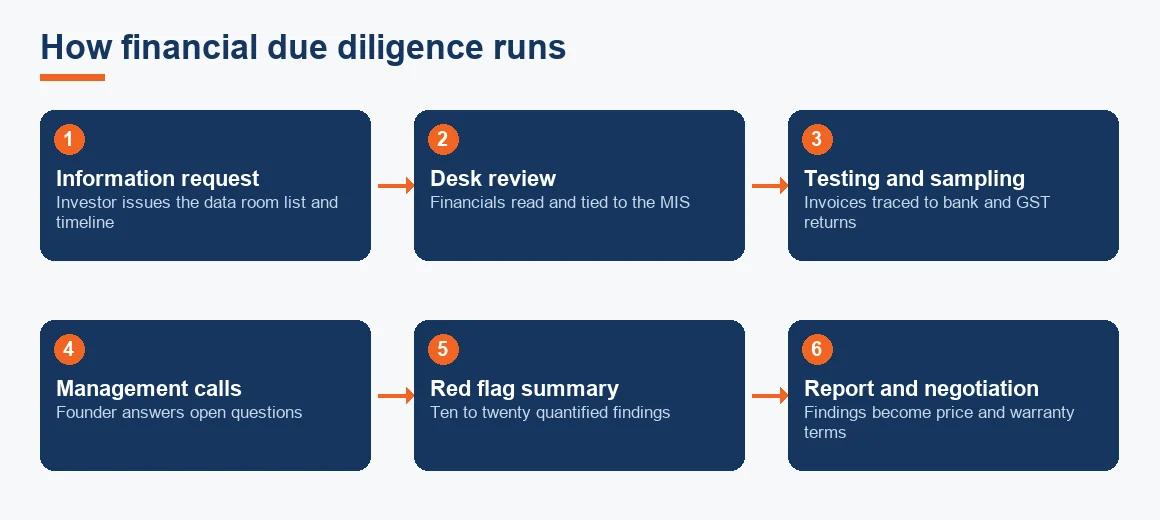
The review runs in a predictable sequence. Understanding it lets you prepare the right evidence at each stage rather than reacting.
- Information request: the investor issues the data room list and a target timeline, usually two to four weeks.
- Desk review: the team reads the financials, ties the audited numbers to the MIS and builds a first list of questions.
- Testing and sampling: they sample invoices, trace them to bank credits and GST returns, and reconcile every bank account to the ledger.
- Management calls: the founder and finance lead answer the open questions and provide missing documents.
- Red flag summary: the team issues a short list of ten to twenty items, each quantified, ahead of the full report.
- Final report and negotiation: findings convert into price adjustments, warranties and conditions precedent to closing.
A common accelerator is deciding early whether you need a full-time accountant or software, a choice we set out in when should a startup hire a CA vs use accounting software.
What is a financial data room for startups?
A data room is the secure, indexed repository, almost always a shared drive with controlled access, where every document the diligence team needs lives. A good room is organised by the same headings as the checklist, so a reviewer can move from revenue to compliance to the cap table without asking. The discipline matters: teams read an untidy room as a signal that the underlying controls are weak, and they respond by widening the sample and hardening the warranties. Keeping the room current between rounds also shortens the next raise, because most of the work is already done.
What are red flags in startup due diligence?
The findings that recur most often in Indian startup books are consistent enough to list. Fixing them before diligence starts is far cheaper than conceding on them afterwards.
| Red flag | What the team finds | Consequence in the term sheet |
|---|---|---|
| Premature revenue | Sales recognised before the service is delivered or the product shipped | Revenue and EBITDA restated down, lowering the multiple |
| Founder personal expenses | Cars, travel and household costs run through the company | EBITDA normalised; questions on governance |
| Unpaid statutory dues | TDS deducted but not deposited, or GST short-paid | Indemnity plus interest and penalty provision |
| Missing ROC filings | Annual returns or event-based forms not filed with the MCA | Condition precedent to file before closing |
| Cash sales without invoices | Revenue with no tax invoice or GST trail | Revenue disallowed; credibility damage |
| Unreconciled settlements | Payment gateway or marketplace receipts not tied to the ledger | Working capital adjustment |
If your business claims the Section 80-IAC tax holiday for DPIIT startups, keep that eligibility file in the room too, because diligence will test whether the exemption was validly claimed.
How to prepare financials for investor due diligence?
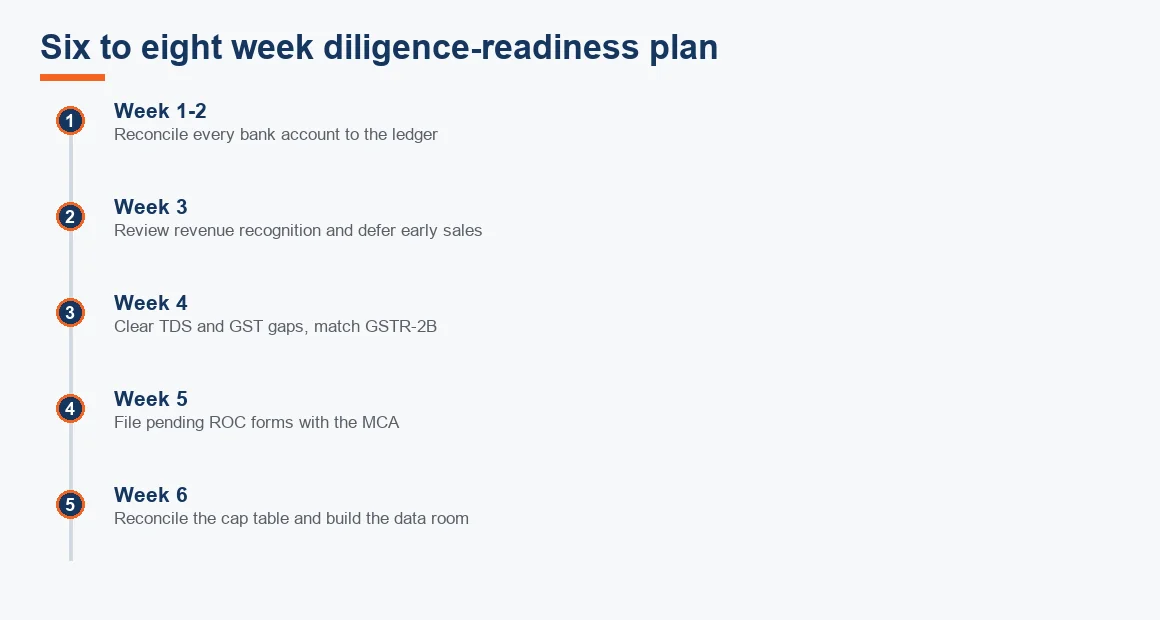
Preparation is a project you can start six to eight weeks before you expect a term sheet.
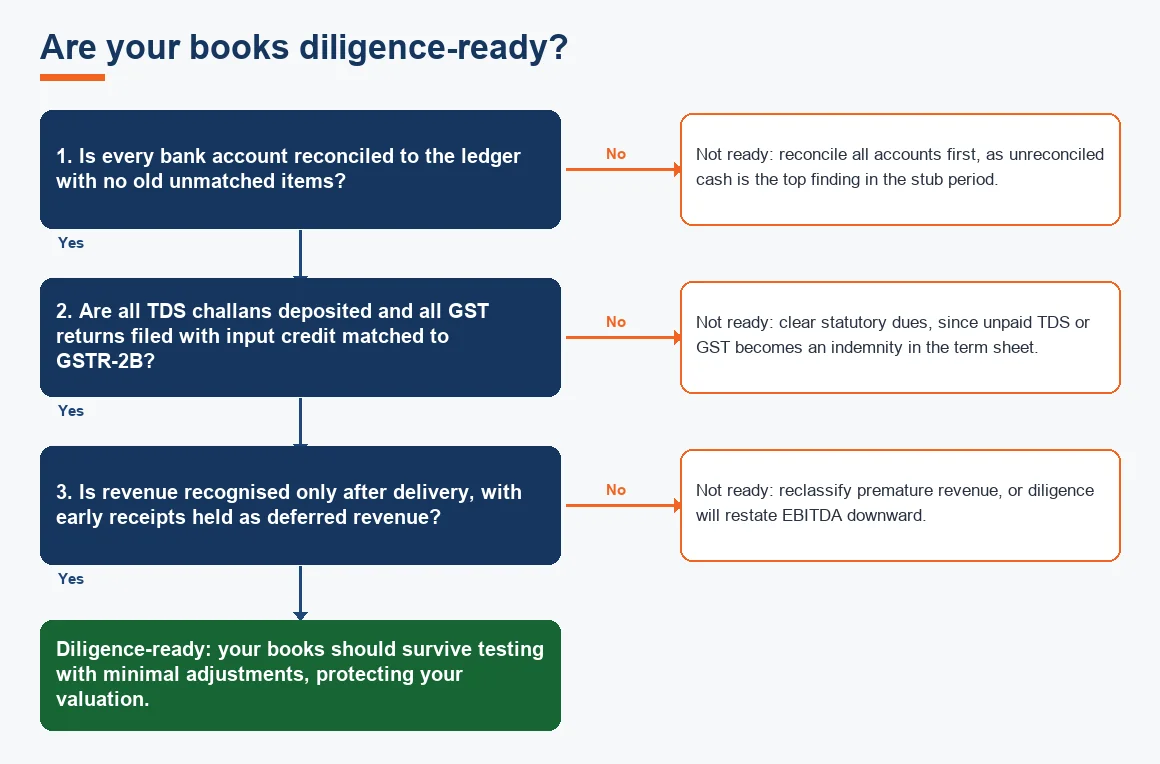
- Reconcile every bank account to the ledger and clear old unmatched items, using proper bank reconciliation for each month.
- Review revenue recognition against delivery, and reclassify anything booked early into deferred revenue.
- Confirm every TDS challan is deposited and every GST return filed, then match input credit to GSTR-2B.
- File any pending ROC forms with the MCA and update the statutory registers.
- Move founder personal costs out of the company or disclose them cleanly as related party items.
- Prepare an accounts receivable aging schedule and provide for genuinely doubtful debts.
- Reconcile the cap table to share allotment records and board approvals.
What is the difference between financial and legal due diligence?
Financial due diligence tests the numbers: revenue, earnings, working capital, cash burn and unrecorded liabilities. Legal due diligence tests the framework around them: whether the company validly owns its shares and intellectual property, whether contracts are enforceable, whether litigation is pending and whether corporate approvals were properly passed. They draw from the same data room but produce separate reports, and a serious investor commissions both. Tax diligence sometimes runs as a third, narrower stream focused on GST, TDS and income tax exposure. For a founder, the practical point is that a clean set of books answers most of the financial report and a good chunk of the tax one, so the accounting work you do first carries the heaviest weight.
Worked example: normalising EBITDA in a quality of earnings review
The single most valuation-sensitive step is the quality of earnings adjustment, where the team converts your reported EBITDA into a normalised figure. The example below shows a typical set of adjustments for a startup reporting ₹42,00,000 of EBITDA in FY 2025-26. Figures are indicative.
| Item | Adjustment (₹) | Running EBITDA (₹) |
|---|---|---|
| Reported EBITDA, FY 2025-26 | , | 42,00,000 |
| Add back: founder's personal car and travel booked to the company | +6,00,000 | 48,00,000 |
| Less: revenue recognised before service delivery (reversed) | −9,00,000 | 39,00,000 |
| Less: one-off consulting income (non-recurring) | −4,00,000 | 35,00,000 |
| Less: provision for unpaid GST late fee and interest | −1,50,000 | 33,50,000 |
| Normalised EBITDA | , | 33,50,000 |
The reported ₹42,00,000 falls to a normalised ₹33,50,000, a drop of ₹8,50,000. On a 10x multiple that is ₹85 lakh of enterprise value the founder can lose simply because the books were not cleaned first. Every one of these adjustments was avoidable with the preparation checklist above.
Key terms
- Ind AS 115 Revenue Recognition: the standard that decides when revenue can be recorded, based on transfer of control to the customer.
- Deferred Revenue: cash received for goods or services not yet delivered, held as a liability until earned.
- Working Capital: current assets less current liabilities, the short-term funding the business needs to operate.
- Cash Runway Calculation: the number of months a startup can operate before cash runs out at the current burn.
- Cap Table Dilution: the reduction in existing shareholders' ownership when new shares are issued in a round.
Key takeaways
- A financial due diligence checklist covers three completed financial years plus the current year to date, supported by MIS, GST and TDS history, bank statements and the cap table.
- Diligence tests quality of earnings, working capital, statutory compliance and related party transactions, then issues a red flag summary that drives valuation.
- The most common and most avoidable findings are premature revenue, founder personal expenses, unpaid TDS or GST and missing MCA filings.
- Normalising EBITDA can cut reported earnings materially; cleaning the books before diligence protects both the multiple and the base number.
- Start preparation six to eight weeks before a term sheet, and keep the data room current between rounds to shorten the next raise.
For the statutory positions above, the primary sources are the GST portal and CBIC for GST and input credit, the Income Tax Department for TDS and Form 26AS, and the Ministry of Corporate Affairs for ROC filings. You can pressure-test related judgements with our Ind AS Applicability Checker and, where fixed assets are material to earnings, the Depreciation Calculator.
Decision guide