
In this guide
The Section 80-IAC startup tax exemption lets an eligible, DPIIT-recognised startup claim a 100 per cent deduction of its profits and gains from business for three consecutive assessment years, chosen out of the first ten years from incorporation. In plain terms, for those three years the eligible business profit is not taxed at the normal corporate rate. It is one of the more valuable incentives available to a young Indian company, but it comes with conditions, a certificate process, and one important catch around Minimum Alternate Tax that founders regularly miss. This explainer walks through the rule as it stands in 2026. For hands-on help running the numbers, our Startup Accounting Services India team handles the working.
What is the tax holiday under Section 80-IAC?
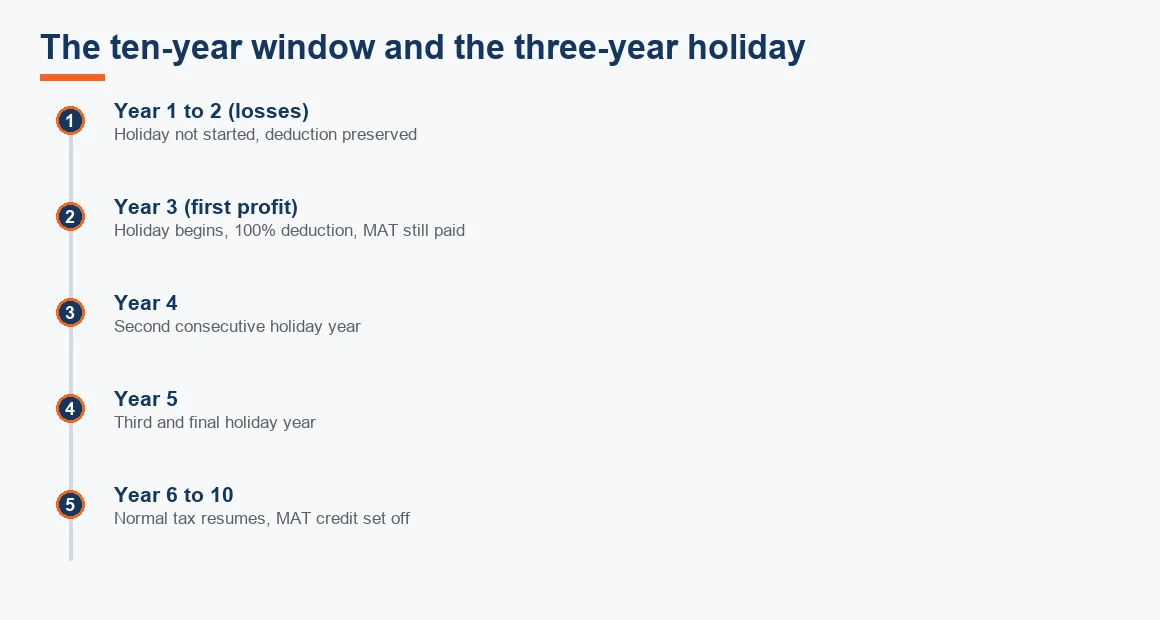
Section 80-IAC of the Income Tax Act allows an eligible startup a deduction of an amount equal to 100 per cent of the profits and gains derived from its eligible business. The deduction can be claimed for any three consecutive assessment years, and the startup gets to choose those three years out of the block of the first ten years beginning from the year of incorporation. That choice matters a great deal. Most startups make losses in their early years, so parking the holiday on the first profitable years, rather than burning it on loss-making ones, is the whole point of the design.
The incentive sits alongside, but is quite separate from, Section 80-IA, which gives infrastructure developers a ten-year deduction and has nothing to do with startups. The eligibility tests are completely different, so do not read commentary on 80-IA and assume it applies to you. Section 80-IAC is the provision written specifically for the recognised-startup ecosystem.
Who is eligible for the 80-IAC tax exemption?
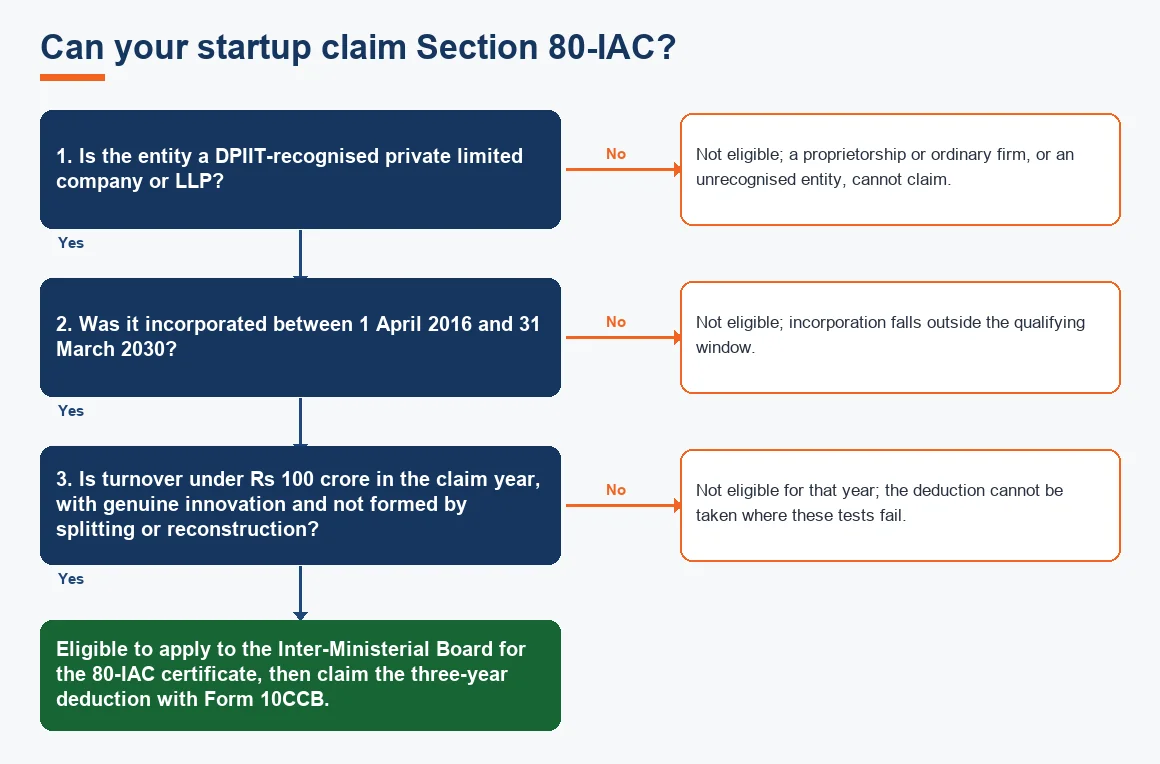
Eligibility is a checklist, and every box has to be ticked. An entity qualifies only if it meets all of the following.
- It is a private limited company or a limited liability partnership. A sole proprietorship or an ordinary partnership firm cannot claim.
- It is recognised by DPIIT (the Department for Promotion of Industry and Internal Trade) as a startup.
- It was incorporated on or after 1 April 2016 and on or before the current cut-off date.
- Its total turnover does not exceed Rs 100 crore in the previous year relevant to the assessment year for which the deduction is claimed.
- It is working towards innovation, development or improvement of products, processes or services, or is a scalable business model with high potential for employment or wealth creation.
- It is not formed by splitting up or reconstructing a business already in existence, and it does not use plant and machinery previously used in India beyond the permitted limit.
The turnover test is applied year by year, not once. A startup that crosses Rs 100 crore in a later year simply cannot claim the deduction for that year, though the earlier claimed years are unaffected. This is a different question from whether a startup should pay income tax at all: yes, startups are ordinary taxpayers, and outside the three-year holiday they file and pay like any other company. If you are still working out your first-year obligations, our note on what accounting a startup actually needs in year one is a better starting point than the tax holiday itself.
What is the 80-IAC amendment and the 2030 window?
The most recent change is the extension of the incorporation window. The Finance Act 2025 pushed the cut-off date from 1 April 2025 to 31 March 2030, a five-year extension. In practice this means any eligible entity incorporated up to 31 March 2030 can still apply for the certificate and claim the three-year holiday within its first ten years. The core structure, 100 per cent deduction for three consecutive years out of ten, was left unchanged. The turnover ceiling of Rs 100 crore in the year of claim also continues.
For founders deciding when to incorporate, the extended runway removes a lot of the earlier urgency, but it does not change the arithmetic of when to start the holiday. That still depends on your profit curve, which is why reading your management accounts properly matters; our piece on burn rate and runway covers how to see the profit inflection coming.
How to claim the 80-IAC exemption: step by step
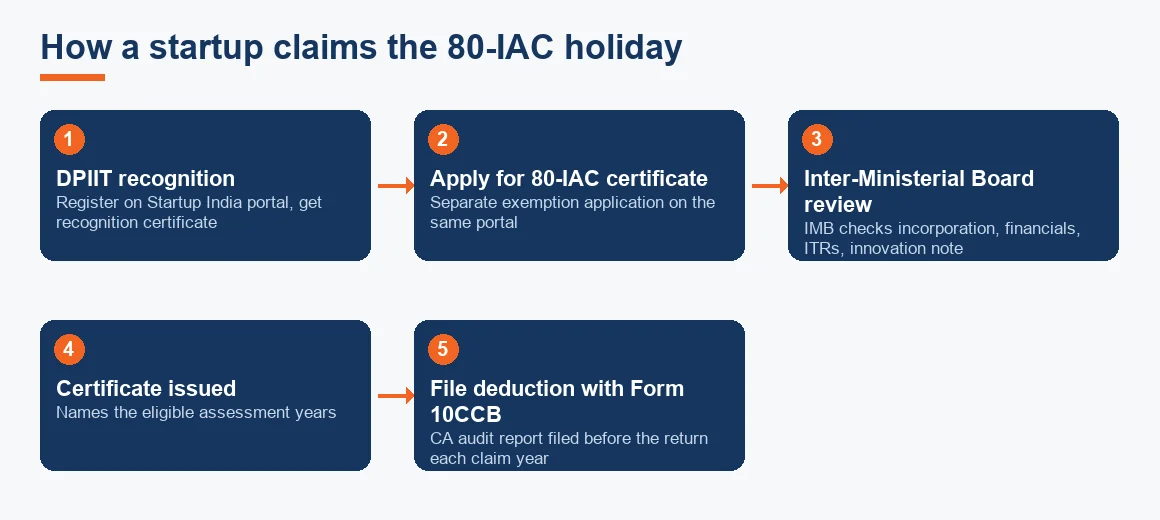
The claim is a two-stage affair. First you obtain the certificate, then you actually take the deduction in a return. The sequence is as follows.
- Get DPIIT recognition. Register the company or LLP as a startup on the Startup India portal and obtain the DPIIT recognition certificate. This is the gateway; without it, nothing else follows.
- Apply for the tax exemption certificate. Through the same portal, apply specifically for the Section 80-IAC exemption. This is a separate application from recognition.
- Inter-Ministerial Board review. The Inter-Ministerial Board (IMB) examines the application together with the certificate of incorporation, audited financial statements, income tax returns for the last three years, and a note explaining the innovation or scalability.
- Receive the certificate. If approved, the IMB issues a certificate naming the eligible assessment years. Keep this on file; it is your authority to claim.
- File the deduction with an audit report. In each claim year, the deduction is taken in the income tax return, supported by an audit report in Form 10CCB from a chartered accountant, filed before the return.
Because the IMB assesses genuine innovation, the note supporting the application carries real weight. Investor-grade books help here too: the same documentation that satisfies a diligence process supports an IMB application, as we discuss in due-diligence-ready books.
What is Form 10CCB?
Form 10CCB is the audit report that a chartered accountant certifies to support a deduction under Section 80-IAC (and certain other profit-linked deductions). It confirms the eligible business, the profits attributable to it, and the correctness of the deduction claimed. It must be filed electronically before the due date of the return for each year the deduction is taken. No Form 10CCB, no valid claim, however clean the underlying accounts may be.
Does Section 80-IAC exempt a startup from MAT?
No, and this is the catch that surprises founders. Even during the three holiday years, a company claiming the 80-IAC deduction still pays Minimum Alternate Tax under section 115JB at 15 per cent (plus surcharge and cess) on its book profit. An LLP pays Alternate Minimum Tax under section 115JC at 18.5 per cent. So the deduction reduces your normal tax to nil on the eligible business, but the MAT floor still applies. The saving is real but it is the gap between your normal tax and the MAT floor, not your entire tax bill.
There is a trade-off to understand here. The concessional 22 per cent company regime under section 115BAA is exempt from MAT, but a company opting into it must forgo the 80-IAC deduction. You cannot have both. Weighing the three-year holiday (with MAT) against the permanent lower rate (without the holiday) is a genuine planning decision, and it turns on your profit profile over the first decade. The MAT or AMT credit paid during the holiday can be carried forward for fifteen assessment years and set off once the holiday ends, so it is not lost. Our deferred tax calculator helps you model how that credit unwinds.
| Feature | Section 80-IAC (startup holiday) | Section 80-IA (infrastructure) |
|---|---|---|
| Who it is for | DPIIT-recognised startups (Pvt Ltd or LLP) | Infrastructure developers (roads, ports, power, parks) |
| Deduction | 100% of eligible profits | 100% of eligible profits |
| Number of years | 3 consecutive, chosen from first 10 | 10 consecutive, chosen from first 15 or 20 |
| Turnover ceiling | Rs 100 crore in year of claim | No such startup-style cap |
| MAT / AMT during holiday | Yes, still payable | Yes, still payable |
Worked example: choosing the three best years
Consider a DPIIT-recognised private limited company incorporated in FY 2023-24 that loses money in its first two years and turns profitable from year three. It elects to run the 80-IAC holiday over years three, four and five. The figures below use a normal company rate of 25 per cent plus 4 per cent cess (an effective 26 per cent), and a MAT floor of 15 per cent plus cess (an effective 15.6 per cent). All amounts are indicative.
| Assessment year | Book profit (Rs) | Normal tax at 26% (Rs) | MAT payable at 15.6% (Rs) | Tax saved (Rs) |
|---|---|---|---|---|
| AY 2026-27 (year 3) | 40,00,000 | 10,40,000 | 6,24,000 | 4,16,000 |
| AY 2027-28 (year 4) | 90,00,000 | 23,40,000 | 14,04,000 | 9,36,000 |
| AY 2028-29 (year 5) | 95,00,000 | 24,70,000 | 14,82,000 | 9,88,000 |
| Total | 2,25,00,000 | 58,50,000 | 35,10,000 | 23,40,000 |
Over the three years the company pays MAT of Rs 35.10 lakh instead of normal tax of Rs 58.50 lakh, a saving of Rs 23.40 lakh. The example also shows the point of the earlier warning: the company does not pay zero, it pays the MAT floor. Had it wasted the holiday on the two loss years, the deduction would have sheltered nothing.
Where 80-IAC fits for different startup types
The holiday is sector-neutral, but how you evidence eligible business profit varies. A SaaS company recognising revenue over subscription periods will present very different profit workings from a marketplace seller; our SaaS Accounting Services (IT & SaaS) and IT & Software Company Accounting Services pages cover those revenue mechanics, and E-Commerce Accounting Services deals with settlement and returns accounting. Founders also confuse this holiday with the location-based ones. The GIFT City IFSC tax holiday and the SEZ deduction on software export revenue under Section 10AA are separate regimes with their own tests, not substitutes for 80-IAC.
Key terms
- Monthly Burn Rate: the net cash a startup consumes each month, which shapes when it turns profitable.
- Cash Runway Calculation: how many months of operation your current cash supports at the present burn.
- Cap Table Dilution: the reduction in existing shareholders' ownership as new shares are issued to investors.
- Ind AS 102 Share-based Payment: the standard governing how ESOP cost is measured and charged to the profit and loss account.
When to bring in a chartered accountant
The 80-IAC claim is one of those areas where the certificate process, the Form 10CCB audit report and the MAT interaction all have to line up, and a small error (wrong claim years, income wrongly classified as eligible business profit) is expensive to unwind. If you are unsure whether to run your own books or engage help at this stage, our guidance on when a startup should hire a CA versus use accounting software is worth reading before you file. You can also model the fixed-asset side of your profit projection with our depreciation calculator.
Key takeaways
- Section 80-IAC gives a 100 per cent profit deduction for three consecutive assessment years, chosen from the first ten years after incorporation.
- You must be a DPIIT-recognised Pvt Ltd or LLP, incorporated by 31 March 2030, under Rs 100 crore turnover in the claim year, and genuinely innovative.
- The deduction does not waive MAT (115JB, 15 per cent) or AMT (115JC, 18.5 per cent); the credit carries forward fifteen years.
- The claim needs an Inter-Ministerial Board certificate plus a Form 10CCB audit report filed with the return.
- Choosing the three years to match your peak profit years is the single most valuable decision in the process.
For the exact statutory wording, refer to the provisions of Section 80-IAC and section 115JB on the Income Tax Department portal, and note that the incorporation cut-off was extended by the Finance Act 2025. Registration and certificate steps are administered through DPIIT, so confirm the current form set on the Income Tax Department e-filing site before you file Form 10CCB.
Decision guide